Provider deliverability · Orange / Wanadoo (France)
Why is Orange blocking my emails?

By Samuel Chenard · CEO & Co-Founder, Palisade · Reviewed September 15, 2026
Orange rejects mail that fails one of its published requirements and names the reason with a numeric code at the end of the error, such as OFR002_104. The most common are a missing DKIM signature (code 535), an SPF failure (519), a DMARC failure (515), a block-listed IP (99 to 103), and too many simultaneous connections (104).
The 30-second check
Orange is unusually direct about authentication. Its postmaster page says "SPF is required", "DKIM signing is required, message without signature may be rejected", and "DMARC configuration is required". For large senders it adds that all three "must all pass" and that the header From domain must match the authenticated domains. The free checker below reads SPF, DKIM and DMARC for the domain you send from in about thirty seconds.
Check your domain now
Enter your sending domain and the check runs instantly on the next page. Free, no signup.
Why Orange / Wanadoo is blocking your email
| Likely cause | What's happening |
|---|---|
| No DKIM signature, or one that does not match your From domain | Orange lists DKIM as mandatory and documents the rejection as code 535: "DKIM signing is missing, message has been rejected". A message signed only by your sending platform's own domain is a second trap: the large-sender checklist says the header From domain "must match your authenticated domains", and code 988 tells rate-limited senders to "use your own DKIM domain to sign your messages". |
| SPF does not authorise the IP that actually sent the message | Code 519 is "The sending IP address is not authorized to send messages for your domain as defined in the sender's Domain name SPF configuration (DNS/TXT)", and 397/398 is a broken SPF record. A new sending service that was never added to the record, or a record that fails to parse, produces this on every message. |
| Your own DMARC policy told Orange to reject | Code 515 reads "DMARC authentication failed, message rejected as defined by your DMARC policy". Orange did what your record asked. It happens when the domain is at `p=quarantine` or `p=reject` while a legitimate sender still fails alignment, which is exactly the situation aggregate reports exist to surface before the policy is tightened. |
| The sending IP or domain is on a block list | Orange checks Abusix (code 100), Spamhaus (101) and Cloudmark (102) for the IP, Abusix and Spamhaus for the sending domain (425), and keeps its own list (99 and 103, "Your sending IP has been blacklisted by Orange"). The public listings have self-service lookups; the Orange-internal one needs the contact form. |
| Too many connections, or too much per connection | Orange publishes hard numbers: "100 messages per connection, up to two simultaneous connections per sending IP address, and up to 100 recipients per message", with the note that "Different limits may applied based on your current reputation". Code 104 is too many simultaneous connections, 109 too many messages per connection. The example error Orange prints is `Trop de connexions, veuillez verifier votre configuration. Too many connections, slow down. OFR002_104`. |
| Missing reverse DNS, a bad HELO, or a dynamic IP | Code 107 is a missing PTR record, and Orange adds that the PTR hostname must resolve back to the sending IP. The 20x codes are an invalid HELO/EHLO, which must be a fully qualified domain name that resolves. The sending IP "must be a static IP address" and the sender domain needs valid A or MX records (code 405). |
| Content Orange's filter classifies as spam, or a poor reputation | Code 506 is "Your message has been blocked by Orange, suspected spam"; Orange says senders seeing many of these can request information through the Vade Secure Sendertool. Codes 988 to 990 are rate limits for a low IP or domain reputation, and 99x is a rate limit for "poor behavior". Orange's spam-report threshold is 0.6%, with a stated plan to move to 0.3%. |
| Dead addresses on the list | Code 416, "User doesn't exist here", is the one Orange asks senders to act on themselves: "Please remove this email address from your distribution list, it does not exist". A French list that has not been cleaned concentrates its dead addresses at Orange and Wanadoo, and Orange reads that as a reputation signal. |
Check the public signals before changing settings
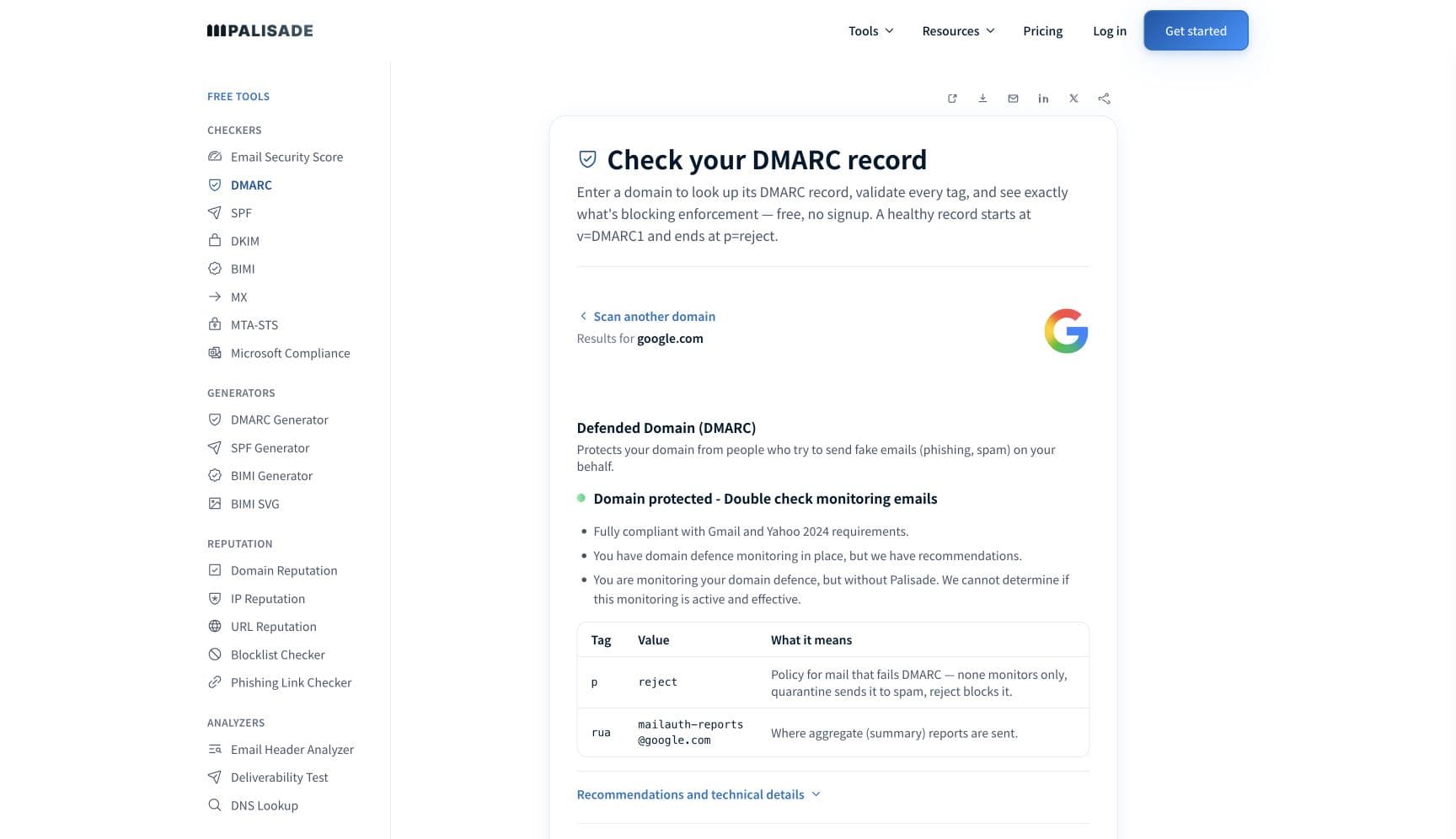
Check your DMARC record gives you a fast public-DNS baseline. It does not replace the provider's private reputation or placement data, but it tells you whether an authentication problem is visible before you edit a sending platform.
How to fix it, step by step
Check SPF, DKIM and DMARC on the domain in your From header
Use the free checker above (or at /tools/dmarc). Orange requires all three and, for large senders, requires all three to pass with the From domain aligned to the authenticated domain. If DKIM is missing or signed by your platform's domain instead of yours, you have found the block before reading any code.
Read the numeric code at the end of the Orange error
Orange errors end in a code such as
OFR002_104; the number after the underscore is the reason. Match it against the table on the Orange postmaster page. Codes 515, 519 and 535 are authentication; 99 to 103 and 425 are block lists; 104 and 109 are connection limits; 416 is a dead address.Sign with DKIM on your own domain and align it
Publish the selector for every service that sends as your domain and confirm the
d=tag is your From domain or a parent of it. Orange's rate-limit guidance for code 988 is explicit: sign with your own DKIM domain. Verify the published key at /tools/dkim before you retry.Add every sending IP to SPF and fix the record
Code 519 means the IP that delivered the message is not in your SPF record; 397 and 398 mean the record itself is wrong. List every platform that sends as your domain, keep the record under the ten-lookup limit, and re-check it at /tools/spf. Orange notes DNS caches can take up to 24 hours to expire after a change.
Clear the block lists Orange consults
Look the IP up at Abusix, Spamhaus and Cloudmark, and the domain at Abusix and Spamhaus, using the lookup links Orange publishes beside codes 100 to 102 and 425. Run /tools/blocklist-checker for the wider picture. Codes 99 and 103 are Orange's own list and are cleared only through the contact form.
Throttle to Orange's published limits
Configure your MTA for at most two simultaneous connections per sending IP to Orange, no more than 100 messages per connection, and no more than 100 recipients per message. Orange says different limits may apply based on reputation, so a new IP should start below these numbers.
Fix reverse DNS, HELO and TLS
Set a PTR record whose hostname resolves back to the sending IP, use a resolving fully qualified domain name in HELO/EHLO, and offer TLS 1.2 or higher, which Orange strongly recommends because it no longer supports lower versions. Check the PTR and IP reputation at /tools/ip-reputation.
Remove code 416 addresses and lower complaints
Drop every address Orange has answered with "User doesn't exist here", add an RFC 8058 one-click unsubscribe, and keep spam reports well under Orange's 0.6% threshold, because Orange has said it will gradually adopt 0.3%. Large senders should also add the Feedback-ID header Orange asks for.
Escalate through the Orange deliverability form with the exact code
For codes 99, 103, 406, 506 and 536, and for rate limiting that persists after the fixes above, use the Orange contact form and select the option "Un problème d'envoi d'emails vers les adresses Orange ou Wanadoo (deliverability issue)". Include the full error line with its code, the sending IPs and the domain.
Related free tools: DKIM checker · SPF checker · IP reputation and reverse DNS · Blocklist checker
If you send in volume: Orange / Wanadoo's published rules
Orange publishes a separate checklist for large senders, which it defines as "more than 1000 messages per day". SPF, DKIM and DMARC "are mandatory and must all pass", and the header From domain "must match your authenticated domains". Senders should follow the M3AAWG best practices (Orange is a sponsor member), use the Feedback-ID header, make the display name in the header From "accurately represent the true sender, specifically the entity that holds the recipient's consent", and host a website behind the From domain that shows the company's address and identity, a reminder of how consent was obtained, and the legal notices. Spam reports "at 0.6% or above might trigger some protection mechanisms", and Orange states it "will gradually adopt a 0.3% spam-report rate" in line with the industry. Lists must not be bought, opt-in needs a verification email, and opt-out must be easy with RFC 8058 one-click unsubscribe. The Orange feedback loop is available only to authorised members of Signal Spam, the French public-private reporting scheme Orange sponsors. Checked 2026-09-15.
Check your standing with Orange / Wanadoo
- Orange Postmaster (delivery guidelines and error codes)
The complete rulebook in English: requirements, the large-sender checklist, the full error-code table, and Orange's outbound IP ranges. Read the code table before opening a ticket.
- Orange deliverability contact form
The escalation path for Orange-internal blocks and persistent rate limits. Select the option for a sending problem to Orange or Wanadoo addresses and include the exact error line.
- Signal Spam
The French reporting scheme that carries Orange's feedback loop. Only authorised Signal Spam members receive Orange complaint data, so bulk senders to France should join it.
- Vade Secure Sendertool
Where Orange sends senders who see many code 506 (suspected spam) rejections to submit an information request about the classification.
Bounce codes you may be seeing
Blocks in this cluster surface as specific SMTP codes. Match yours below; the linked guides cover each code's verbatim provider messages and full fix.
- Trop de connexions, veuillez verifier votre configuration. Too many connections, slow down. OFR002_104: Orange's published example, a connection-limit deferral; the number after the underscore is the reason code Full guide →
- Code 535, DKIM signing is missing, message has been rejected; code 519, the sending IP is not authorised by the domain's SPF record; code 515, DMARC authentication failed, message rejected as defined by your DMARC policy Full guide →
- Codes 99 and 103, sending IP blacklisted by Orange; 100 to 102, IP listed at Abusix, Spamhaus or Cloudmark; 425, sending domain blacklisted; 506, message blocked by Orange, suspected spam Full guide →
- Code 416, User doesn't exist here: remove the address from the list rather than retrying Full guide →
The real root cause: unenforced authentication
Orange has written down what most providers only imply. SPF, DKIM and DMARC are all required, all three have to pass for anyone sending real volume, and the visible From domain has to be the domain that authenticated. Three of its rejection codes exist purely to tell you which of those checks failed. The codes are useful, but by the time you are reading them the damage is done at Orange, and the same weakness is costing you silently at every provider that does not print a reason. The fix is not to satisfy Orange; it is to make every sender of your domain authenticate and align, then publish a DMARC policy that turns the arrangement into enforcement. Aggregate reports show every service sending as your domain, including the ones nobody remembers authorising and the one whose DKIM key was never published. Authenticate each, then move from p=none to p=reject so that mail which cannot prove it is yours is refused everywhere, and code 515 becomes something that only ever happens to a forger.
DMARC software that does the work
Palisade's AI agent takes domains all the way to enforcement: hosted SPF, DKIM, DMARC, and MTA-STS records on paid plans, DMARC reports monitored continuously, and every policy step drafted for your approval on the way to p=reject. The Free plan covers one domain and up to 1,000 emails per month, and the agent names every problem it finds there; applying the agent's fixes needs a paid plan, and the full product is open for a 15-day trial.
1 domain free up to 1,000 emails/month
Fixing this across every client domain
A client with French customers hits Orange and Wanadoo constantly, and Orange's mandatory-DKIM rule turns a fleet of client domains into a fleet of separate signing and alignment projects. Palisade makes that one workflow: hosted and managed SPF, DKIM, DMARC, and MTA-STS records for every client domain, aggregate reports read so each unsigned or misaligned sending service is named rather than guessed at, and a path to p=reject with your team approving every change. Native ConnectWise, HaloPSA, and Autotask integrations put it in your PSA, pricing is per client domain with rates that improve as the portfolio grows, and your own MSP domain is a free NFR domain to prove the process on first.
Questions readers ask
Frequently asked questions
What does OFR002_104 from Orange mean?
It is Orange's error format: a bilingual message followed by an identifier whose last number is the reason code. Code 104 is "You are opening too many simultaneous connections". Orange recommends two simultaneous connections per sending IP and 100 messages per connection. Reduce concurrency in your MTA and the deferrals stop.
Does Orange require DKIM?
Orange requires DKIM. Its postmaster page states "DKIM signing is required, message without signature may be rejected", and code 535 is the rejection for a missing signature. For large senders, SPF, DKIM and DMARC "are mandatory and must all pass" and the header From domain must match the authenticated domain.
What is Orange error code 515?
Code 515 is "DMARC authentication failed, message rejected as defined by your DMARC policy". Orange applied the policy your own domain publishes. Find the sender that fails alignment in your aggregate reports, authenticate it, and only then keep the policy at quarantine or reject.
What is Orange error code 506?
Code 506 is "Your message has been blocked by Orange, suspected spam". Orange's guidance is to use the contact form with the deliverability option, and, for senders seeing many 506 rejections, to submit an information request through the Vade Secure Sendertool. Orange does not say which filter produced the classification.
How do I contact the Orange postmaster about a block?
Use the Orange contact form and select "Un problème d'envoi d'emails vers les adresses Orange ou Wanadoo (deliverability issue)". Orange asks senders to review the postmaster checklist and test their configuration first. Abuse reports go to abuse@orange.fr, which is a different queue from deliverability.
Does Orange have a feedback loop?
Yes, but only through Signal Spam. Orange says "Only SignalSpam authorized members may receive Orange Feedback Loop", so a sender wanting complaint data from Orange mailboxes has to join the French reporting scheme rather than enrol with Orange directly. Membership is a prerequisite, not a request you make to the Orange postmaster.
What spam complaint rate does Orange allow?
Orange says spam reports "at 0.6% or above might trigger some protection mechanisms" and that it "will gradually adopt a 0.3% spam-report rate" to align with industry standards. Treat 0.3% as the ceiling now rather than waiting for the change to land.
Are Orange and Wanadoo the same for senders?
Yes. Wanadoo addresses are served by Orange, the postmaster page covers "Orange/Wanadoo Email users" together, and the contact form option names both. One rule set, one error-code table and one escalation path apply to both domains. A rejection from a wanadoo.fr address carries the same OFR code as one from orange.fr.
Sources and last verified
Every Orange / Wanadoo fact on this page is drawn from that provider's own documentation, last checked 2026-09-15. Provider policies change; if a detail looks off, the linked source is authoritative.
- Orange delivery guidelines (page dated "updated on Sept 1st 2026"): follow RFC 5321 and RFC 5322; monitor Abusix, Spamhaus and Cloudmark listings; "Sending IP must be a static IP address"; a valid PTR record; valid A or MX records; a valid FQDN HELO/EHLO; TLS 1.2 or greater because lower versions are no longer supported; "SPF is required", "DKIM signing is required, message without signature may be rejected", "DMARC configuration is required", ARC sealing strongly recommended for forwarded messages; "Orange recommends 100 messages per connection, up to two simultaneous connections per sending IP address, and up to 100 recipients per message" with "Different limits may applied based on your current reputation"; a 45MB size limit; code 416 "Invalid recipient" means the address is not a valid Orange/Wanadoo addresspostmaster.orange.fr · checked 2026-09-15
- Orange notes for large senders ("more than 1000 messages per day"): Orange is a sponsor member of M3AAWG and of Signal Spam; "Only SignalSpam authorized members may receive Orange Feedback Loop"; "Authentication mechanisms (SPF/DKIM/DMARC) are mandatory and must all pass, your header 'From' domain name must match your authenticated domains"; use the Feedback-ID header; the display name "must accurately represent the true sender, specifically the entity that holds the recipient's consent"; host a website behind the From domain with company address and identity, a consent reminder and legal notices; "Spam reports rate at 0.6% or above might trigger some protection mechanisms" and Orange "will gradually adopt a 0.3% spam-report rate before triggering protection mechanisms"; do not buy lists, use verified opt-in and easy opt-out per RFC 8058; many OFR_506 codes can be queried via the Vade Secure Sendertoolpostmaster.orange.fr · checked 2026-09-15
- Orange error format and code table: errors look like "Trop de connexions, veuillez verifier votre configuration. Too many connections, slow down. OFR002_104", where 104 is the code; 99 and 103 "Your sending IP has been blacklisted by Orange"; 100 Abusix, 101 Spamhaus, 102 Cloudmark IP listings; 104 too many simultaneous connections (recommended 2); 107 missing PTR record whose hostname must resolve to the sending IP; 109 too many messages per connection (recommended 100); 20x invalid HELO/EHLO; 397/398 sender domain SPF error; 405 sender domain DNS error; 406 and 536 "Your Sender has been rejected"; 416 "User doesn't exist here"; 425 sender domain blacklisted by Abusix or Spamhaus; 506 "Your message has been blocked by Orange, suspected spam"; 515 "DMARC authentication failed, message rejected as defined by your DMARC policy"; 519 sending IP not authorised by the sender domain's SPF; 535 "DKIM signing is missing, message has been rejected"; 988 rate limited for low reputation with the advice "Please use your own DKIM domain to sign your messages"; 989/990 sending domain rate limited for low reputation; 99x rate limited for poor behavior; escalation via the contact form option "Un problème d'envoi d'emails vers les adresses Orange ou Wanadoo (deliverability issue)"; abuse reports to abuse@orange.frpostmaster.orange.fr · checked 2026-09-15
- The Orange contact form is the published escalation path for deliverability problems, reached from the postmaster page's "contact form" linksformulaires.services.orange.fr · checked 2026-09-15
- Signal Spam is the French public-private spam-reporting partnership through which Orange delivers its feedback loop to authorised memberswww.signal-spam.fr · checked 2026-09-15
- The Vade Secure Sendertool is where Orange directs senders who encounter many OFR_506 rejections to submit an information requestsendertool.vadesecure.com · checked 2026-09-15
- RFC 8058, Signaling One-Click Functionality for List Email Headers, is the one-click unsubscribe standard Orange's large-sender checklist points at: List-Unsubscribe carries one HTTPS URI and List-Unsubscribe-Post carries "List-Unsubscribe=One-Click", with a DKIM signature covering bothwww.rfc-editor.org · checked 2026-09-15
Related guides
550 5.7.1554 5.7.1421 4.7.0550 5.1.1d=adkim / aspfselector