
dmarcian vs Palisade in 2026
dmarcian is built around reporting, education, and an operator-led process. Palisade is agentic: its AI agent acts on what it finds, drafts the fixes, and proposes each step toward enforcement for your approval. That difference compounds across a portfolio of any size.
Our verdict: Choose Palisade when you want an AI agent to investigate senders, draft SPF and DKIM fixes, and propose every policy step for approval. Choose dmarcian when a read-only, operator-led platform with reporting, education, and published volume-based plans better fits your team.
 Samuel Chenard · CEO & Co-Founder, PalisadeSource checks through 2026-07-10
1 domain free up to 1,000 emails/month
 ChatGPT
 Claude
 Gemini
 Perplexity
 Grok
Grok dmarcian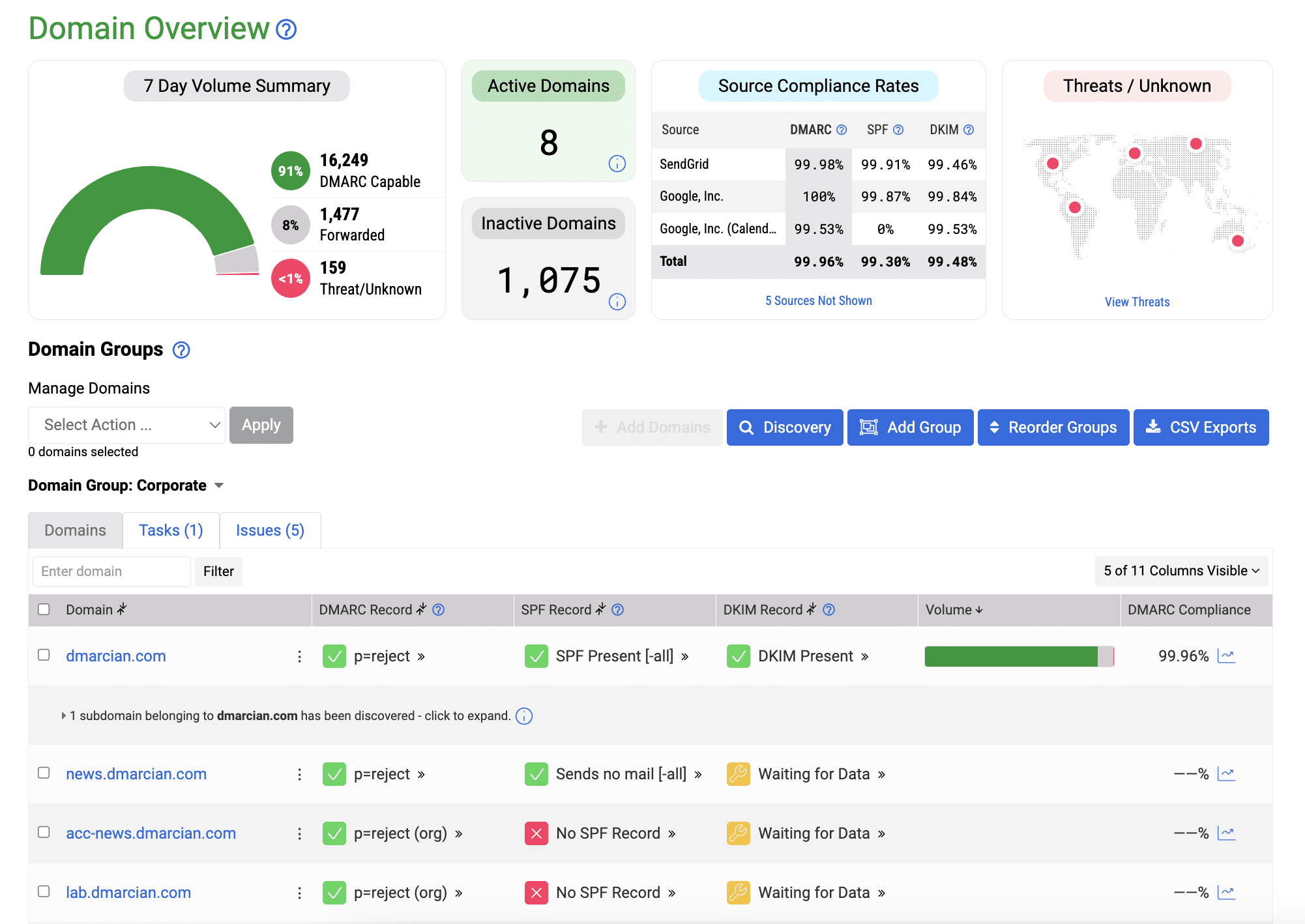
 Palisade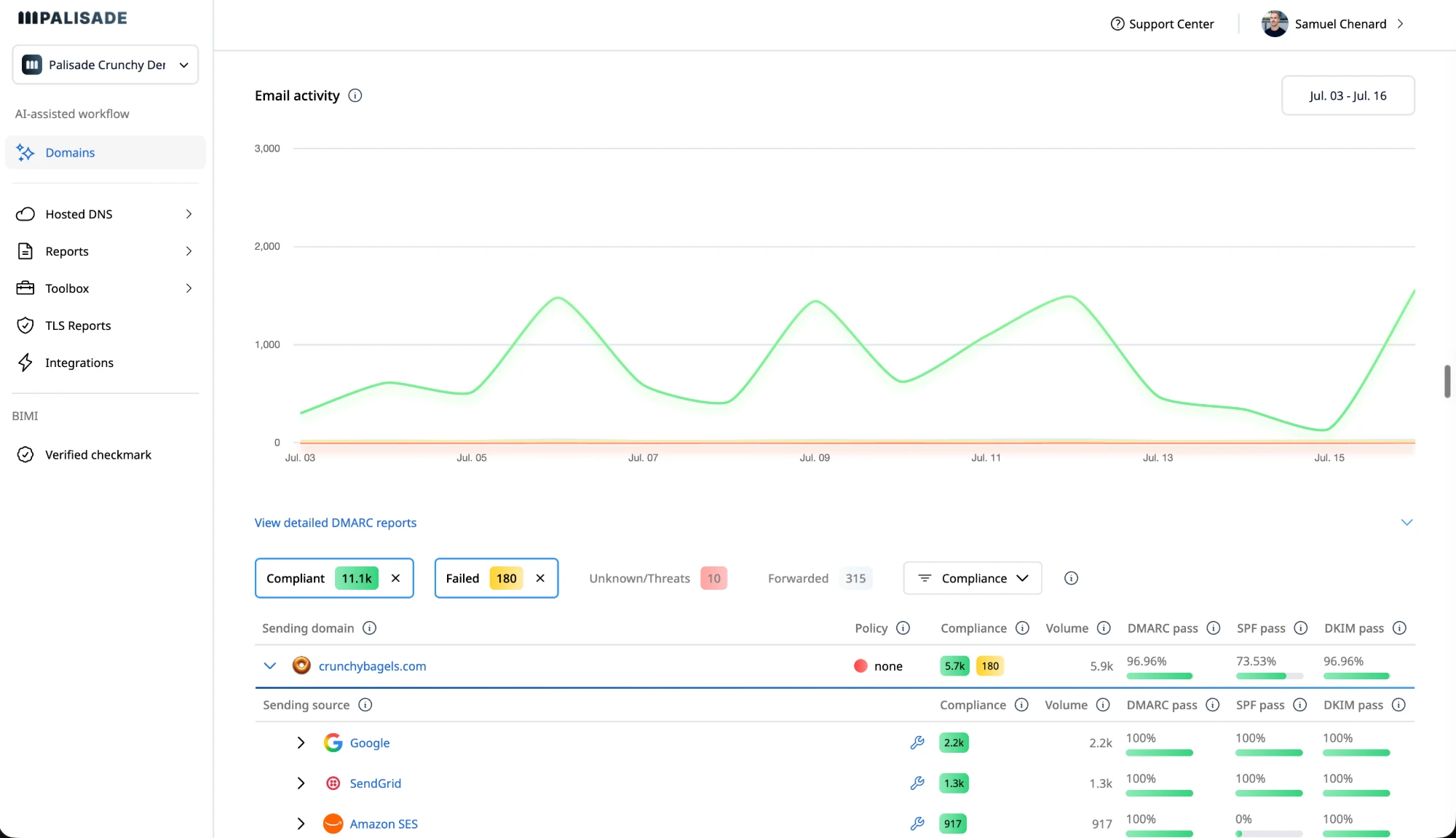
Palisade is free for one domain, up to 1,000 emails a month. Paid IT-team plans are sized by email volume. Start a 15-day full-product trial with no credit card.
Which one is right for you?
Best for Teams wanting a read-only DNS model
Best for MSPs and IT teams responsible for multiple domains
- You prefer a more traditional dmarcian workflow with people involved in each enforcement step.
- Your buying criteria center on vendor-specific enterprise requirements.
- You want dmarcian's reporting, education, and read-only DNS model, with your team carrying each enforcement step.
- dmarcian's published domain-and-message-volume plans fit your budget, and Enterprise-only API access meets your requirements.
- You run an MSP, or an internal IT or security team, responsible for multiple domains.
- You want an AI agent to investigate issues, configure authentication, and move domains toward p=reject.
- Teams already using Claude, OpenAI, or other AI tools can bring the same agent-led operating model to DMARC.
Free for one domain, up to 1,000 emails a month. Paid IT-team plans are sized by email volume. Start a 15-day full-product trial with no credit card.
Where the day-to-day work actually differs
| Feature | dmarcian | Palisade |
|---|---|---|
| Enforcement | ||
| AI agent that does the enforcement work (you approve each step)Whether the platform investigates senders, drafts fixes, and proposes enforcement steps for review. | No AI agent | Agent drafts and proposes |
| Reporting and analysis | ||
| DMARC report monitoring & analyticsWhether the platform turns DMARC reports into readable findings about sending sources. | Report analytics | Sender findings and tickets |
| Automated scheduled reports & alertsWhether the platform sends scheduled reports and authentication alerts. | Scheduled report alerts | Report and ticket alerts |
| Education & remediation | ||
| Public DMARC learning pathWhether operators get an ordered path for learning DMARC and carrying out a deployment.dmarcian describes DMARC Academy as a free curriculum for learning how to deploy DMARC, SPF, and DKIM. Palisade's Learning Center publishes a five-step path from DMARC basics through p=reject (checked 2026-08-28). Source (2026-08-28) Source 2 (2026-08-28) | Free DMARC Academy | 5-step path to p=reject |
| Email-source classificationHow the platform separates recognized senders, suspicious traffic, and authentication states.dmarcian says its Source Viewer categorizes legitimate and suspicious sources and tracks their behavior over time. Palisade publishes sender review states plus classifications for unknown and forwarded traffic (checked 2026-08-28). Source (2026-08-28) Source 2 (2026-08-28) | Source Viewer categories | Sender review states |
| Remediation work after a findingHow the product turns a finding into the next operator action.dmarcian advertises step-by-step remediation guidance and recommendations for SPF and DKIM configuration changes. Palisade publishes sender-specific SPF and DKIM fix drafting, with a human approval gate before changes ship (checked 2026-08-28). Source (2026-08-28) Source 2 (2026-08-28) | Guidance and recommendations | Agent drafts the fix |
| Limits & metering | ||
| API access on every planWhether API access is included throughout the product's plan range. | Enterprise plan only | Included on every plan |
| Published free tierWho can use the no-cost plan and what kind of domain it can cover.dmarcian publishes its Personal plan at $0 for non-business use and says an account with a business-associated domain will expire. Palisade publishes a free plan for one domain the user owns (checked 2026-08-28). Source (2026-08-28) Source 2 (2026-08-28) | Personal, non-business use | 1 owned domain |
| Free-tier capacityThe domain and monthly message limits on the no-cost plan.dmarcian's Personal plan includes up to two active domains and 1,250 DMARC-capable messages per month. Palisade's Free plan covers one domain and up to 1,000 emails per month (checked 2026-08-28). Source (2026-08-28) Source 2 (2026-08-28) | 2 domains, 1,250 messages | 1 domain, 1,000 emails |
| Free-tier report historyHow much DMARC report history the free plan keeps available.dmarcian's pricing table lists one month of data history on Personal. Palisade publishes 14 days of DMARC history on Free (checked 2026-08-30). Source (2026-08-28) Source 2 (2026-08-28) | 1 month | 14 days |
| MSP operations | ||
| Native ConnectWise, HaloPSA & Autotask integrationsWhether the platform connects to the PSA systems an MSP uses to manage client work. | Not advertised | Native PSA integrations |
| White-label client reportingWhether an MSP can present client reports under its own brand. | Not advertised | Included for MSPs |
| Multi-tenant / multi-domain managementWhether one workspace can manage multiple domains or client tenants. | Supported | Supported |
| Hosted records & DNS | ||
| Hosted DMARC, SPF, DKIM, BIMI recordsWhether the platform can host and manage email-authentication records instead of only reading them. | Read-only DNS model | Hosted on managed DNS |
| SPF flatteningWhether SPF includes are collapsed to stay within the DNS lookup limit. | Validation only | Hosted SPF flattening |
| AI and automation access | ||
| REST API for programmatic domain-management dataWhether an operator can use documented software access instead of working only in the dashboard.dmarcian advertises a RESTful API with documentation and batch endpoints as an Enterprise-only feature. Palisade publishes a REST API (checked 2026-08-27). Source (2026-08-27) | Enterprise REST API | REST API published |
| MCP server for connecting AI assistants to domain dataWhether an AI assistant can reach the product's data directly.dmarcian does not advertise an MCP server or an AI-assistant integration on its DMARC Management Platform page, whose published feature list names Domain Overview, Detail Viewer, Source Viewer, Alert Central, Automatic Domain Discovery, Enterprise API, SSO, and Intelligent Subdomain Management (checked 2026-08-27). Palisade publishes an MCP server. Source (2026-08-27) | No MCP server listed | MCP server published |
| AI-assisted sender investigation and fix draftingWhether the vendor advertises AI that investigates senders and prepares authentication changes.dmarcian does not advertise AI or machine-learning product features on its DMARC Management Platform page, which describes reporting, alerts, an API, webhooks, and SSO instead (checked 2026-08-27). Palisade's agent investigates senders, drafts SPF and DKIM fixes, and proposes each policy step for human approval. Source (2026-08-27) | No AI feature listed | Agent drafts fixes |
Want to compare the workflow yourself? Try Palisade free with one domain and up to 1,000 emails a month.
Palisade 96 vs dmarcian 65, and why
Both products are scored on the same eight dimensions the comparison hub uses, so the figures here are the figures there. Four are derived from vendor facts that each carry a source and a checked date. Four are editorial, marked as such below, and each states its reasoning and its source.
Each dimension is out of 10 and the total is the raw sum out of 80, rescaled to 100 — the raw figure is printed beside it so the conversion is checkable rather than a black box. Scored on what each vendor publishes, not on how the product feels in use. Editorial dimensions last reviewed 2026-09-02.
How reachable the product is from your own software and AI tools. 10 = a documented API on every plan plus a published MCP server. 6 = an API, gated to a tier or to a sales conversation. 3 = no programmatic access advertised.
dmarcian documents an enterprise-only REST API, while no MCP server is published (checked 2026-08-28). Source (2026-09-02)
Palisade publishes a REST API and a remote MCP server on every plan, making the same domain data and remediation workflows available to connected software. Source (2026-08-30)
How much of the report analysis is done for you. 10 = the platform turns raw report data into a prioritised, actionable queue on its own.
The published plans list DMARC data analysis and visual reporting; the published setup path has the customer make the DNS change. Source (2026-08-30)
Report data is analysed into a prioritised list of sender, SPF, DKIM and DMARC issues, so nobody reads raw XML. Source (2026-08-30)
How much of the work the vendor's own software does. 10 = it identifies the sending sources, drafts the SPF and DKIM fixes each one needs, and proposes the next policy step. 6 = it applies the records for you, but a person decides what to fix and when to advance. 3 = it reports, and every change is yours to make. A vendor whose team does the work rather than its software scores here on the software alone.
The software identifies sending sources and recommends deployment steps; its published setup guide has the domain owner publish the DMARC record at the DNS provider. Source (2026-09-02)
The agent investigates each sender, drafts the SPF and DKIM changes it needs, and proposes the next policy step; a human approves before deployment. Source (2026-08-30)
10 = full pricing published. 6 = some tiers published, rest quote-gated. 3 = quote only.
Published: free plan, then flat monthly plans by email volume from $19/mo Source (2026-08-30)
10 = hosts the records for you. 6 = partial or add-on. 3 = you manage your own DNS.
Not offered: the platform's published feature set covers reporting, analysis and discovery, and the setup guide has customers publish records at their own DNS provider Source (2026-09-02)
10 = a genuine free plan. 6 = time-limited trial only. 3 = no free access.
Free plan: one domain, up to 1,000 emails/mo, 14-day report history, no credit card, plus a 15-day full-product trial Source (2026-08-30)
10 = a real MSP program with multi-tenant management. 6 = partial. 3 = none.
How much work it takes to get a domain from p=none to p=reject. 10 = the platform (or the vendor's team) gets you there without manual DNS edits.
Its published setup path has the customer publish the DMARC record at the DNS provider. Reviewed public material does not establish a hosted-record or direct-write alternative. Source (2026-09-02)
The DMARC Agent detects when a domain's authentication and alignment are ready for the next policy stage and proposes the move, but a human still approves and applies it, so it is not fully hands-off. Source (2026-08-30)
Where Palisade and dmarcian actually differ
Each argument keeps the product screens, sourced comparison points, and supporting analysis together.
Free access vs business capacity
Is dmarcian free? What the Personal tier actually covers
A lot of people search for a free dmarcian option, and one exists, with sharp edges. The Personal plan is $0 but explicitly limited to non-business domains, two of them, under 1,250 messages a month, with one month of history. It's a hobbyist tier by design, and dmarcian says so plainly.Source 1, Source 2
dmarcian
A relevant product screenshot was not available in the reviewed evidence.
For a business domain, the practical dmarcian entry point is Basic at $19.99/mo billed yearly. Palisade's Free plan covers one domain you own and up to 1,000 emails a month, while the 15-day full-product trial lets you evaluate a broader rollout. After that, IT teams choose a published email-volume tier and MSPs use per-client-domain portfolio pricing.
What each side charges
Three points on each published range: the cheapest plan, one in the middle, and the top of what the vendor publishes. Every plan on both sides is in the pricing section further down.
- Personal$0
Non-business domains only: 2 domains, under 1,250 messages/mo, 1 user, 1-month history
- Plus$199/mo billed yearly ($240 monthly)
8 domains, 1M messages/mo, 3 users, 1-year history
- Custom / partnerContact sales
Partner discounts exist but aren't published
- Free$0
1 domain, your own, capped at 1,000 emails/mo
- IT teams: up to 500,000 emails/mo$59/mo ($47/mo billed annually)
Same product: 6 set-up domains, pick the tier that matches your sending
- Enterprise (more than 2.5M / month)Custom
Custom volume, retention, and terms
Read-only DNS vs managed DNS
Read-only by design vs managed by design
dmarcian's position is principled: their platform reads and interprets DMARC data but doesn't sit in your DNS critical path: in their words, a “read-only design that safeguards your client's DNS integrity.” You keep full control; you also keep all the work of implementing every change on every domain.
dmarcian
A relevant product screenshot was not available in the reviewed evidence.
- Hosted DMARC, SPF, DKIM, BIMI records: Read-only DNS model
- SPF flattening: Validation only
Palisade
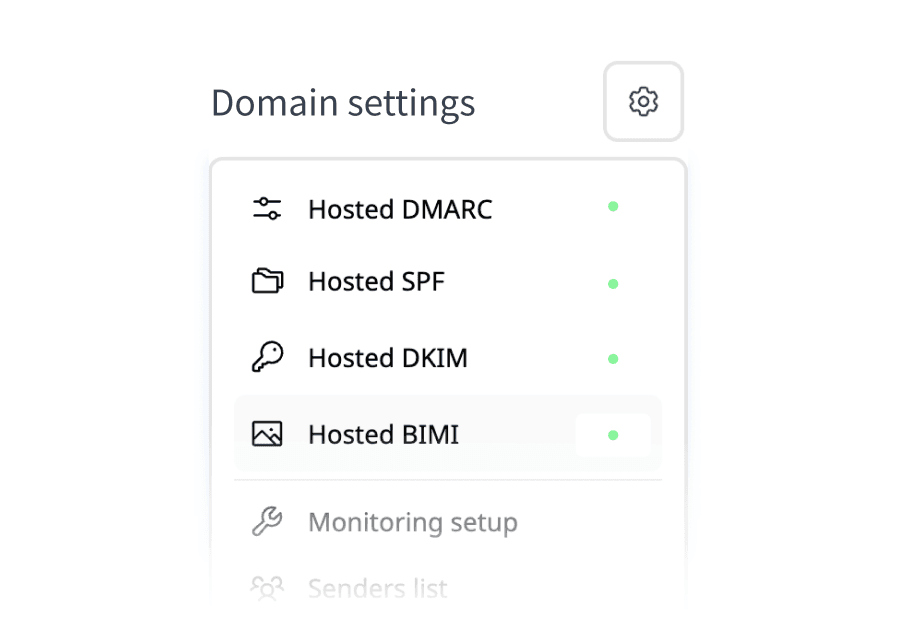
- Hosted DMARC, SPF, DKIM, BIMI records: Hosted on managed DNS
- SPF flattening: Hosted SPF flattening
Palisade takes the opposite bet: hosted SPF, DKIM, DMARC, and BIMI records on redundant managed DNS, SPF flattening to stay inside the 10-lookup limit, and an AI agent that carries out the enforcement plan under your approval. For an MSP running hundreds of domains, we think the platform should do the work, but if your clients' compliance rules forbid third parties in the DNS path, dmarcian's stance may genuinely fit better.
General tooling vs MSP workflow
The MSP tooling gap
dmarcian has an MSP program, centralized multi-domain management, an MSP portal with education and sales assets. What it doesn't advertise: PSA integrations (no ConnectWise, HaloPSA, or Autotask anywhere on their platform, MSP, or partner pages when we checked) and white-label reporting.
dmarcian
A relevant product screenshot was not available in the reviewed evidence.
- Native ConnectWise, HaloPSA & Autotask integrations: Not advertised
- White-label client reporting: Not advertised
- Multi-tenant / multi-domain management: Supported
Palisade
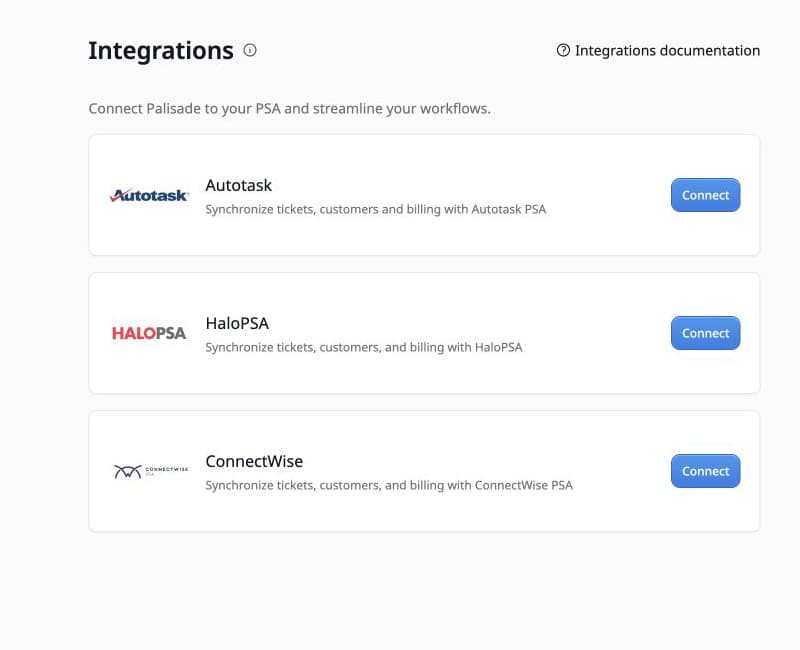
- Native ConnectWise, HaloPSA & Autotask integrations: Native PSA integrations
- White-label client reporting: Included for MSPs
- Multi-tenant / multi-domain management: Supported
Palisade wires into the tools an MSP already runs: domains sync from your PSA, alerts become tickets, and white-label prospecting reports give your sales team something to sell with. That's the difference between a DMARC tool an MSP can use and a platform built around how MSPs operate.
Native PSA integrations
Palisade imports client domains straight from these three. dmarcian's own coverage is stated above, from their site.
- ConnectWise PSA
- Autotask
- HaloPSA


In-house expertise vs managed execution
Where dmarcian fits
dmarcian's founder helped write the DMARC spec, and it shows in the product's educational depth: DMARC Academy, detailed source classification, and explanatory tooling are the best in the category. Organizations that want to build real in-house DMARC expertise, or consultants who bill for that expertise, get real value there. Palisade optimizes for the opposite user: the MSP that wants enforcement done, at scale, without becoming a DMARC school.Source 1, Source 2 +2 more
dmarcian
A relevant product screenshot was not available in the reviewed evidence.
Dashboard access vs programmatic access
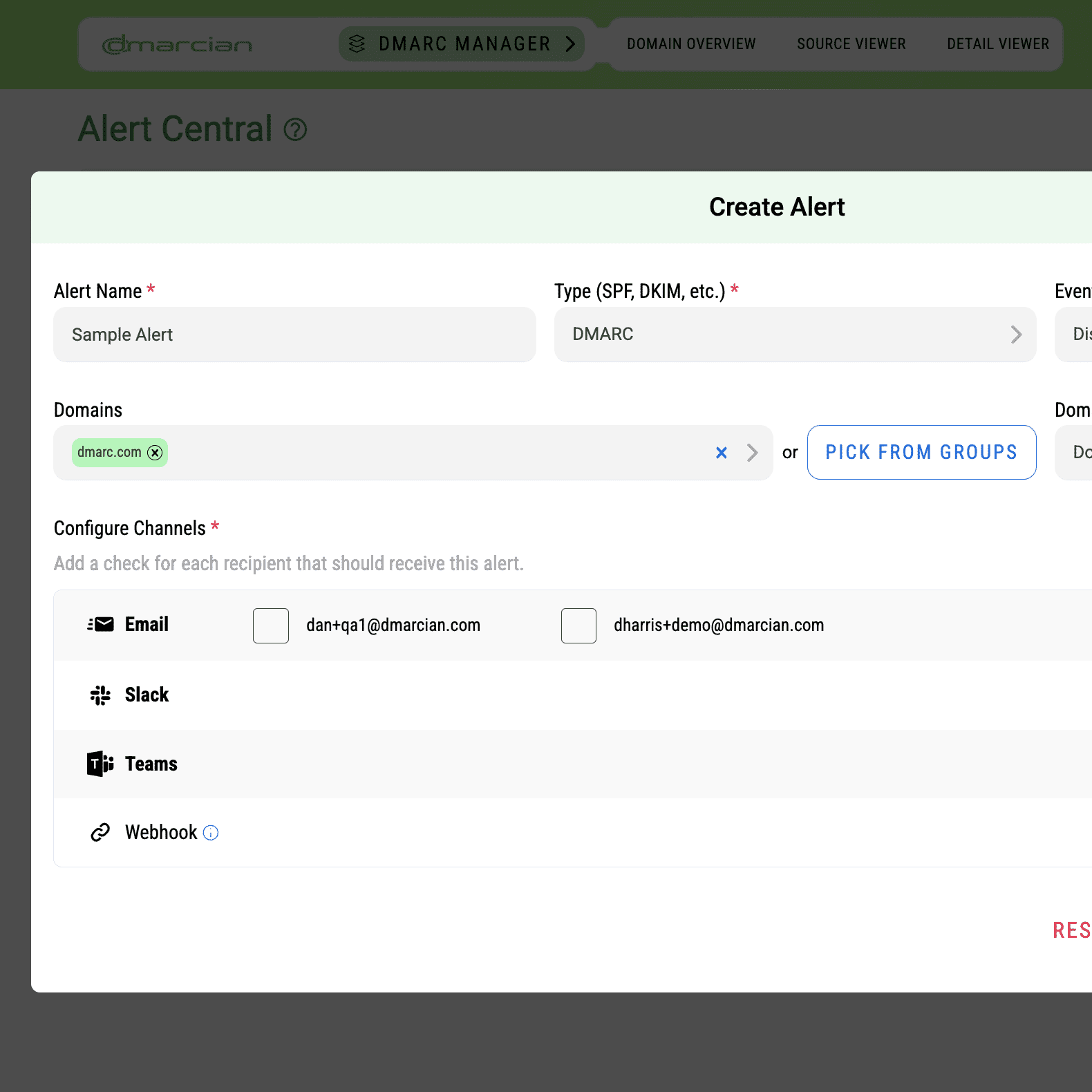
dmarcian's Enterprise REST API and webhook alerts, with no published MCP server
dmarcian advertises an Enterprise-only RESTful API with documentation and batch endpoints. Its Alert Central documentation says alerts can go to email, Slack, Teams, or a webhook. On the product page checked here, dmarcian describes reporting, alerts, API access, SSO, and subdomain management, but does not advertise an MCP server, an AI-assistant integration, or AI or machine-learning features (checked 2026-08-27). Source (2026-08-27) Source 2 (2026-08-27)
dmarcian
Palisade
A relevant product screenshot was not available in the reviewed evidence.
- REST API for programmatic domain-management data: REST API published
- MCP server for connecting AI assistants to domain data: MCP server published
- AI-assisted sender investigation and fix drafting: Agent drafts fixes
Palisade publishes both an MCP server and a REST API. Its agent investigates senders, drafts SPF and DKIM fixes, and proposes each policy step. A human approves before anything ships.
Reachable from your own AI tools
Palisade's MCP server exposes 42 tools over OAuth, so the assistant your team already uses can read domains, pull the exact records to publish and work the task queue. These are the clients the connection guide walks through.
- ChatGPT
- Claude
- Codex
- Cursor
- Windsurf
- Any MCP client





Still deciding between dmarcian and Palisade? See what changes with Palisade.
1 domain free up to 1,000 emails/month


 Microsoft 365
 Zoho Mail

The agent does the heavy lifting
Sources identified, SPF and DKIM fixes drafted, each policy step proposed. You approve; nothing ships on its own.
Connect your AI with MCP
42 tools over MCP, so your assistant reads your domains and works the queue.
Connect your DNS manager directly


Approved records go into your own zone at your own provider, across 64. No credentials reach us.
“We evaluated many DMARC providers before choosing Palisade. The quality of their product, the responsiveness and friendliness of their team and their rapid progress on their product roadmap made it a no-brainer for us to move forward.”
dmarcian pricing explained (and how Palisade compares)
dmarcian publishes clean plan pricing tiered by active domains and DMARC message volume. From their pricing page when we checked:
What you'd actually pay
The same five buyer sizes on every comparison, so a shape carries from one page to the next.
1 domain, up to 1,000 emails a month
Personal: up to 2 active domains and 1,250 messages per month; non-business use only
2 set-up domains, up to 100K emails a month
Basic: up to 2 active domains and 100,000 DMARC-capable messages per month
10 set-up domains, up to 1M emails a month
Enterprise: up to 15 active domains and 5,000,000 DMARC-capable messages per month; no 10-domain tier is published
20 set-up domains, up to 2.5M emails a month
Published subscriptions stop at 15 active domains; larger counts use custom pricing
Client domains under management, any volume
Service-provider and partner pricing is not published
Palisade’s figures are derived from its published tiers. dmarcian figures read from their pricing page on 2026-08-28. Plans and prices may have changed since.
How dmarcian prices
- Message overages are handled with custom pricing, per their pricing page.
- The free Personal tier is explicitly for non-business domains (family photos, hobbies, their words).
- dmarcian offers a 30-day free trial on paid plans, longer than Palisade's 15 days.
- API access is an Enterprise-plan feature; Palisade includes its API on every plan.
How Palisade prices
- Flat monthly IT-team plans from $19/month, sized by email volume, with 2 to 20 set-up domains by tier and free unlimited domain adding.
- MSP client domains are priced per domain with no email metering, so a client's sending growth does not change its rate.
- API access is included on every plan and hosted records on every paid plan; white-label reporting is included for MSP and Enterprise.
- 15-day free trial of the full product.
dmarcian pricing read from their public pricing page on 2026-07-10.Plans and prices may have changed since.
Try Palisade free on one domain, or start a 15-day full-product trial with no credit card.
What each one covers, and where it stops
Published facts only, read from each vendor's own material. Neither column describes a hands-on trial, because we have not run one.
dmarcian is a DMARC reporting and education platform built around an operator-led process. It reads and interprets DMARC data, keeps DNS outside its critical path, and supports centralized multi-domain management for MSPs. Its DMARC Academy, source classification, and explanatory tooling suit organizations that want to build in-house DMARC expertise while retaining control of each enforcement step.
dmarcian publishes business plans based on active domains and DMARC message volume. Basic starts at $19.99/mo billed yearly, while the free Personal tier covers non-business domains. Enterprise includes API access and domain discovery. Custom / partner options list Contact sales instead of a published price, and dmarcian handles message overages with custom pricing.
Palisade is built around an agent that does the DMARC work rather than reporting on it. It identifies every sending source, drafts the SPF and DKIM changes each one needs, and proposes the next policy step when the evidence supports it.
The agent investigates every sender, drafts every fix, and proposes each policy step, you approve before anything ships.
- Provides DMARC report analytics
- Provides scheduled reports and alerts
- Supports multi-tenant and multi-domain management
- Offers an Enterprise REST API
- The agent investigates senders and drafts the fix, so the work arrives prepared rather than as a list of findings
- Hosted SPF, DKIM and DMARC on redundant managed DNS, so an approved change can be carried out rather than handed off
- Portfolio workflow for MSPs, with ConnectWise, HaloPSA and Autotask integrations and a free NFR domain
- An MCP server and a REST API, so the same data and workflow are reachable from the AI tools a team already uses
- Does not advertise an AI agent for enforcement work
- Does not advertise API access outside its Enterprise plan
- Does not advertise named ConnectWise, HaloPSA, or Autotask connectors
- Does not advertise white-label client reporting
- Does not advertise hosted DMARC, SPF, DKIM, or BIMI records
- Every policy change waits for a human approval, by design: nothing ships on the agent's own authority
- MSP pricing is quoted per client domain rather than published as a rate card
- Plans are sized by monthly email volume, so a low-domain, high-volume sender lands on a higher tier than domain count alone suggests
- Starts at
- $19.99/mo billed yearly
- Free tier
- $0 for 2 non-business domains
- Trial length
- 30 days on paid plans
- Enterprise
- $499/mo billed yearly
- Starts at
- Free for 1 domain; IT plans from $19/mo by email volume
- Free tier
- 1 domain, up to 1,000 emails/month
- Trial
- 15 days, full product, no credit card
- MSP model
- Quoted per client domain, portfolio-based
What Palisade customers say
5.0 out of 5 on G2Trusted by over 10,000 domains
“Palisade made it so easy for us to get our blue verified checkmark and achieve our BIMI compliance”


Sources and further reading
Source checks run through 2026-07-10; every entry keeps its individual check date.
- dmarcian pricing
Checked 2026-07-10
- dmarcian API and published product feature list
Checked 2026-08-27
- dmarcian MSPs and IT agencies
Checked 2026-07-10
- dmarcian full sub-domain delegation
Checked 2026-07-10
- dmarcian Alert Central webhook notifications
Checked 2026-08-27
- dmarcian Alert Central webhook documentation
Checked 2026-08-27
- dmarcian product changelog
Checked 2026-08-27
Palisade vs dmarcian: FAQ
What is the main difference between dmarcian and Palisade?
Palisade is agentic DMARC software. Its agent investigates sending sources, works through SPF and DKIM alignment, and moves domains toward p=reject while your team stays in control. When evaluating dmarcian, compare that operating model with the workflow in its current product documentation and decide how much work you want your team to carry.
Who should choose Palisade?
Choose Palisade if you want an AI agent to carry routine DMARC work through enforcement, whether you manage one domain or thousands. It is also a natural fit for teams already using Claude, OpenAI, or other AI tools to get operational work done.
Who should choose dmarcian?
Choose dmarcian if its current integrations, procurement model, or operating workflow better match your requirements. A more operator-led platform can also fit a team that prefers to review reports and make each change itself.
Does Palisade guarantee a specific time to p=reject?
No responsible DMARC platform should promise the same enforcement timeline for every domain. Timing depends on the number of sending sources, access to DNS and third-party systems, and how quickly each legitimate stream can be aligned. Palisade's agent reduces routine investigation and configuration work while operators retain control over policy decisions.
Switching from dmarcian takes three steps
- 1
Batch-import your domains
Bring your domains into Palisade in bulk, or let your ConnectWise, HaloPSA, or Autotask integration pull the client list automatically.
- 2
Run both platforms in parallel
DMARC reporting supports multiple recipients, so Palisade and dmarcian receive the same reports during the overlap. Compare classifications side by side.
- 3
Cut DNS over with Easy API
Move to Palisade's hosted records via API-driven DNS deployment: this is the step dmarcian's read-only model never takes, and where the automation begins.
1 domain free up to 1,000 emails/month
Competitor information on this page was last reviewed against public sources on 2026-07-10. Spotted something out of date? Tell us and we'll fix it.