
EasyDMARC vs Palisade in 2026
EasyDMARC gives operators guided tools for DMARC work. Palisade is agentic: its AI agent investigates issues, configures authentication, and proposes each step toward enforcement for your approval. That operating model works whether you manage one domain or thousands.
Our verdict: Pick Palisade if you want an AI agent to investigate senders, draft authentication fixes, and propose each enforcement step for your approval. Pick EasyDMARC if your team prefers guided tools and wants to make each change itself.
 Samuel Chenard · CEO & Co-Founder, PalisadeSource checks through 2026-07-10
1 domain free up to 1,000 emails/month
 ChatGPT
 Claude
 Gemini
 Perplexity
 Grok
Grok EasyDMARC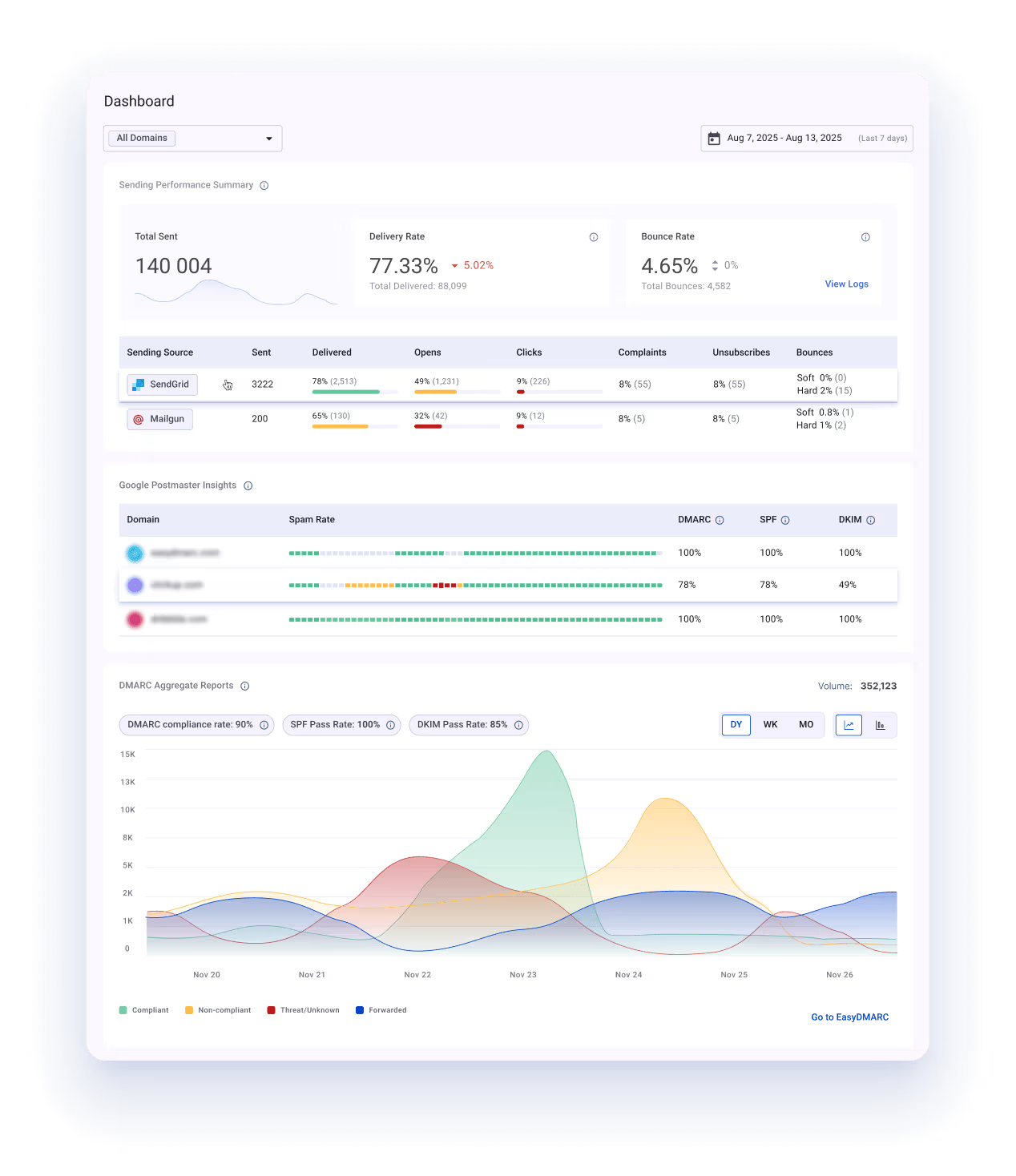
 Palisade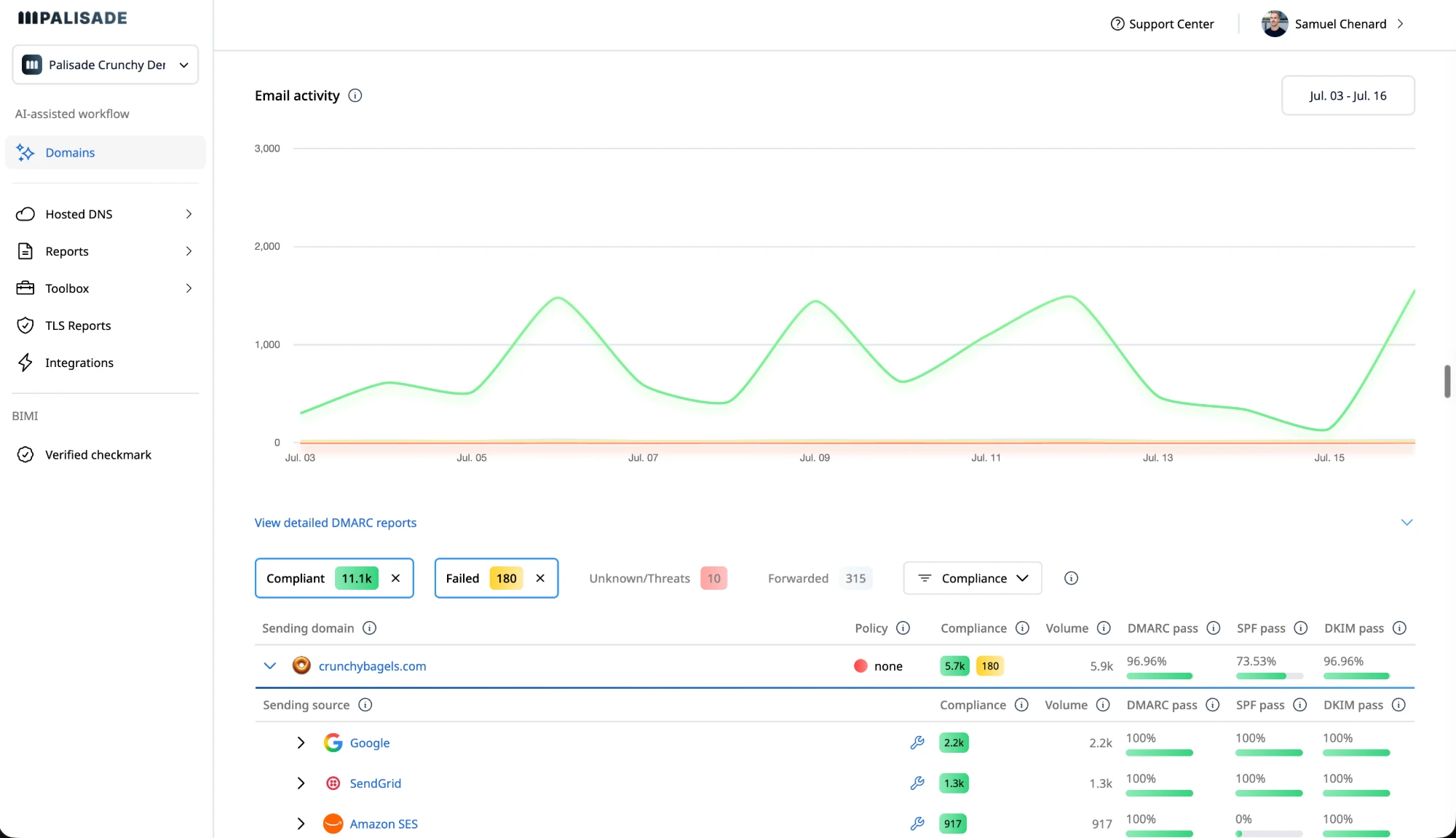
Palisade is free for one domain, up to 1,000 emails a month. Paid IT-team plans are sized by email volume. Start a 15-day full-product trial with no credit card.
Which one is right for you?
Best for MSPs that want to review and apply each change themselves
Best for MSPs and IT teams responsible for multiple domains
- You prefer a more traditional EasyDMARC workflow with people involved in each enforcement step.
- Your buying criteria center on vendor-specific enterprise requirements.
- You want SyncroMSP specifically: EasyDMARC integrates it alongside ConnectWise, HaloPSA and Autotask, which both products cover.
- EasyDMARC's published email-volume and domain-based plans fit your budget, including its separate contact-sales MSP pricing model.
- You run an MSP, or an internal IT or security team, responsible for multiple domains.
- You want an AI agent to investigate issues, configure authentication, and move domains toward p=reject.
- Teams already using Claude, OpenAI, or other AI tools can bring the same agent-led operating model to DMARC.
Free for one domain, up to 1,000 emails a month. Paid IT-team plans are sized by email volume. Start a 15-day full-product trial with no credit card.
Where the day-to-day work actually differs
| Feature | EasyDMARC | Palisade |
|---|---|---|
| Enforcement | ||
| AI agent that does the enforcement work (you approve each step)Whether a product investigates senders, drafts fixes, and proposes enforcement steps for review. | Not advertised | Agent drafts and proposes |
| Reporting and analysis | ||
| DMARC report monitoring & analyticsWhether a product collects DMARC reports and shows their authentication results. | Supported | Report monitoring |
| Limits & metering | ||
| Client email volume in the MSP billing calculationWhether client sending volume changes how the provider calculates MSP pricing.EasyDMARC says its MSP pricing follows actual domain and email volume. Palisade says client email volume is not metered and a client tripling its sending costs nothing extra (checked 2026-08-28). Source (2026-08-28) Source 2 (2026-08-28) | Domain and email volume | Client volume not metered |
| Overage behavior when a plan's email quota is exceededWhat happens to reporting access after monthly volume runs over.EasyDMARC's MSP pricing page says that exceeding a monthly email quota removes access to reports and the dashboard until the plan is upgraded. Palisade's MSP page says client email volume is not metered and advertises no email caps or overage fees (checked 2026-08-28). Source (2026-08-28) Source 2 (2026-08-28) | Dashboard access suspended | No client overage state |
| Client-domain capacity on the MSP planWhether the MSP offer sets a published ceiling on managed client domains.EasyDMARC's MSP plan lists domains as up to unlimited. Palisade's MSP page lists client domains as unlimited (checked 2026-08-28). Source (2026-08-28) Source 2 (2026-08-28) | Up to unlimited domains | Unlimited client domains |
| MSP operations | ||
| Native ConnectWise, HaloPSA & Autotask integrationsWhether a product connects directly to the named professional-services automation tools. | Native PSA integrations | Native PSA integrations |
| Multi-tenant client managementWhether one account can manage separate client domains and organizations. | Multi-tenant MSP tooling | Multi-tenant management |
| White-label client reportingWhether client-facing reports can carry a provider's branding. | White-label reporting | White-label reporting |
| REST API for tenants, domains, records, and reportsWhether an API can manage tenants, domains, DNS records, and reports.EasyDMARC's developer documentation advertises REST API access for organizations, domains, DNS records, aggregate reports, and partner billing and subscription operations (checked 2026-08-27). Source (2026-08-27) | Developer REST API | API on every plan |
| Native SyncroMSP integrationWhether SyncroMSP can connect directly to the DMARC platform.EasyDMARC lists SyncroMSP as a native PSA integration. Palisade's MSP page advertises ConnectWise PSA, Autotask, and HaloPSA but does not advertise SyncroMSP (checked 2026-08-28). Source (2026-08-28) Source 2 (2026-08-28) | Native SyncroMSP | Not advertised |
| PSA ticket and billing synchronizationWhether DMARC work and client billing data can flow into the service desk.EasyDMARC says alerts auto-create tickets and domain groups map to PSA customer accounts for billing and support. Palisade says its ConnectWise, Autotask, and HaloPSA integrations keep tickets and billing in sync (checked 2026-08-28). Source (2026-08-28) Source 2 (2026-08-28) | Alerts create tickets | Tickets and billing sync |
| MSP pricing & terms | ||
| Per-client-domain pricing that scales with portfolio sizeWhether MSP pricing follows client-domain count and falls at larger portfolio sizes.EasyDMARC says its MSP plan bills per domain each month and that volume pricing begins at MSP scale. Palisade bills per client domain and says its rate improves as the portfolio grows (checked 2026-08-28). Source (2026-08-28) Source 2 (2026-08-28) | Domain-count volume tiers | Rate improves with portfolio |
| No annual commitment or minimum portfolio commitmentWhether an MSP must sign an annual term or bring a minimum number of client domains.EasyDMARC advertises no annual commitment, no minimum commitment, and no setup fees for its MSP plan. Palisade advertises no commitments or minimums for MSP pricing (checked 2026-08-28). Source (2026-08-28) Source 2 (2026-08-28) | No annual term or minimum | No commitments or minimums |
| Published numeric per-domain rate cardWhether an MSP can see per-domain prices before contacting sales.EasyDMARC does not advertise a numeric per-domain MSP rate; its MSP page directs buyers to contact the team for a pricing package. Palisade likewise describes portfolio-based pricing without advertising numeric rates (checked 2026-08-28). Source (2026-08-28) Source 2 (2026-08-28) | Contact MSP team for pricing | Portfolio quote |
| Hosted records & DNS | ||
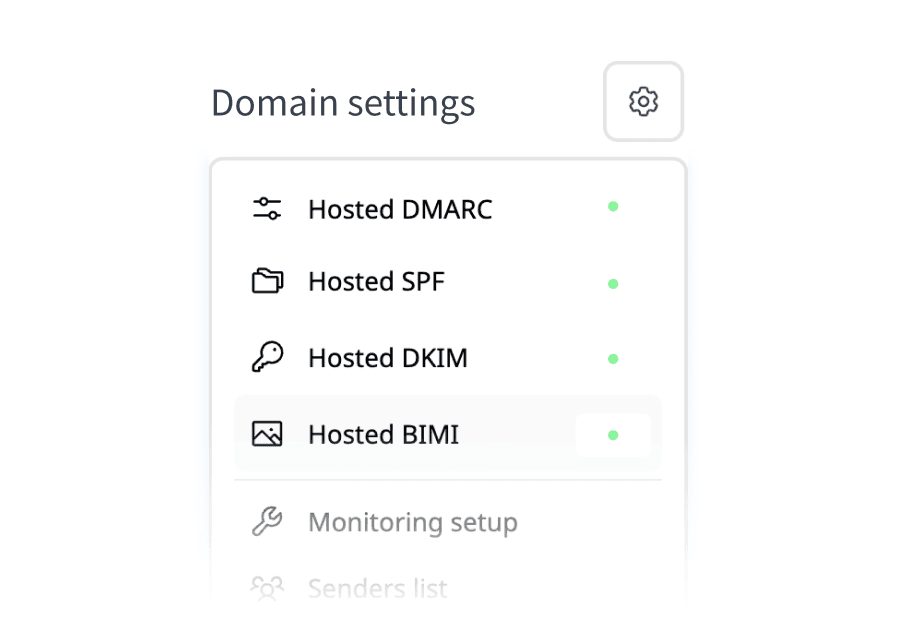
| Hosted DMARC, SPF, DKIM, BIMIWhether the platform hosts the named email-authentication records. | Supported | Hosted email records |
| Hosted records on redundant managed DNSWhether hosted records are served through redundant managed DNS infrastructure. | Not advertised | Redundant managed DNS |
| SPF flatteningWhether SPF records are flattened to avoid the DNS lookup limit. | Dynamic SPF flattening | Hosted SPF flattening |
| AI and automation access | ||
| REST API for domains, reports, and organizationsWhether software can create and query domains, reporting, and organizations.EasyDMARC documents a REST API. Its support page says accounts without API access are redirected to contact sales for enablement (checked 2026-08-27). Source (2026-08-27) Source 2 (2026-08-27) | Sales enablement may apply | REST API published |
| MCP server for connecting AI assistants to domain dataWhether an AI assistant can reach the product's data directly.EasyDMARC does not advertise an MCP server or an AI-assistant integration on its developer documentation or integrations index (checked 2026-08-27). Source (2026-08-27) Source 2 (2026-08-27) | No MCP server listed | MCP server published |
| Machine learning for DMARC report analysisWhether the vendor advertises AI or machine learning inside the product.EasyDMARC advertises machine learning that parses DMARC reports into a human-friendly dashboard (checked 2026-08-27). Source (2026-08-27) | ML report parsing | Agent drafts fixes |
| Webhooks for event deliveryWhether events can reach another system without someone checking the dashboard.EasyDMARC documents webhooks that POST JSON event details to a chosen endpoint (checked 2026-08-27). Source (2026-08-27) | JSON event webhooks | REST API and MCP |
Want to compare the workflow yourself? Try Palisade free with one domain and up to 1,000 emails a month.
Palisade 96 vs EasyDMARC 78, and why
Both products are scored on the same eight dimensions the comparison hub uses, so the figures here are the figures there. Four are derived from vendor facts that each carry a source and a checked date. Four are editorial, marked as such below, and each states its reasoning and its source.
Each dimension is out of 10 and the total is the raw sum out of 80, rescaled to 100 — the raw figure is printed beside it so the conversion is checkable rather than a black box. Scored on what each vendor publishes, not on how the product feels in use. Editorial dimensions last reviewed 2026-09-02.
How reachable the product is from your own software and AI tools. 10 = a documented API on every plan plus a published MCP server. 6 = an API, gated to a tier or to a sales conversation. 3 = no programmatic access advertised.
EasyDMARC documents a REST API for tenants, domains, records, and reports, but it does not list an MCP server. Source (2026-08-30)
Palisade publishes a REST API and a remote MCP server on every plan, making the same domain data and remediation workflows available to connected software. Source (2026-08-30)
How much of the report analysis is done for you. 10 = the platform turns raw report data into a prioritised, actionable queue on its own.
Aggregate and forensic reporting with source identification; the remediation decisions remain manual. Source (2026-08-27)
Report data is analysed into a prioritised list of sender, SPF, DKIM and DMARC issues, so nobody reads raw XML. Source (2026-08-30)
How much of the work the vendor's own software does. 10 = it identifies the sending sources, drafts the SPF and DKIM fixes each one needs, and proposes the next policy step. 6 = it applies the records for you, but a person decides what to fix and when to advance. 3 = it reports, and every change is yours to make. A vendor whose team does the work rather than its software scores here on the software alone.
One-click record updates through its DNS integrations apply the record changes, while a person decides when to advance the DMARC policy. Source (2026-08-30)
The agent investigates each sender, drafts the SPF and DKIM changes it needs, and proposes the next policy step; a human approves before deployment. Source (2026-08-30)
10 = full pricing published. 6 = some tiers published, rest quote-gated. 3 = quote only.
Self-service tiers are published; MSP pricing is supplied by quote. Source (2026-08-30)
Published: free plan, then flat monthly plans by email volume from $19/mo Source (2026-08-30)
10 = hosts the records for you. 6 = partial or add-on. 3 = you manage your own DNS.
10 = a genuine free plan. 6 = time-limited trial only. 3 = no free access.
Free plan: one domain, up to 1,000 emails/mo, 14-day report history, no credit card, plus a 15-day full-product trial Source (2026-08-30)
10 = a real MSP program with multi-tenant management. 6 = partial. 3 = none.
How much work it takes to get a domain from p=none to p=reject. 10 = the platform (or the vendor's team) gets you there without manual DNS edits.
Hosts SPF, DKIM, DMARC, BIMI and MTA-STS, so record changes don't need manual DNS edits, but deciding when to advance the policy stage is left to you. Source (2026-08-27)
The DMARC Agent detects when a domain's authentication and alignment are ready for the next policy stage and proposes the move, but a human still approves and applies it, so it is not fully hands-off. Source (2026-08-30)
Where Palisade and EasyDMARC actually differ
Each argument keeps the product screens, sourced comparison points, and supporting analysis together.
Agent-led enforcement vs guided tooling
Enforcement: agent-led vs guided tooling
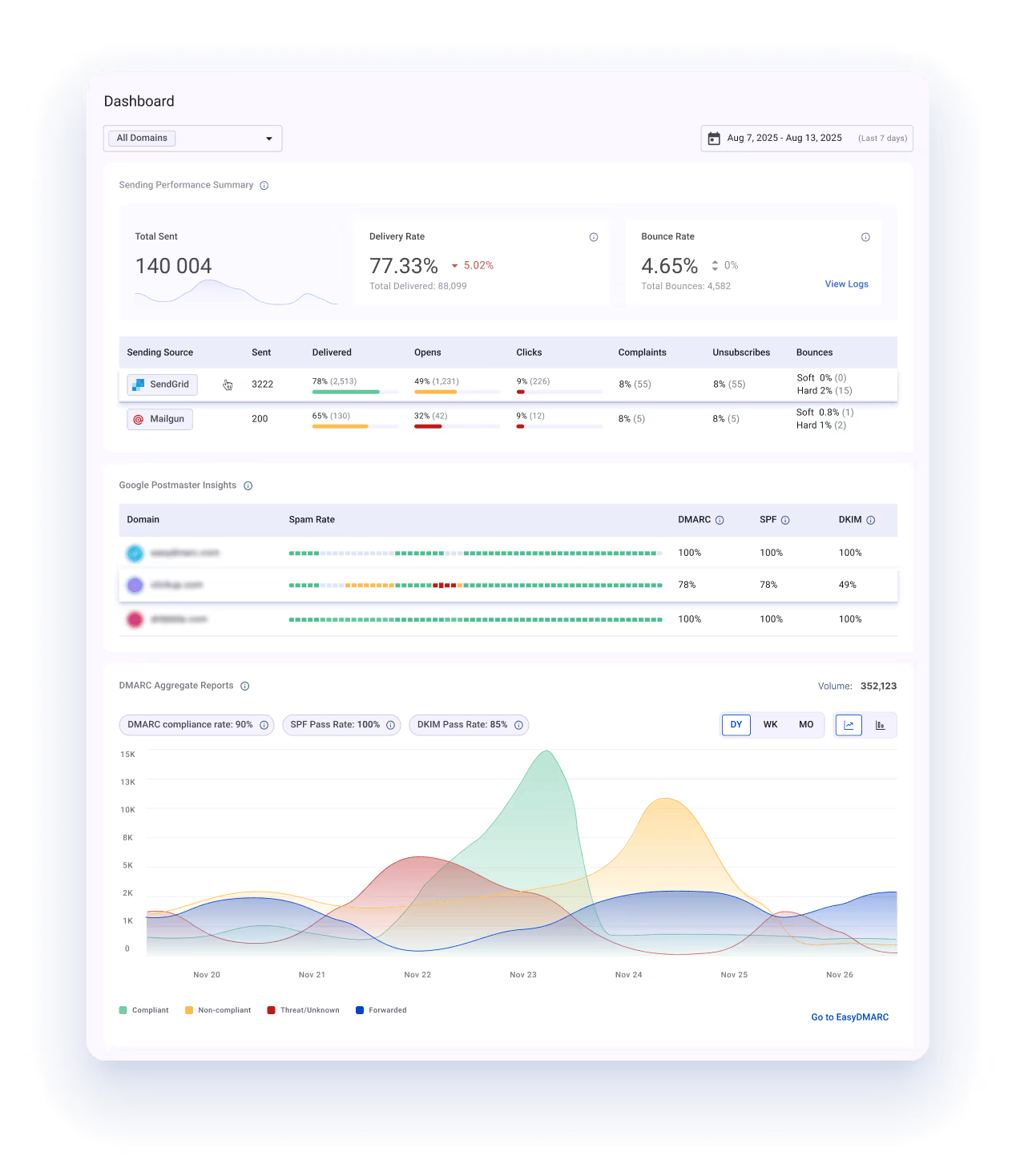
EasyDMARC gives you dashboards, AI-assisted source classification, and guided steps, you and your team still review reports and move policies forward yourselves. The manual path stays manual, on every domain you manage.
EasyDMARC
A relevant product screenshot was not available in the reviewed evidence.
- AI agent that does the enforcement work (you approve each step): Not advertised
Palisade
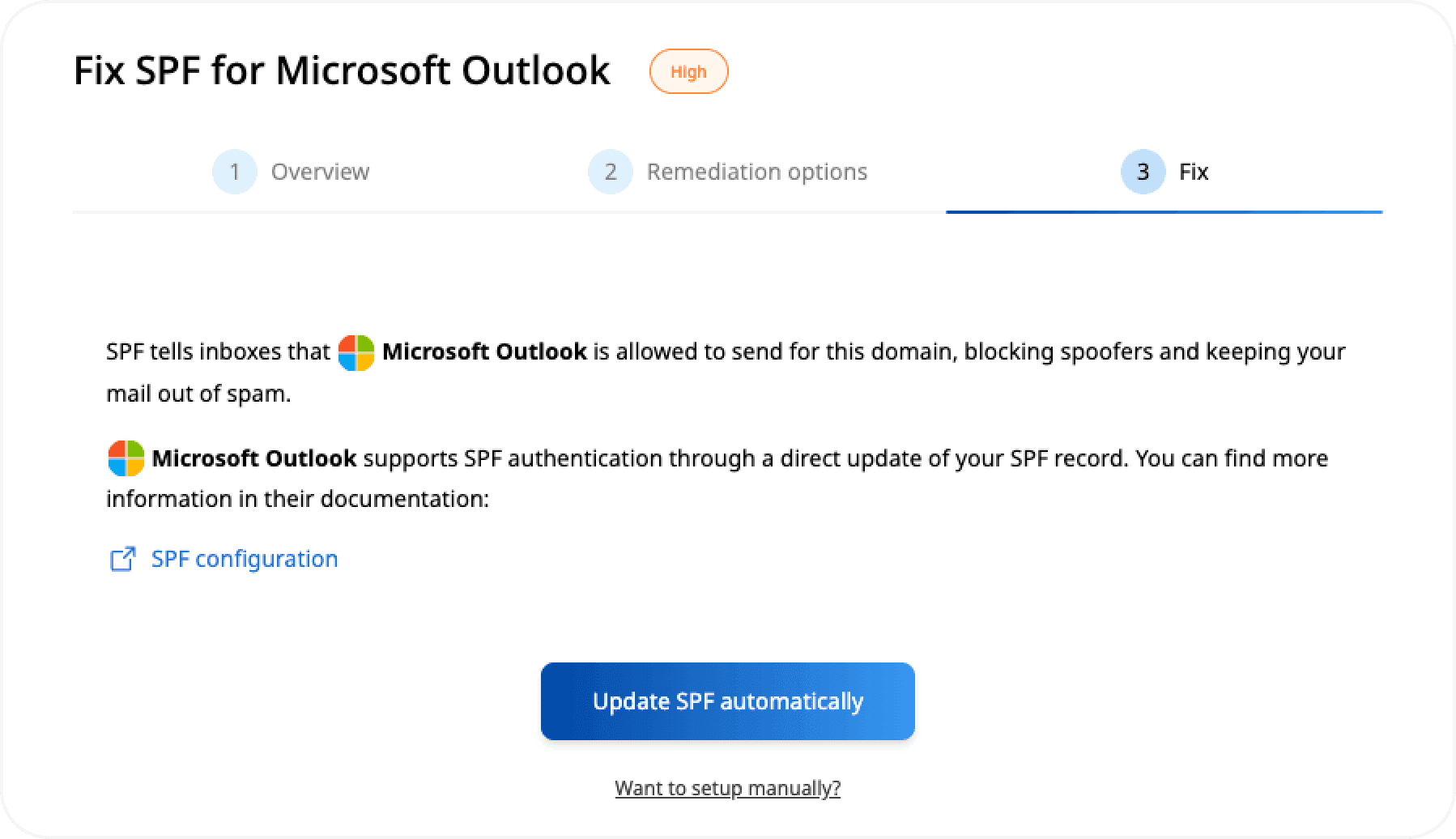
- AI agent that does the enforcement work (you approve each step): Agent drafts and proposes
Palisade removes the manual path. Its AI agent analyzes email flows, identifies legitimate senders, configures SPF and DKIM, and progressively tightens DMARC policy to p=reject, with each step approved by your team. For an MSP, that difference compounds across every domain you manage.
Volume pricing vs predictable billing
What happens when a client's email volume grows
EasyDMARC's published plans start from 100,000 emails per month and price upward by volume; their stated overage policy is that you lose dashboard access until you upgrade the plan. For MSPs, that means volume forecasting per client, and a support fire when a client's newsletter goes out to a bigger list than expected.Source 1, Source 2 +1 more
EasyDMARC
A relevant product screenshot was not available in the reviewed evidence.
Palisade
A relevant product screenshot was not available in the reviewed evidence.
Palisade's MSP pricing doesn't meter client email volume. A client domain is a client domain, whatever it sends, so margins on a fixed-fee client stay predictable because your platform cost can't spike underneath you. For your own organization, plans are flat monthly prices sized by email volume from $19/month, with every domain included.
What each side charges
Three points on each published range: the cheapest plan, one in the middle, and the top of what the vendor publishes. Every plan on both sides is in the pricing section further down.
- Free$0
1,000 emails/mo, 1 domain, 14-day data history, 1 user
- Premium$71.99/mo billed annually ($89.99 monthly)
From 100,000 emails/mo, 4 domains, 1-year history, unlimited invited users
- MSP (per-domain)Not published: contact sales
Unlimited emails/domains, white-label reporting, multi-tenant, API
- Free$0
1 domain, your own, capped at 1,000 emails/mo
- IT teams: up to 500,000 emails/mo$59/mo ($47/mo billed annually)
Same product: 6 set-up domains, pick the tier that matches your sending
- Enterprise (more than 2.5M / month)Custom
Custom volume, retention, and terms
PSA coverage vs operating model
PSA integrations: honest parity
EasyDMARC natively integrates ConnectWise PSA, HaloPSA, Autotask, and SyncroMSP, alert-to-ticket flows included. Palisade covers ConnectWise, HaloPSA, and Autotask natively plus a free API. If PSA coverage is your deciding factor, both platforms clear the bar; the enforcement model and billing structure above are where the real decision lives.
EasyDMARC
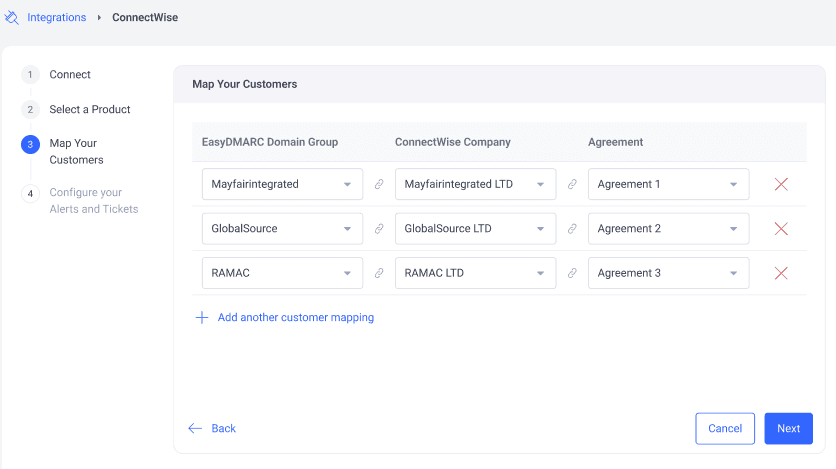
- Native ConnectWise, HaloPSA & Autotask integrations: Native PSA integrations
- Multi-tenant client management: Multi-tenant MSP tooling
- White-label client reporting: White-label reporting
Palisade
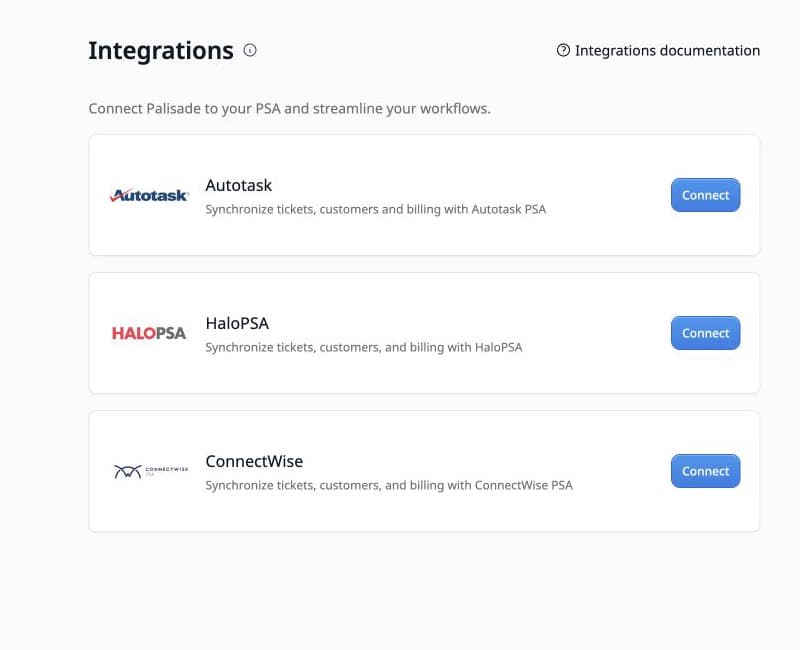
- Native ConnectWise, HaloPSA & Autotask integrations: Native PSA integrations
- Multi-tenant client management: Multi-tenant management
- White-label client reporting: White-label reporting
Native PSA integrations
Palisade imports client domains straight from these three. EasyDMARC's own coverage is stated above, from their site.
- ConnectWise PSA
- Autotask
- HaloPSA


Pricing transparency vs portfolio economics
MSP economics
Both platforms court MSPs. EasyDMARC's MSP program adds white-label reporting, multi-tenancy, and per-domain billing, with the rate behind a sales conversation, and volume pricing at scale by their own description. Palisade uses portfolio-based per-client-domain pricing from the first client domain, with white-label prospecting reports, hosted records on redundant managed DNS, and dedicated onboarding on every plan.Source 1, Source 2
EasyDMARC
Palisade
Dashboard access vs programmatic access
EasyDMARC's REST API and webhooks, with no published MCP server
EasyDMARC publishes a REST API for DNS lookups, DMARC reporting, domains, organizations, and billing. Its public-API guide says an account without API access is redirected to contact sales, so access is not documented as available to every account. It also documents webhooks that send JSON events to a chosen endpoint and advertises machine learning that parses DMARC reports into a human-friendly dashboard. Its developer documentation and integrations index do not advertise an MCP server or AI-assistant integration (checked 2026-08-27). Source (2026-08-27) Source 2 (2026-08-27) Source 3 (2026-08-27) Source 4 (2026-08-27) Source 5 (2026-08-27)
EasyDMARC
A relevant product screenshot was not available in the reviewed evidence.
Palisade
A relevant product screenshot was not available in the reviewed evidence.
- REST API for domains, reports, and organizations: REST API published
- MCP server for connecting AI assistants to domain data: MCP server published
- Machine learning for DMARC report analysis: Agent drafts fixes
Palisade publishes an MCP server and a REST API. The agent investigates senders, drafts SPF and DKIM fixes, and proposes each policy step. A human approves before anything ships.
Reachable from your own AI tools
Palisade's MCP server exposes 42 tools over OAuth, so the assistant your team already uses can read domains, pull the exact records to publish and work the task queue. These are the clients the connection guide walks through.
- ChatGPT
- Claude
- Codex
- Cursor
- Windsurf
- Any MCP client





Still deciding between EasyDMARC and Palisade? See what changes with Palisade.
1 domain free up to 1,000 emails/month


 Microsoft 365
 Zoho Mail

The agent does the heavy lifting
Sources identified, SPF and DKIM fixes drafted, each policy step proposed. You approve; nothing ships on its own.
Connect your AI with MCP
42 tools over MCP, so your assistant reads your domains and works the queue.
Connect your DNS manager directly


Approved records go into your own zone at your own provider, across 64. No credentials reach us.
“We evaluated many DMARC providers before choosing Palisade. The quality of their product, the responsiveness and friendliness of their team and their rapid progress on their product roadmap made it a no-brainer for us to move forward.”
EasyDMARC pricing explained (and how Palisade compares)
EasyDMARC publishes self-serve plans priced by email volume and domain count, with a separate contact-sales track for MSP per-domain pricing. Here is what their pricing page showed when we checked:
What you'd actually pay
The same five buyer sizes on every comparison, so a shape carries from one page to the next.
1 domain, up to 1,000 emails a month
1 domain, 1,000 emails/month
2 set-up domains, up to 100K emails a month
Plus: 2 domains, 100,000 emails/month
10 set-up domains, up to 1M emails a month
20 set-up domains, up to 2.5M emails a month
Enterprise: custom quantity of domains, up to unlimited emails
Client domains under management, any volume
Pay-as-you-go per-domain monthly; rate not published
Palisade’s figures are derived from its published tiers. EasyDMARC figures read from their pricing page on 2026-08-28. Plans and prices may have changed since.
How EasyDMARC prices
- Overage policy, in their words: exceed your monthly email quota and “you'll lose access to your reports/dashboard” until you upgrade.
- Self-serve plans carry domain ceilings (Plus 2, Premium 4); their MSP track prices per domain.
- Their MSP page describes per-domain pay-as-you-go, but notes “volume pricing kicks in at MSP scale”. The per-domain rate itself is not published.
How Palisade prices
- Flat monthly plans sized by email volume from $19/month (20% off on annual billing), with 2 to 20 set-up domains by tier (adding domains is free and unlimited).
- MSPs pay per client domain at a rate based on portfolio size, and client domains carry no email quota, so there is no lockout state and the price doesn't step up as a client's email volume grows.
- Only set-up domains count against an IT tier (2 to 20 by plan); adding domains is free and unlimited, and MSPs add client domains one at a time from the first one.
- No commitments or minimums, and a 15-day free trial.
EasyDMARC pricing read from their public pricing page on 2026-07-10.Plans and prices may have changed since.
Try Palisade free on one domain, or start a 15-day full-product trial with no credit card.
What each one covers, and where it stops
Published facts only, read from each vendor's own material. Neither column describes a hands-on trial, because we have not run one.
EasyDMARC gives operators guided DMARC tools, including dashboards, AI-assisted source classification, and guided steps. Its self-serve plans are organized by domain count and email volume, while MSPs use a separate contact-sales model with per-domain pricing, white-label reporting, and multi-tenant client management.
EasyDMARC also publishes native ConnectWise PSA, HaloPSA, Autotask, and SyncroMSP integrations, with alert-to-ticket flows. Its developer material documents REST API access for organizations and domains, webhooks that send JSON event data to a chosen endpoint, and machine learning that parses DMARC reports into a human-friendly dashboard.
Palisade is built around an agent that does the DMARC work rather than reporting on it. It identifies every sending source, drafts the SPF and DKIM changes each one needs, and proposes the next policy step when the evidence supports it.
The agent investigates every sender, drafts every fix, and proposes each policy step, you approve before anything ships.
- Supports DMARC report monitoring and analytics
- Provides native ConnectWise, HaloPSA, and Autotask integrations
- Provides multi-tenant MSP tooling
- Provides white-label reporting
- Provides a developer REST API for tenants, domains, records, and reports
- The agent investigates senders and drafts the fix, so the work arrives prepared rather than as a list of findings
- Hosted SPF, DKIM and DMARC on redundant managed DNS, so an approved change can be carried out rather than handed off
- Portfolio workflow for MSPs, with ConnectWise, HaloPSA and Autotask integrations and a free NFR domain
- An MCP server and a REST API, so the same data and workflow are reachable from the AI tools a team already uses
- Does not advertise an AI agent that does the enforcement work
- Does not advertise hosted records on redundant managed DNS
- Does not advertise an MCP server for connecting AI assistants to domain data
- Every policy change waits for a human approval, by design: nothing ships on the agent's own authority
- MSP pricing is quoted per client domain rather than published as a rate card
- Plans are sized by monthly email volume, so a low-domain, high-volume sender lands on a higher tier than domain count alone suggests
- Starts at
- $0
- Free tier
- 1 domain and 1,000 emails/mo
- Annual Plus
- $35.99/mo billed annually
- MSP model
- Per-domain pricing; rate not published
- Starts at
- Free for 1 domain; IT plans from $19/mo by email volume
- Free tier
- 1 domain, up to 1,000 emails/month
- Trial
- 15 days, full product, no credit card
- MSP model
- Quoted per client domain, portfolio-based
What Palisade customers say
5.0 out of 5 on G2Trusted by over 10,000 domains
“Palisade made it so easy for us to get our blue verified checkmark and achieve our BIMI compliance”


Sources and further reading
Source checks run through 2026-07-10; every entry keeps its individual check date.
- EasyDMARC pricing
Checked 2026-07-10
- EasyDMARC MSP platform
Checked 2026-07-10
- EasyDMARC MSP solutions
Checked 2026-07-10
- EasyDMARC integrations index (AI access check)
Checked 2026-08-27
- EasyDMARC Developer Documentation
Checked 2026-08-27
- EasyDMARC public API access
Checked 2026-08-27
- EasyDMARC webhook documentation
Checked 2026-08-27
- EasyDMARC AI-powered DMARC reporting
Checked 2026-08-27
Palisade vs EasyDMARC: FAQ
What is the main difference between EasyDMARC and Palisade?
Palisade is agentic DMARC software. Its agent investigates sending sources, works through SPF and DKIM alignment, and moves domains toward p=reject while your team stays in control. When evaluating EasyDMARC, compare that operating model with the workflow in its current product documentation and decide how much work you want your team to carry.
Who should choose Palisade?
Choose Palisade if you want an AI agent to carry routine DMARC work through enforcement, whether you manage one domain or thousands. It is also a natural fit for teams already using Claude, OpenAI, or other AI tools to get operational work done.
Who should choose EasyDMARC?
Choose EasyDMARC if its current integrations, procurement model, or operating workflow better match your requirements. A more operator-led platform can also fit a team that prefers to review reports and make each change itself.
Does Palisade guarantee a specific time to p=reject?
No responsible DMARC platform should promise the same enforcement timeline for every domain. Timing depends on the number of sending sources, access to DNS and third-party systems, and how quickly each legitimate stream can be aligned. Palisade's agent reduces routine investigation and configuration work while operators retain control over policy decisions.
Switching from EasyDMARC takes three steps
- 1
Batch-import your domains
Bring your client domains into Palisade in bulk, or let your PSA integration sync them automatically.
- 2
Run both platforms in parallel
DMARC reporting supports multiple recipients, so Palisade and EasyDMARC receive the same reports during the overlap window. Nothing breaks while you compare.
- 3
Cut DNS over with Easy API
Point records at Palisade's hosted infrastructure via API-driven DNS deployment, then retire the old setup on your schedule.
1 domain free up to 1,000 emails/month
Competitor information on this page was last reviewed against public sources on 2026-07-10. Spotted something out of date? Tell us and we'll fix it.