Provider deliverability · ActiveCampaign
Why are ActiveCampaign emails going to spam?

By Samuel Chenard · CEO & Co-Founder, Palisade · Reviewed September 19, 2026
ActiveCampaign mail is filed as spam because the sending domain was never set up. Until you do that, ActiveCampaign says DKIM signs with a domain it owns, the Return Path is its own, and neither aligns with your From address, so recipients see a via line and filters cannot tie the message to you. Shared-domain reputation and complaint rate follow.
The 30-second check
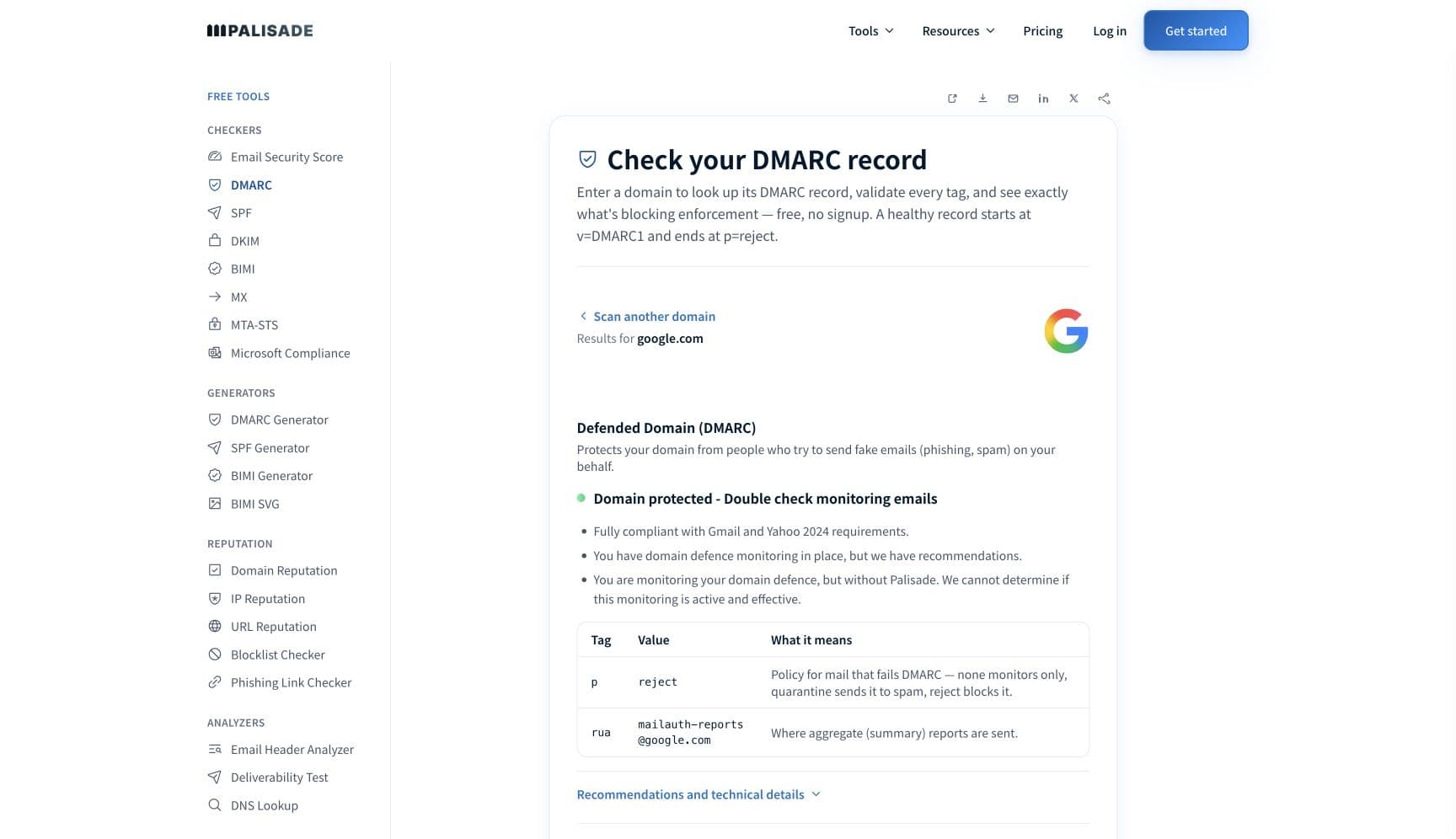
Check the domain in your From address before you rewrite a single subject line. ActiveCampaign's own documentation says that when you start out, "neither the Return Path nor the DKIM domain will match your From address" and calls that "the default scenario for any new ActiveCampaign customer". Everything downstream of that, including DMARC, depends on records you publish. The free DMARC checker reads all three in about thirty seconds.
Check your domain now
Enter your sending domain and the check runs instantly on the next page. Free, no signup.
Why your ActiveCampaign email is going to spam
| Likely cause | What's happening |
|---|---|
| You never set up a sending domain, so DKIM signs as ActiveCampaign | ActiveCampaign is direct about the default: the DKIM domain "will be a domain owned and operated by ActiveCampaign, like acems1.com", and "This default is why DKIM already works when you sign up with ActiveCampaign". It also says that domain "will appear after the 'via' header and as the 'signed-by' within Gmail", and that setting up your sending domain makes the DKIM domain your From domain and removes the via header. This is the first thing to check, every time. |
| SPF passes but does not align with your From address | ActiveCampaign explains that "If you have not set up a Mailserver Domain, ActiveCampaign will user our domain in this place", and in that case "SPF on the Return Path will still pass with ActiveCampaign, but your reporting may show that it fails 'alignment'". A passing SPF check that reports as aligned nowhere is the single most misread result in ActiveCampaign deliverability, because the platform's dashboards look healthy while DMARC sees nothing of yours. |
| You published DMARC at quarantine or reject before turning on DKIM | ActiveCampaign's own verification tool returns the diagnosis: a p=reject or p=quarantine record with no DKIM set up means mail from ActiveCampaign "will most likely bounce unless you have successfully setup DKIM". Its guidance offers two routes, setting up DKIM or relaxing the policy, and says of relaxing it that "Moving to a more relaxed policy is not recommended so this change should be temporary." Set up DKIM first and the policy never needs to move. |
| You are on ActiveCampaign's shared domains and inherit their reputation | "All customers use ActiveCampaign's shared domains by default. This means you also inherit these shared domains' reputations." ActiveCampaign says it works to keep those domains to clean, opt-in senders, and that setting up your own domains gives "further independence from the shared ActiveCampaign reputation". It also cautions that doing so "is not guaranteed to help deliverability", which is the honest version: alignment fixes identity, not list quality. |
| Your From address was silently replaced | For accounts under 5,000 contacts, ActiveCampaign says it "will automatically replace your From Address with a generic one if your domain is not authenticated", giving the example of myname@my-domain.com becoming myname.my-domain.com.1@12345.emcampaign.com. It calls that shared domain something that "should not be adopted as a long-term solution". If subscribers say the sender looks wrong, this is why. |
| Links in the message point at a shared tracking domain | Link tracking is on by default, so the URLs in your messages are replaced with ActiveCampaign tracking links unless you configure a custom domain, which ActiveCampaign documents for Marketing Enterprise accounts. It notes the tracking domain is not used in DMARC evaluation, but also that "Spam filters check the URLs that you are linking to. If you link to a domain that has a poor reputation you will be penalized." |
| Complaints and inactive contacts, which ActiveCampaign records but cannot fix | ActiveCampaign says "A high level of spam complaints from your recipients is most likely the reason behind deliverability problems", and that mail sent to many inactive contacts is treated as unwanted and filed in spam. Its rule of thumb is to send only to contacts who opened in the past 12 to 24 months. It also warns that after you improve, "it will take at least 30-60 days before major mailbox providers re-evaluate your sender reputation." |
Check the public signals before changing settings
The free check above gives you a fast public baseline for how the receiving providers see mail sent through ActiveCampaign. It does not replace the provider's private reputation or placement data, but it tells you whether the problem is visible from outside before you edit a sending platform.
How to fix it, step by step
Run the DMARC check on your From domain
Use the free checker above, or open the DMARC checker page directly. It reads SPF, DKIM, and DMARC for the domain in your From address, which is the domain the receiving filter judges. A missing DKIM record here with a live DMARC policy explains the whole problem before you open ActiveCampaign.
Set up your sending domain in ActiveCampaign
Go to Settings, then Advanced, and use the Sending Domain section. ActiveCampaign says "Setting up a sending domain covers everything you need for DKIM, SPF, and DMARC", and offers Configure Domain, which sets the records up through its integrations with supported DNS providers, or Set up manually, which walks you through publishing them yourself.
Add the Mailserver Domain so SPF aligns too
The Mailserver Domain is a CNAME on a subdomain of yours that points to ActiveCampaign, making your domain the Return Path. ActiveCampaign says it "uses the same organizational domain of your DMARC and will align the SPF", and that it is free and available on all Marketing plans. Only one of DKIM or the Return Path has to align, but aligning both is stronger.
Confirm your own domain is in the signature
Send a test to an outside mailbox and paste the full source into the email header analyzer. You want the
d=tag in the DKIM-Signature header to be your domain rather than an ActiveCampaign one, dmarc=pass, and novialine in Gmail. Verify the published key separately at the DKIM checker.Check your From address has not been substituted
If your account is under 5,000 contacts and the domain was unauthenticated, ActiveCampaign may already be sending as a generic address on its own shared domain. Look at a received message rather than the campaign editor. Completing the sending domain setup restores your own address.
Publish DMARC yourself and then raise the policy
Add a DMARC record on your From domain, or confirm the one ActiveCampaign's setup published. Start at
p=none, read the aggregate reports to confirm ActiveCampaign and every other service is authenticating and aligning, then move to quarantine and reject. No ESP can make that decision for you.Cut the complaint sources and give it time
Suppress contacts who have not opened in 12 to 24 months, move the rest to a lower frequency, and review the signup path so people know what they subscribed to. ActiveCampaign's own note on timing matters here: expect at least 30 to 60 days before mailbox providers re-evaluate your reputation.
Related free tools: DKIM checker · SPF checker · Email header analyzer · Domain reputation
If you send in volume: the receiving providers' published rules
ActiveCampaign is a sending platform, not a mailbox provider, so it publishes no bulk-sender requirements of its own. What it does say is that "Aligning either the DKIM or Mailserver Domain is required as of February 2024" because of the Gmail and Yahoo authentication changes, and that "Both Gmail and Yahoo require authentication for all sending domains." The rules themselves are the receiving providers': Google's Email sender guidelines require every sender to set up SPF or DKIM, keep valid forward and reverse DNS, use TLS, format to RFC 5322, and keep spam rates in Postmaster Tools below 0.3%, and require senders of roughly 5,000 or more messages a day to personal Gmail accounts to pass SPF and DKIM together, publish DMARC, align the From domain with the SPF or DKIM domain, and support one-click unsubscribe on "Marketing messages and subscribed messages". ActiveCampaign's sending domain setup covers the authentication half of that. The complaint rate, the list, and the policy decision remain yours. Google's guidelines and ActiveCampaign's documentation checked 2026-09-02.
Check your standing with ActiveCampaign and the receiving providers
- Set up your sending domain
ActiveCampaign's setup guide for domain verification and authentication, covering both the Configure Domain and Set up manually routes, and the generic From address substitution for accounts under 5,000 contacts.
- Domains and domain alignment
ActiveCampaign's own explanation of which domain appears where: From address, Return Path, DKIM, and link tracking, and which of them have to align for DMARC to pass.
- Custom domain name versus Mailserver Domain
The difference between the white-label login and link tracking domain and the Mailserver Domain that aligns SPF. Two different CNAMEs, commonly confused for one setting.
- Troubleshooting failed email delivery from DMARC
ActiveCampaign's guide to the case where your own DMARC policy is rejecting your own campaigns, including the verification tool's diagnosis text.
- Google Postmaster Tools
The receiving side of the picture. ActiveCampaign recommends adding your Mailserver Domain here once you have one, so the spam rate you are measured on is visible.
If it bounces instead: the codes the receiving provider returns
Spam placement returns no SMTP error, so these are the readings and codes you see when the receiving provider refuses mail sent through ActiveCampaign instead. Match yours below; where a code has a full guide, it is linked.
- No SMTP error at all: spam placement is recorded as delivered in ActiveCampaign's reporting, because the receiving server accepted the message and then filed it in the spam folder
- "You have a p=reject or p=quarantine DMARC record, and you have not setup DKIM": ActiveCampaign's own verification tool naming the case where your policy is rejecting your own campaigns
- 550 5.7.26 (unauthenticated email from your domain): Gmail rejecting outright, the same alignment gap one step past spam-foldering Full guide →
- 421 4.7.0: the deferral family a receiving provider uses when it is throttling rather than refusing, common while a domain's reputation is being re-evaluated Full guide →
The real root cause: unenforced authentication
ActiveCampaign describes its own default honestly: at signup, neither the Return Path nor the DKIM domain matches your From address, and it says plainly that this is normal and that SPF and DKIM still pass. Both statements are true, and together they are why the problem hides. A passing check on somebody else's domain tells a receiving filter nothing about you. Setting up the sending domain moves the signature onto your domain, which is most of the work and all of the platform's part of it. What is left is the part only the domain owner can do: state a policy, and know every other service sending under the same name. Those other services, the CRM, the invoicing tool, the help desk, the form handler, are why an authenticated ActiveCampaign account still sees spam placement. Aggregate reports name them one by one, including the ones nobody remembers signing up for. Once each is authenticated and aligned, walking the policy from p=none to p=reject removes the last variable: nothing that is not yours can spend the reputation your campaigns depend on.
DMARC software that does the work
Palisade's AI agent takes domains all the way to enforcement: hosted SPF, DKIM, DMARC, and MTA-STS records on paid plans, DMARC reports monitored continuously, and every policy step drafted for your approval on the way to p=reject. The full product is open for a 15-day trial, and nothing is charged until it ends.
15-day full-product trial. Nothing is charged until it ends.
Fixing this across every client domain
A client on ActiveCampaign is a client whose sending domain has two owners: the marketing person clicking through the sending domain wizard, and you holding the DNS. Half-finished setup is the normal state, because campaigns still send without it, and ActiveCampaign's Configure Domain option asks for the DNS provider login, which is a conversation most MSPs would rather have in advance than after. Palisade gives you the portfolio view: hosted and managed SPF, DKIM, DMARC, and MTA-STS records for every client domain, aggregate reports read for you so the ActiveCampaign stream and every other sender is named rather than guessed at, prioritised tickets when a domain drifts, and a route to p=reject with your team approving each change. Native ConnectWise, HaloPSA, and Autotask integrations put it in your PSA, pricing is per client domain with rates that improve as the portfolio grows, and your own MSP domain is a free NFR domain to run the process on first.
Questions readers ask
Frequently asked questions
Does setting up an ActiveCampaign sending domain stop emails going to spam?
What does "via activehosted.com" or "signed-by acems1.com" mean?
What is a Mailserver Domain in ActiveCampaign?
Why did ActiveCampaign change my From address?
Does ActiveCampaign set up DMARC for me?
Why does ActiveCampaign say delivered when the email is in spam?
My DMARC record is causing ActiveCampaign emails to bounce. What now?
How long until deliverability improves after I fix authentication?
Sources and last verified
Every claim about ActiveCampaign on this page links to the source it came from, each with the date it was last checked. Provider policies change; if a detail looks off, the linked source is authoritative.
- ActiveCampaign default domains: the DKIM domain "will be a domain owned and operated by ActiveCampaign, like acems1.com"; "This default is why DKIM already works when you sign up with ActiveCampaign"; "By default, the DKIM domain will appear after the 'via' header and as the 'signed-by' within Gmail"; setting up a sending domain makes the DKIM domain the From domain and "the 'via' header will go away"; "If you have not set up a Mailserver Domain, ActiveCampaign will user our domain in this place... your reporting may show that it fails 'alignment'"; "neither the Return Path nor the DKIM domain will match your From address. This is the default scenario for any new ActiveCampaign customer"; "For DMARC to pass, the Return Path or the DKIM domain must match the From address domain"; link tracking is on by default and "Marketing Enterprise accounts can set up a Custom Domain" for the link tracker; Configure Domain sets up DKIM, DMARC and SPF for you, Set up manually walks through themhelp.activecampaign.com · checked 2026-09-02
- ActiveCampaign sending domain setup: "Setting up a sending domain covers everything you need for DKIM, SPF, and DMARC"; domain verification applies to all accounts created on or after July 29, 2020 and is required before sending; "You will encounter major deliverability issues if you do not authenticate your domain"; "for accounts under 5,000 contacts, ActiveCampaign will automatically replace your From Address with a generic one if your domain is not authenticated", with the example myname.my-domain.com.1@12345.emcampaign.com, and "This generic, shared domain should not be adopted as a long-term solution"; Configure Domain uses native integrations with supported DNS providers and does not support all of themhelp.activecampaign.com · checked 2026-09-02
- ActiveCampaign on shared domains and the Mailserver Domain: "All customers use ActiveCampaign's shared domains by default. This means you also inherit these shared domains' reputations"; setting up your own domains gives "further independence from the shared ActiveCampaign reputation" but "is not guaranteed to help deliverability"; the Mailserver Domain "is checked for SPF and provides domain alignment for the SPF domain", "uses the same organizational domain of your DMARC and will align the SPF"; "Aligning either the DKIM or Mailserver Domain is required as of February 2024"; a Mailserver Domain is available on all Marketing plans and neither it nor the Custom Domain removes the on-behalf-of header on its ownhelp.activecampaign.com · checked 2026-09-02
- ActiveCampaign's DMARC troubleshooting: its verification tool reports "You have a p=reject or p=quarantine DMARC record, and you have not setup DKIM. This means all your mail from ActiveCampaign will most likely bounce unless you have successfully setup DKIM. Either setup DKIM for this domain, or change the policy in your DMARC record to p=none"; "Moving to a more relaxed policy is not recommended so this change should be temporary"; "If you are using DMARC with ActiveCampaign, you need to set up DKIM as well in order to pass the DMARC checks"help.activecampaign.com · checked 2026-09-02
- ActiveCampaign on spam placement: "If you are sending to many inactive contacts who don't open your emails, ISPs will consider your mail 'unwanted' and deliver it to the spam folder"; "you should only be sending to contacts who have opened in the past 12-24 months (or less)"; "Spam filters check the URLs that you are linking to. If you link to a domain that has a poor reputation you will be penalized"; advice against link shorteners and single-image emailshelp.activecampaign.com · checked 2026-09-02
- ActiveCampaign on complaints: "A high level of spam complaints from your recipients is most likely the reason behind deliverability problems"; "it will take at least 30-60 days before major mailbox providers re-evaluate your sender reputation"help.activecampaign.com · checked 2026-09-02
- Google sender guidelines that apply to mail sent through ActiveCampaign: SPF or DKIM for all senders, valid forward and reverse DNS, TLS, RFC 5322 formatting, spam rates in Postmaster Tools below 0.3%; senders of roughly 5,000 or more messages a day to personal Gmail accounts must pass SPF and DKIM, publish DMARC, align the From header domain with the SPF or DKIM domain, and support one-click unsubscribe on "Marketing messages and subscribed messages"support.google.com · checked 2026-09-02
- The Yahoo half of the requirement ActiveCampaign points at: Yahoo asks every sender to authenticate with "SPF or DKIM at a minimum", keep a spam rate "below 0.3%", and hold a valid forward and reverse DNS record for the sending IPs, and asks bulk senders for both SPF and DKIM plus "a valid DMARC policy with at least p=none", one-click list-unsubscribe, and unsubscribes honoured within two dayssenders.yahooinc.com · checked 2026-09-02
- RFC 5322, "Internet Message Format", is the Standards Track specification (October 2008) that Google's formatting requirement points at: it defines the syntax of an email message and its header fields, including From, To, Date and Message-IDwww.rfc-editor.org · checked 2026-09-02
Related guides
550 5.7.26421 4.7.0d=adkim / aspfinclude: