Provider deliverability · AOL (Yahoo infrastructure)
Why is AOL blocking my emails?

By Samuel Chenard · CEO & Co-Founder, Palisade · Reviewed September 19, 2026
AOL is not a separate mail filter. AOL mailboxes are handled by Yahoo, postmaster.aol.com redirects to Yahoo's Sender Hub, and Yahoo's sender requirements decide whether your mail is accepted. So an AOL block means what a Yahoo block means: failed SPF, DKIM, or DMARC, a spam complaint rate over 0.3%, or a poor sending reputation.
The 30-second check
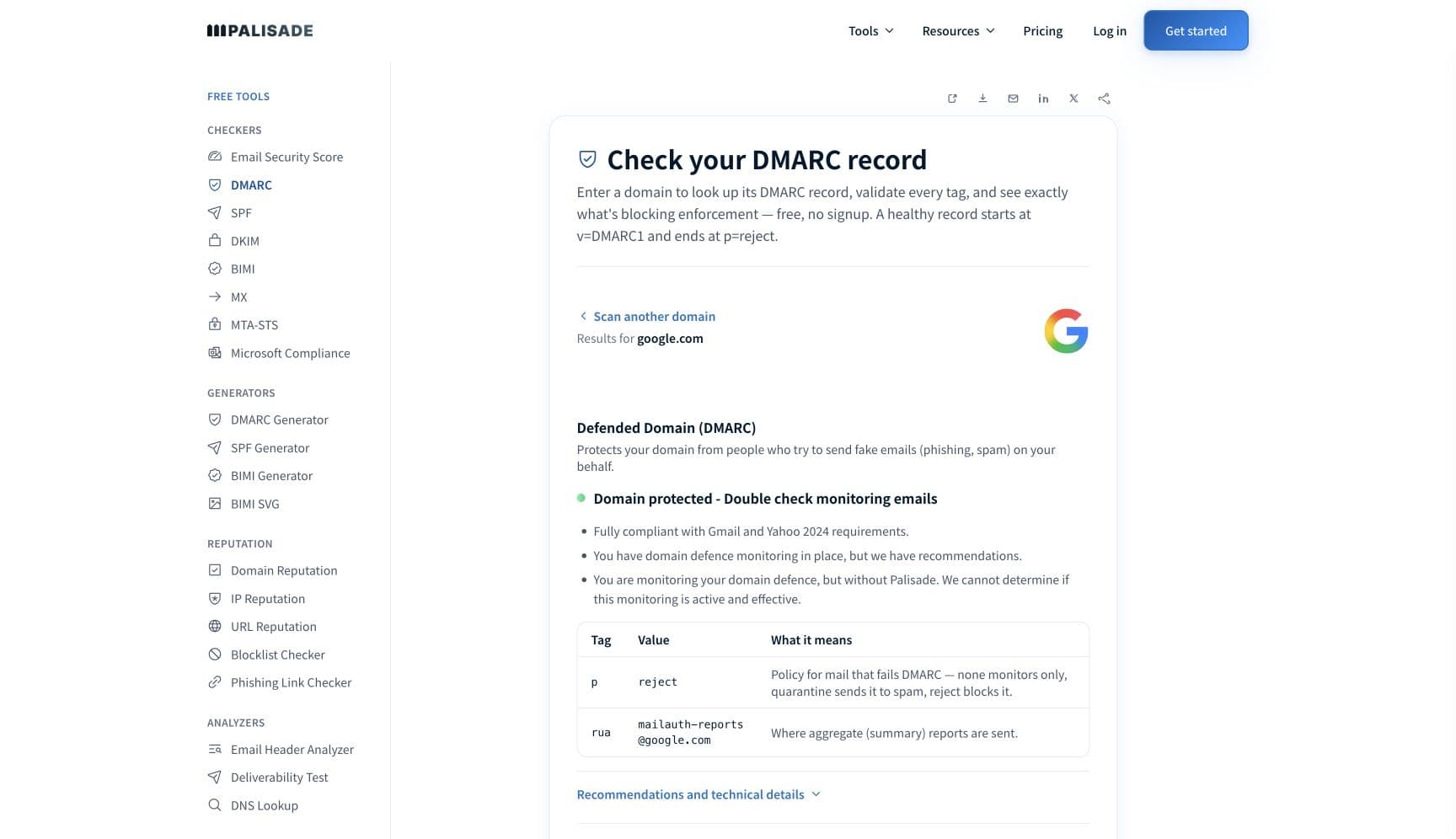
There is no AOL-specific record to publish, so check the domain in your From address against Yahoo's requirements. Yahoo asks every sender for SPF or DKIM at a minimum, and asks bulk senders for both plus a DMARC policy of at least p=none that passes, with the From domain aligned. The free DMARC checker reads all three records in about thirty seconds.
Check your domain now
Enter your sending domain and the check runs instantly on the next page. Free, no signup.
Why AOL is blocking your email
| Likely cause | What's happening |
|---|---|
| Your domain does not meet Yahoo's sender requirements | Yahoo's published floor for every sender is to "Implement SPF or DKIM at a minimum", with valid forward and reverse DNS for sending IPs and compliance with RFCs 5321 and 5322. Bulk senders must "Implement both SPF & DKIM", "Publish a valid DMARC policy with at least p=none - DMARC must pass", and sign with a minimum 1024-bit DKIM key. Yahoo says the requirements apply to "all domains and consumer email brands hosted by Yahoo Mail", and its own sender support handles AOL mailboxes. |
| Your spam complaint rate is above 0.3% | Yahoo publishes the number plainly: "Keep your spam rate below 0.3%", and adds that "Spam rate is calculated in our system based on mail delivered to the inbox". Its FAQ says "Our system continuously evaluates mail, and we may defer mail from domains with a high complaint rate", which is why a complaint problem usually shows up first as slow delivery to aol.com rather than an outright refusal. |
| A stale AOL segment on your list | In our experience AOL addresses are among the oldest entries in a list, which makes them the ones most likely to be abandoned, recycled, or unknown by now; Yahoo publishes nothing on this. Yahoo names invalid recipients among its permanent-rejection causes, and lists excessive unknown recipients and excessive unsolicited messages among its documented errors, so a list segment nobody has cleaned in years produces exactly the pattern that turns into a block. |
| Unusual volume or traffic patterns from your sending IP | Yahoo documents its 421 and 451 responses as temporary problems driven by unusual traffic patterns, spam characteristics, user complaints, suspicious behaviour, and temporary authentication issues, carrying TS-series markers. A cold IP or a sudden re-engagement campaign aimed at an old AOL segment is the classic trigger. The deferrals lift as clean volume accumulates, or harden into rejections if the pattern continues. |
| Your IP is on Spamhaus, or reverse DNS does not check out | Yahoo names Spamhaus listings among the causes of its 553 and 554 permanent failures, alongside invalid addresses, failed DMARC or DKIM authentication, unacceptable content, and suspicious behaviour. Its baseline requirements also include valid forward and reverse DNS for every sending IP. Neither is something good content compensates for. |
| Content Yahoo classifies as phishing or malware | Yahoo documents a separate PH-series family of content-based blocks covering viruses, phishing, ransomware, malware, and malicious links. Legitimate senders reach it through a compromised account, a link on a domain with a bad history, or a URL shortener, rather than through their own wording. |
| You are waiting on an AOL delist portal that does not exist | This is not a filter, but it is the reason AOL blocks stay unresolved longest. There is no AOL postmaster site, no AOL feedback loop, and no self-service AOL delisting page. postmaster.aol.com redirects to Yahoo's Sender Hub, and Yahoo's contact page offers a single ticket option covering "Problems Delivering Mails to AOL or Yahoo mailboxes". That ticket is the escalation path. |
Check the public signals before changing settings
The free check above gives you a fast public baseline for how AOL sees your mail. It does not replace the provider's private reputation or placement data, but it tells you whether the problem is visible from outside before you edit a sending platform.
How to fix it, step by step
Run the DMARC check on your sending domain
Use the free checker above, or open the DMARC checker page directly. It reads the SPF, DKIM, and DMARC records for the domain in your From address and shows whether alignment can succeed. Since AOL is filtered by Yahoo, this is the same check that decides your yahoo.com delivery, and one fix covers both.
Meet Yahoo's bulk-sender bar even if you think you are small
Yahoo's FAQ says a bulk sender is one sending a significant volume and adds "We will not specify a volume threshold". There is no line to duck under, so treat the bulk bar as the target: SPF and DKIM both passing, a DMARC record of at least p=none that passes, DKIM keys of 1024 bits or more, and the From domain aligned with the SPF or DKIM domain.
Clean the AOL segment before you send to it again
Suppress addresses that have not opened in a year or more, and remove every hard bounce rather than retrying it. Unknown recipients are one of Yahoo's own stated causes for permanent rejection, and an old AOL segment is where they concentrate.
Enroll your signing domain in Yahoo's Complaint Feedback Loop
Create a Sender Hub profile, add and verify your domain, and enroll it. Yahoo then sends an ARF report for each complaint so you can suppress that recipient. Yahoo describes the CFL as a domain-based service and requires outbound mail to be DKIM-signed to enroll, which is one more reason authentication comes first.
Clear the infrastructure items: rDNS, TLS, blocklists
Confirm forward and reverse DNS match on every sending IP and that your mail is RFC 5321 and 5322 compliant. Run the IPs through the blocklist checker and clear any Spamhaus listing, which Yahoo names explicitly among the causes of its permanent rejections.
Publish DMARC and walk it toward enforcement
Yahoo's floor is p=none, but p=none only reports. Collect aggregate reports, authenticate every legitimate sender they surface, then move to quarantine and reject so spoofed mail stops spending the reputation your AOL delivery depends on.
Send a test, then open a Sender Hub ticket if it persists
Mail an aol.com address and confirm spf=pass, dkim=pass, and dmarc=pass in the headers using the email header analyzer. If compliant mail is still refused after a week of clean sending, open a ticket at Yahoo's contact page under "Problems Delivering Mails to AOL or Yahoo mailboxes".
Related free tools: SPF checker · DKIM checker · Blocklist checker · Email header analyzer
If you send in volume: the Yahoo rules that apply to AOL
AOL publishes no requirements of its own. The rules that decide your AOL delivery are Yahoo's, which went into enforcement in February 2024 and cover "all domains and consumer email brands hosted by Yahoo Mail": SPF or DKIM at a minimum for every sender, and for bulk senders both SPF and DKIM passing, "a valid DMARC policy with at least p=none - DMARC must pass", DKIM keys of at least 1024 bits, a spam rate held below 0.3% calculated on mail delivered to the inbox, a functioning list-unsubscribe header supporting one-click unsubscribe, and unsubscribes honored within 2 days. Yahoo deliberately declines to set a volume threshold: its FAQ says a bulk sender is "an email sender sending a significant volume of mail" and that "We will not specify a volume threshold." Non-compliant mail "may be sent to the spam folder or rejected". Yahoo also notes that one-click unsubscribe is required only for promotional and marketing messages, not for transactional mail such as order confirmations and password resets. Yahoo Sender Hub documentation checked 2026-09-02.
Check your standing with AOL
- Yahoo Sender Hub (the AOL postmaster site redirects here)
Yahoo's sender portal, and where postmaster.aol.com sends you. Create a profile, verify your domain, and manage CFL enrollment and other sender features from one place.
- Sender support: AOL and Yahoo delivery problems
The escalation path. The contact page lists "Problems Delivering Mails to AOL or Yahoo mailboxes" as one ticket option, and "Report Abuse from AOL and Yahoo domains" as another. There is no separate AOL delist portal.
- Complaint Feedback Loop (CFL)
Sends an ARF report when a recipient marks your mail as spam so you can suppress them. Yahoo describes it as a domain-based service and requires DKIM-signed outbound mail to enroll.
- Yahoo SMTP error code reference
Yahoo's explanation of its 421 and 451 deferrals and its 553 and 554 rejections, including the TS-series and PH-series families you will see in AOL bounces.
Bounce codes you may be seeing
A block from AOL surfaces as a specific SMTP code. Some lists below also carry codes returned by the systems receiving your mail; each line names its issuer. Match yours below; where a code has a full guide, it is linked.
- 421 4.7.0 with a TS-series marker: the temporary deferral Yahoo returns for unusual traffic patterns, spam characteristics, or user complaints Full guide →
- 553 5.7.1: part of Yahoo's permanent rejection family, returned for an invalid recipient, a failed DMARC or DKIM check, unacceptable content, other suspicious behaviour, or a Spamhaus listing Full guide →
- 554: the same permanent family. Yahoo documents one set of causes for both codes and does not map a cause to a code Full guide →
- PH-series codes: content blocks for viruses, phishing, ransomware, malware, and malicious links. Yahoo does not publish a per-code directory with verbatim strings
The real root cause: unenforced authentication
The most expensive thing about an AOL block is looking for AOL. There is no AOL portal, no AOL allow-list, and no AOL-specific DNS record, so time spent searching for one is time the actual cause keeps running. Under the surface it is the ordinary chain: mail that cannot prove it is yours filters badly, badly filtered mail draws complaints from people who never asked for it, complaints push the rate toward 0.3%, and Yahoo's system defers domains with a high complaint rate before it rejects them. Spoofed mail sits inside that chain and you cannot suppress it, because the Complaint Feedback Loop only reports on DKIM-signed mail that is genuinely yours. Making authentication settled is what breaks the chain: SPF and DKIM correct for every service that sends as your domain, DMARC aligned with the From address, and the policy walked from p=none up to p=reject so impostor mail never reaches an aol.com inbox to be complained about. Monitoring names the senders; enforcement is what makes the block stop and stay stopped, at aol.com and yahoo.com alike.
DMARC software that does the work
Palisade's AI agent takes domains all the way to enforcement: hosted SPF, DKIM, DMARC, and MTA-STS records on paid plans, DMARC reports monitored continuously, and every policy step drafted for your approval on the way to p=reject. The full product is open for a 15-day trial, and nothing is charged until it ends.
15-day full-product trial. Nothing is charged until it ends.
Fixing this across every client domain
A client with an AOL problem usually has a Yahoo problem they have not noticed yet, because the same filters grade both and each client domain is graded on its own records and its own complaint rate. Yahoo publishes no volume threshold, so the smallest client in your book is held to the same bar as the largest. Palisade makes that one workflow instead of fifty: hosted and managed SPF, DKIM, DMARC, and MTA-STS records for every client domain, aggregate reports read so failing senders are named before deferrals start, prioritised tickets when a domain drifts, and a route to p=reject with your team approving each change. Native ConnectWise, HaloPSA, and Autotask integrations put it in your PSA, pricing is per client domain with rates that improve as the portfolio grows, and your own MSP domain is a free NFR domain to prove the process on first.
Questions readers ask
Frequently asked questions
Is AOL email still filtered separately from Yahoo?
Does AOL have its own postmaster site or delist portal?
Do I need separate DNS records for AOL and Yahoo?
What is AOL's spam complaint rate limit?
Does AOL require DMARC?
Why did AOL suddenly start blocking my emails?
Does the Yahoo Complaint Feedback Loop cover AOL complaints?
How long does an AOL block last?
Sources and last verified
Every claim about AOL on this page links to the source it came from, each with the date it was last checked. Provider policies change; if a detail looks off, the linked source is authoritative.
- RFC 5321, Simple Mail Transfer Protocol, is the IETF specification behind the "comply with RFCs 5321 and 5322" line in Yahoo's sender requirements: it specifies "the basic protocol for Internet electronic mail transport"www.rfc-editor.org · checked 2026-09-02
- RFC 5322, Internet Message Format, is the other specification that line names: it defines "a syntax for text messages that are sent between computer users, within the framework of electronic mail messages"www.rfc-editor.org · checked 2026-09-02
- postmaster.aol.com returns HTTP 301 Moved Permanently to https://senders.yahooinc.com/, confirming AOL's postmaster channel is Yahoo's Sender Hub (verified by HTTP request)postmaster.aol.com · checked 2026-09-02
- Yahoo sender support routes AOL through the same channel as Yahoo: the contact page lists "Problems Delivering Mails to AOL or Yahoo mailboxes" and "Report Abuse from AOL and Yahoo domains" as ticket options, and publishes no separate AOL delist portalsenders.yahooinc.com · checked 2026-09-02
- Yahoo sender requirements: all senders "Implement SPF or DKIM at a minimum", "Keep your spam rate below 0.3%", "Have a valid forward and reverse DNS record for your sending IPs", "Comply with RFCs 5321 and 5322"; bulk senders "Implement both SPF & DKIM", "Publish a valid DMARC policy with at least p=none - DMARC must pass", "Authenticate every email with DKIM with a minimum 1024-bit key length", "Implement a functioning list-unsubscribe header, which supports one-click unsubscribe" and "Honor unsubscribes within 2 days"; "Spam rate is calculated in our system based on mail delivered to the inbox"senders.yahooinc.com · checked 2026-09-02
- Yahoo FAQ: "These requirements apply for all domains and consumer email brands hosted by Yahoo Mail"; "A 'bulk' sender is classified as an email sender sending a significant volume of mail. We will not specify a volume threshold"; "Our system continuously evaluates mail, and we may defer mail from domains with a high complaint rate"; "If you do not meet the requirements, your mail may be sent to the spam folder or rejected"; one-click unsubscribe is required only for promotional and marketing messages and does not apply to transactional messages such as order confirmations and password resetssenders.yahooinc.com · checked 2026-09-02
- Yahoo SMTP error documentation: 421 and 451 indicate a temporary problem caused by unusual traffic patterns, spam characteristics, user complaints, suspicious behaviour, or temporary authentication issues (TS-series); 553 and 554 indicate a permanent problem including invalid addresses, failed DMARC or DKIM authentication, unacceptable content, suspicious behaviour, and Spamhaus listings; PH-series codes cover content blocks for viruses, phishing, ransomware, malware, and malicious links; no per-code directory with verbatim strings is publishedsenders.yahooinc.com · checked 2026-09-02
- Complaint Feedback Loop: "The Complaint Feedback Loop program...is a domain based service"; "In order to enroll in the CFL, senders must sign their outbound email with DKIM, so that Yahoo can determine the actual sender"; Yahoo sends the enrolled address an ARF report so the sender can suppress that recipient. The CFL page does not mention AOLsenders.yahooinc.com · checked 2026-09-02
Related guides
421 4.7.0553 5.7.1554 5.7.1p=nonep=rejectadkim / aspf