Provider deliverability · AT&T Mail (att.net, sbcglobal.net, bellsouth.net, on Yahoo)
Why is AT&T blocking my emails?

By Samuel Chenard · CEO & Co-Founder, Palisade · Reviewed September 15, 2026
AT&T blocking your emails is almost always Yahoo blocking them: AT&T Mail (att.net, sbcglobal.net, bellsouth.net and nine sibling domains) is hosted by Yahoo, so the mailbox filter is Yahoo's and it rejects failed SPF, DKIM, or DMARC, a complaint rate over 0.3%, or a bad sending IP. Separately, AT&T keeps its own network block list, reached at abuse_rbl@abuse-att.net.
The 30-second check
Work out which of the two filters you hit. A rejection from Yahoo's servers means the domain in your From header failed Yahoo's requirements: SPF or DKIM at a minimum, both plus a passing DMARC policy for bulk senders, with the From domain aligned. A connection that AT&T's network refuses outright is AT&T's own block list. The free checker below reads SPF, DKIM and DMARC for your domain in about thirty seconds, which settles the first case.
Check your domain now
Enter your sending domain and the check runs instantly on the next page. Free, no signup.
Why AT&T Mail is blocking your email
| Likely cause | What's happening |
|---|---|
| The domain fails SPF, DKIM or DMARC under Yahoo's requirements | Yahoo's requirements apply "for all domains and consumer email brands hosted by Yahoo Mail", and AT&T Mail is one of them. Every sender must "Implement SPF or DKIM at a minimum"; bulk senders must "Implement both SPF & DKIM", "Publish a valid DMARC policy with at least p=none" that passes, and align the From domain with the SPF or DKIM domain. |
| AT&T's own block list refused the connection | AT&T keeps a network-level list separate from Yahoo's filtering. Its postmaster page says "Our security measures can sometimes misread and block legitimate messages. Contact us about our email block list for help", and the contact it publishes is abuse_rbl@abuse-att.net. AT&T's guidelines add that it will block, and "may take legal action" over, mass messages sent to discover accounts. |
| A dynamic, shared or frequently changing sending IP | AT&T's best practices say "Send email using your ISP's mail servers. If you use dial-up or other dynamic IP addresses, your email might not work" and "Don't send email from an IP address where the sender changes often". Yahoo adds the requirement for "a valid forward and reverse DNS record for your sending IPs" with non-generic PTR names. |
| The IP is on a public RBL | AT&T's guideline is blunt: "Remove your IP address from any Real-time Blackhole Lists (RBLs). If you're on one, contact the list's manager." Yahoo names Spamhaus among the reasons for a permanent 553 or 554. A listing therefore trips both filters at once. |
| Your own DMARC policy told Yahoo to reject | Yahoo states that with a DMARC policy of p=reject, "any message without a proper DKIM signature or SPF alignment will be rejected by Yahoo's mail servers". A legitimate sending service that fails alignment while your domain is at reject bounces at att.net by your own instruction. |
| Spam complaints from AT&T subscribers are above 0.3% | Yahoo's rule is "Keep your spam rate below 0.3%", and it "may defer mail from domains with a high complaint rate". AT&T Yahoo Mail gives subscribers a one-click Block Senders and a spam button, and those complaints count in the same pool as yahoo.com and aol.com users. |
| Bursts, inaccurate headers or no one-click unsubscribe | AT&T asks senders to "Avoid sending multiple emails at one time" and to "Use accurate header info", checked by viewing the raw source of a sent message. Yahoo requires a functioning List-Unsubscribe header supporting one-click unsubscribe on promotional mail, preferably per RFC 8058 and honoured within two days; Yahoo says a link in the body alone does not meet the requirement. |
Check the public signals before changing settings
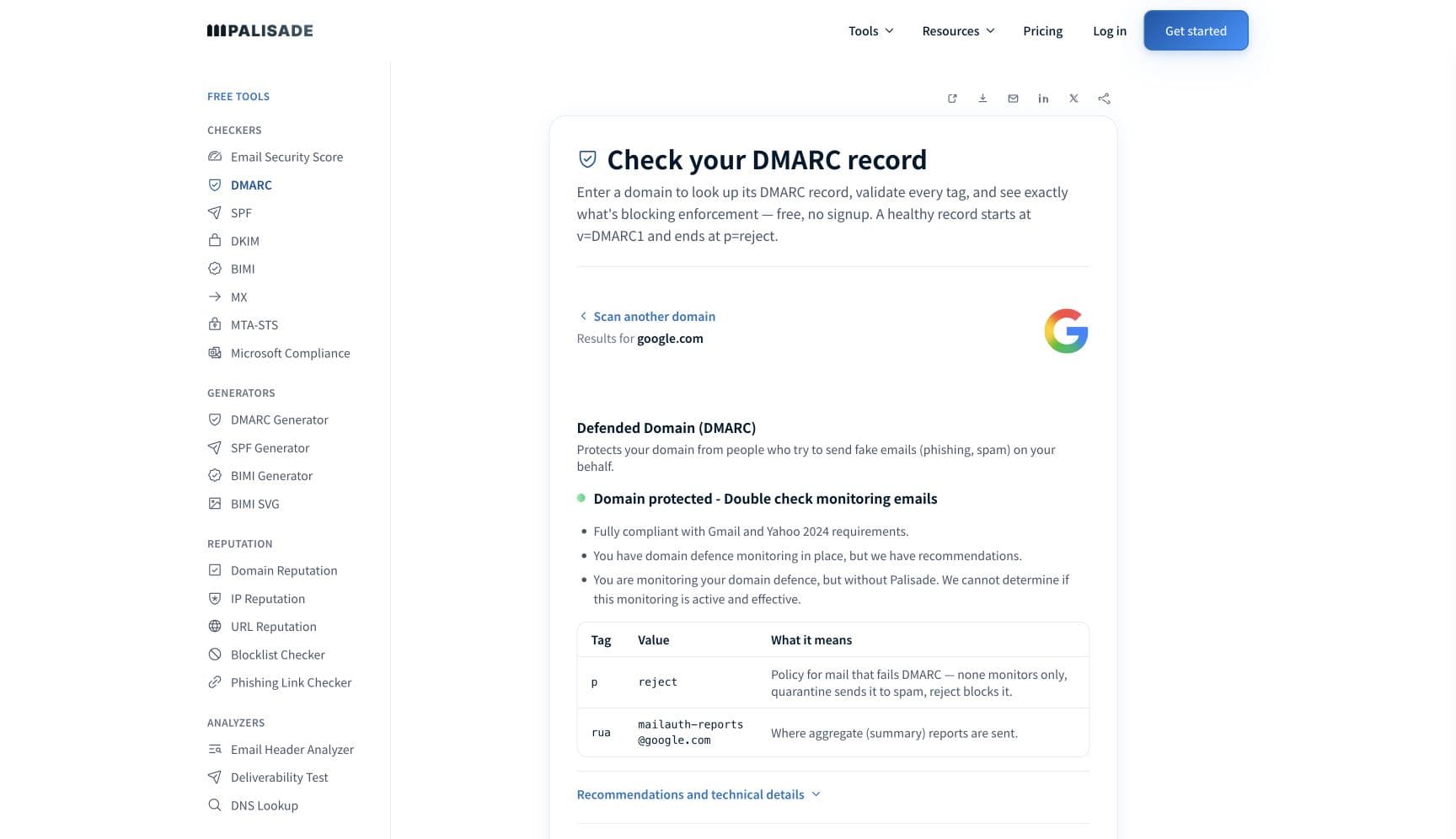
Check your DMARC record gives you a fast public-DNS baseline. It does not replace the provider's private reputation or placement data, but it tells you whether an authentication problem is visible before you edit a sending platform.
How to fix it, step by step
Check SPF, DKIM and DMARC on the domain in your From header
Use the free checker above (or at /tools/dmarc). Yahoo judges the From domain, so confirm SPF names every service that sends as it, DKIM verifies on your own domain, and a DMARC record exists and passes. This clears the most common cause before you write to anyone.
Decide whether the block is Yahoo's or AT&T's
A 553 or 554 from Yahoo's servers naming an address, a DMARC or DKIM policy or a listing is Yahoo. A TS-coded 421 or 451 is a Yahoo deferral for complaints or unusual traffic. A connection refused at the network edge with no Yahoo text is AT&T's own list. Read the exact error before choosing an escalation path.
Fix the sending IP: static, reverse DNS, off every RBL
Send from a fixed IP whose PTR names your mail hostname and resolves back, and run /tools/ip-reputation and /tools/blocklist-checker. AT&T tells senders to get off RBLs by contacting the list manager; do that before contacting AT&T, or the block returns.
Sign with DKIM on your own domain and align it
Publish the DKIM selector for every service that sends as your domain and confirm the
d=tag is your From domain or a parent. Verify at /tools/dkim. Yahoo's complaint feedback loop is keyed to the DKIM domain, so this step also unlocks complaint data from AT&T subscribers.Add one-click unsubscribe and honour it in two days
Publish a List-Unsubscribe header that supports one-click unsubscribe, preferably the RFC 8058 Post method with an HTTPS URI and a List-Unsubscribe-Post header, DKIM-sign both, and process requests within two days. Yahoo requires it on promotional and subscribed mail, not on transactional.
Smooth out volume and clean the headers
Throttle sends rather than bursting, and check the raw source of a sent message for accurate From, Return-Path and Message-ID headers, as AT&T's guidelines ask. Both AT&T and Yahoo treat bursts to unknown addresses as probing.
Escalate to the right desk with the exact error
For AT&T's own block list, email abuse_rbl@abuse-att.net with the sending IP, the recipient domain, and the exact error and time. For a Yahoo rejection or deferral, use Yahoo's Sender Hub contact form. Neither publishes a self-service delist portal.
Related free tools: IP reputation and reverse DNS · Blocklist checker · SPF checker · DKIM checker
If you send in volume: AT&T Mail's published rules
AT&T publishes a short best-practices list rather than bulk-sender requirements: follow the relevant RFCs, comply with the CAN-SPAM Act of 2003, send from your ISP's mail servers rather than dynamic IPs, avoid sending multiple emails at one time, remove your IP from any RBL, do not send from an IP where the sender changes often, use accurate header information, and never send mass messages to discover accounts. Yahoo's bulk rules apply on top, because AT&T Mail is hosted by Yahoo: SPF and DKIM both, a DMARC policy of at least p=none that passes with the From domain aligned, a spam complaint rate below 0.3%, a List-Unsubscribe header supporting one-click unsubscribe on promotional mail, preferably per RFC 8058, honoured within two days, and valid forward and reverse DNS on every sending IP. Yahoo will not specify a volume threshold. Checked 2026-09-15.
Check your standing with AT&T Mail
- AT&T Mail postmaster help
AT&T's postmaster page for providers: links to its best practices, DKIM domains, fraud resources, and the block-list contact abuse_rbl@abuse-att.net. There is no form; it is an email address.
- AT&T email best practices
AT&T's eight-point sender guideline. It is about IPs, RBLs and headers, and says nothing about authentication; Yahoo's requirements cover that.
- AT&T digital signatures (DKIM)
AT&T's list of the twelve domains it signs, and its description of subscriber mail sent through Yahoo. Read with the Yahoo-hosted help centre, it is the first-party evidence of who runs the filter.
- Help for AT&T Yahoo Mail
The subscriber help centre, hosted by Yahoo. Useful for seeing exactly how an AT&T recipient blocks a sender or reports spam.
- Yahoo Sender Hub: best practices
The requirements that decide whether mail to att.net and its sibling domains is accepted.
- Yahoo Sender Hub: contact
The delivery-problem ticket for Yahoo-hosted mailboxes, AT&T's included.
Bounce codes you may be seeing
Blocks in this cluster surface as specific SMTP codes. Match yours below; the linked guides cover each code's verbatim provider messages and full fix.
- 553 or 554 permanent rejections from Yahoo's servers: an invalid address, a failure against the sending domain's DMARC or DKIM policy, or a Spamhaus listing Full guide →
- 421 or 451 with a TS code: a temporary Yahoo deferral for unusual traffic, spam characteristics or user complaints Full guide →
- A connection refused at AT&T's network edge with no Yahoo text: AT&T's own block list; the published contact is abuse_rbl@abuse-att.net
The real root cause: unenforced authentication
AT&T is two filters wearing one name, and the split is instructive. The part AT&T still runs itself is about pipes: static IPs, clean RBL records, no bursts. Fix it once and it stays fixed. The part it handed to Yahoo is about identity, and it asks the same question every large mailbox provider now asks: can the domain in the From header prove that this message is its own. That question is answered by SPF, DKIM and DMARC alignment across every service that sends as your domain, not by anything you can say to a postmaster. DMARC aggregate reports show you each sender and which check it fails. Authenticate and align them, then move the policy from p=none to p=reject so that mail which cannot prove it is yours is refused everywhere, and att.net, sbcglobal.net and bellsouth.net stop being a special case.
DMARC software that does the work
Palisade's AI agent takes domains all the way to enforcement: hosted SPF, DKIM, DMARC, and MTA-STS records on paid plans, DMARC reports monitored continuously, and every policy step drafted for your approval on the way to p=reject. The Free plan covers one domain and up to 1,000 emails per month, and the agent names every problem it finds there; applying the agent's fixes needs a paid plan, and the full product is open for a 15-day trial.
1 domain free up to 1,000 emails/month
Fixing this across every client domain
AT&T's legacy domains are everywhere in the southern and western United States, and a client list with a few thousand sbcglobal.net and bellsouth.net addresses is now judged by Yahoo's filter without anyone having changed a setting. Palisade makes the response one workflow across every client domain: hosted and managed SPF, DKIM, DMARC, and MTA-STS records, aggregate reports read so each unauthenticated sending service is named rather than guessed at, and a path to p=reject with your team approving every change. Native ConnectWise, HaloPSA, and Autotask integrations put it in your PSA, pricing is per client domain with rates that improve as the portfolio grows, and your own MSP domain is a free NFR domain to prove the process on first.
Questions readers ask
Frequently asked questions
Is AT&T email the same as Yahoo?
AT&T Mail is delivered by Yahoo. AT&T's DKIM page describes subscriber mail sent through Yahoo!, its help centre is "Help for AT&T Yahoo Mail" at help.yahoo.com, and Yahoo's sender requirements apply to every consumer brand Yahoo hosts. AT&T separately keeps a network block list of its own, with its own contact.
Which domains does AT&T Mail cover?
AT&T Mail covers twelve domains, as AT&T lists them: currently.com, ameritech.net, att.net, bellsouth.net, flash.net, nvbell.net, pacbell.net, prodigy.net, sbcglobal.net, snet.net, swbell.net and wans.net. Mail from all of them carries an AT&T DKIM signature, and mail to all of them is filtered the same way.
How do I contact the AT&T postmaster about a block?
AT&T's postmaster page says "Contact us about our email block list" and links the address abuse_rbl@abuse-att.net. That desk handles AT&T's own network list. A rejection that carries Yahoo's error text is Yahoo's decision and goes to the Sender Hub contact form instead.
Does AT&T require SPF, DKIM and DMARC?
AT&T's own guidelines do not mention them, but Yahoo's requirements apply to AT&T Mail: SPF or DKIM from every sender, both plus a passing DMARC policy from bulk senders, and From-domain alignment. Yahoo rejects mail that fails a domain's own DMARC reject policy.
What does AT&T say about dynamic IP addresses?
"Send email using your ISP's mail servers. If you use dial-up or other dynamic IP addresses, your email might not work." AT&T also says not to send from an IP where the sender changes often. A fixed IP with a reverse DNS name that reflects your domain satisfies both AT&T and Yahoo.
Does AT&T have a feedback loop?
Not its own. Yahoo's Complaint Feedback Loop sends ARF reports for every domain Yahoo hosts, so enrolling your DKIM domain on Yahoo's Sender Hub delivers complaints from AT&T subscribers along with those from Yahoo and AOL users. AT&T's postmaster page links no feedback loop of its own.
Does AT&T publish a volume threshold for bulk senders?
No. AT&T's eight-point best-practices list sets no volume figure, and Yahoo, whose rules apply to AT&T Mail, says "We will not specify a volume threshold" and defines a bulk sender as one sending a significant volume of mail. Treat any regular sending to att.net addresses as bulk and meet the bulk requirements.
What spam complaint rate applies to att.net mail?
Yahoo's: "Keep your spam rate below 0.3%", evaluated continuously across all Yahoo-hosted mailboxes, with deferrals for domains that run high. Complaints from att.net, sbcglobal.net and bellsouth.net users count in the same pool as yahoo.com and aol.com complaints. AT&T's own guidelines publish no separate figure.
Sources and last verified
Every AT&T Mail fact on this page is drawn from that provider's own documentation, last checked 2026-09-15. Provider policies change; if a detail looks off, the linked source is authoritative.
- AT&T Mail postmaster help: the page for postmasters and providers links "Read our email best practices", "Find out about digital signatures (DKIM)" and "Contact us about our email block list", the last resolving to abuse_rbl@abuse-att.net; FAQ: "Our security measures can sometimes misread and block legitimate messages. Contact us about our email block list for help"; after an error emailing an AT&T customer, "Read the error message for more info. Think your email was blocked? Contact us about our email block list"; page last updated March 24, 2025www.att.com · checked 2026-09-15
- AT&T email best practices (last updated December 7, 2022): "Follow any relevant Requests for Comments (RFCs)"; verify compliance with the Federal Can Spam Act of 2003; "Send email using your ISP's mail servers. If you use dial-up or other dynamic IP addresses, your email might not work"; "Avoid sending multiple emails at one time"; "Remove your IP address from any Real-time Blackhole Lists (RBLs). If you're on one, contact the list's manager"; "Don't send email from an IP address where the sender changes often"; "Use accurate header info. Check the header details by viewing the raw source code of a sent message"; "Don't try to find email accounts by sending mass messages to spam our server. We'll block these emails and may take legal action"www.att.com · checked 2026-09-15
- AT&T digital signatures (DKIM) (last updated January 18, 2023): "Emails you send through Yahoo! or other servers have an AT&T digital signature"; "Emails you send through Yahoo!® will have s=s1024 in the DKIM signature"; the signed domains are currently.com, ameritech.net, att.net, bellsouth.net, flash.net, nvbell.net, pacbell.net, prodigy.net, sbcglobal.net, snet.net, swbell.net and wans.netwww.att.com · checked 2026-09-15
- The AT&T Mail subscriber help centre is titled "Help for AT&T Yahoo Mail" and is hosted at help.yahoo.com, with articles on blocking senders and marking spam in AT&T Yahoo Mailhelp.yahoo.com · checked 2026-09-15
- Yahoo sender requirements: all senders "Implement SPF or DKIM at a minimum"; bulk senders "Implement both SPF & DKIM", "Publish a valid DMARC policy with at least p=none - DMARC must pass" and align the From domain with the SPF or DKIM domain; "Keep your spam rate below 0.3%"; a functioning List-Unsubscribe header with one-click unsubscribe honoured within 2 days; "Have a valid forward and reverse DNS record for your sending IPs" with non-generic PTR namessenders.yahooinc.com · checked 2026-09-15
- Yahoo FAQ: the requirements "apply for all domains and consumer email brands hosted by Yahoo Mail"; "We will not specify a volume threshold"; "we may defer mail from domains with a high complaint rate"; an unsubscribe link in the body alone is not sufficient and the List-Unsubscribe header is required on promotional mail; with a p=reject DMARC policy "any message without a proper DKIM signature or SPF alignment will be rejected by Yahoo's mail servers"senders.yahooinc.com · checked 2026-09-15
- Yahoo SMTP error codes: 553 and 554 are permanent, including an invalid address and a failure "against your sending domain's DMARC or DKIM policy"; TS-series errors are temporary deferrals caused among other things by substantial complaints from Yahoo userssenders.yahooinc.com · checked 2026-09-15
- Yahoo Sender Hub contact: the delivery-problems ticket for mailboxes Yahoo hosts; no self-service delist portal is publishedsenders.yahooinc.com · checked 2026-09-15
- RFC 8058, Signaling One-Click Functionality for List Email Headers, is the one-click unsubscribe standard Yahoo's requirements point at: List-Unsubscribe carries one HTTPS URI and List-Unsubscribe-Post carries "List-Unsubscribe=One-Click", with a DKIM signature covering both header fieldswww.rfc-editor.org · checked 2026-09-15
Related guides
554 5.7.1421 4.7.0550 5.1.1p=rejectd=ptr