Email deliverability Q&A
Why are my newsletters going to spam?

By Samuel Chenard · CEO & Co-Founder, Palisade · Reviewed July 20, 2026
Newsletters go to spam for one of four reasons: failing authentication, a missing one-click unsubscribe, a spam-complaint rate past Google's 0.30% ceiling, or collapsing engagement. Since February 2024, Gmail and Yahoo enforce SPF, DKIM, and aligned DMARC on bulk senders, so one misconfigured newsletter subdomain can junk the entire list at once.
| At a glance | |
|---|---|
| Authentication | Gmail and Yahoo require SPF, DKIM, and DMARC for bulk senders; the From domain must align |
| Spam-rate ceiling | Below 0.30% in Google Postmaster Tools (aim under 0.10%); Yahoo states the same 0.3% figure |
| Unsubscribe | One-click unsubscribe (RFC 8058) required for marketing mail; Yahoo requires honoring within 2 days |
| Bulk threshold | Gmail: 5,000+ messages/day to Gmail accounts. Yahoo: declines to publish a number. |
| Blast radius | Filtering is per sending domain and IP, so one bad campaign drags the next one down |
| Who fixes it | The sender. DNS, headers, and list practice are all on your side. |
Newsletter filtering stopped being mysterious in February 2024. Gmail published hard requirements for anyone sending 5,000 or more messages a day to Gmail accounts, Yahoo shipped a matching set, and both now enforce them at delivery time. A newsletter that misses any one of them (authentication, one-click unsubscribe, spam rate) gets junked or rejected regardless of how good the content is.
That changes how you diagnose. Before 2024, spam placement was mostly a reputation story you influenced slowly. Now the first question is binary: does your newsletter pass SPF, DKIM, and DMARC with the From domain aligned, and does it carry the RFC 8058 unsubscribe headers? If no, nothing else you tune matters. If yes, you are back in the classic territory of complaint rates and engagement, and those have published numbers too.
This page is platform-agnostic: the requirements attach to your sending domain, not to whichever ESP pushes the button. The one structural detail newsletters add is the subdomain. Most ESPs send your newsletter from something like news.yourdomain.com, and authentication has to be correct on that subdomain specifically, which is exactly where default ESP setups quietly fail.
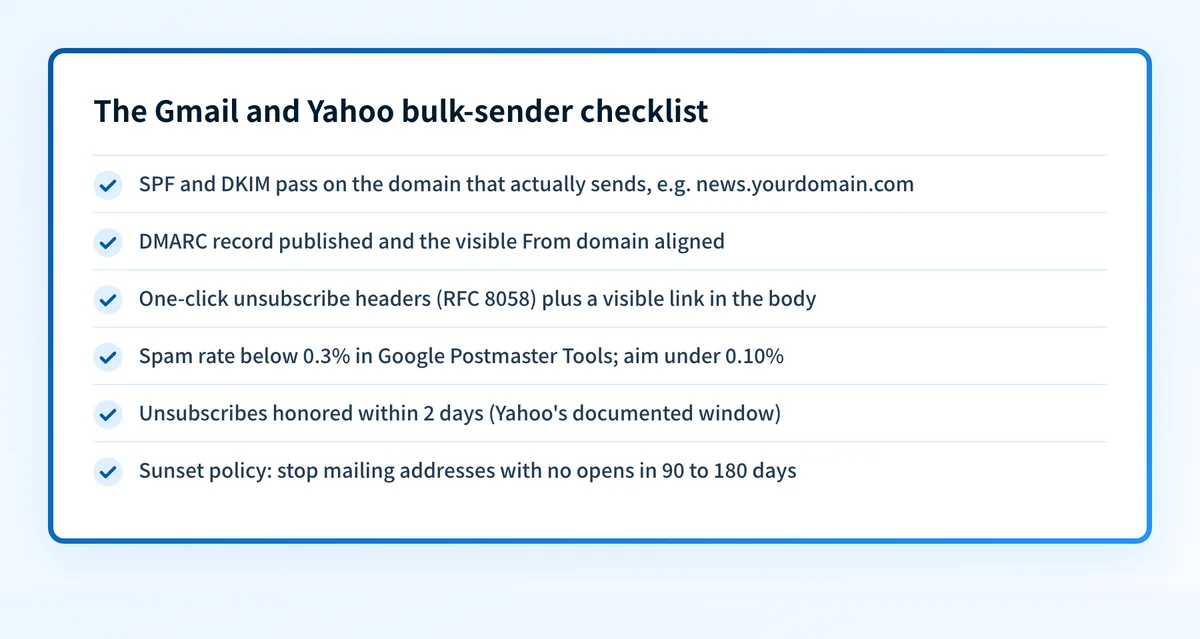
What Gmail and Yahoo actually require from newsletter senders
| Requirement | Gmail (5,000+ msgs/day) | Yahoo (bulk senders) |
|---|---|---|
| Authentication | SPF, DKIM, and a DMARC policy (p=none minimum) on the sending domain | SPF and DKIM, plus DMARC at p=none or stronger |
| Alignment | From: domain must align with the SPF or DKIM domain to pass DMARC | DMARC must pass with the From domain aligned to SPF or DKIM |
| Unsubscribe | Marketing and subscribed messages must support one-click unsubscribe with a visible link in the body | Functioning list-unsubscribe supporting one-click; unsubscribes honored within 2 days |
| Spam rate | Below 0.30% in Postmaster Tools; Google recommends staying under 0.10% | Below 0.3%, calculated on mail delivered to the inbox |
| Bulk threshold | 5,000 or more messages per day to Gmail accounts | Not published: Yahoo classifies bulk as a significant volume and states it will not specify a threshold |
Both requirement sets were checked against Google's and Yahoo's own sender documentation on 2026-07-20; links in Sources below. The thresholds are floors for delivery, not targets: a sender sitting at 0.29% complaints is not safe, just not yet blocked.
Authenticate the newsletter subdomain, not just the root
Newsletters usually leave from a delegated subdomain (news., mail., em.) so the marketing stream carries its own reputation. The catch is that SPF and DKIM have to pass for the domains actually used on the wire, and align with the From address your readers see. SPF is evaluated against the bounce (Return-Path) domain, which many ESPs keep on their own infrastructure by default; DKIM alignment depends on the d= domain in the signature matching yours.
The classic failure looks like this: the ESP signs with its own domain, SPF passes for the ESP's bounce domain, and neither aligns with yourdomain.com in the From header. Every check on the ESP dashboard shows green, and DMARC still fails. The fix is completing the ESP's custom domain authentication so DKIM signs as your domain (or your newsletter subdomain), and pointing the required CNAME or TXT records at DNS you actually control.
One more subdomain trap: DMARC policy inheritance. If your organizational domain publishes a DMARC record and the subdomain has none, the subdomain inherits it (including any sp= subdomain policy). Moving the root to enforcement while the newsletter subdomain still fails alignment turns a spam-folder problem into outright rejection. Check the subdomain's effective policy before the root tightens.
The complaint-rate math, in real numbers
Google's ceiling is a spam rate below 0.30% in Postmaster Tools, with a recommendation to stay under 0.10%. In list terms: 3 complaints per 1,000 messages that Gmail users receive is the edge of the cliff, and 1 per 1,000 is where Google wants you. Yahoo publishes the same 0.3% figure, measured on mail delivered to the inbox. These are small numbers; one stale segment or one re-mailed old list can clear them in a single send.
You cannot manage what you cannot see, and complaint data lives with the providers, not your ESP. Postmaster Tools reports your Gmail spam rate per domain; Yahoo offers a complaint feedback loop. If your newsletter domain is not registered in Postmaster Tools yet, that is the first ten minutes of any diagnosis, because it tells you whether you have an authentication problem, a complaint problem, or both.
Engagement is the quieter half of the same signal. Mailbox providers watch what recipients do with your mail, and a list full of addresses that never open is indistinguishable from a scraped one. The practical countermeasure is a sunset policy: stop mailing addresses that have not engaged in some defined window, and win them back through a separate, smaller stream if at all. Shrinking the list this way reliably improves placement for everyone left.
One-click unsubscribe is a deliverability feature
RFC 8058 defines the mechanism both providers now require: a List-Unsubscribe header carrying an HTTPS URL plus a List-Unsubscribe-Post: List-Unsubscribe=One-Click header, so the mailbox provider can unsubscribe a reader with a single tap from the inbox UI. The POST design exists because security software fetches every link in mail headers automatically; a plain GET unsubscribe link would get triggered by scanners, so the standard requires an explicit POST to count as intent.
Treat the unsubscribe path as complaint prevention. A reader who cannot leave in one click leaves via the spam button instead, and that report counts against the 0.30% ceiling forever. Making unsubscribe effortless is how you keep complaints down; hiding it is how newsletters with clean lists still end up filtered. Most established ESPs emit the RFC 8058 headers once configured; verify by inspecting the raw headers of a real delivered message, not the ESP's marketing page.
Newsletter spam-placement triage
| Symptom | Likely cause | The fix |
|---|---|---|
| Whole list flipped to spam at once | Authentication requirement not met: SPF, DKIM, or DMARC failing or unaligned on the newsletter subdomain | Complete the ESP's custom domain authentication, confirm alignment, re-test before the next send |
| Spam placement in Gmail only | Spam rate drifting toward 0.30% in Postmaster Tools | Register the domain in Postmaster Tools, cut the segments generating complaints, target under 0.10% |
| Mail rejected outright, bounces cite 550 5.7.26 | Gmail refusing unauthenticated bulk mail at the door | Fix authentication first; the code has a dedicated walkthrough in the SMTP error-code reference |
| Yahoo filtering while Gmail delivers | Complaint rate or missing one-click unsubscribe; Yahoo enforces the 2-day honoring window | Verify RFC 8058 headers in raw delivered mail and confirm unsubscribes suppress within 2 days |
| Placement decayed gradually over months | Engagement collapse: a growing share of the list never opens | Apply a sunset policy, mail engaged segments first, rebuild frequency around actual interest |
| New ESP or new subdomain, immediate spam placement | No sending history: cold domain and IP reputation | Warm up gradually, starting with your most engaged readers, before mailing the full list |
For any specific code in a bounce message, match it in the SMTP error-code reference at /learning/smtp-error-codes: verbatim provider strings, ranked causes, and the step-by-step fix per code.
How to fix it
Test the domain your newsletter actually sends from
Run the newsletter From domain (the subdomain, if you use one) through the free email security score below. It checks SPF, DKIM, DMARC, and blocklist status in one pass, so you know immediately whether you are failing the 2024 requirements or fighting a reputation problem.
Run the check now
Enter your sending domain and the check runs instantly on the next page. Free, no signup.
Align SPF and DKIM with the visible From domain
Complete your ESP's custom authentication so DKIM signs with your domain and alignment passes. Green checks on the ESP dashboard are not the test; a DMARC pass with your From domain is. The free checkers at /tools/spf and /tools/dkim validate each record as you publish it.
Ship RFC 8058 one-click unsubscribe headers
Confirm real delivered messages carry
List-Unsubscribewith an HTTPS URL andList-Unsubscribe-Post: List-Unsubscribe=One-Click, plus a visible unsubscribe link in the body. Suppress unsubscribes fast; Yahoo's documented window is 2 days.Register in Google Postmaster Tools and watch the spam rate
Postmaster Tools is the only place Google reports your Gmail spam rate. Keep it under 0.10% and treat 0.30% as the cliff edge, because that is where Google's requirement sits.
Sunset the unengaged before they sink the engaged
Stop mailing addresses with no opens or clicks in your chosen window (90 to 180 days is common practice). A smaller list that wants your mail outperforms a big one that reports it.
Keep DMARC aggregate reports flowing
Aggregate reports show every source sending as your domain and whether it authenticates, so the next ESP migration or forgotten tool surfaces in a report instead of a spam-placement surprise.
Related free tools: DMARC checker · SPF checker · DKIM checker
The durable fix is enforcement, not another warm-up
List hygiene and unsubscribe headers handle the behavioral half, but the authentication half only stays fixed if SPF, DKIM, and DMARC stay correct as ESPs, subdomains, and tools change. Monitoring shows you the failure after a campaign already landed in spam; it does not stop the next one.
The end state worth reaching is DMARC at p=reject with every legitimate sender authenticated and aligned, newsletter subdomain included. Receivers drop spoofed mail, your own campaigns stop tripping authentication filters, and inbox placement goes back to reflecting what you send rather than how your DNS is configured.
DMARC software that does the work
Palisade's AI agent carries every domain to p=reject, with you approving each step. The agent's fixes and hosted SPF, DKIM and DMARC records are part of the full product, which you can try before any charge.
Audit any domain free, no card needed. A card starts the 15-day trial.
Why it matters for MSPs
When Gmail or Yahoo tightens enforcement, it hits every un-authenticated client domain in your book the same week, and the tickets all read the same: the newsletter stopped landing. Audit marketing subdomains across the portfolio, not just root domains, because ESP-delegated subdomains are where alignment silently fails. Palisade hosts and manages SPF, DKIM, and DMARC records per client domain, watches the aggregate reports continuously, and carries each domain to p=reject (each step approved by your team), with ConnectWise, HaloPSA, and Autotask integrations so the alert lands in your PSA. Your own MSP domain is a free NFR domain to prove the workflow on before you roll it out to clients.
Questions readers ask
Frequently asked questions
Does one-click unsubscribe shrink my list too fast?
Will fixing authentication get me back in the inbox immediately?
Sources
Every benchmark above was verified against the vendor's own documentation on the date shown.
- Bulk senders (5,000+ messages/day to Gmail accounts) must pass SPF, DKIM, and DMARC with the From domain aligned; 'Keep spam rates reported in Postmaster Tools below 0.30%' and stay under 0.10%. Google email sender guidelines (checked 2026-07-20)
- 'Marketing messages and subscribed messages must support one-click unsubscribe, and include a clearly visible unsubscribe link in the message body'. Google email sender guidelines (checked 2026-07-20)
- Yahoo bulk senders need SPF, DKIM, and DMARC at p=none minimum with alignment; 'Keep your spam rate below 0.3%'; 'Honor unsubscribes within 2 days'. Yahoo Sender Hub best practices (checked 2026-07-20)
- Yahoo declines to define a bulk-sender volume threshold: a bulk sender is one 'sending a significant volume of mail' and Yahoo 'will not specify a volume threshold'. Yahoo Sender Hub FAQ (checked 2026-07-20)
- One-click unsubscribe = List-Unsubscribe HTTPS URL plus List-Unsubscribe-Post: List-Unsubscribe=One-Click, actioned by HTTPS POST so automated link-scanning cannot trigger it. RFC 8058 (IETF) (checked 2026-07-20)