Email deliverability Q&A
Does DMARC affect email marketing?

By Samuel Chenard · CEO & Co-Founder, Palisade · Reviewed July 20, 2026
Yes: DMARC now directly decides whether marketing email reaches the inbox. Google and Microsoft both require it for senders over 5,000 messages a day, so a missing or failing record costs you placement outright. Done properly, it also unlocks BIMI, the verified brand logo shown next to your campaigns in supporting inboxes.
| At a glance | |
|---|---|
| Google requirement | Bulk senders (5,000+/day to Gmail) must publish SPF, DKIM, and DMARC; From domain must align |
| Microsoft requirement | Outlook.com requires SPF, DKIM, and DMARC for 5,000+/day senders; non-compliant mail is junked, then rejected |
| Spam-rate ceiling | Google: keep spam complaints under 0.30%, ideally under 0.10% |
| The upside | BIMI logo display, but only at p=quarantine or p=reject with no legacy pct value below 100 |
| Who owns it | Marketing feels the damage; DNS access sits with IT. The fix is a shared ticket. |
For years, DMARC lived in the security team's backlog while marketing shipped campaigns without thinking about it. That split ended in February 2024, when Google started enforcing authentication requirements for bulk senders, and Microsoft followed for Outlook.com in May 2025. Both now treat DMARC as table stakes for anyone sending 5,000 or more messages a day, which describes nearly every marketing program with a real list.
The mechanics matter less to a marketing leader than the consequences, so here is the short version. DMARC ties the domain your subscribers see in the From line to the domains that actually pass SPF or DKIM checks. When those match, your campaign is authenticated and the mailbox provider can trust it. When they do not match (the common case for teams sending through an ESP they never configured), your mail fails DMARC, and providers increasingly respond by filtering or refusing it.
So the honest answer to the question is yes, on every front that matters: whether your campaigns get delivered at all, how much of your budget dies in the spam folder, and, at full enforcement, how your brand looks in the inbox, because a verified logo through BIMI is only available to domains that finish the job.
What the providers actually mandate
| Provider | Published requirement | Consequence of failing |
|---|---|---|
| Google (Email sender guidelines) | Bulk senders (5,000+/day to Gmail) must set up SPF, DKIM, and DMARC; the From domain must align with the SPF or DKIM domain; spam rate below 0.10%, never reaching 0.30% | Mail rejected or marked as spam |
| Microsoft (Outlook.com postmaster) | Senders over 5,000/day must comply with SPF, DKIM, and DMARC, enforced from May 5, 2025 | Non-compliant mail routed to junk first, with rejection to follow until DNS records are corrected |
| BIMI Group (implementation guide) | Logo display requires DMARC at enforcement on the organizational domain and subdomains: p=quarantine or p=reject, and no pct below 100 | No logo. Monitoring-only (p=none) domains are explicitly not accepted |
Note the asymmetry: Google accepts a DMARC policy of p=none to meet the minimum sending bar, but BIMI does not. Compliance gets you delivered; enforcement gets you the logo. All three sources checked 2026-07-20; links in Sources below.
The deliverability upside: DMARC is now an inbox-placement input
Mailbox providers score senders on identity, and DMARC is how identity is proven. Google's sender guidelines spell out the bulk-sender bar: SPF and DKIM set up, a DMARC record published, and the From domain aligned with whichever of the two passes. Microsoft's Outlook.com postmaster page carries the same trio for 5,000-plus-a-day senders, and is explicit about the penalty path: junk folder now, outright rejection once enforcement tightens.
For a marketing team, that changes the economics of every send. List growth, segmentation, and subject-line testing all optimize the numerator; authentication failures quietly shrink the denominator, because a blocked message never gets the chance to be opened. Teams routinely A/B test button colors while a misaligned DKIM signature costs them a double-digit slice of Gmail delivery.
There is also a compounding effect. Providers build domain reputation from authenticated history, so a domain that passes DMARC consistently accrues trust that survives the occasional complaint spike. An unauthenticated domain builds no such record: every campaign is judged cold.
What breaks when marketing ignores alignment
The most common failure is invisible from inside the ESP dashboard. Marketing connects a platform, the platform sends 'on behalf of' the brand using its own infrastructure, and everything reports as delivered until Gmail's bar moves. The mail may pass SPF, but it passes for the ESP's domain, not yours. DMARC checks alignment with the From domain your subscribers see, and unaligned mail fails no matter what the platform's own dashboard says.
Sending without a custom domain is the same problem in a louder form. Mailchimp's own documentation warns that a free From address (a Gmail or Yahoo address, for instance) 'may cause delivery problems' and that public email services cannot be authenticated at all; it tells senders that Gmail and Yahoo require custom authentication and a published DMARC record. Google sets its bulk-sender bar at more than 5,000 messages a day to Gmail accounts; Yahoo applies the same requirements but says it will not specify a volume threshold. Every major ESP has an equivalent page, because the default configuration is built for a quick start, not for deliverability.
When alignment fails at a domain that enforces DMARC, the refusal comes back as a hard bounce with an authentication code (Gmail's is 550 5.7.26, Microsoft's is 550 5.7.509). Those codes and their fixes live in the SMTP error-code reference; the marketing takeaway is simpler: valid subscriber addresses bouncing after a platform change means authentication, not list decay.
The quiet cost is the one to escalate. Filtering rarely announces itself; open rates sag over a quarter, the team blames creative fatigue, and nobody checks whether the new sending tool a colleague connected in March ever got its DKIM record published. DMARC aggregate reports exist precisely to make that visible.
BIMI: the visual payoff for finishing the job
BIMI (Brand Indicators for Message Identification) is the reward at the end of the DMARC road: your verified logo displayed next to your messages in Gmail, Yahoo, Apple Mail, and other supporting inboxes. It is the one email-authentication project with an outcome a CMO can see.
The entry requirement is strict, and it is the reason this page keeps insisting on enforcement. The BIMI Group's implementation guide requires DMARC at enforcement on the organizational domain and its subdomains, meaning p=quarantine or p=reject, and states plainly that 'None' policies or a pct below 100 are not accepted. A monitoring-only DMARC record, the p=none setup many teams stop at, satisfies Google's minimum sending bar but earns no logo.
Display also typically requires a Verified Mark Certificate (VMC) at providers like Gmail, which involves trademark verification of the logo itself. That is a procurement task, not a DNS task, and it only becomes worth starting once the policy requirement is met. Check where your domain stands with the free BIMI checker at /tools/bimi.
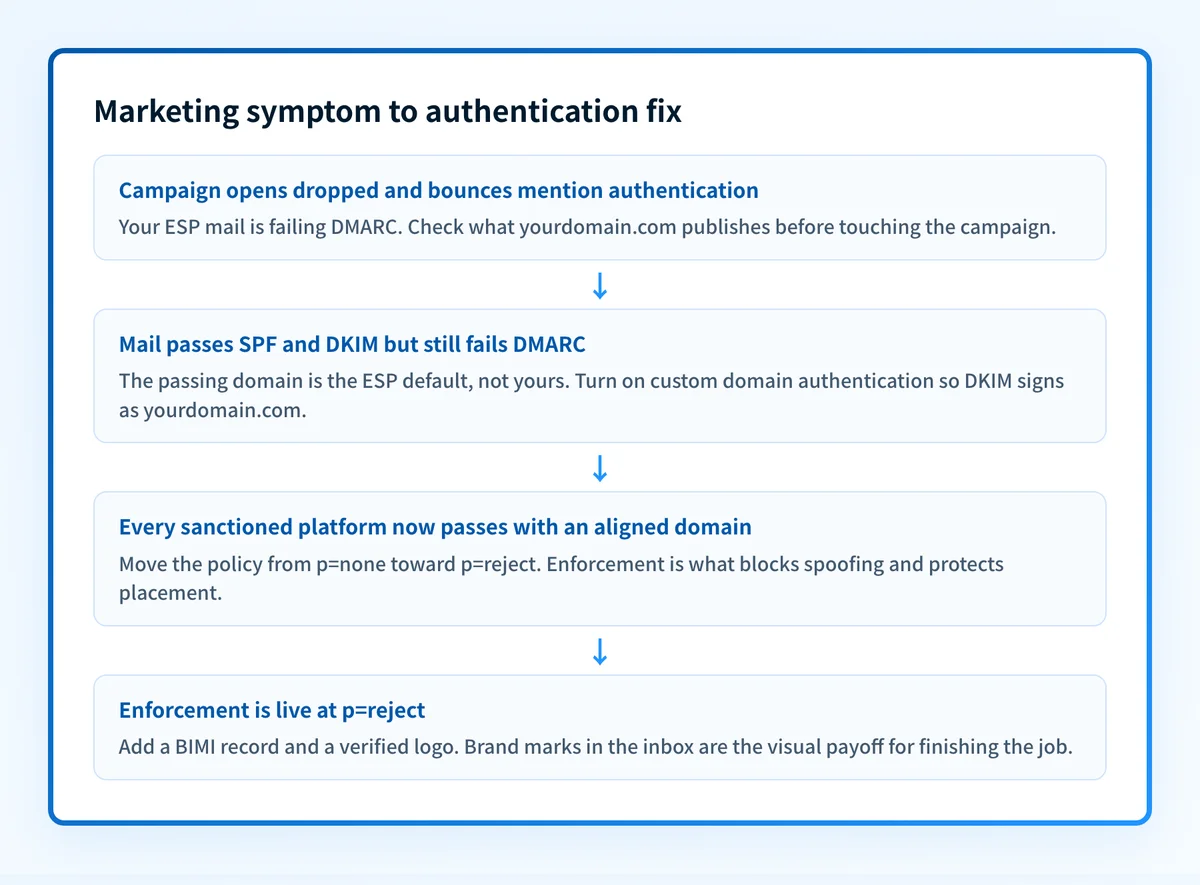
Marketing symptom, authentication cause, fix
| What marketing sees | What is actually happening | The fix |
|---|---|---|
| Campaigns to Gmail underperform every other provider | Bulk-sender requirements unmet: missing DMARC record or unaligned SPF/DKIM | Publish DMARC, align the ESP's sending domain with your From domain |
| Valid subscribers hard-bounce after adding a new sending tool | The new platform sends unaligned, and enforcing receivers reject it | Authenticate the platform with its own DKIM key on your domain before the first send |
| Open rates sag slowly with no list change | Silent spam-foldering as providers lose trust in an unauthenticated domain | Check DMARC aggregate reports for failing sources, fix each one |
| Mail shows 'via espname.com' or a shared platform domain | Sending on the ESP's default domain instead of a custom authenticated domain | Set up a custom sending domain in the ESP, then verify alignment |
| Competitor's logo shows in Gmail, yours does not | Their DMARC is at enforcement with a BIMI record and VMC; yours is at p=none or absent | Reach p=quarantine or p=reject with no legacy pct value below 100, then publish BIMI |
For the exact bounce codes behind any of these rejections, match the code in the SMTP error-code reference at /learning/smtp-error-codes rather than guessing from the symptom.
How to fix it
Check where your domain stands today
Run your sending domain through the free DMARC checker below. It shows whether a record exists, what policy it carries, and whether you are at the monitoring stage, at enforcement, or exposed with nothing published.
Run the check now
Enter your sending domain and the check runs instantly on the next page. Free, no signup.
Inventory every platform that sends as your brand
ESP, CRM, transactional service, surveys, events, billing: each one is a sending source that must authenticate. Marketing usually knows about tools that IT has never heard of, which is why this list has to come from your side.
Get every source aligned, starting with the ESP
Have each platform sign with DKIM on your own domain (most ESPs call this a custom or dedicated sending domain) so it aligns with your From address. The checkers at /tools/spf and /tools/dkim confirm each record as it goes live.
Turn on aggregate reports and read them for a few weeks
DMARC aggregate reports list every source sending as your domain and whether it passes. This is where the forgotten survey tool and the spoofer both show up, and it is the evidence you need before tightening policy.
Move to enforcement, then claim the logo
Once every legitimate source passes, step the policy to p=quarantine and then p=reject. That is the point where spoofing stops, deliverability trust compounds, and a BIMI record with a VMC can put your logo in the inbox.
Related free tools: BIMI checker · SPF checker · DKIM checker
Enforcement is the goal; monitoring is just the map
Most marketing teams that start this journey stall at p=none: the record exists, the reports flow, and the project quietly loses to next quarter's campaign calendar. But p=none is the version of DMARC that satisfies checklists without changing outcomes. It stops no spoofing, earns no BIMI logo, and leaves the deliverability upside on the table.
The end state that pays is p=reject with every legitimate sender aligned: spoofed mail impersonating your brand gets dropped, your campaigns carry a proven identity everywhere they land, and the visible trust signals follow. Palisade's agent does the part nobody has time for, watching the reports and proposing each step toward enforcement, with your team approving every policy change.
DMARC software that does the work
Palisade's AI agent carries every domain to p=reject, with you approving each step. The agent's fixes and hosted SPF, DKIM and DMARC records are part of the full product, which you can try before any charge.
Audit any domain free, no card needed. A card starts the 15-day trial.
Why it matters for MSPs
Marketing-led clients are the tenants most likely to connect a new sending platform without a ticket, and the first symptom is a campaign-day bounce spike that lands on your desk. Make DMARC part of the managed baseline instead of a reactive fix: aggregate reports per client domain surface every unauthorized or unaligned sender before the client's subscribers see a bounce. Palisade hosts SPF, DKIM, DMARC, and BIMI-prerequisite records per domain, detects when each one is ready for the next policy stage on the path to p=reject and proposes the change for your review, and files the alert in ConnectWise, HaloPSA, or Autotask when a client's marketing team plugs in something new. Pricing is per client domain with rates that improve as the portfolio grows and no client email metering, with a free NFR domain for your own MSP brand.
Questions readers ask
Frequently asked questions
Do I need DMARC if I send fewer than 5,000 emails a day?
Will publishing a DMARC record hurt my current campaigns?
Does DMARC improve open rates?
My ESP says my campaigns are authenticated. Is that enough?
Can I get a BIMI logo with a p=none DMARC policy?
Who should own DMARC: marketing or IT?
Does DMARC stop competitors or scammers from spoofing my brand's campaigns?
Sources
Every benchmark above was verified against the vendor's own documentation on the date shown.
- Bulk senders (5,000+ messages/day to Gmail) must set up SPF, DKIM, and DMARC; the From domain must align with the SPF or DKIM domain; spam rates must stay below 0.30%. Google Help: Email sender guidelines (checked 2026-07-20)
- Outlook.com requires SPF, DKIM, and DMARC compliance for domains sending over 5,000 emails/day from May 5, 2025; non-compliant mail goes to junk, with rejection to follow. Microsoft Outlook.com postmaster (sender policies) (checked 2026-07-20)
- BIMI requires DMARC at enforcement (p=quarantine or p=reject, including subdomains); 'None' policies or 'pct' less than 100 percent are not accepted. BIMI Group implementation guide (checked 2026-07-20)
- A free From email domain may cause delivery problems; public email services cannot be authenticated, and Gmail and Yahoo require custom authentication plus a published DMARC record above 5,000 emails in 24 hours. Mailchimp Help: Set up email domain authentication (checked 2026-07-20)