
DMARC Monitor vs Palisade in 2026
DMARC Monitor by Logix combines DMARC report collection, readable analysis, and consultation to guide a domain from monitoring toward enforcement. Palisade is agentic: its AI agent investigates senders, drafts SPF and DKIM fixes, and proposes each policy step for your approval.
Our verdict: Pick DMARC Monitor if you want a traditional plan-and-consultation path with published domain bands. Pick Palisade if you want an AI agent to carry the investigation and configuration work through enforcement while your team approves each change.
 Samuel Chenard · CEO & Co-Founder, PalisadeSource checks through 2026-10-13
15-day full-product trial. Nothing is charged until it ends.
 ChatGPT
 Claude
 Gemini
 Perplexity
 Grok
Grok Palisade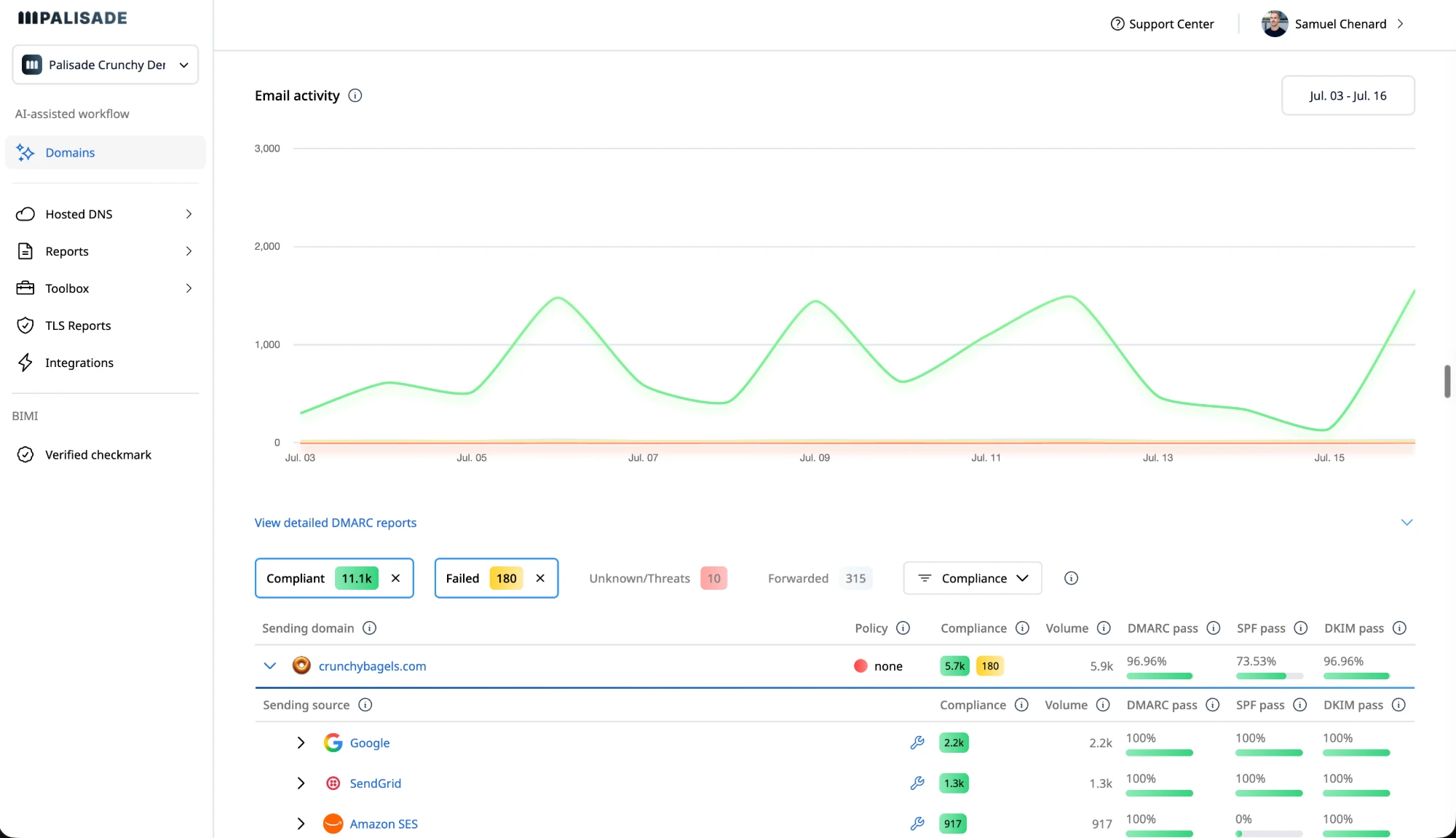

Provisional · 5/8 dimensions established
Average of established dimensions; may change as remaining dimensions are verified.
Full rubric · 8/8 dimensions established
Palisade's IT-team plans start at $19 a month, sized by email volume. Start with a 15-day full-product trial; nothing is charged until it ends.
Which one is right for you?
Best for Teams wanting annual domain bands and consultation
Best for MSPs and IT teams responsible for multiple domains
- The documented DMARC Monitor workflow and commercial terms match your operating requirements.
- Your buying criteria center on vendor-specific enterprise requirements.
- You want annual plans organized around published active and inactive domain bands, with a free option for initial report gathering.
- You want scheduled reporting, forensic visibility, and optional human consultation while progressing from p=none toward p=reject.
- You run an MSP, or an internal IT or security team, responsible for multiple domains.
- You want an AI agent to investigate issues, configure authentication, and move domains toward p=reject.
- Teams already using Claude, OpenAI, or other AI tools can bring the same agent-led operating model to DMARC.
IT-team plans start at $19 a month, sized by email volume. Start with a 15-day full-product trial; nothing is charged until it ends.
Where the day-to-day work actually differs
| Feature | DMARC Monitor | Palisade |
|---|---|---|
| Monitoring & analysis | ||
| DMARC aggregate report monitoring and analyticsWhether DMARC aggregate reports are collected and analyzed for sender authentication review.Source (2026-08-26) | Supported | Agent analyzes reports |
| Forensic report visibility with message-header detailWhether failed messages can be reviewed with message-header detail.Source (2026-08-26) | Supported | Aggregate reports only |
| Daily or weekly scheduled reportingWhether teams receive status reports on a daily or weekly schedule.Source (2026-08-26) | Supported | Supported |
| Cousin-domain or look-alike domain reportingWhether look-alike domains can be monitored for potential brand misuse.Source (2026-08-26) | Supported | Not offered |
| Enforcement workflow | ||
| Guided progression from p=none to p=quarantine to p=rejectWhether a domain can progress through DMARC enforcement policies in stages.Source (2026-08-26) | Supported | Agent proposes policy steps |
| Human interpretation and consultation for remediationWhether remediation findings can be interpreted with guidance for the operator.Source (2026-08-26) | Supported | Agent drafts and proposes |
| AI agent that investigates senders and drafts each fix for approvalWhether an agent investigates senders, drafts fixes, and presents them for approval.DMARC Monitor describes a user-friendly tool, expert guidance, and at-cost managed interpretation, but does not advertise an AI agent that investigates and drafts fixes for operator approval (checked 2026-08-26). Source (2026-08-26) | No agent advertised | Agent drafts and proposes |
| DNS operations | ||
| Hosted authentication records and direct automated DNS deploymentWhether authentication records can be hosted and approved DNS changes deployed.DMARC Monitor explains that valid sending servers lead to SPF updates and that an email gateway enforces DKIM, but does not advertise hosted authentication records or a direct automated DNS deployment path (checked 2026-08-26). Source (2026-08-26) | No hosted DNS advertised | Hosted records and deployment |
| Operations & integrations | ||
| Native ConnectWise, HaloPSA, or Autotask integrationsWhether the named PSA systems connect directly to client-domain workflows.DMARC Monitor's public navigation and product pages do not publish an integrations catalogue or advertise native ConnectWise, HaloPSA, or Autotask integrations (checked 2026-08-26). Source (2026-08-26) | Native PSAs not advertised | Native PSA integrations |
| Public API access on published plansWhether documented APIs are available for use across published plans.DMARC Monitor's public product, features, plans, consultation, and contact pages do not advertise API access or publish API documentation (checked 2026-08-26). Source (2026-08-26) | No API documentation | API on every plan |
| AI and automation access | ||
| Documented REST or GraphQL API for programmatic accessWhether software can retrieve product data through a documented API.DMARC Monitor's public navigation lists Plans, Features, Consultation, Learn, Contact Us, and Blog; it does not advertise a documented REST or GraphQL API (checked 2026-08-27). Source (2026-08-27) | —No public API listed | REST API published |
| MCP server for connecting AI assistants to domain dataWhether an AI assistant can reach the product's data directly.DMARC Monitor's public navigation does not advertise an MCP server or an AI-assistant integration (checked 2026-08-27). Source (2026-08-27) | —No MCP server listed | MCP server published |
| Advertised AI or machine-learning featuresWhether the vendor advertises AI or machine learning inside the product.DMARC Monitor describes a user-friendly tool, expert guidance, and deployment specialists; it does not advertise AI or machine-learning features (checked 2026-08-27). Source (2026-08-27) | —No AI features listed | Agent drafts work |
| Scheduled report delivery outside the dashboardWhether domain-report data can be delivered without opening the dashboard.DMARC Monitor says it can send current-status reports on a daily or weekly basis (checked 2026-08-27). Source (2026-08-27) | Daily or weekly email | REST API published |
Want to compare the workflow yourself? Start a 15-day full-product trial of Palisade.
Palisade vs DMARC Monitor: score evidence and limitations
Both products are scored on the same eight dimensions the comparison hub uses, so the figures here are the figures there. Four are derived from vendor facts that each carry a source and a checked date. Four are editorial, marked as such below, and each states its reasoning and its source.
Each dimension is out of 10 and the total is the raw sum out of 80, rescaled to 100 — the raw figure is printed beside it so the conversion is checkable rather than a black box. Scored on what each vendor publishes, not on how the product feels in use. Unknown scoring dimensions are shown as Not established; provisional scores average only established dimensions and show coverage. They may change as remaining dimensions are verified. Current ranks include full and provisional scores; equal displayed scores share a rank. Historical assessments are separate. Editorial dimensions last reviewed 2026-10-15.
Provisional · 5/8 dimensions established
Average of established dimensions; may change as remaining dimensions are verified.
Full rubric · 8/8 dimensions established
How reachable the vendor's DMARC data is from your own software and AI tools. Two paths count, an API and an MCP server, and each only if it reaches DMARC data (domains, records, reports or sending sources). A path is open when it is documented and included from the cheapest paid plan; gated when it needs a higher tier, an add-on, a sales call or a request, or the vendor does not say which plans include it. 10 = both open. 9 = one open, one gated. 8 = both gated. 7 = one open, the other absent. 6 = one gated, the other absent. 5 = access claimed in marketing only, with no docs or plan listing. 4 = reachable only through a self-hosted tool's own interface or a host platform's API, such as parsedmarc's library or Splunk's REST API; a dashboard over a database you run yourself does not count. 3 = no API or MCP server reaches DMARC data.
Programmatic DMARC-data access is not specified on the reviewed homepage. Source (2026-08-28)
Palisade publishes a REST API and a remote MCP server on every plan, making the same domain data and remediation workflows available to connected software. Source (2026-08-30)
How much of the report analysis is done for you. 10 = the platform turns raw report data into a prioritised, actionable queue on its own.
The platform converts XML, provides near-real-time filtered views, forensic details, notifications, and scheduled status reports. Source (2026-08-28)
Report data is analysed into a prioritised list of sender, SPF, DKIM and DMARC issues, so nobody reads raw XML. Source (2026-08-30)
How much of the work the vendor's own software does. 10 = it identifies the sending sources, drafts the SPF and DKIM fixes each one needs, and proposes the next policy step. 6 = it applies the records for you, but a person decides what to fix and when to advance. 3 = it reports, and every change is yours to make. A vendor whose team does the work rather than its software scores here on the software alone.
The software converts DMARC XML into readable reports and filtered views, while Logix describes its specialists as guiding implementation and policy changes. Source (2026-08-28)
The agent investigates each sender, drafts the SPF and DKIM changes it needs, and proposes the next policy step; a human approves before deployment. Source (2026-08-30)
10 = full pricing published. 6 = some tiers published, rest quote-gated. 3 = quote only.
Bronze, Silver, and Gold annual prices are published; the Advance plan is contact-based. Source (2026-08-28)
Self-service IT-team prices are published by email volume from $19/month; MSP pricing is portfolio-based per client domain, and Enterprise pricing is custom. Source (2026-08-30)
10 = hosts the records for you. 6 = partial or add-on. 3 = you manage your own DNS.
DMARC Monitor offers consultation, report interpretation and policy assessment; hosted authentication-record operation is unverified. Source (2026-08-28)
Yes: hosted DMARC, SPF, DKIM, BIMI & MTA-STS Source (2026-08-30)
10 = a genuine free plan. 6 = time-limited trial only. 3 = no free access.
Logix advertises a free DMARC report plan in addition to its paid monitoring plans. Source (2026-08-28)
No free plan: a 15-day full-product trial; nothing is charged until the trial ends Source (2026-09-25)
10 = a real MSP program with multi-tenant management. 6 = partial. 3 = none.
No public MSP, reseller, or multi-tenant partner programme was located in the reviewed material. Source (2026-08-28)
Yes: MSP-first, multi-tenant with native PSA integrations Source (2026-08-30)
How much work it takes to get a domain from p=none to p=reject. 10 = the platform (or the vendor's team) gets you there without manual DNS edits.
Implementation specialists publish a service-led path through p=none, quarantine, and p=reject and help apply findings from review meetings. Source (2026-08-28)
The DMARC Agent detects when a domain's authentication and alignment are ready for the next policy stage and proposes the move, but a human still approves and applies it, so it is not fully hands-off. Source (2026-08-30)
Where Palisade and DMARC Monitor actually differ
Each argument keeps the product screens, sourced comparison points, and supporting analysis together.
Report visibility vs remediation work
Monitoring: a genuine parity area
DMARC Monitor has a clear monitoring core. Its consultation page says the service receives DMARC reports containing sending sources, domains or IPs, and SPF and DKIM pass or fail results. The features page adds reader-friendly overviews, date-range filtering, host-level optimization tips, and near-real-time charts. That is the same first job an IT team expects from a DMARC platform: turn receiver feedback into a view of who is sending on behalf of the domain and where authentication is breaking. Source (2026-08-26) Source 2 (2026-08-26)
DMARC Monitor
A relevant product screenshot was not available in the reviewed evidence.
Palisade
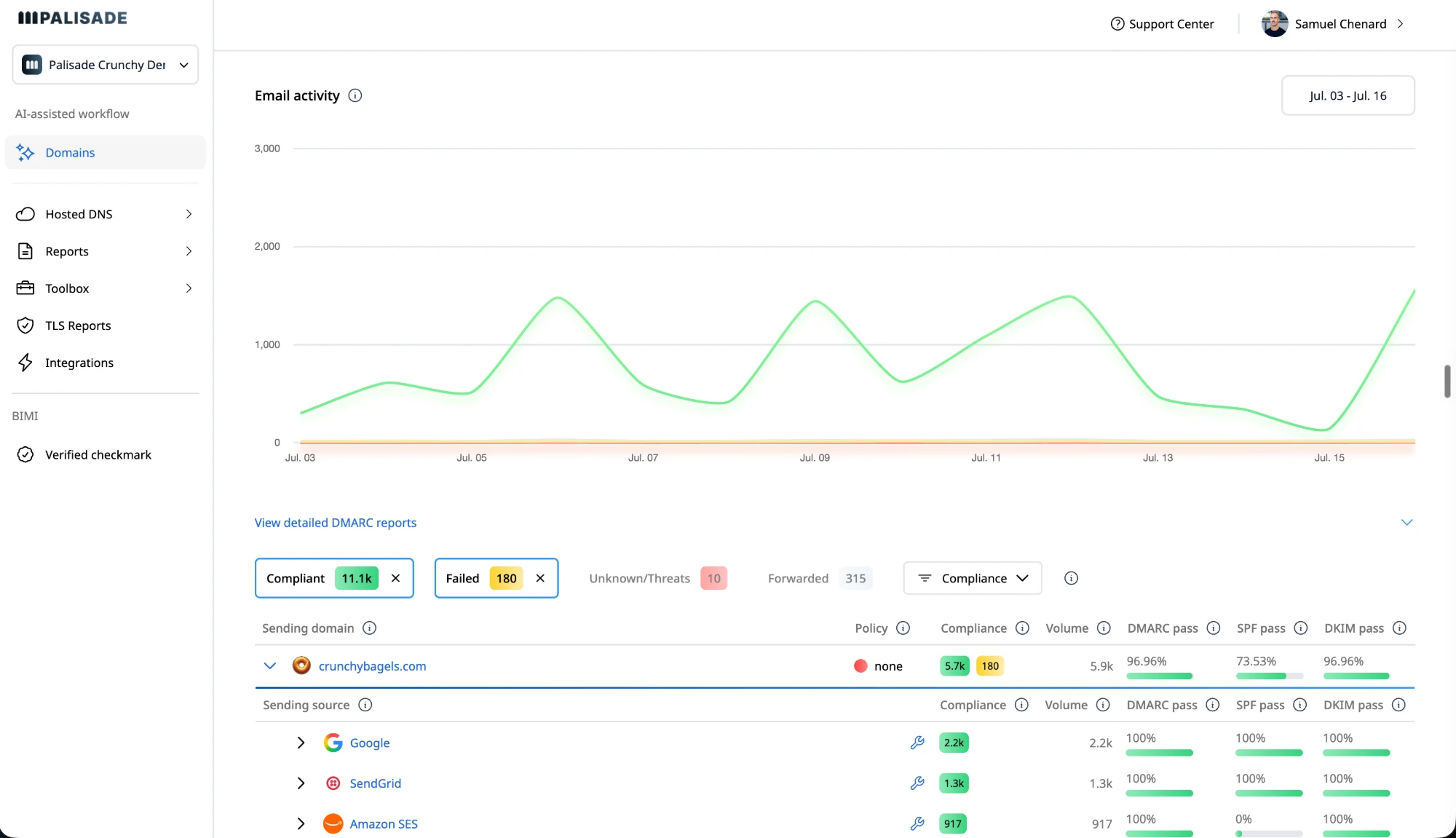
- DMARC aggregate report monitoring and analytics: Agent analyzes reports
- Forensic report visibility with message-header detail: Aggregate reports only
- Daily or weekly scheduled reporting: Supported
The site also advertises forensic reports that track messages failing authentication and expose message headers, plus daily or weekly status reports. Its paid plans list push notifications, weekly scheduled reporting, and cousin-domain reporting. If your requirement is report collection, visibility into senders, periodic status, and a way to inspect suspicious failures, DMARC Monitor belongs in the credible option set. Palisade does those monitoring jobs too; the material difference appears after the report has identified the problem. Source (2026-08-26) Source 2 (2026-08-26)
Consultation vs agent-led execution
Enforcement: consultation versus agent-led execution
DMARC Monitor's public workflow is deliberately staged. The homepage says to begin at p=none, collect XML reports, shortlist known valid sending domains and IPs, move to p=quarantine after the traffic is understood, and ultimately move to p=reject once performance is steady. Its consultation page describes Logix handholding customers through that compliance process, while the features page positions the product as an expert guide that helps put a reject policy in place. A team that wants a documented sequence and access to human interpretation can fit that model. Source (2026-08-26) Source 2 (2026-08-26) Source 3 (2026-08-26)
DMARC Monitor
A relevant product screenshot was not available in the reviewed evidence.
Palisade
A relevant product screenshot was not available in the reviewed evidence.
- Guided progression from p=none to p=quarantine to p=reject: Agent proposes policy steps
- Human interpretation and consultation for remediation: Agent drafts and proposes
- AI agent that investigates senders and drafts each fix for approval: Agent drafts and proposes
The public pages reviewed do not describe an AI agent that investigates every sender, drafts SPF or DKIM fixes, and queues each policy step for approval. They describe a user-friendly tool, deployment specialists, and an additional at-cost managed interpretation service. Palisade takes a different route: the agent investigates every sender, drafts every fix, and proposes each policy step; your team approves before anything ships. That distinction is about who carries the work, not whether a human remains accountable for the DNS and policy decision. Source (2026-08-26) Source 2 (2026-08-26)
Guidance vs DNS deployment
DNS and authentication changes: confirm the boundary
DMARC Monitor's consultation material explains the operational logic behind authentication changes: validate each sending server or IP, update SPF appropriately, and route servers through a common email gateway that enforces DKIM. The product's analyzer also checks a domain's DMARC, SPF, and DKIM status. Those pages establish monitoring, assessment, and guidance, but they do not present a hosted-records product or a public DNS-provider deployment catalogue. Source (2026-08-26) Source 2 (2026-08-26)
DMARC Monitor
A relevant product screenshot was not available in the reviewed evidence.
- Hosted authentication records and direct automated DNS deployment: No hosted DNS advertisedSource
Palisade
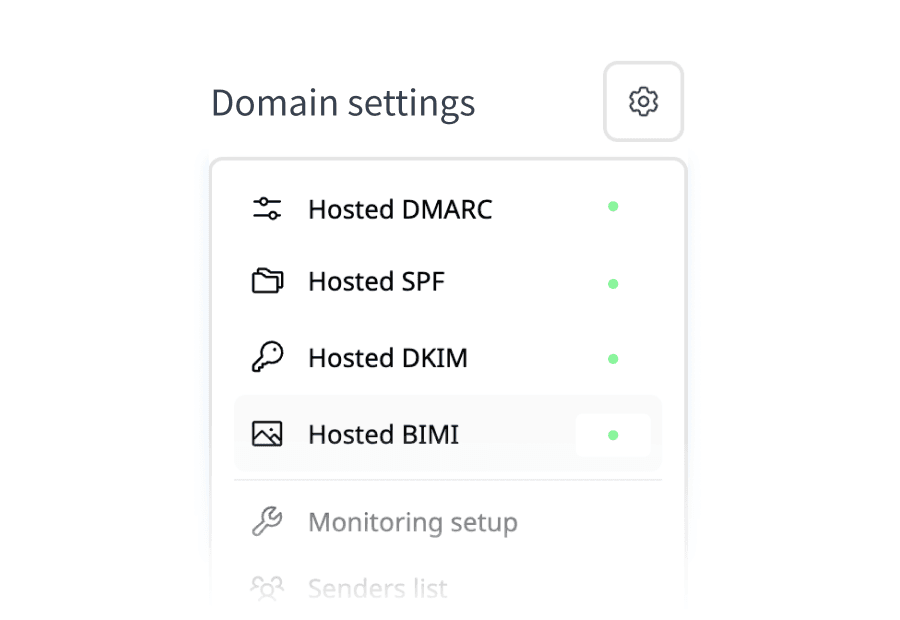
- Hosted authentication records and direct automated DNS deployment: Hosted records and deployment
That boundary matters during a migration. If you choose DMARC Monitor, ask who writes the SPF, DKIM, and DMARC records, whether the work is performed through your DNS provider or by a Logix consultant, how approvals are recorded, and what remains for your operator to do. Palisade supports hosted records and Smart DNS Deployment. Customers authorize either a one-time provider sign-in or an optional account connection for Cloudflare, GoDaddy or Route 53, then approve proposed record changes before publication in the browser app. API keys and MCP cannot publish through those account connections. These are different implementation responsibilities even where the monitoring output looks similar. Source (2026-08-26) Source 2 (2026-10-13)
Domain bands vs integration depth
Operations and scale: published domain bands, limited public integration detail
DMARC Monitor's pricing is easy to read at the domain-band level: Bronze covers two active domains, Silver five, and Gold twenty-five, with inactive-domain allowances alongside them. Each paid tier lists unlimited report gathering, a 365-day log-retention period, push notifications, weekly scheduled reporting, cousin-domain reporting, and implementation, monitoring, and reporting. The free plan is useful for an initial read because it lists unlimited report gathering and online reporting, while clearly limiting retention and support. Source (2026-08-26) Source 2 (2026-08-26)
DMARC Monitor
A relevant product screenshot was not available in the reviewed evidence.
Palisade
A relevant product screenshot was not available in the reviewed evidence.
- Native ConnectWise, HaloPSA, or Autotask integrations: Native PSA integrations
- Public API access on published plans: API on every plan
For an internal team with a known number of brands, that structure is straightforward. For an MSP or service provider, the public site is less explicit: the pages reviewed do not advertise multi-tenant client workspaces, white-label reporting, ConnectWise, HaloPSA, Autotask, or API access. Treat those as discovery questions, not assumed gaps in the underlying product. Palisade publishes the relevant operating model directly: MSP pricing is portfolio-based per client domain, PSA integrations cover ConnectWise, HaloPSA, and Autotask, and API access is available on every plan. Source (2026-08-26) Source 2 (2026-08-26)
Native PSA integrations
Palisade imports client domains straight from these three. DMARC Monitor's own coverage is stated above, from their site.
- ConnectWise PSA
- Autotask
- HaloPSA


Dashboard access vs programmatic access
DMARC Monitor schedules emailed reports but lists no API or MCP server
DMARC Monitor's public navigation lists Plans, Features, Consultation, Learn, Contact Us, and Blog. Its feature page describes a user-friendly tool, expert guidance, deployment specialists, report views, and daily or weekly reports. Those public pages do not advertise a documented REST or GraphQL API, an MCP server, an AI-assistant integration, or AI or machine-learning features (checked 2026-08-27). Source (2026-08-27) Source 2 (2026-08-27)
DMARC Monitor
A relevant product screenshot was not available in the reviewed evidence.
Palisade
A relevant product screenshot was not available in the reviewed evidence.
- Documented REST or GraphQL API for programmatic access: REST API published
- MCP server for connecting AI assistants to domain data: MCP server published
- Advertised AI or machine-learning features: Agent drafts work
Palisade publishes an MCP server and REST API. Its agent investigates senders, drafts SPF and DKIM fixes, and proposes each policy step. A human approves before anything ships. For operators who want an AI assistant to work from domain data while retaining that review step, this is a different route from a dashboard with scheduled reports.
Reachable from your own AI tools
Palisade's MCP server exposes 42 tools over OAuth, so the assistant your team already uses can read domains, pull the exact records to publish and work the task queue. These are the clients the connection guide walks through.
- ChatGPT
- Claude
- Codex
- Cursor
- Windsurf
- Any MCP client





Still deciding between DMARC Monitor and Palisade? See what changes with Palisade.
15-day full-product trial. Nothing is charged until it ends.


 Microsoft 365
 Zoho Mail

The agent does the heavy lifting
Sources identified, SPF and DKIM fixes drafted, each policy step proposed. You approve; nothing ships on its own.
Connect your AI with MCP
42 tools over MCP, so your assistant reads your domains and works the queue.
Connect your DNS manager directly


One-time sign-in supports 64 providers without retaining credentials. Optional account connections support Cloudflare, GoDaddy and Route 53. You approve every change.
“We evaluated many DMARC providers before choosing Palisade. The quality of their product, the responsiveness and friendliness of their team and their rapid progress on their product roadmap made it a no-brainer for us to move forward.”
DMARC Monitor pricing explained (and how Palisade compares)
DMARC Monitor publishes a free plan and three paid annual plans. The paid tiers are based on active and inactive domain counts, and the site lists reporting, retention, notifications, and review support in each tier. These are the prices and inclusions shown on the public plans page when checked:
What you'd actually pay
The same five buyer sizes on every comparison, so a shape carries from one page to the next.
1 domain, up to 1,000 emails a month
Free Plan: any number of primary domains and unlimited report gathering; no email-volume allowance is published
2 set-up domains, up to 100K emails a month
Bronze: 2 active domains and unlimited report gathering; no email-volume allowance is published
10 set-up domains, up to 1M emails a month
Silver covers 5 active domains and Gold covers 25. Confirm the appropriate plan for 10 domains and its volume suitability; report gathering is not an email-volume allowance.
20 set-up domains, up to 2.5M emails a month
Gold: 25 active domains and unlimited report gathering; no 20-domain tier or email-volume allowance is published
Client domains under management, any volume
No MSP or per-client-domain price is published
Palisade’s figures are derived from its published tiers. DMARC Monitor pricing or licensing source reference: vendor source citation date 2026-10-13. Additional published terms checked 2026-10-13. Plans and prices may have changed since.
How DMARC Monitor prices
- The public plans page labels the paid prices in Rs and annual terms; it does not state the currency name or show a monthly equivalent.
- The free-plan page says primary and inactive domain counts are not limited, but gives the free service 90 days of retention, monthly scheduled reporting, and no support or consulting.
- DMARC Monitor also sells reporting and data interpretation, policy assessment, and compliance as consultation services. The consultation page describes interpretation as an additional at-cost service, so plan pricing and consulting scope should be confirmed together before purchase.
- The public site does not publish a separate MSP or partner price card, multi-tenant controls, or an API plan (checked 2026-08-26).
How Palisade prices
- Palisade publishes flat monthly IT-team tiers at $19, $29, $59, $99, and $249 for 100K, 250K, 500K, 1M, and 2.5M emails/month. Annual billing is 20% lower.
- Palisade's paid IT tiers cap DMARC setup at 2, 3, 6, 10, and 20 domains respectively; adding domains is free and unlimited, and only setup domains count against the tier. MSPs instead pay per client domain, with a rate that improves as the portfolio grows and a minimum of 5 client domains, plus a free NFR domain for the MSP's own use.
- Palisade's IT-team and MSP plans include unlimited report history (Enterprise retention follows custom terms), and API access is included on every plan. The full-product trial lasts 15 days.
- The practical pricing comparison is therefore not only annual domain bands versus monthly email-volume tiers. It is also whether your team wants to purchase consultation around a report workflow or have an agent investigate, draft, and queue the operational work for approval.
DMARC Monitor source reference: primary reference citation date 2026-10-13.DMARC Monitor source reference: additional source reference citation date 2026-10-13.DMARC Monitor source reference: additional source reference citation date 2026-10-13.Palisade source reference: the public pricing page citation date 2026-08-30.Plans and prices may have changed since.
Start a 15-day full-product trial of Palisade. Nothing is charged until it ends.
What each one covers, and where it stops
Published facts only, read from each vendor's own material. Neither column describes a hands-on trial, because we have not run one.
DMARC Monitor by Logix collects DMARC reports, turns XML data into readable analysis, identifies sending sources, and provides consultation as a domain moves from monitoring to enforcement. Its monitoring material covers authentication results, forensic report detail, filtering, charts, scheduled reports, and cousin-domain reporting for teams that need visibility into sending activity and suspicious failures.
DMARC Monitor publishes a free plan and annual paid plans based on active and inactive domain counts. Free includes unlimited report gathering, 90-day retention, monthly reporting, and no support or consulting; paid plans add 365-day retention, weekly reports, notifications, cousin-domain reporting, and review meetings. Logix also offers separately priced consultation for report interpretation and compliance work.
Palisade is built around an agent that does the DMARC work rather than reporting on it. It identifies every sending source, drafts the SPF and DKIM changes each one needs, and proposes the next policy step when the evidence supports it.
The agent investigates every sender, drafts every fix, and proposes each policy step, you approve before anything ships.
- Provides DMARC aggregate report monitoring and analytics
- Provides forensic report visibility with message-header detail
- Provides daily or weekly scheduled reporting
- Provides cousin-domain or look-alike domain reporting
- Supports staged DMARC policy progression from p=none to p=quarantine to p=reject
- The agent investigates senders and drafts the fix, so the work arrives prepared rather than as a list of findings
- Hosted SPF, DKIM and DMARC records, so an approved change can be carried out rather than handed off
- Portfolio workflow for MSPs, with ConnectWise, HaloPSA and Autotask integrations and a free NFR domain
- An MCP server and a REST API, so the same data and workflow are reachable from the AI tools a team already uses
- Does not advertise an AI agent that investigates senders and drafts fixes for approval
- Does not advertise hosted authentication records or direct automated DNS deployment
- Does not advertise native ConnectWise, HaloPSA, or Autotask integrations
- Does not list a documented REST or GraphQL API
- Does not list an MCP server for AI assistants
- Every policy change waits for a human approval, by design: nothing ships on the agent's own authority
- MSP pricing is portfolio-based per client domain, with a minimum of 5 client domains
- Plans are sized by monthly email volume, so a low-domain, high-volume sender lands on a higher tier than domain count alone suggests
- Starts at
- Free
- Free retention
- 90 days
- Paid retention
- 365 days
- Bronze band
- 2 active, 5 inactive domains
- MSP model
- Not published
- Starts at
- IT plans from $19/mo by email volume; 15-day trial
- Trial
- 15 days, full product
- MSP model
- Portfolio-based per client domain; minimum of 5 client domains
What Palisade customers say
5.0 out of 5 on G2Trusted by over 10,000 domains
“Palisade made it so easy for us to get our blue verified checkmark and achieve our BIMI compliance”


Sources and further reading
Source checks run through 2026-10-13; every entry keeps its individual check date.
- DMARC Monitor home
Checked 2026-08-28
- DMARC Monitor features
Checked 2026-08-28
- DMARC Monitor plans
Checked 2026-10-13
- DMARC Monitor consultation services
Checked 2026-10-13
- DMARC Monitor free plan
Checked 2026-08-26
- DMARC Monitor domain checker
Checked 2026-08-26
- DMARC Monitor primary documentation
Checked 2026-10-13
- Source
Checked 2026-08-30
- Source
Checked 2026-10-13
- Source
Checked 2026-08-26
Palisade vs DMARC Monitor: FAQ
What is DMARC Monitor?
DMARC Monitor is a DMARC reporting and compliance product by Logix InfoSecurity. Its public product pages describe XML report collection, reader-friendly analytics, sender and IP identification, forensic report views, scheduled reporting, and consultation to help a domain progress toward p=reject.
Does DMARC Monitor help a domain reach p=reject?
Yes. DMARC Monitor's published workflow starts with p=none and report collection, moves to p=quarantine after legitimate senders are understood, and then progresses to p=reject when performance is steady. The site also offers consultation for interpretation, policy assessment, and compliance.
Does DMARC Monitor have a free plan?
Yes. The free-plan page lists any number of primary and inactive domains, unlimited report gathering, 90-day log retention, online reporting, and monthly scheduled reporting. It also says the free plan has no support or consulting.
How much does DMARC Monitor cost?
The public plans page lists Bronze at Rs 135000 per annum for 2 active domains, Silver at Rs 180000 per annum for 5 active domains, and Gold at Rs 480000 per annum for 25 active domains. Advance requires contacting sales; a separate free-plan page documents the free reporting offer. Paid plan prices were checked on 2026-10-13. Source (2026-10-13) Source 2 (2026-10-13)
Does DMARC Monitor offer an AI enforcement agent?
DMARC Monitor's public pages describe expert guidance, deployment specialists, and at-cost managed report interpretation. They do not advertise an AI agent that investigates senders and drafts each fix for approval (checked 2026-08-26). Palisade's agent is built around that reviewable, agentic workflow.
Who should choose DMARC Monitor instead of Palisade?
DMARC Monitor can fit a team that wants published annual domain bands, scheduled reports, forensic visibility, and optional human consultation. Choose Palisade if you want an AI agent to carry the investigation and configuration work through enforcement, with your team approving every change before it ships.
Switching from DMARC Monitor takes three steps
- 1
Batch-import your domains
Bring your client domains into Palisade in bulk, or let your ConnectWise, HaloPSA, or Autotask integration sync them automatically.
- 2
Run both platforms in parallel
Keep both reporting destinations configured during the overlap, verify external-report authorization where required, and confirm reports arrive in both platforms before retiring DMARC Monitor. Review hosted-record dependencies before changing DNS.
- 3
Cut DNS over on your schedule
Point records at Palisade's hosted infrastructure, then retire the old setup when you're satisfied.
15-day full-product trial. Nothing is charged until it ends.
Source citations on this page run through 2026-10-13; individual claims retain their dates and evidence limitations. Spotted something out of date? Tell us and we'll fix it.