Email blocklist · Cisco Systems, Inc.
SpamCop blacklist removal: why your sending IP is on the SCBL, and how it clears

By Samuel Chenard · CEO & Co-Founder, Palisade · Reviewed July 19, 2026
SpamCop runs the SCBL, a list of sending IPs that transmitted mail reported as spam by its users and spamtraps. Most mail servers query bl.spamcop.net, so a listing blocks delivery widely. There is no removal form: stop whatever is sending reported mail, and the listing expires automatically about 24 hours after the last report.
| SpamCop at a glance | |
|---|---|
| Operator | Cisco Systems, Inc. |
| Type | IP blocklist (DNSBL) |
| IP lookup zone | bl.spamcop.net |
| Query method | A-record DNSBL queried at bl.spamcop.net during the SMTP session. A listed IP returns 127.0.0.2. Free to query; SpamCop asks users who use and like the list to donate rather than charging a query fee. |
| Who uses it | Many mail servers, ISPs, and spam-filtering systems query the SCBL in real time during the SMTP transaction and use the answer to reject, defer, or score inbound mail. |
| Reach | High while it lasts. A listing can defer or reject your mail at a wide range of receivers, but it is time-limited and clears itself once reports stop. |
| Removal cost | Free on every list (paid delisting offers are scams) |
Check if you're on SpamCop
SpamCop lists sending IP addresses, not domains, so check the IP your mail actually leaves from (your outbound mail server), not your website's IP. Enter it below to see whether it is on the SCBL and, if it is, roughly how long until the listing expires.
Is your IP or domain on SpamCop?
Enter your sending IP or domain and the check runs instantly on the next page. Free, no signup.
Related free tools: Full blocklist checker · DNS lookup (raw bl.spamcop.net) · DMARC checker · Email security score
What is SpamCop?
SpamCop is one of the oldest spam-reporting services on the internet, running since 1998 and now operated by Cisco Systems. It does not filter your mail itself. It publishes the SpamCop Blocking List (SCBL), a list of IP addresses that have sent mail its users and spamtraps reported as spam. Mail servers that receive your messages query bl.spamcop.net in real time and use the answer to reject, defer, or score you. Because many receivers consult the SCBL, one listing can dent delivery at a wide range of providers at once.
Two things set the SCBL apart from a list like Spamhaus. First, it is purely report-driven: SpamCop lists an IP because reported mail and spamtrap hits crossed a scoring threshold, not because of how your DNS or server is configured. In SpamCop's own words, the blocklist "does not list for missing or incorrect DNS/rDNS." Second, it is time-based and fully automatic. There is no removal form and no way to request early delisting; once the reports stop, the listing expires on its own within about 24 hours. Your job is to find and stop whatever is generating the reports.
The SpamCop lists, and what each one covers
SpamCop is not one list. Identify the exact zone that flagged you: it decides what you fix and how you get removed.
| List | What it covers | Where it's queried | Getting off |
|---|---|---|---|
SCBL SpamCop Blocking List IP | Sending IP addresses that transmitted mail reported as spam by SpamCop users and spamtraps, once the weighted report score crosses the listing threshold. It lists IPs only, never domains or email addresses, and never for missing or incorrect rDNS. | bl.spamcop.netcode 127.0.0.2 | Expires automatically Automatic. With no new reports, a listing expires 24 hours after the last reported email; every fresh report resets that clock. There is no removal form. Once an IP enters delisting, allow up to about 4 hours for it to propagate to SpamCop's mirrors. |
Why your IP or domain got listed
A listing is a reputation verdict. These are the situations SpamCop lists senders for:
Your IP sent mail that SpamCop users reported as spam, and the volume of reports relative to the mail that IP sends crossed the listing threshold.
SpamCop spamtraps (addresses that never opted in to anything) received mail from your IP; spamtrap hits are weighted heavily in the score.
Your server sent bounce or autoresponder messages that reached a SpamCop spamtrap in enough volume to meet the criteria, which is how backscatter earns a listing.
The bar is not one message: the SCBL will not list on a single report, and with only two reports it lists for at most 12 hours after the most recent reported mail.
What does not list you: the SCBL covers sending IPs only, so it never lists a domain or an email address, and it never lists for missing or wrong reverse DNS.
Most common reasons senders land here, ranked
| Likely cause | What's happening |
|---|---|
| A compromised mailbox, script, or device on your IP sent spam | A common cause SpamCop names. A phished account, a vulnerable web form, or a malware-infected host starts sending spam from your IP. Reports and spamtrap hits pile up fast and the SCBL lists the IP. |
| Nobody is stopping mail spoofed in your name | If your domain has no DMARC policy at enforcement, attackers can spoof it. The spam they blast gets reported and lands in spamtraps, and where it rides infrastructure tied to your sending IPs, those reports list you. This is the seam Palisade closes. |
| Backscatter from accept-then-bounce mail | If your server accepts mail and only later sends a bounce, and the forged sender is a SpamCop spamtrap, you mail the trap directly. SpamCop lists servers that backscatter into traps in sufficient volume, even though you never meant to send spam. |
| A shared or recycled sending IP arrived with baggage | On shared sending platforms another tenant's reported mail can list the IP you also use. A freshly allocated IP can also inherit a report history from a previous user who has nothing to do with you. |
| A SpamCop user mistakenly reported your legitimate mail | The SCBL runs on human reports, and people make mistakes. A wrongly reported campaign can list you briefly. These listings are short and clear on their own once no further reports arrive. |
How to delist from SpamCop
You do not submit a removal to SpamCop; the listing expires on its own once you stop the cause. SpamCop re-lists an IP the moment fresh reports arrive, so clearing the source has to come first. Work the steps in order. One point SpamCop is firm about: do not email asking for early delisting, because the clock is already running and a new report only resets it.
Confirm the listing and read the countdown
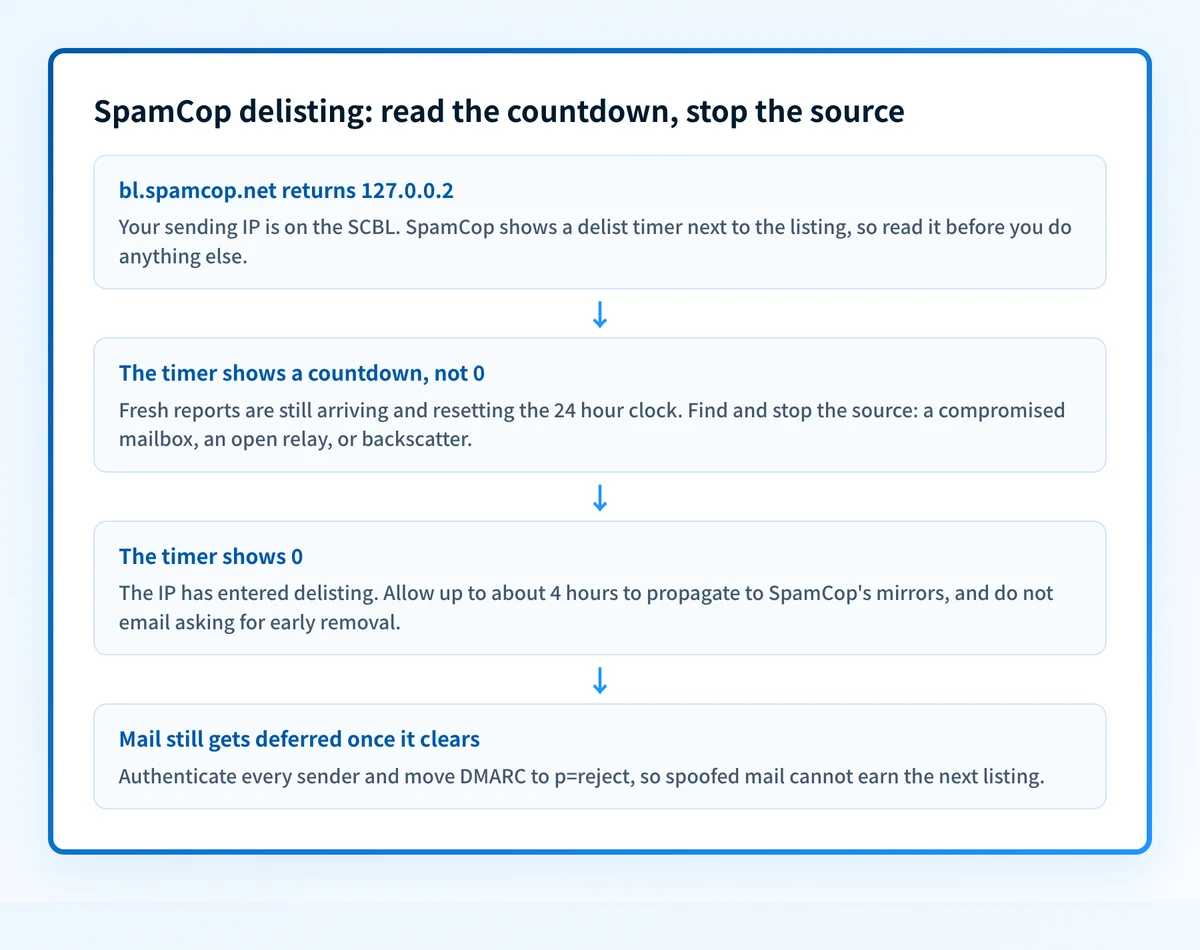
Run your sending IP through the free IP reputation check below, then look it up on bl.spamcop.net. SpamCop shows a timer for when the IP will delist; a value of "0" means it has already entered the delisting process.
Find and stop whatever is sending reported mail
Reset the compromised mailbox, patch or close the open relay or vulnerable form, and clean any infected host. Because the SCBL is report-driven, the listing will not clear until the mail generating reports actually stops.
Fix backscatter if that is the cause
Reject unknown recipients during the SMTP session instead of accepting mail and bouncing it later, so you stop mailing forged senders and spamtraps. If the block surfaces as a bounce, it is a
5.7.1rejection that names bl.spamcop.net; the linked code page has the detail.Authenticate every sender so it cannot recur
Publish correct SPF, sign with DKIM on each service that sends as you, and move DMARC to
p=reject. Verify with the free SPF, DKIM, and DMARC checkers. Enforcement is what stops spoofed mail from generating the next round of reports.Let the automatic expiry run
Do not write to SpamCop asking for early removal. With no new reports the IP delists automatically within 24 hours, then takes up to about 4 hours to propagate to SpamCop's mirrors. There is nothing to submit and no fee to pay.
Re-check and keep monitoring
Confirm you are clear on bl.spamcop.net, then keep watching the IP and your DMARC reports so the next compromise shows up as an alert instead of a fresh SpamCop listing and a wave of bounces.
Removal is free
SpamCop delisting is automatic and costs nothing: there is no fee, no form, and no account to create. You cannot buy speed either. In SpamCop's own words, "The IP will delist automatically within 24 hours, if there are no new reports." Any third-party service that charges to "remove you from SpamCop" is selling a wait you already get for free. Put the effort into stopping the source instead.
Open www.spamcop.netWhen a SpamCop listing isn't your fault
A SpamCop listing is report-driven and human-fed, so innocent senders do sometimes get caught. SpamCop states plainly that its statistics come from "reports from fallible humans, and unfortunately innocent parties that have not sent any spam sometimes get listed." IP addresses also change hands, so a listing history can belong to a previous user of your address. On shared platforms the reported mail may be a co-tenant's, and backscatter means a misconfigured bounce, not deliberate spam, can list you. Check bl.spamcop.net and read the listing history before assuming the worst.
How to stay off SpamCop
Authenticate everything: SPF that names every real sender, DKIM signing on each service, and DMARC that you actually move to enforcement.
Enforce DMARC at
p=rejectso receivers reject mail that spoofs your domain, which cuts the reports and spamtrap hits domain-spoofing generates.Reject unknown recipients during the SMTP session rather than accepting then bouncing, so you never backscatter into a SpamCop spamtrap.
Keep sending IPs clean: watch for compromised accounts and scripts, set correct rDNS with a matching HELO, and send from IP space meant for mail.
Monitor IP reputation and DMARC reports continuously, so a compromise surfaces as an alert instead of a listing and a run of rejections.
The real fix: enforce authentication, don't just monitor
The SCBL is a symptom meter. It lists your IP because reports and spamtrap hits piled up, and it clears itself once they stop. Checking it tells you that you are listed; it does nothing to stop the compromised account, the spoofed campaign, or the backscatter that generated the reports. Enforcement does. Authenticate every sender, host SPF, DKIM, and DMARC so they stay correct, watch the reports for senders you did not know about, and move every domain to p=reject so forged mail is dropped before it ever earns you a listing.
DMARC software that does the work
Palisade's AI agent takes domains all the way to enforcement: hosted SPF, DKIM, DMARC, and MTA-STS records on paid plans, DMARC reports monitored continuously, and every policy step drafted for your approval on the way to p=reject. The full product is open for a 15-day trial, and nothing is charged until it ends.
15-day full-product trial. Nothing is charged until it ends.
Watching SpamCop across every client domain
One listed client IP is an afternoon of cleanup; a book of clients each one phished account away from a SpamCop listing is the job. The SCBL clears itself in 24 hours, but only after you find and stop the sender, and doing that by hand across every tenant does not scale. Palisade hosts and manages SPF, DKIM, and DMARC for every client domain, surfaces the unknown or compromised sender in the DMARC reports before reports and spamtrap hits stack up, and carries each domain to p=reject, with your team approving each step. It watches every client IP and domain from one console and opens tickets in ConnectWise, HaloPSA, and Autotask, and your own MSP domain is a free NFR domain to prove it on.
Questions readers ask
Frequently asked questions
How long does SpamCop delisting take?
How do I remove my IP from SpamCop? Is there a delisting form?
Why does my IP keep getting relisted on SpamCop?
Does SpamCop list domains or only IP addresses?
What does a bl.spamcop.net 127.0.0.2 result mean?
Is SpamCop delisting free?
My mail was rejected citing SpamCop. What should I do first?
Sources and last verified
Every SpamCop fact on this page is drawn from the operator's own documentation, last checked 2026-07-20. Blocklist policies change; if a detail looks off, the linked source is authoritative.
- The SCBL is a list of IPs that transmitted reported email to SpamCop users, used to block and filter unwanted email.“The SCBL is a list of IP addresses which have transmitted reported email to SpamCop users, which in turn is used to block and filter unwanted email.”www.spamcop.net · checked 2026-07-19
- The SCBL is time-based, so it delists quickly and automatically once reports stop.“The SCBL is time-based, resulting in quick and automatic delisting of these sites when reports stop.”www.spamcop.net · checked 2026-07-19
- Without new reports, a reported address stays on the SCBL for only 24 hours.“Also, without any additional reports, a reported address stays on the SCBL for only 24 hours.”www.spamcop.net · checked 2026-07-19
- The SCBL will not list on a single report, and lists for at most 12 hours on only two reports; it will not list if no reports arrive within 24 hours.“The SCBL will not list an IP address with only one report filed.”www.spamcop.net · checked 2026-07-19
- Spamtraps are non-existent addresses SpamCop sets up to identify spam, and spamtrap reports are weighted heavily in the score.“Spamtraps. Non-existent email addresses set up by SpamCop to definitively identify spam.”www.spamcop.net · checked 2026-07-19
- A server that sends bounces to an SCBL spamtrap in sufficient quantity gets listed (backscatter).“If a server sends bounces to an SCBL spamtrap in sufficient quantity to meet the listing criteria, the SCBL will list that server.”www.spamcop.net · checked 2026-07-19
- Mail servers query bl.spamcop.net; a listed IP is signalled by the return code 127.0.0.2.“The response code from the SpamCop server to indicate a queried IP is listed is 127.0.0.2”www.spamcop.net · checked 2026-07-19
- SpamCop does not charge a query fee; it asks users who use and like the list to donate to help keep the service running.“If you use the list and like it, please give some money to help keep it alive.”www.spamcop.net · checked 2026-07-20
- You cannot manually remove an IP; SpamCop delists it automatically after 24 hours with no new reports.“The short answer is that you cannot be removed.”www.spamcop.net · checked 2026-07-19
- SpamCop asks admins not to request early delisting; the IP delists automatically within 24 hours if there are no new reports.“The IP will delist automatically within 24 hours, if there are no new reports”www.spamcop.net · checked 2026-07-19
- After an IP enters delisting, propagation to SpamCop's mirrors can take up to 4 hours.“It may take up to 4 hours for the delist to fully propagate to our mirrors and bl users”www.spamcop.net · checked 2026-07-19
- The SCBL lists sending IPs only, not email addresses or domains, and not for missing or incorrect DNS/rDNS.“The SpamCop blocklist lists only IPs that are sending spam; the blocklist does not list email addresses or domain names. It does not list for missing or incorrect DNS/rDNS”www.spamcop.net · checked 2026-07-19
- A common cause of a listing is a worm/virus/trojan compromised PC on the network sending spam.“A common cause of an IP being listed is a worm/virus/trojan compromised PC on your network sending spam.”www.spamcop.net · checked 2026-07-19
- SCBL statistics come from fallible human reports, so innocent parties sometimes get listed.“The statistics that the SCBL relies on are generated by reports from fallible humans, and unfortunately innocent parties that have not sent any spam sometimes get listed.”www.spamcop.net · checked 2026-07-19
- SpamCop has operated since 1998 and is now run by Cisco Systems (Cisco Talos).“SpamCop has been protecting the internet community since 1998.”www.spamcop.net · checked 2026-07-19