DMARC Subdomains: aspf, adkim & sp Explained
 ChatGPT
 Claude
 Gemini
 Perplexity
 Grok
GrokIn brief
Compare DMARC aspf and adkim alignment with sp subdomain policy. See what relaxed and strict mean, when each tag applies, and how to check your sender domains.
In DMARC, aspf sets SPF alignment and adkim sets DKIM alignment: relaxed (r, the default) permits the same Organizational Domain, while strict (s) requires an exact match with the visible From domain. The sp tag instead requests a policy for DMARC failures on applicable existing subdomains; it does not change alignment.
At a high level, DMARC checks two things. First, authentication from SPF or DKIM. Second, alignment, which compares the visible RFC5322 From domain, called the Author Domain in RFC 9989, with the domain that passed SPF or DKIM. Your aspf and adkim tags decide how strict that comparison must be. Strict alignment requires identical domains. Relaxed alignment requires the same Organizational Domain.
The sp tag has a narrower scope. Under RFC 9989 policy discovery, it supplies the requested failure policy for an existing Author Domain below the prevailing Organizational Domain when the applicable DMARC Policy Record is found at that Organizational Domain or its Public Suffix Domain (PSD). If sp is absent, p is the fallback. A record found at the exact Author Domain uses its own p; RFC 9989 says sp is ignored on DMARC Policy Records published on subdomains of Organizational Domains and PSDs.
For the policy-selection sequence, including p, sp, np, and the DNS Tree Walk, use Do subdomains inherit DMARC policy?. If you are preparing an operational change from relaxed to strict DKIM alignment, use How to change the DMARC adkim tag safely. This page keeps the broader comparison and examples in one place.
Strict alignment is uncommon in the public DNS: Palisade's 2026 study of 100,000 ranked domains found that 8.2% of valid DMARC records request strict SPF or DKIM alignment. That does not make strict mode wrong; it shows why a rollout should be based on the organization's real sender topology rather than copied from a generic record.
aspf vs adkim: the short answer
| Tag | Authenticated identity DMARC compares with the Author Domain | Relaxed (r) | Strict (s) | Default when omitted |
|---|---|---|---|---|
aspf | SPF-authenticated RFC5321 Mail From domain | Same Organizational Domain | Exact domain match | r |
adkim | d= domain in a passing DKIM signature | Same Organizational Domain | Exact domain match | r |
A message passes DMARC when at least one supported authentication mechanism passes and aligns: aligned SPF or aligned DKIM is sufficient. The aspf and adkim tags do not change whether SPF or DKIM itself passes, and neither tag sets the failure policy.
DMARC subdomain decisions at a glance
| Tag | Controls | RFC behavior when omitted |
|---|---|---|
p | Requested policy for DMARC failures at the applicable policy domain | An otherwise usable record without a valid p can be treated as p=none under the conditions in RFC 9989 Section 4.10.1 |
sp | Requested policy for existing subdomains when the applicable record belongs to the Organizational Domain or PSD | Uses p when sp is omitted and np is absent or not applicable |
np | Requested policy for non-existent subdomains of the prevailing Organizational Domain | Uses sp, then p, when omitted |
aspf | Strict or relaxed SPF identifier alignment | Relaxed (r) when omitted |
adkim | Strict or relaxed DKIM identifier alignment | Relaxed (r) when omitted |
Policy tags and alignment tags answer different questions. p, sp, and np express the requested handling for a message that fails DMARC. aspf and adkim decide how closely an authenticated SPF or DKIM domain must match the visible From domain to produce an aligned pass.
What the sp tag really controls
Where DMARC looks first
DMARC policy discovery starts with the visible RFC5322 From domain, not the Envelope From or Return Path. For example, if a message has From: info@domain.com, its Author Domain is domain.com.
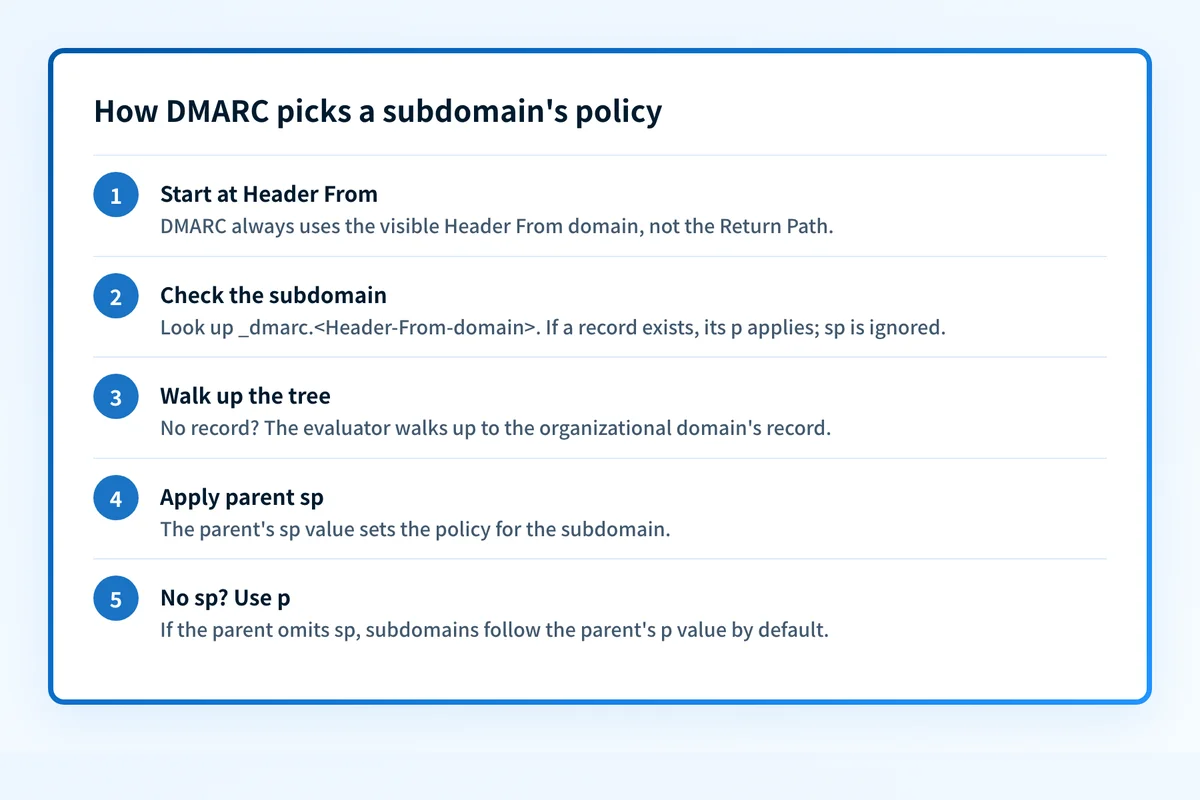 For an existing subdomain,
 sp is considered when policy discovery selects the Organizational Domain or PSD record rather than an exact Author Domain record.
The evaluator tries _dmarc.. If no valid record exists there, RFC 9989 uses a bounded DNS tree walk toward the organizational or public-suffix policy domain. For example, it can query _dmarc.promo.mail.example.com, then _dmarc.mail.example.com, and then _dmarc.example.com.
RFC 9989, published in May 2026 with RFC 9990 and RFC 9991 for reporting, replaced RFC 7489. It replaces public-suffix-list policy discovery with the DNS tree walk and adds np for non-existent subdomains alongside sp. The sp, aspf, and adkim behavior covered here remains central. See what DMARCbis changed for the full migration summary.
When sp applies
- If the Author Domain has its own valid DMARC record, that record's
ppolicy is used. - If policy discovery selects the Organizational Domain or PSD record and the Author Domain is an existing subdomain of that domain, the selected record's valid
spvalue applies. - If the applicable Organizational Domain or PSD record omits
sp, itspvalue applies to an existing subdomain. - If a DMARC Policy Record is published on a subdomain of an Organizational Domain or PSD, its
spvalue is ignored. The record'spvalue applies to that exact Author Domain. - If the Author Domain does not exist,
npis considered beforesp; the subdomain policy guide covers that branch in detail.
- Valid
spvalues arenone,quarantine, andreject. The difference between the last two matters at enforcement time, see reject vs quarantine. - There is no
sp=samein the DMARC specification. Some tools display wording like same as p or inherit to describe the default behavior whenspis omitted. That label means the subdomain follows the parent’spvalue.
- Header From is
promo.mail.example.com
_dmarc.promo.mail.example.comexists withp=none.- Result. Use
p=nonefrom that record.spon any parent is not consulted.
- Header From is
mail.example.com
- No
_dmarc.mail.example.com. Parent_dmarc.example.comexists withp=reject; sp=quarantine. - Result. Use
sp=quarantinefrom the parent because the Header From is a subdomain without its own record.
- Header From is
help.example.com
- No
_dmarc.help.example.com. Parent_dmarc.example.comexists withp=rejectand nosp. - Result. Subdomain inherits
p=rejectbecausespis absent.
- Header From is
example.com
_dmarc.example.comexists withp=reject; sp=none.- Result. Use
p=reject.spis irrelevant because the Header From is the parent itself.
sp can do in practice
sp=noneexpresses no handling preference for failures from applicable existing subdomains.sp=quarantinesays the Domain Owner considers those failures suspicious.sp=rejectsays the Domain Owner considers those failures a clear indication that use of the domain is not valid.
Record fragments to adapt
These examples are illustrative. Replace the reporting address with one authorized for your domain and review the complete record before publication.
- Root protected, subdomains monitored
v=DMARC1; p=reject; sp=none; rua=mailto:dmarc-reports@example.com
- Namespace fully enforced
v=DMARC1; p=reject; sp=reject; rua=mailto:dmarc-reports@example.com
- Subdomain override during onboarding
_dmarc.events.example.com TXT "v=DMARC1; p=none; rua=mailto:dmarc-reports@example.com"
Operational guidance
Choose sp from production evidence, not from the apparent simplicity of the namespace. Inventory active Author Domains, inspect delivered-message authentication, and review aggregate reports before requesting stricter handling. Publish a separate subdomain record when that Author Domain needs its own policy, reporting destination, alignment mode, or operational owner. A parent sp change can affect legitimate low-volume senders that a public DNS inventory cannot reveal.
Alignment modes: what aspf and adkim actually control
DMARC has two independent alignment checks.
- SPF alignment uses the RFC5321 Mail From identity, often called the Return Path. Check what a domain currently publishes with the SPF checker.
- DKIM alignment uses the
d=domain in the DKIM signature.
s) or relaxed (r).
aspf (SPF alignment)
aspf=rrelaxed. The From domain must share the same organizational domain with the SPF authenticated domain.aspf=sstrict. The domains must match exactly.
adkim=rrelaxed. The From domain must share the same organizational domain with the DKIMd=domain.adkim=sstrict. The domains must match exactly.
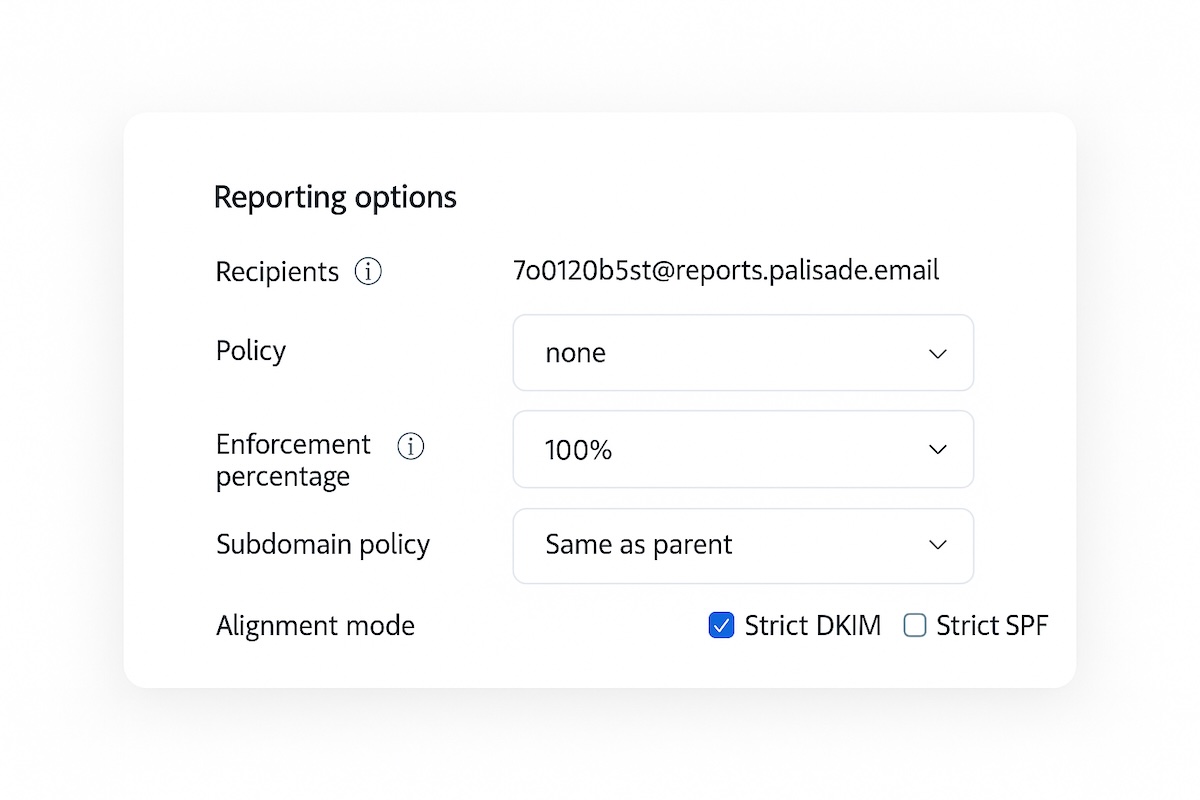
Palisade's DMARC agent helps operators manage sp, aspf, and adkim across their domains.
Operational fit for each alignment mode
aspf=s (SPF strict)
What it requires From domain must match the SPF identity exactly.
When it may fit
- Every legitimate sender can use an SPF-authenticated Mail From domain identical to the Author Domain.
- The organization deliberately wants SPF-based DMARC passes to require that exact domain relationship.
- Many providers default to subdomain Return Path values like
bounce.mail.example.com. Those fail under strict mode unless reconfigured. - Legacy systems may not support a root Return Path.
billing@example.com via a billing platform that insists on spf.mail.example.com. With aspf=s, SPF fails alignment until you change the Return Path to example.com or rely on DKIM alignment instead.
aspf=r (SPF relaxed)
What it requires From and SPF identity share the same organizational domain.
When it may fit
- Operational flexibility for multi ESP environments and faster onboarding.
- Accommodates controlled subdomain Return Path values that share the same Organizational Domain as the Author Domain.
- More than one domain can satisfy the relationship, so subdomain issuance and Return Path ownership still need governance.
- Relaxed alignment is not a receiver-delivery guarantee and does not make a failing SPF check pass.
news@example.com via an ESP that uses return.news.example.com. With aspf=r, a passing SPF result for that Mail From domain can align with the Author Domain.
adkim=r (DKIM relaxed)
What it requires
From and DKIM d= share the same organizational domain.
When it may fit
- A legitimate platform signs with a controlled subdomain that shares the Author Domain's Organizational Domain.
- The organization needs that passing subdomain signature to remain eligible for a DKIM-aligned DMARC pass.
- Subdomain signing authority and DKIM key rotation still need governance.
- Forwarding can preserve or break DKIM depending on whether the signed content changes; relaxed alignment does not guarantee that the signature survives.
support@example.com with a passing signature using d=support.example.com. With adkim=r, DKIM aligns and can produce the DMARC pass even if SPF does not provide an aligned pass after forwarding.
adkim=s (DKIM strict)
What it requires
From domain must match DKIM d= exactly.
When it may fit
- Every production sender that relies on DKIM alignment can sign with a
d=domain identical to its visible From domain. - The organization deliberately wants DKIM-based DMARC passes to require that exact relationship.
- Some providers cannot sign with root
d=without extra setup. - Migration requires DNS changes and coordination.
alerts@example.com, signed d=example.com using a centralized service. With adkim=s, any vendor that insists on d=vendor.example.com fails until you move them to root signing.
How to decide from production evidence
- Inventory every email source. Note the current Return Path domain and the DKIM
d=domain. An email security score gives a quick baseline before you start. - Treat relaxed alignment as the protocol default, not as evidence that every sender is configured correctly.
- Change
adkimto strict only after every production path that depends on DKIM alignment has an exact-match signing domain or another verified aligned pass. Use the operational adkim change and rollback guide for that review. - Change
aspfto strict only after the SPF-authenticated Mail From identity for every relevant sender exactly matches its Author Domain, or DKIM supplies the intended aligned pass. - Use per-subdomain DMARC records when an Author Domain requires a separate policy, reporting destination, alignment setting, or operational owner.
- Decide
p,sp, andnpseparately from alignment mode. Review the p/sp/np inheritance and DNS Tree Walk before changing namespace-wide handling.
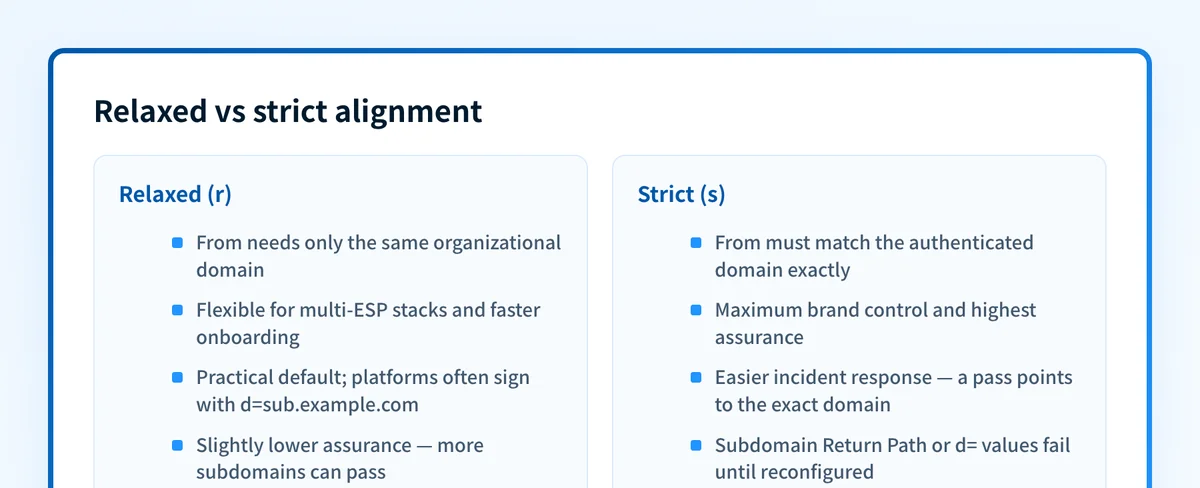 Applies to both aspf (SPF) and adkim (DKIM) alignment.
Real subdomain scenarios
- Marketing on a new ESP signs with
d=promo.example.comand usesreturn.promo.example.com. If the visible From domain ispromo.example.com, a passing SPF result for that Mail From domain or a passing DKIM signature with thatd=domain can satisfy relaxed alignment. Publishing the tags alone does not make authentication pass. - A legacy ticketing tool sends from
support@example.combut uses a vendor Return Path that you cannot change. SPF often fails after forwarding to agents. If a delivered message retains a passing DKIM signature withd=support.example.com, that signature aligns underadkim=rand can satisfy DMARC even when SPF fails. Publishing DKIM keys alone does not establish a passing signature. - A phishing campaign abuses the existing subdomain
secure-login.example.com. Raising the parent tosp=rejector publishing_dmarc.secure-login.example.comwithp=rejectasks participating receivers to reject messages that fail DMARC for that name.
Check the record before changing alignment or subdomain policy
Use the DMARC checker to confirm the public policy record at the Author Domain and any applicable parent. The checker can show published tags and syntax; it cannot identify every production sender, prove that a delivered message aligned, or predict a Mail Receiver's private delivery decision.
Palisade analyzes DMARC aggregate-report evidence to identify sending sources and alignment issues and to propose remediation work. Your team reviews the evidence and controls any DNS change. Start with Palisade when the unresolved job is ongoing sender inventory and policy progression rather than a one-time public record check.
Evidence
Sources and further reading
Questions readers ask
FAQs
Q1. Do subdomains inherit the root DMARC policy by default
An applicable existing subdomain can use the Organizational Domain or PSD record's sp value, or its p value when sp is absent. A valid record at the exact Author Domain takes precedence, and sp on a subdomain-published record is ignored.
Q2. What happens if I omit sp
Applicable existing subdomains use the Organizational Domain or PSD record's p value. For example, if the applicable record has p=reject and no sp, reject is the Domain Owner's requested policy for those failures; a Mail Receiver still makes the handling decision.
Q3. Should most organizations pick strict or relaxed alignment
There is no universal tightening sequence. Relaxed alignment is the RFC default. Strict alignment is appropriate only when production evidence shows that the exact domain requirement matches every sender that must use that authentication path.
Q4. Can different subdomains use different policies
Yes. Publish a DMARC record at each subdomain that needs a custom stance. For example, _dmarc.events.example.com can use p=none during onboarding, while _dmarc.billing.example.com uses p=reject.
Q5. Is sp=none safe to leave in place
sp=none expresses no requested handling preference for applicable subdomain failures. Whether to change it depends on the Domain Owner's policy decision and evidence that legitimate subdomain mail passes DMARC; the RFC does not require a universal deadline or progression.
Q6. How do aspf and adkim interact with sp
aspf and adkim decide whether authentication aligns. When policy discovery selects an Organizational Domain or PSD record, sp can supply the requested policy for failures from applicable existing subdomains. They cover different parts of the evaluation.
Q7. What is a sensible starting configuration
p=none; sp=none; aspf=r; adkim=r is an illustrative policy and alignment fragment, not a universal prescription or a complete reporting configuration. Before changing policy or alignment, identify production senders, inspect delivered-message results, and review aggregate reports. A Mail Receiver still makes the final handling decision.

Written by
Samuel ChenardCEO & Co-Founder, Palisade
Samuel Chenard is the CEO and co-founder of Palisade, agentic DMARC software for IT teams and MSPs, from one domain to thousands.
More from Samuel →