Warmly email warmup: what the search term may mean
 ChatGPT
 Claude
 Gemini
 Perplexity
 Grok
GrokIn brief
Warmly email warmup is an ambiguous search term. It may refer to Warmy Email Warm-Up, but the spelling and intended workflow are not confirmed.
"Warmly email warmup" is ambiguous. No verified product or workflow named "Warmly" is established by the available primary sources. The closest documented name is Warmy's "Email Warm-Up" offering, but treating "Warmly" as a misspelling of "Warmy" is an inference, not a confirmed correction. Confirm the product name and the goal before connecting a sending inbox or changing mail settings.
At a glance
Quick takeaways
- "Warmly" and "Warmy" are different spellings, and the available sources only document Warmy.
- Warmy labels one offering "Email Warm-Up."
- Warmy says it provides "real-time insights into email placement inbox, spam, or promotions."
- Warmy also says its service prepares "domains and IPs" for outreach campaigns, which is vendor marketing language.
- Warmup Inbox describes a separate vendor workflow: connect an inbox, exchange messages in its network, then track deliverability.
- Neither vendor page establishes a mailbox-provider-endorsed warm-up procedure, a universal sending schedule, or a guaranteed placement outcome.
What "Warmly email warmup" can refer to
The search term may be looking for a product with a similar name, or it may be asking about the general idea of warming up an email-sending inbox. Those are different questions.
Warmy's public homepage calls its offering "Email Warm-Up." Its product page also states that it provides "real-time insights into email placement inbox, spam, or promotions," alongside deliverability, domain-reputation, and DNS-configuration metrics. That is a statement about Warmy's product, not evidence that a warm-up service changes a mailbox provider's placement decision.
A different vendor, Warmup Inbox, describes its own service in three stated stages:
- "Connect your sending inbox"
- "Our network opens & replies"
- "Track Deliverability"
For broader context on the signals involved in sending mail, see email deliverability. Deliverability is a wider operational subject than the name or workflow of one warm-up service.
When the answer changes
Use the product name and the evidence you have to choose the next action.
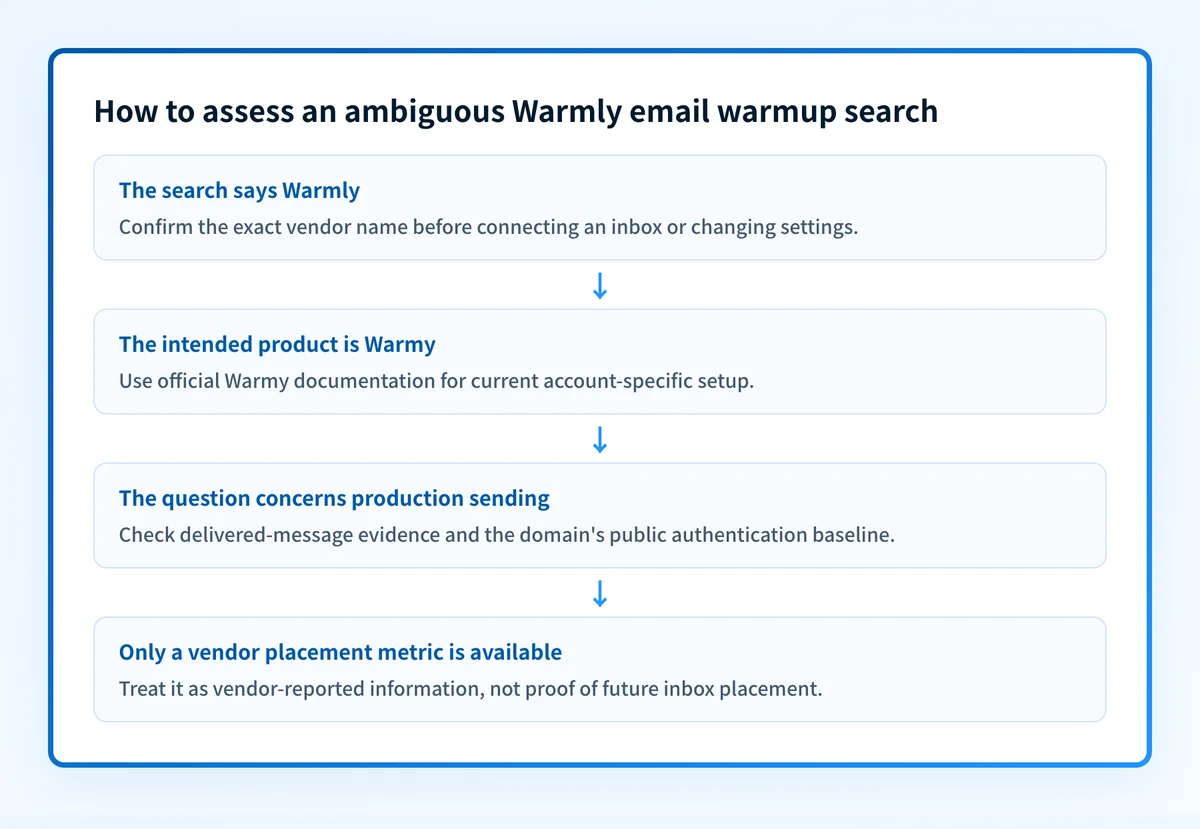
- If you meant Warmy, use Warmy's official site or support documentation to confirm the current setup path, prerequisites, and account-specific settings before connecting an inbox.
- If you meant Warmly as an email-writing word, this is a writing-style question, not a documented email-deliverability workflow.
- If you are evaluating a warm-up service generally, do not infer a universal procedure from either vendor's marketing page.
- If you have a delivered production message, inspect its authentication results and the sending path before attributing placement changes to a warm-up service.
- If you need to assess an AI-branded warm-up product, see AI email warmup: what it is and what it cannot prove.
A worked evidence example
A product page can support a statement about what that product says it offers. It cannot, on its own, prove an outcome for a particular sending domain.
Search term: warmly email warmup
Confirmed product name: not yet confirmed
Documented vendor statement:
Warmy: "Email Warm-Up"
Vendor-reported metric statement:
"real-time insights into email placement inbox, spam, or promotions"
What this does not establish:
- A mailbox provider endorsed the workflow
- A fixed warm-up volume or duration
- Inbox placement for your production messages
- A future delivery outcome
If the intended product is Warmy, the documented statement is that Warmy offers "Email Warm-Up." If the intended product is not Warmy, the evidence above does not identify it.
A separate evidence object is needed before making operational decisions. A delivered message from the real production application can show authentication results for that message. DNS records can show what is published. Vendor status can show what the vendor reports. DMARC aggregate reports can later show observed authentication patterns across sending sources. These are different layers of evidence.
Do not connect a business-critical sending inbox or change DNS based only on a similarly named search result. Confirm the vendor, account, and intended sending path first.
What to check next
Start with the evidence closest to your question.
If the question is "Which product did I mean?", confirm the exact spelling in the vendor account, contract, browser history, or internal request. Do not assume that Warmly means Warmy.
If the question is "Is the sending domain ready for outreach?", inspect the domain's authentication and security baseline. Palisade's email security score tool can check public signals related to the domain's email-security posture.
If the question is "Did a particular message authenticate?", use the delivered message's raw headers and compare them with the actual sending application. A public domain check cannot show the complete production path or a receiver's private placement decision.
If the question is about another named service, use its official documentation. For a separate product-specific discussion, see Apollo email warmup: what it does and what it cannot prove.
Check the sending domain's public security baseline
If the product name is confirmed but the unresolved question is the domain's public email-authentication posture, inspect that baseline before treating a vendor metric as a production result.
Check the email security score
A public score cannot prove inbox placement, verify a warm-up service's effect, show every production sender, or predict how a receiver will handle future mail. For ongoing DMARC work, Palisade is agentic DMARC software that analyzes aggregate-report data, identifies sending sources and authentication or alignment issues, and proposes a next policy step for human review. It does not control a receiver's private reputation decision or guarantee delivery.
Evidence
Sources and further reading
Questions readers ask
Frequently asked questions
Is warmly a good email closing?
"Warmly" is a sign-off, so whether it fits depends on your relationship with the recipient and how formal the message is. That is a writing question rather than a deliverability one, and this page covers email warm-up instead. If you meant the sending process, the answer below explains how warm-up services work.
How do you warm up an email?
You connect a sending inbox to a warm-up service, which then exchanges messages with other mailboxes in its network and reports what it observes. Warmup Inbox describes exactly that sequence: connect your sending inbox, its network opens and replies, then track deliverability. Warmy calls its own offering "Email Warm-Up." No mailbox provider endorses a universal procedure, so treat each vendor's version as its own product rather than a standard.
Is Warmly the same as Warmy?
They are spelled differently, and the documented product is Warmy, without the "l." Reading "Warmly" as "Warmy" is a reasonable guess rather than a confirmed correction. Check the spelling in your account, contract, or internal request before you connect an inbox or follow setup instructions.

Written by
Johanie DupontBrand & Ecommerce Email
Johanie Dupont works on brand and ecommerce email at Palisade: BIMI and verified marks, sender requirements, and getting marketing mail into the inbox.
More from Johanie →