Email warmup GitHub: what the search does and does not show
 ChatGPT
 Claude
 Gemini
 Perplexity
 Grok
GrokIn brief
Email warmup GitHub does not identify a verified GitHub warmup feature. Check the actual sending domain's authentication and security evidence.

Email warmup GitHub does not identify a verified GitHub email-warmup feature or setup workflow. GitHub is a platform for developers, code, collaboration, automation, and security, while email warmup refers to activity performed by an email-focused service. If you are assessing a real sending domain, inspect its authentication and security posture first instead of assuming that a GitHub search result proves anything about sending behavior or inbox placement.
At a glance
Quick takeaways
- GitHub describes a platform for developers, agents, and code, not a documented native email-warmup product.
- A GitHub repository is code and documentation, not proof that a production sending domain is authenticated or trusted by receivers.
- Mailwarm describes its own warm-up service as exchanging messages with accounts in its network, including inbox actions.
- The cited material does not establish that email warmup improves reputation, avoids spam filtering, or guarantees inbox placement.
- A public domain assessment can inspect published email-security evidence, but it cannot prove a receiver's private decision about a specific message.
- Deliverability investigation starts with the actual sender, domain, and message path.
How the distinction works
GitHub says its platform brings together "developers, agents, and code" and presents capabilities for code, planning, collaboration, automation, and security on its main product page. That page does not document an email-warmup product, native setup flow, integration, or recommended workflow.
This is a narrow observation about the cited GitHub page. It does not prove that GitHub contains no repository, third-party project, or discussion related to warmup. A specific project would need its own repository URL, documentation, maintenance history, and operating instructions before it could be evaluated as a concrete tool.
An email warmup service is a different kind of system. For example, Mailwarm's product page states: "Your email account automatically sends dozens of emails to +50,000 Mailwarm's accounts, and get replies." It also describes inbox actions, including "Moved to Inbox." Those statements describe Mailwarm's stated service behavior only. They do not establish a universal result for every warmup service, sending domain, mailbox provider, or recipient.
For the wider operational topic, see email deliverability. Delivery depends on the real production path. A code-hosting search cannot establish whether an application sends mail, which domain it uses in the visible From field, or whether that mail authenticates.
When the answer changes
The answer changes when you have a specific, documented repository or an actual sending system to assess.
A GitHub project may be relevant if its own documentation identifies:
- The maintained repository and its owner.
- The email service or mailbox accounts it connects to.
- The data it reads, sends, or stores.
- The authentication method and any required permissions.
- Its production safeguards, limits, and rollback process.
The question also changes when you have evidence from the sending domain itself. Published DNS records can show whether a domain has certain email-authentication and security records. They cannot show whether the production application uses those records correctly, whether a delivered message passed authentication, or how a recipient handled it.
Do not treat a public DNS result as approval to begin or expand a production sending program. Validate the exact message path before changing sending behavior.
If you are choosing between a repository and a warmup provider, keep the assessment separate from deliverability claims. The available evidence does not support a claim that either option will improve inbox placement. It also does not identify a native GitHub alternative to an email-warmup service.
Related searches may lead to product-specific pages such as AI email warmup or Apollo email warmup. Those pages concern distinct product contexts. They do not turn GitHub itself into a verified email-sending platform.
A worked evidence rule for this search
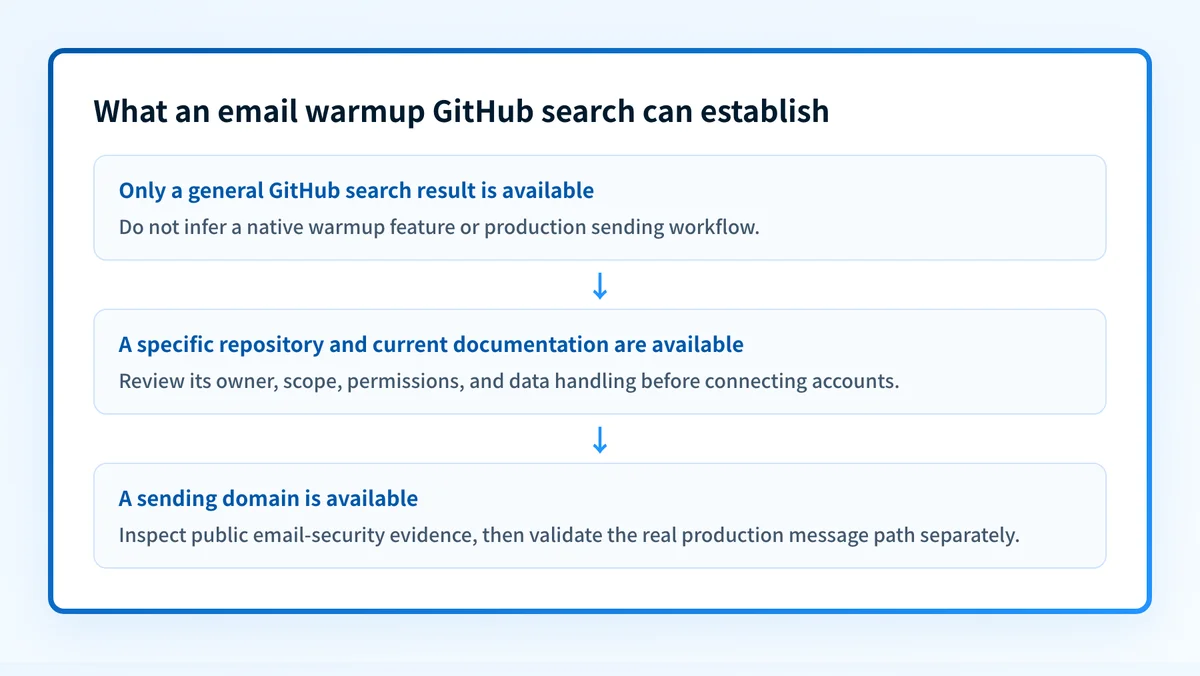
Use this decision rule before acting on an "email warmup GitHub" result:
Search result: "email warmup GitHub"
If there is no specific repository URL and current project documentation:
  Do not infer a GitHub email-warmup feature or production workflow.
If there is a specific repository:
  Review its documented owner, scope, permissions, data handling, and release activity.
  Do not infer deliverability results from repository presence alone.
If you need to assess a sending domain:
  Inspect the domain's published email-security posture.
  Then validate the actual production sender and a real delivered message separately.
The final two checks answer different questions.
- A domain-level check can inspect public DNS evidence associated with email security.
- A delivered-message check requires a real message from the exact production path and its available headers or receiving-system evidence.
- Ongoing DMARC analysis requires aggregate-report data after reports accumulate.
Mailwarm's own site includes the question "Is email warmup enough to fix deliverability issues?" in its FAQ navigation, but the cited material does not provide an answer. Do not fill that evidence gap with a claim about effectiveness.
Take the next step with the evidence you have
If your only evidence is a GitHub search, find the exact repository and read its current documentation before connecting accounts, granting permissions, or sending mail through it.
If you have a sending domain, use Palisade's email security score to inspect its public email-security posture. Record the domain you checked and compare the result with the DNS configuration your team expects.
If you have a message from the production sender, keep the message evidence separate from the public lookup. Check the visible From domain, the sending application, and the authentication results available for that exact message. If the sender is part of a broader program, use the deliverability hub to frame the work around the actual sending path.
Check the sending domain behind the search
A GitHub result does not show the email-security records published for the domain you plan to send from. Check that actual domain first, then compare the public result with your intended DNS configuration.
Check the domain's email security posture
A public domain check cannot prove that a repository is safe to connect, that a production application is using the domain correctly, that a receiver will place a message in the inbox, or that email warmup repaired a sending problem. For ongoing DMARC work, Palisade is agentic DMARC software that analyzes aggregate-report data, identifies authentication or alignment issues, and proposes the next policy step for human review. It does not autonomously change your DMARC policy or guarantee delivery.
Evidence
Sources and further reading
Questions readers ask
Frequently asked questions
Does GitHub have a native email-warmup feature?
GitHub does not document an email-warmup feature, and its product page presents code, planning, collaboration, automation, and security instead. Warmup is something email services sell, not a code-hosting platform. Anything warmup-related you find on GitHub is third-party code rather than a GitHub product.
Does a GitHub repository prove that email warmup will work?
No, because a repository holds code and documentation, not evidence about your mail. Its existence says nothing about how a domain sends, whether those messages authenticate, or what a receiver does with them.
Is Mailwarm the same as GitHub?
No, they are different kinds of product. GitHub is a platform for developers and code. Mailwarm describes an email-warmup service that exchanges messages with accounts in its stated network.
Can a public domain check prove inbox placement?
No, because a public domain check reads published records rather than a receiver's decision. It can show the email-security evidence a domain publishes. It cannot show how a receiver handled one message or where the next one will land.
Should I connect an email account to a GitHub project found in search?
Connect an account only after you have identified the exact project and reviewed its current documentation, owner, permissions, data handling, and production safeguards. A search result on its own does not name a specific repository worth approving. Handing mailbox access to unreviewed code puts that account and its mail at risk.

Written by
Johanie DupontBrand & Ecommerce Email
Johanie Dupont works on brand and ecommerce email at Palisade: BIMI and verified marks, sender requirements, and getting marketing mail into the inbox.
More from Johanie →