Apollo email warmup: what it does and what it cannot prove
 ChatGPT
 Claude
 Gemini
 Perplexity
 Grok
GrokIn brief
Apollo email warmup uses inbox-network activity for connected mailboxes, but it does not prove authentication, consent, or inbox placement today.
Apollo Email Warmup is a connected-mailbox feature that uses a third-party inbox network to send and engage with system-generated warmup messages. Apollo documents it for new mailboxes and domains. It can create warmup activity, but that activity does not prove that a real campaign is authenticated, sent to consenting recipients, or placed in recipients' inboxes. Apollo's separate Inbox ramp up option gradually raises sending in Apollo sequences or scheduled emails for mailboxes with prior history.
At a glance
Quick takeaways
- Apollo Email Warmup requires a mailbox connected to Apollo.
- Apollo says Email Warmup uses a private inbox network and Warmbox.ai.
- Apollo distinguishes Email Warmup from Inbox ramp up, which raises Apollo sending gradually for mailboxes with sending history.
- Warmup activity does not prove SPF, DKIM, or DMARC authentication for a production campaign.
- A warmup setting does not show recipient consent, list quality, or a receiving provider's inbox-placement decision.
- Public authentication records and real delivered-message evidence answer different questions from warmup activity.
How Apollo email warmup works
Apollo's Email Warmup documentation describes a feature for connected mailboxes that sends system-generated messages through a private inbox network supplied by Warmbox.ai. Apollo positions the feature for new mailboxes and domains. Its purpose is preparatory mailbox activity, not a test of a specific campaign's delivery.
Apollo also documents Inbox ramp up as a different option. Rather than using the warmup inbox network, it gradually increases sending from Apollo sequences or scheduled emails for mailboxes that already have sending history. The distinction matters because neither option establishes whether the production path has the authentication configuration required by the visible From domain.
Email deliverability includes authentication, reputation, content, recipient engagement, and receiver-specific handling. See the email deliverability hub for the wider model. A warmup feature can affect activity around a mailbox, while a mailbox provider still makes its own decision about each real message.
DMARC evaluates whether SPF or DKIM passes and aligns with the message's visible From domain. The domain owner publishes a DMARC policy in DNS, and the receiving system performs the evaluation for the message it receives, as specified by RFC 9989. Warmup traffic is not a substitute for that message-level authentication result.
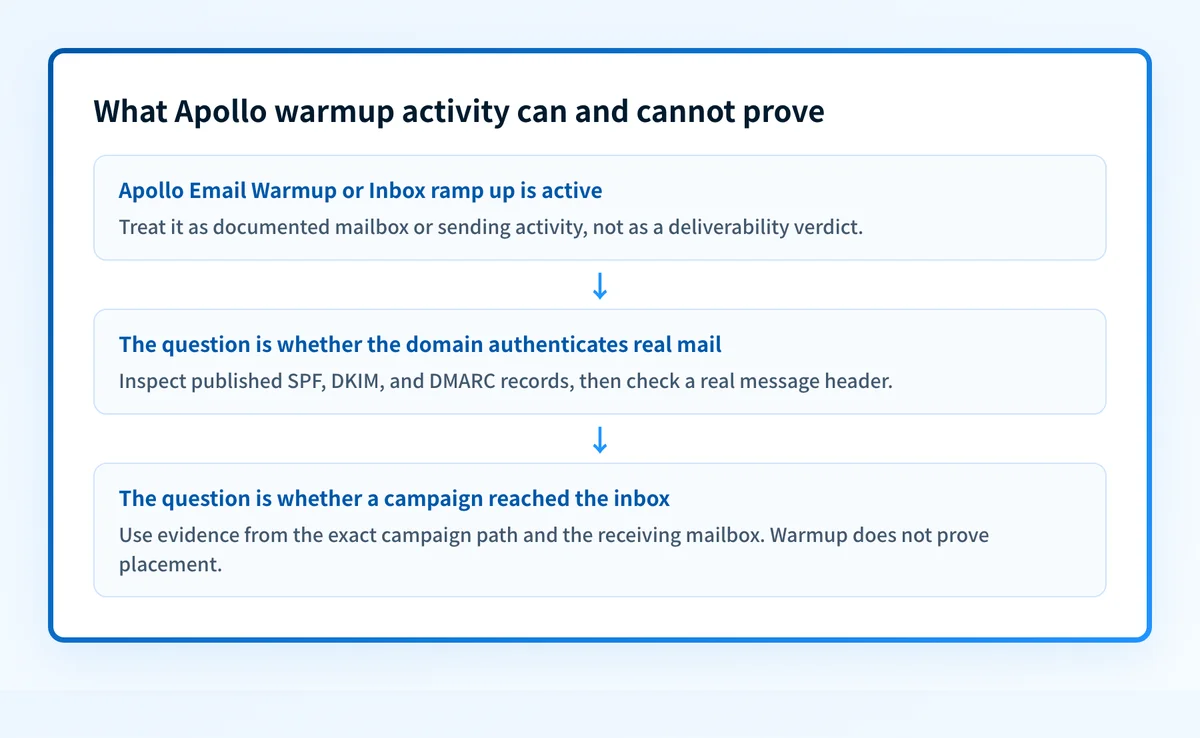
When the answer changes
Use the evidence that matches the question.
- If the mailbox and domain are new, Apollo's Email Warmup feature may be the relevant Apollo option because Apollo documents it for new mailboxes and domains.
- If the mailbox already has sending history and the question is about gradually raising Apollo sequence or scheduled-email volume, Apollo's Inbox ramp up option is the closer documented feature.
- If a campaign fails DMARC, shows an authentication warning, or has an unaligned sender identity, inspect the authentication configuration and a delivered message. Warmup activity does not resolve that evidence.
- If recipients report spam-folder placement or filtering, preserve an example from the exact campaign path and investigate the observed symptoms. The guide to emails going to spam covers that diagnostic task.
The usable decision rule is straightforward: use Apollo's documented feature descriptions to choose between warmup activity and ramped Apollo sending, then use DNS records and a real delivered message to assess authentication and campaign behavior.
A worked evidence check
Suppose sales.yourdomain.com sends a real Apollo campaign with a visible From address at yourdomain.com. A warmup setting can show that Apollo is performing warmup activity for the connected mailbox. It cannot answer whether the actual campaign message passes DMARC.
Inspect a real message header from that production path. The relevant evidence may include a receiver-generated result like this illustrative shape:
Authentication-Results: mx.receiver.example;
  spf=pass smtp.mailfrom=mail.yourdomain.com;
  dkim=pass header.d=yourdomain.com;
  dmarc=pass header.from=yourdomain.com
This example is illustrative only. Do not publish or share unredacted message headers, customer addresses, message IDs, or tokens.
Under RFC 8601, an Authentication-Results field communicates authentication assessments made by the receiving system. The field can include SPF, DKIM, and DMARC method results and their associated properties. The exact values in a real header depend on the receiver and the message path.
A result such as dmarc=pass is evidence about that delivered message. It still does not guarantee later inbox placement because receiving systems can use additional local signals. Conversely, a warmup activity indicator is not an Authentication-Results field and does not prove that this production message passed DMARC.
For a deeper protocol explanation, see what DMARC is. If you are evaluating generic service categories rather than Apollo's feature, use Email warmup service: compare the evidence before choosing.
Check the evidence before changing sending volume
Start with the evidence you already have.
- If you only have a domain name, inspect its public SPF, DKIM, and DMARC configuration with the Email Security Score.
- If you have a real campaign message, obtain its raw headers from the receiving mailbox and compare its authentication results with the visible From domain and return-path domain.
- If you have reports of filtering, retain the campaign details and diagnose the exact sending path before changing volume or assuming warmup caused the result.
- If you receive DMARC aggregate reports over time, use them to inventory sending sources and identify authentication or alignment failures that a public DNS check cannot reveal.
Inspect authentication before relying on warmup
Apollo's documented feature can create warmup activity, while a public authentication check can reveal whether the domain publishes SPF, DKIM, and DMARC records that need review before production sending.
Check public email authentication
If DMARC reports later reveal unknown sources or alignment failures across the domain, Palisade is DMARC software that analyzes DMARC aggregate-report data, identifies issues, and creates prioritized remediation tickets for human review. It does not control Apollo, automatically change DNS or sender settings, prove inbox placement, or guarantee a receiver's behavior.
Evidence
Sources and further reading
Questions readers ask
Frequently asked questions
What is the best email warm up tool?
There is no single best email warmup tool for every mailbox or sending program. Choose a product based on the evidence it produces, its documented behavior, and whether it addresses your actual problem. A warmup feature does not replace public authentication checks or real-message investigation.
What is the most hacked email provider?
No authoritative, universal ranking establishes one email provider as the "most hacked." Account-compromise risk depends on factors such as phishing resistance, multi-factor authentication, recovery controls, device security, and user practices. A provider's security posture is separate from email warmup and inbox placement.
How do I turn off Apollo email warming?
Check Apollo's current Email Warmup documentation and the controls available in your authenticated account before making a change. The documented feature description does not make a current account-specific disabling workflow universal, so do not rely on inferred UI steps.
Does email warmup actually work?
Yes, email warmup can create the activity its provider documents, such as messages sent through a warmup network. It does not prove authentication for a real campaign, recipient consent, sender reputation at a particular receiver, or inbox placement. Validate those questions with DNS records, delivered-message headers, and observed campaign evidence.
Does Apollo Email Warmup fix a damaged reputation?
No. Apollo states that Email Warmup cannot repair a damaged sender reputation. Investigate the affected production sending path, authentication results, recipient practices, and filtering evidence instead of treating warmup activity as a repair result.

Written by
Johanie DupontBrand & Ecommerce Email
Johanie Dupont works on brand and ecommerce email at Palisade: BIMI and verified marks, sender requirements, and getting marketing mail into the inbox.
More from Johanie →