Lemlist email warmup: what Lemwarm does and cannot prove
 ChatGPT
 Claude
 Gemini
 Perplexity
 Grok
GrokIn brief
Lemlist email warmup uses Lemwarm to send warm-up activity and track deliverability signals, but its score alone does not prove inbox placement.
Lemlist email warmup refers to Lemwarm, Lemlist's included automated warm-up and deliverability product. Lemwarm says it creates inbox activity through its network, tracks a deliverability score, and flags risks related to sending behavior and content. Those signals can help assess an inbox before a campaign, but they do not prove that a real production campaign will reach a recipient's inbox.
At a glance
Quick takeaways
- Lemlist says every Lemlist seat includes Lemwarm, its automated warm-up and deliverability booster.
- Lemwarm says its network includes more than 20,000 healthy domains in more than 100 countries.
- Lemwarm reports a deliverability score and alerts for risks related to sending behavior and content.
- Lemwarm recommends about four weeks of warm-up, then two more weeks before real campaigns begin.
- A warm-up score is a product-provided signal, not receiver-side proof of inbox placement.
- SPF, DKIM, DMARC, MX records, sending volume, list quality, and content can all affect deliverability risk.
How Lemlist email warmup works
Lemlist describes Lemwarm as an automated warm-up and deliverability booster included with every Lemlist seat. The associated Lemwarm product page says its service warms inboxes across a network of more than 20,000 healthy domains in more than 100 countries, with "Real inboxes, real replies, no bots."
The vendor also says Lemwarm monitors a deliverability score and detects spam risks that may affect campaigns based on sending behavior and content. That makes it a vendor-provided monitoring signal for the connected inbox. It is part of the broader work described in email deliverability, where technical authentication, sender behavior, and receiver-specific decisions all matter.
Lemwarm identifies several risk categories:
- Missing or misconfigured SPF, DKIM, DMARC, or MX records.
- Sudden sending-volume increases.
- Unverified recipient lists.
- Content risks.
When a Lemwarm score changes the answer
Use a Lemwarm score or alert as an input to investigate, not as the final answer to "Will this campaign land in the inbox?"
The answer changes with the evidence available:
- If Lemwarm identifies an SPF, DKIM, DMARC, or MX issue, inspect the published technical configuration before raising production volume; for a routing alert, check which MX records the domain publishes. What SPF is explains one part of the authentication layer.
- If the score shows a risk after a volume increase, compare the planned campaign volume with recent sending behavior. A warm-up pattern does not establish that a larger campaign has the same receiver response.
- If the score flags content or list risk, test the approved campaign through the real sending path and review the list's collection and consent process.
- If recipients report spam placement or messages are missing, collect message headers and delivery evidence from the exact campaign path. The warm-up score alone cannot explain a recipient's mailbox decision.
For a broader discussion of automated warm-up products and their limits, see AI email warmup: what it is and what it cannot prove.
A practical decision rule for Lemlist email warmup
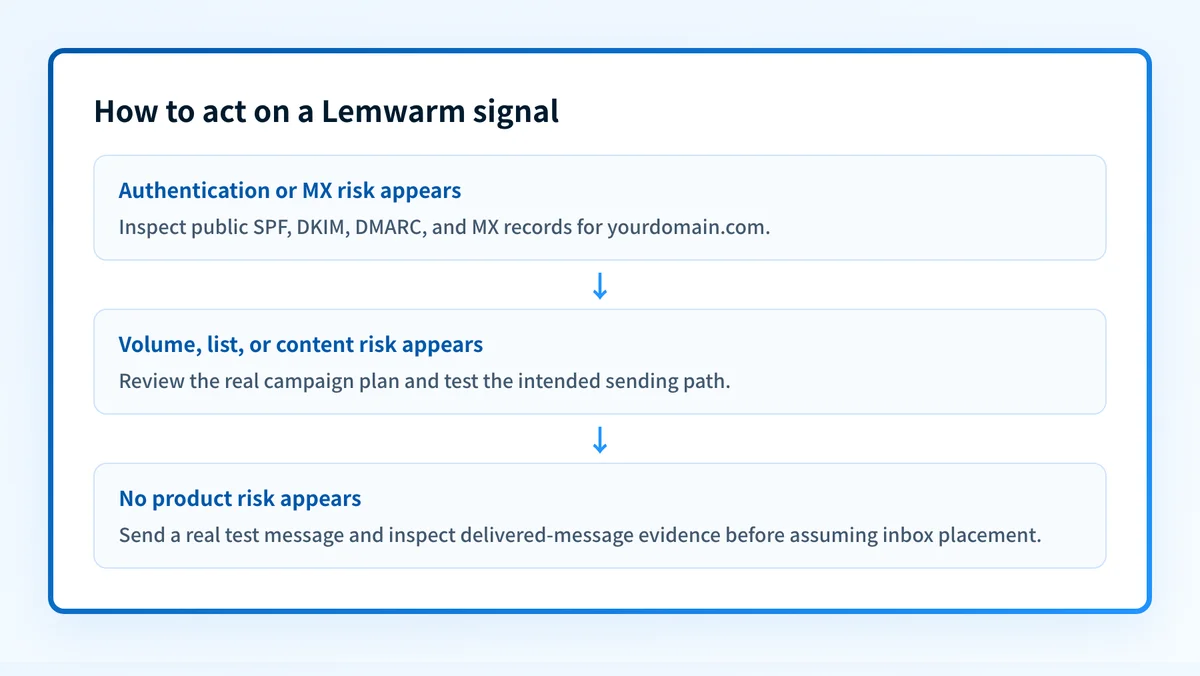
Treat the result as a signal that determines the next check:
Illustrative only
Lemwarm score or alert
|
|-- Authentication or MX risk appears
|   -> Check SPF, DKIM, DMARC, and MX records.
|
|-- Volume, list, or content risk appears
|   -> Review the real campaign plan and test a controlled production path.
|
|-- No risk appears
    -> Do not assume inbox placement. Send a real test and inspect its results.
A passing warm-up signal does not establish four separate layers of evidence.
- DNS: The intended SPF, DKIM, DMARC, and MX records resolve through authoritative DNS and a public resolver.
- Vendor: Lemwarm or the sending provider reports its own connection or risk status.
- Message: A delivered message from the real campaign path shows the relevant authentication results in its raw headers.
- DMARC: Aggregate reports show which sources are using the visible From domain and whether their SPF or DKIM identifiers align.
What to check before starting a real campaign
Start with the evidence you already have.
If you have a Lemwarm alert about technical setup, check the domain's public authentication and mail-routing signals. If your concern is campaign behavior, compare the planned list, content, and volume with the activity that produced the alert. If mail has already been sent, inspect a real delivered message and the sending platform's delivery evidence.
Lemwarm says Gmail and Outlook can connect in one click, and lists Zoho, FastMail, and Proton as other supported providers. The available vendor statements do not establish the current setup screens, whether warm-up starts automatically, or the precise controls available for each provider. Use Lemlist's Help Center for current provider and technical-setup instructions.
A public diagnostic can help find visible domain issues before a campaign starts. It cannot validate the private connection state of a Lemlist inbox, prove a production message used the expected signing path, or predict recipient inbox placement.
Check the domain signals behind a Lemwarm alert
If Lemwarm identifies a technical risk, inspect the public SPF, DKIM, DMARC, MX, and related email-security signals for the sending domain before changing campaign volume.
Check the email security score
A public domain check cannot prove that Lemwarm is configured correctly, repair a campaign, monitor future sender behavior, or show how a specific recipient mailbox will place a message.
For teams that need ongoing visibility after launch, Palisade autonomously analyzes DMARC aggregate-report data, identifies sending sources and authentication or alignment issues, and creates prioritized remediation tickets. It can propose the next DMARC policy step when the evidence supports it, while a human reviews the evidence and applies the change. It does not control Lemwarm, change a mailbox provider's placement decision, or guarantee delivery.
Evidence
Sources and further reading
Questions readers ask
Frequently asked questions
Is Lemwarm included with Lemlist?
Yes, Lemwarm comes with every Lemlist seat. Lemlist says each seat includes its built-in deliverability tools, and Lemwarm is one of them.
Does Lemwarm guarantee inbox placement?
No, Lemwarm cannot guarantee placement, because receiving mail systems make that decision themselves. Lemwarm gives you a score and risk alerts, and Lemlist does not claim those signals confirm where a real campaign lands.
How long does Lemwarm recommend warming up an inbox?
Lemwarm recommends about four weeks of warm-up, then two more weeks before starting real campaigns. It recommends leaving the service running afterward. This is vendor guidance, not a universal mailbox-provider rule.
Can Lemwarm identify DMARC problems?
Lemwarm can point at a DMARC problem only indirectly, through the risk categories it flags. It lists missing or misconfigured SPF, DKIM, DMARC, and MX records among common deliverability concerns, which can point you at a problem without diagnosing it. Confirm the actual DNS records and check a real production message before treating the issue as resolved.
Does a good warm-up score mean a campaign is safe to send?
No, a good score does not make a campaign safe to send, because it says nothing about the campaign itself. Your list, volume, content, and sending path all still shape the result, and each receiver decides placement on its own. Treat the score as a reason to keep checking, not as a green light.

Written by
Johanie DupontBrand & Ecommerce Email
Johanie Dupont works on brand and ecommerce email at Palisade: BIMI and verified marks, sender requirements, and getting marketing mail into the inbox.
More from Johanie →