Open source email warmup: what the term actually means
 ChatGPT
 Claude
 Gemini
 Perplexity
 Grok
GrokIn brief
Open source email warmup is not a defined software category. Learn how to distinguish open-source email infrastructure from documented warm-up tools.
Open source email warmup is not a defined software category based on the available primary-source material. An email product can be open source, and a separate product can describe warm-up activity, without either fact proving that there is an open-source warm-up tool. Treat the term as a claim to verify in a project's official documentation, especially before connecting a production sending domain.
At a glance
Quick takeaways
- Open-source email infrastructure and email warm-up are separate product descriptions.
- Forward Email calls itself a free, open-source email service for custom domains, but its public description does not establish a warm-up feature.
- Mailwarm describes automated messages and replies across its account network, but that is a vendor description of its own commercial service.
- Available evidence does not establish that warm-up activity improves inbox placement or sender reputation.
- A project should explicitly document warm-up behavior, controls, and evidence collection before it is called an open-source email-warmup tool.
- Authentication posture and real message evidence are more useful starting points than a category label.
How the distinction works
Forward Email describes itself as "a free, open-source email service for custom domains". Its public description concerns custom-domain email forwarding and hosting. That makes it an example of open-source email infrastructure, not evidence of an email-warmup capability.
A warm-up service describes a different mechanism. Mailwarm says its service automatically sends messages to accounts in its network and receives replies. It also says daily activity can include messages being opened, marked as important, and replied to. Those statements describe Mailwarm's product behavior. They do not establish how a mailbox provider evaluates mail, and they do not prove an inbox-placement or reputation outcome.
This distinction matters because "open source" identifies how software is made available, while "warmup" would need to identify a documented operational function. Neither label supplies evidence about a domain's current authentication, a message's delivered headers, or a receiver's private filtering decision.
For broader context on the factors that affect mail handling, see email deliverability. If you need evidence from a particular delivered message, analyzing email headers online is the adjacent task to start with.
When the answer changes
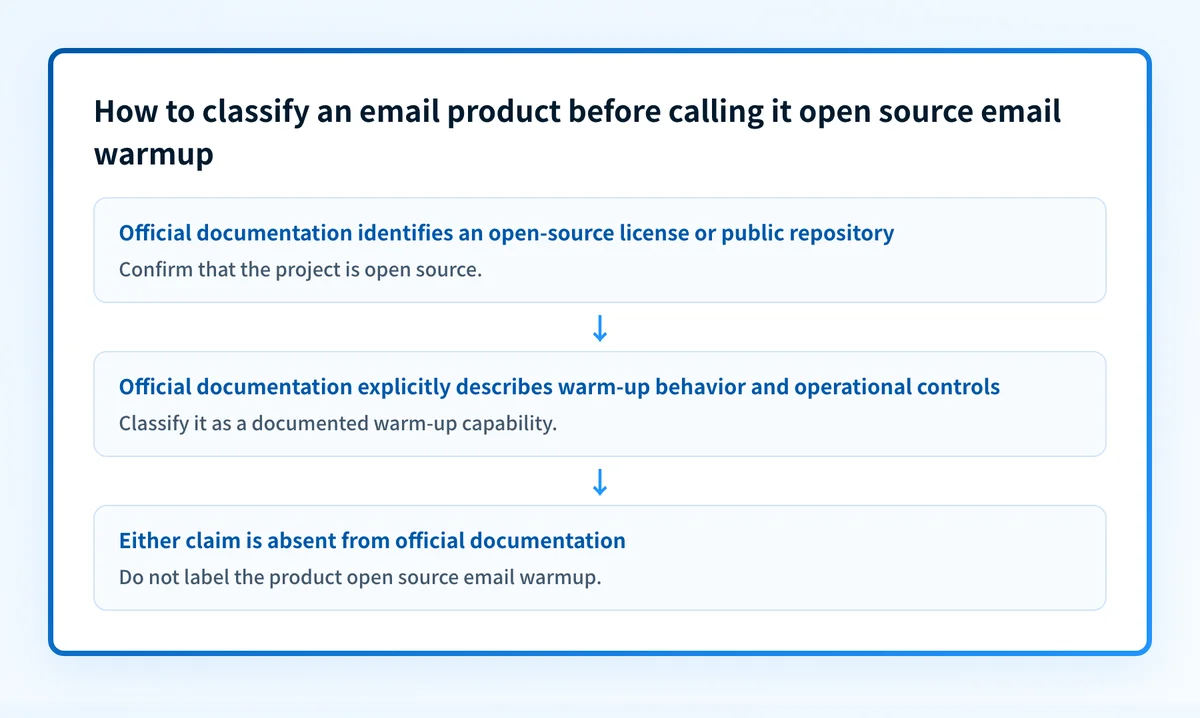
Call a product an open-source email-warmup tool only when its official materials explicitly establish all of the following:
- The project is available under an identified open-source license or has an official public repository.
- Its documentation explicitly describes warm-up behavior rather than only forwarding, hosting, sending, or receiving email.
- The documentation identifies the operational controls, such as what the software sends or receives and how an operator configures it.
- The documentation explains what evidence the tool collects and what the results mean.
Forward Email's plan information provides a useful example of why product-specific documentation matters. Its Free plan is forwarding-only and, according to Forward Email's plan explanation, cannot send directly from the custom domain or store email on its servers. That is a limitation of that plan, not a rule about open-source software or email warm-up generally.
A worked classification example
Use the product's own public documentation before applying the label.
Product: Forward Email
Official description: "a free, open-source email service for custom domains"
Documented function: custom-domain email forwarding and hosting
Documented warm-up behavior: not established by the cited product description
Classification: open-source email infrastructure, not confirmed open-source email warmup
Now compare the separate warm-up description:
Product: Mailwarm
Official description: automated messages sent to and replies received from its account network
Open-source license or repository: not established by the cited product description
Classification: commercial warm-up service description, not confirmed open-source email warmup
Neither example supports a claim that warm-up improves inbox placement. The supplied primary material does not include a mailbox-provider requirement, standards document, or other controlling source that establishes such an outcome.
A useful practical test is to separate three questions:
- Does the product's documentation establish that it is open source?
- Does the documentation establish that it performs warm-up activity?
- Does your own sending domain have valid authentication and delivered-message evidence?
What to check next
Start with the evidence you already have.
- If you have a project name, read its official repository and documentation. Look for an explicit license, a maintained installation path, a documented warm-up mechanism, and an explanation of the evidence it produces.
- If you have a delivered message, inspect the raw headers from that exact sending path. This can show authentication results for that message, but it cannot prove future delivery outcomes or a receiver's private reputation decision.
- If you are reviewing a domain before changing sending practices, use the email deliverability hub to separate authentication, message evidence, and operational questions.
- If you are considering a vendor-specific warm-up feature, compare its documented behavior with the limited question you need answered. Apollo email warmup covers that distinction for Apollo's offering.
Check your domain's authentication posture before changing sending practices
Before drawing conclusions from an email-warmup label, inspect the domain's current security and authentication posture with Palisade's diagnostic tool.
Check the email security score
A public domain check cannot prove that a production application sends through the expected path, that a mailbox provider will place a message in the inbox, or that future messages will authenticate.
Evidence
Sources and further reading
Questions readers ask
Frequently asked questions
Can I use Forward Email as an open-source email-warmup tool?
No, because Forward Email is not a warm-up product. Forward Email describes a free, open-source email service for custom domains, and its documentation names no warm-up feature at all. If warm-up is what you need, look at products that actually describe it.
Does Mailwarm describe an open-source warm-up product?
No, Mailwarm describes a commercial warm-up service. Its page covers its own account-network activity and mentions no open-source licence, public repository, or self-hosted deployment. Treat it as a paid product rather than something you can inspect or run yourself.
Does email warmup improve inbox placement?
Nobody has shown that it does, because no mailbox provider publishes a rule that rewards warm-up activity. Mailwarm describes what happens inside its own service, which is a description of the product rather than a measured placement result. Check your authentication records and the headers of a real delivered message instead.
Does email forwarding mean a service can send from my custom domain?
No, forwarding and sending are different jobs. Forward Email states that its Free plan supports forwarding only and says that plan cannot send directly from the custom domain or store email on its servers. That is a limit of that plan, so check the documentation for whichever plan and service you use.
What evidence should I review before changing sending practices?
Review the domain's published DNS records, the sending vendor's verification status, headers from a real message sent through the production path, and DMARC aggregate reports after data accumulates. Each layer answers a different question.

Written by
Johanie DupontBrand & Ecommerce Email
Johanie Dupont works on brand and ecommerce email at Palisade: BIMI and verified marks, sender requirements, and getting marketing mail into the inbox.
More from Johanie →