Unlimited email warmup: what the label actually covers
 ChatGPT
 Claude
 Gemini
 Perplexity
 Grok
GrokIn brief
Unlimited email warmup usually describes a vendor plan feature, not unlimited sending. Compare the stated inbox, support, test, and daily-email limits.
Unlimited email warmup is usually a vendor-plan label, not a promise of unlimited warmup messages or unlimited sending volume. Check what the provider makes unlimited, then find the plan's explicit daily email allowance, mailbox guidance, and support or testing limits. On one published plan, TrulyInbox pairs "Unlimited Accounts" with a limit of "200 warmup emails/day." Email deliverability also depends on factors that a plan label does not define.
At a glance
Quick takeaways
- "Unlimited" can describe connected email accounts, support, spam tests, or another plan feature.
- An unlimited-account claim does not necessarily mean unlimited warmup emails per day.
- TrulyInbox publishes "Unlimited Accounts" alongside "200 warmup emails/day."
- EmailWarmup.com uses "unlimited" for deliverability support and free spam tests, which are separate from message volume.
- Treat a recommendation to keep warmup enabled as vendor guidance unless a mailbox provider documents the same requirement.
- Compare the written limits before relying on an unlimited email warmup claim.
How an unlimited email warmup plan works
"Unlimited email warmup" has no universal definition in the material available from mailbox providers or standards bodies. It is better read as commercial wording that needs a feature-by-feature interpretation.
For example, TrulyInbox's published pricing page states: "Unlimited Accounts Connect unlimited email accounts. No per-inbox pricing, ever." The same page states "200 warmup emails/day." It also says that plan is "Best suited for 3 email inboxes" and describes an allocation of "send 67 warmup emails per mailbox daily."
Those statements can coexist. The account-connection feature is unlimited under that plan's wording, while the daily warmup-email volume is finite. Neither statement establishes a general rule for other providers.
Other uses of the same word make the distinction clearer. EmailWarmup.com's product page promotes "unlimited deliverability support" and "Unlimited free email spam tests." Those offers describe support and tests. They do not, by themselves, state unlimited warmup-message volume.
A warmup plan is therefore an input to a broader deliverability process, not a complete description of mail performance. For adjacent plan-label questions, see AI email warmup: what it is and what it cannot prove.
When the answer changes
The answer changes when the provider defines "unlimited" differently. Read the exact noun next to the word.
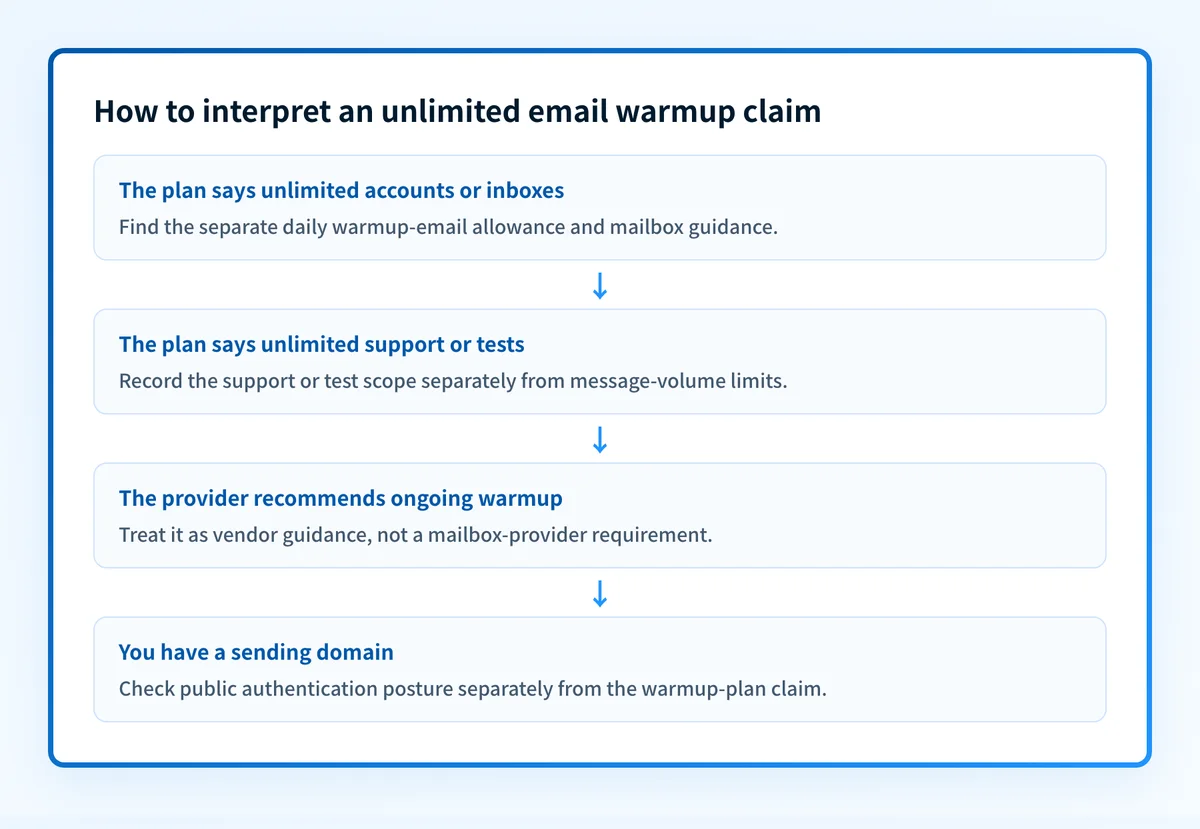
Use this decision rule:
- If the plan says unlimited accounts or inboxes, compare it with any per-day warmup-email allowance and recommended mailbox count.
- If the plan says unlimited support, determine what support channel or service period that statement covers.
- If the plan says unlimited tests, check whether the plan separately limits connected accounts, warmup messages, or test types.
- If the plan recommends an ongoing warmup setting, treat that as the provider's guidance unless a mailbox provider publishes the same requirement.
Do not turn an "unlimited" label into a sending-volume assumption. A plan can have unlimited account connections and a separate finite daily warmup allocation.
This distinction also matters when comparing products. A buyer cannot infer matching limits, timing, inbox-placement outcomes, or provider acceptance from a shared use of the word "unlimited." Compare the plan text that is published for the exact service and tier under consideration.
Worked example: read the limit behind the label
A plan description can contain both an unlimited feature and a bounded operating allowance:
Plan label: Unlimited Accounts
Connected accounts: unlimited
Warmup email allowance: 200 warmup emails/day
Suggested mailbox use: 3 email inboxes
Illustrative per-mailbox allocation: 67 warmup emails daily
This is a worked interpretation of the wording published by TrulyInbox, not a universal warmup-plan specification.
The useful question is not "Is this unlimited?" in isolation. Ask:
- What does the provider explicitly say is unlimited?
- Is there a daily warmup-email allowance?
- Does the provider suggest a number of mailboxes for that allowance?
- Are support, spam tests, and account connections described as separate features?
- Does the provider publish a recommendation about when warmup should remain enabled?
The record also helps separate vendor claims from email authentication evidence. A warmup plan description does not show whether the sending domain publishes SPF, DKIM, or DMARC correctly, and it does not show how a specific receiver will place future messages. For a related vendor-specific explanation, see Apollo email warmup: what it does and what it cannot prove.
Check the next thing based on the evidence you have
If you are comparing plans, collect the current plan page and identify every stated limit before selecting a tier. If you already have a sending domain, inspect its authentication posture separately from the warmup provider's marketing language.
Use an authentication check when you have a domain name and need a public DNS view. Keep the result separate from any claim about warmup effectiveness, since a public check cannot observe an individual recipient's placement decision or a service's internal warmup activity.
Check the sending domain's authentication posture
Run the sending domain through Palisade's score checker to inspect its public email-authentication posture alongside the plan limits you recorded.
Check the email security score
A public score cannot verify inbox placement, prove a warmup service's effectiveness, observe continuous sending behavior, or establish a receiver's private reputation decision.
If your team needs to identify sending sources and authentication or alignment issues across domains, Palisade autonomously analyzes DMARC aggregate-report data and creates prioritized remediation tickets. A human reviews the evidence and applies any DNS or policy change.
Palisade does not guarantee delivery or inbox placement, and it does not prove that a vendor's warmup plan will produce a particular result.
Evidence
Sources and further reading
Questions readers ask
Frequently asked questions
Does unlimited email warmup mean unlimited sending?
No, the word usually covers one part of the plan rather than your whole sending. TrulyInbox, for example, advertises unlimited account connections while also stating "200 warmup emails/day" in the same plan material. Read the provider's stated volume limit instead of assuming "unlimited" applies to everything.
Are unlimited inbox connections the same as unlimited warmup emails?
No, they are two separate plan features. TrulyInbox lists "Unlimited Accounts" alongside a stated daily warmup-email allowance, so how many mailboxes you can connect says nothing about how many warmup messages each one may send.
Does unlimited deliverability support mean unlimited warmup volume?
No, that phrase is about support, not sending volume. EmailWarmup.com uses "unlimited deliverability support" and separately promotes "Unlimited free email spam tests." Neither statement promises an unlimited warmup-message allowance.
Should email warmup stay enabled permanently?
Leaving warmup on permanently is vendor advice rather than a rule. Warmforge recommends leaving its warmup running after the initial period it suggests, and no mailbox provider publishes a requirement to keep warmup on. Treat it as a vendor's operating preference and decide against your own sending pattern.
Can an email security score prove that warmup is working?
No, a public score cannot tell you that. It inspects the authentication posture your domain publishes, which reveals nothing about a warmup service's behavior, where your mail lands, or how a receiver rates your reputation in private.

Written by
Johanie DupontBrand & Ecommerce Email
Johanie Dupont works on brand and ecommerce email at Palisade: BIMI and verified marks, sender requirements, and getting marketing mail into the inbox.
More from Johanie →