Email IP warmup
 ChatGPT
 Claude
 Gemini
 Perplexity
 Grok
GrokIn brief
Email IP warmup is a sending-infrastructure practice offered by some email platforms. Check authentication and delivery evidence before attributing a.
Email IP warmup is a sending-infrastructure practice that some email platforms offer alongside direct sending IPs. It is not an email-authentication protocol, and it does not prove that a message will reach an inbox. Treat it as one part of a broader email deliverability investigation: first confirm the production sender, authentication results, and observed delivery outcomes.
At a glance
Quick takeaways
- Email IP warmup is an infrastructure concern, not a DMARC, SPF, or DKIM setting.
- Bird lists "Managed warm-up" alongside direct sending IPs in its email product offering.
- A warmup claim does not prove that a specific message was delivered, accepted, or placed in an inbox.
- Authentication and sending infrastructure are separate checks, even when an email provider offers both.
- Delivered, bounced, complained, and queued are distinct outcomes worth observing during a sending change.
- A public security check can identify published authentication posture, but it cannot reveal a receiver's private placement decision.
How email IP warmup fits into sending infrastructure
An IP address is a network identifier used to route traffic. In email operations, a sending platform may use IP infrastructure as part of the path that submits messages to recipient systems. Bird's email product page advertises "Direct sending IPs" and "Managed warm-up" in the same product description, alongside ISP-aware routing and authentication handling.
That placement supports a narrow conclusion: IP warmup is related to the sending infrastructure a platform manages. It should not be described as a universal protocol requirement or as a guaranteed delivery technique. No DMARC record tag enables IP warmup, and no SPF or DKIM result confirms that a platform has warmed an IP.
Email authentication answers a different question. DMARC evaluates whether SPF or DKIM passes with a domain aligned to the visible From domain. A message can have authentication evidence that needs review even when the sending service offers managed warm-up. For the protocol basics, see what DMARC is.
The practical distinction matters when a sending change coincides with delivery trouble. Do not assume the infrastructure change is the cause before collecting evidence from the actual production path. A delivered message header, the sender's delivery event, and the receiver's own available diagnostics provide more specific evidence than a product feature label.
When the answer changes
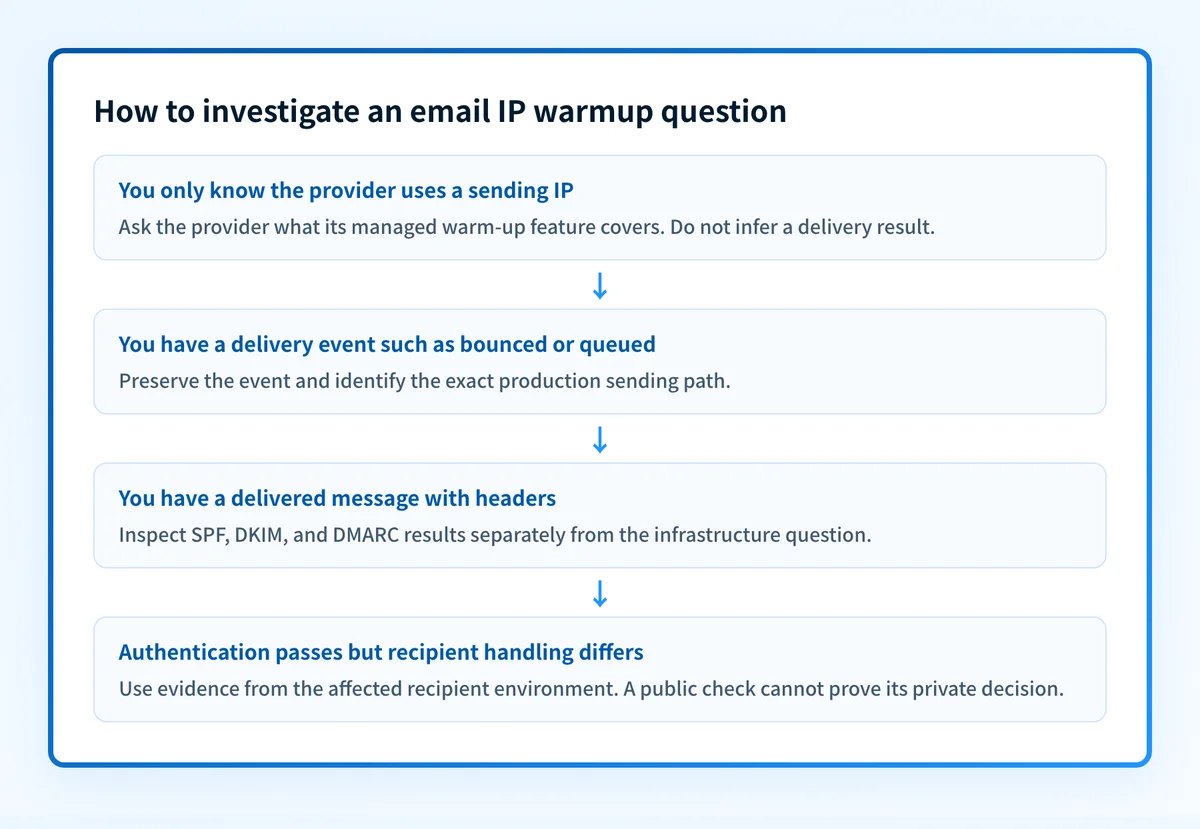
The right next action depends on the evidence you have, not on whether a platform advertises warm-up.
Use this decision rule:
- If you only know that a platform uses a direct sending IP, treat warmup as a platform capability to clarify with that provider. It does not establish what happened to a particular message.
- If you have a bounced, queued, complained, or delivered event, preserve that event and compare it with the message's sending path. Bird documents these as distinct test-mode states in its email product materials.
- If you have a raw delivered message, inspect its authentication results. The
Authentication-Resultsheader records a receiver's authentication assessment and is defined by RFC 8601. - If you see an authentication failure, resolve the SPF, DKIM, or DMARC issue before treating the incident as an IP warmup question.
- If authentication passes but placement or acceptance differs across recipients, gather evidence from the affected recipient environment. A public check cannot reveal a mailbox provider's private filtering or future placement decision.
Do not change DNS or sending infrastructure solely because a provider feature description mentions warm-up. First identify the production sending path and compare the change with observed message evidence.
This is also why IP warmup should remain separate from broader deliverability work. Email deliverability includes more than the identity of the sending IP. Authentication, content, recipient-system decisions, and the exact route of a message can all affect what you observe.
Worked evidence example
Suppose a team moves a production stream to a provider that advertises direct sending IPs and managed warm-up. The useful evidence object is not a guessed volume schedule. It is a record of the sending path and the result for an actual message.
Illustrative only
Sending platform: your-email-provider
Visible From domain: updates.yourdomain.com
Sending IP: provider-managed IP
Observed event: bounced
Authentication-Results: recipient.example;
  spf=pass smtp.mailfrom=mail.yourdomain.com;
  dkim=pass header.d=yourdomain.com;
  dmarc=pass header.from=yourdomain.com
This example separates the facts that can be checked:
- The sending platform and sending IP identify the path that needs investigation.
- The visible From domain identifies the domain used for DMARC alignment.
- The observed event records what happened to this message in the sender's available evidence.
- The authentication results show a receiving system recorded SPF, DKIM, and DMARC passes for this illustrative message.
For more detail on reputation-related signals, see what an email blocklist is and how to check one. A blocklist lookup may identify a public listing, but it does not prove that a particular receiver rejected mail because of that listing.
What to check next
Start with the evidence closest to the issue:
- For a domain-level question, check the currently published security and authentication posture.
- For a delivery event, inspect the sender's event record and a raw message from the same production path.
- For a receiver-specific decision, use the affected provider's own available dashboard, feedback, or postmaster evidence.
- For an ongoing domain portfolio, compare aggregate DMARC-report evidence with the approved sender inventory.
Check the domain posture before blaming IP warmup
Run the sending domain through the Email Security Score tool to inspect its public authentication and email-security posture. Compare the result with a raw message and the delivery event from the affected production path.
Check the email security score
A public domain check cannot prove that an IP was warmed, explain an individual receiver's decision, monitor future delivery, or guarantee inbox placement. For an ongoing DMARC reporting workflow, Palisade is agentic DMARC software that analyzes aggregate-report data, identifies sending sources and authentication or alignment issues, and proposes next policy steps for human review.
Palisade does not control a receiver's private reputation decision, change DMARC policy without human review, or guarantee delivery.
Evidence
Sources and further reading
Questions readers ask
Frequently asked questions
Is email IP warmup an email-authentication setting?
No. Email IP warmup is separate from SPF, DKIM, and DMARC. Authentication results can show whether a message authenticated for a recipient system, while warmup refers to sending infrastructure managed by a platform.
Does managed warm-up guarantee inbox placement?
No. A provider offering managed warm-up does not guarantee delivery, inbox placement, or a receiver's future filtering decision. Recipient systems can apply their own policies and assessments.
Can a DMARC pass prove an IP warmup worked?
No. A DMARC pass shows that DMARC evaluation passed for that message at that receiver. It does not prove anything about an IP warmup process or explain every delivery outcome.
What evidence should I collect after changing sending infrastructure?
Collect the sender's delivery event, the sending platform and production path, and raw headers from a delivered test message where available. Keep the evidence from the same message stream so authentication and delivery observations can be compared.
Can a public domain check diagnose a recipient-specific rejection?
No. A public check can inspect published DNS and domain-level security signals. It cannot reveal why one recipient system rejected, filtered, or placed a message.

Written by
Johanie DupontBrand & Ecommerce Email
Johanie Dupont works on brand and ecommerce email at Palisade: BIMI and verified marks, sender requirements, and getting marketing mail into the inbox.
More from Johanie →