
EmailAuth.io vs Palisade in 2026
EmailAuth.io combines DMARC reporting with threat investigation, alerts, BIMI, and security-integration options. Palisade is agentic: its AI agent investigates senders, prepares authentication fixes, and carries domains toward enforcement with your approval.
Our verdict: EmailAuth.io is a quote-led email-authentication product with DMARC reporting, investigation context, alerts, BIMI, and public API/STIX/TAXII integration language, plus SaaS and on-premise deployment options. Pick EmailAuth.io if those security-led options suit a team that will confirm scope with sales. Pick Palisade if you want an AI agent to investigate senders, prepare SPF and DKIM fixes, and propose approved policy changes that fit the domains with your approval.
 Samuel Chenard · CEO & Co-Founder, PalisadeSource checks through 2026-10-14
15-day full-product trial. Nothing is charged until it ends.
 ChatGPT
 Claude
 Gemini
 Perplexity
 Grok
Grok EmailAuth.io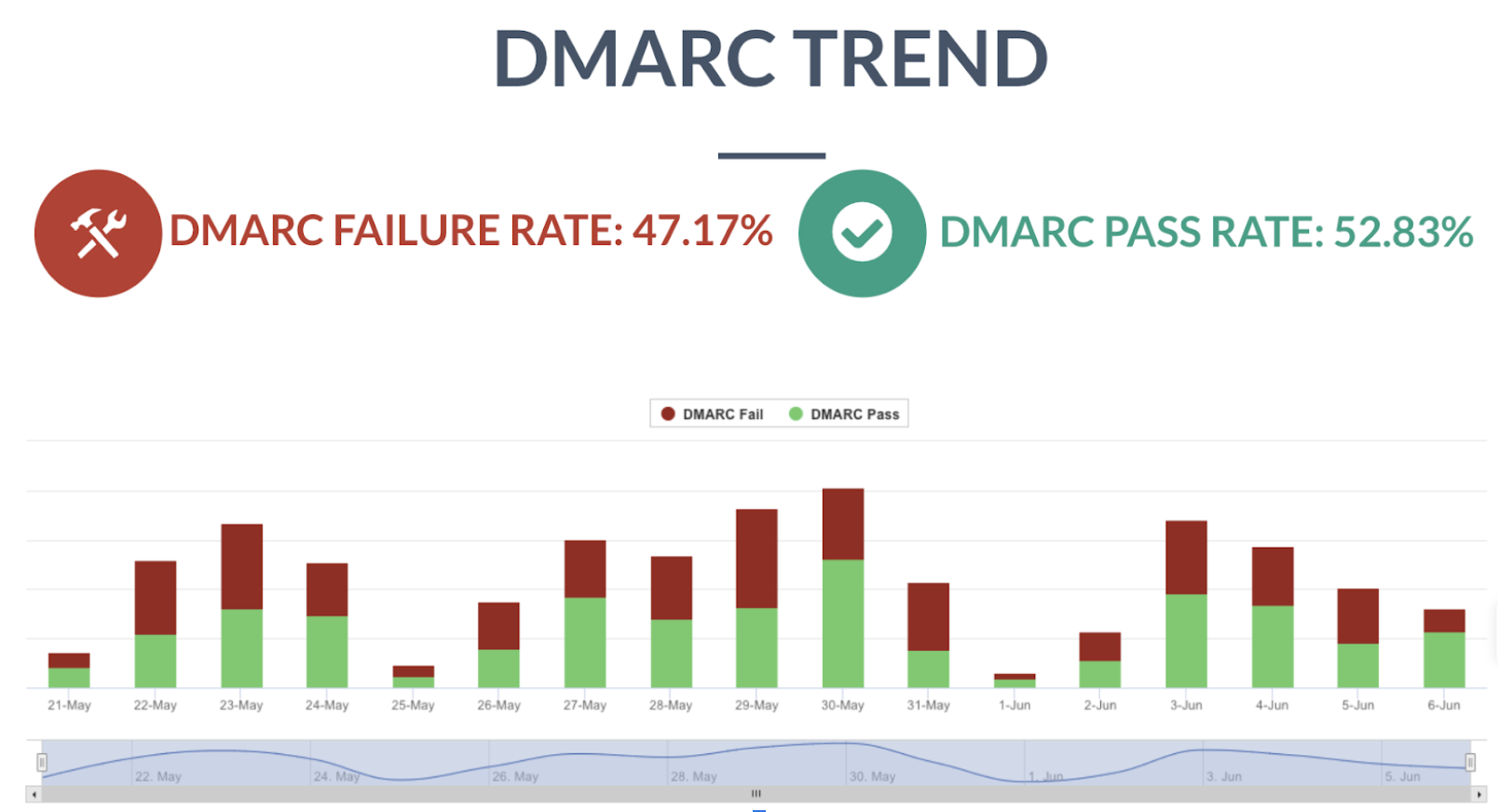
 Palisade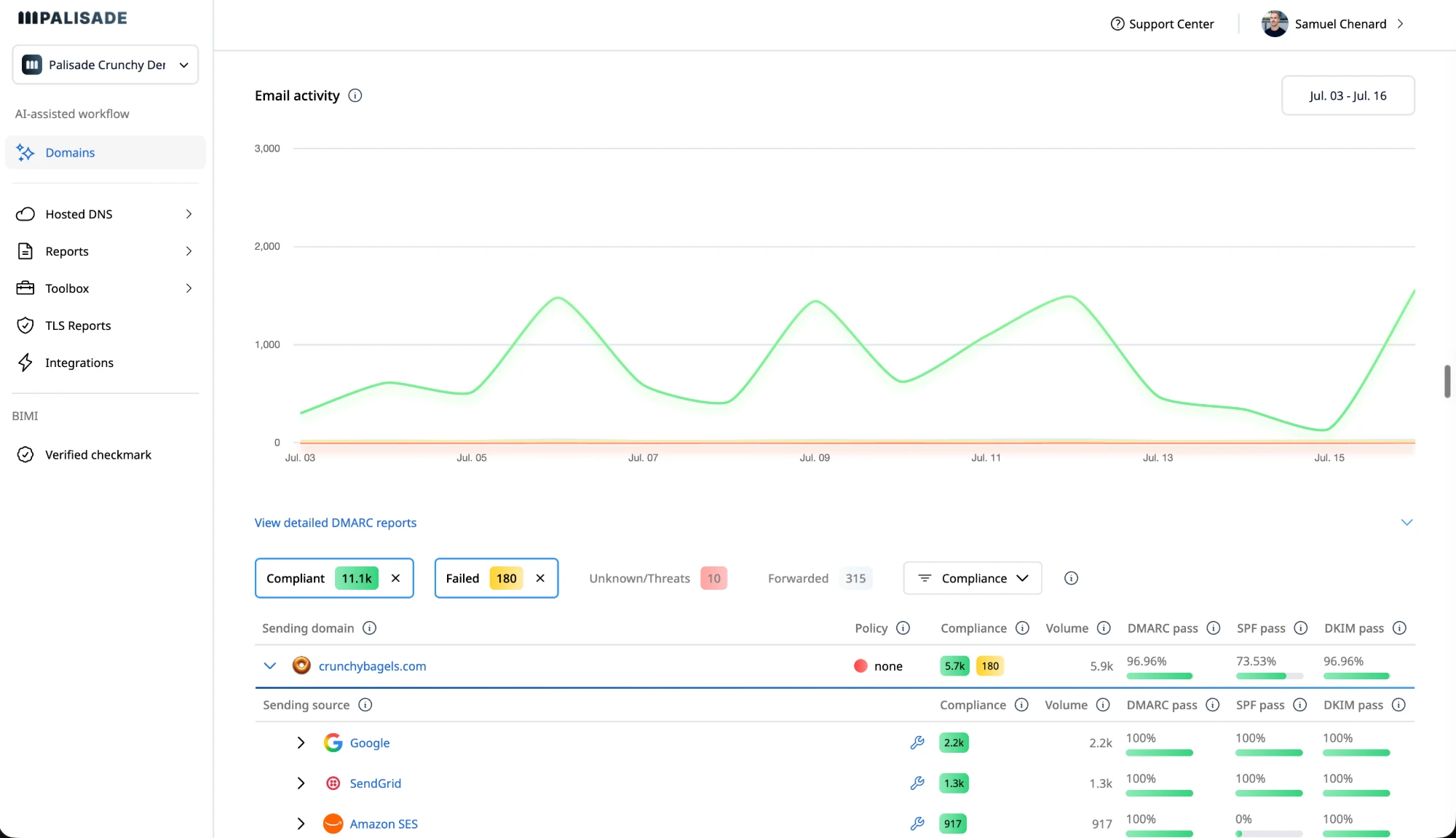
Provisional · 3/8 dimensions established
Average of established dimensions; may change as remaining dimensions are verified.
Full rubric · 8/8 dimensions established
Palisade's IT-team plans start at $19 a month, sized by email volume. Start with a 15-day full-product trial; nothing is charged until it ends.
Which one is right for you?
Best for Security teams that need threat investigation or on-premise deployment
Best for MSPs and IT teams responsible for multiple domains
- You want EmailAuth.io's Threat Map, IP investigation context, and configurable threat alerts alongside DMARC reporting.
- You need an on-premise deployment option as well as the SaaS application described on EmailAuth.io's homepage.
- Your security stack can consume API or STIX/TAXII data, and you want EmailAuth.io's SOAR-oriented integration path.
- You are comfortable requesting a tailored plan because EmailAuth.io does not publish a public rate card or named plan limits.
- You want an AI agent to investigate every sender, draft SPF and DKIM fixes, and propose each policy step toward p=reject for approval.
- You want hosted SPF, DKIM, DMARC, BIMI, and MTA-STS records, or Smart DNS Deployment through your DNS provider.
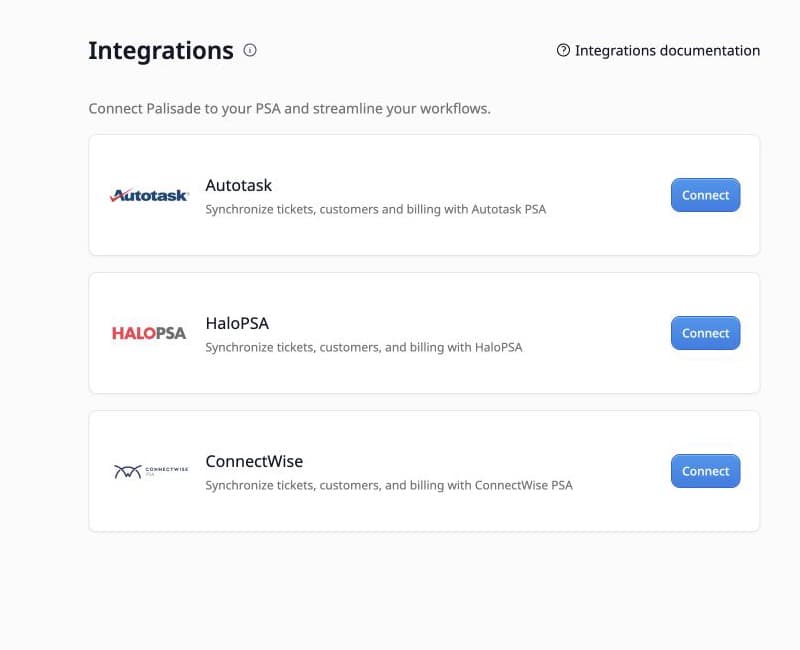
- You manage client domains and need native ConnectWise, HaloPSA, and Autotask integrations with portfolio-based MSP pricing.
- You want published IT-team pricing, free unlimited domain adding, and a 15-day full-product trial.
IT-team plans start at $19 a month, sized by email volume. Start with a 15-day full-product trial; nothing is charged until it ends.
Where the day-to-day work actually differs
| Feature | EmailAuth.io | Palisade |
|---|---|---|
| Enforcement and setup | ||
| AI agent that investigates senders and carries approved SPF, DKIM, and DMARC steps toward p=rejectWhether the product investigates senders and prepares approved authentication and policy work.EmailAuth.io describes automated setup and a free demo, but its public product pages do not advertise an agent that investigates senders, drafts fixes, and carries each policy step to p=reject (checked 2026-08-26). Source (2026-08-26) | No agent advertised | Agent drafts and proposes |
| Guided SPF, DKIM, and DMARC record creation and setupWhether the product helps create and set up SPF, DKIM, and DMARC records.EmailAuth.io publishes a personalised DMARC-record flow, setup guidance for SPF and DKIM, and links to its record generator and validators. Source (2026-08-26) | Personalized setup guidance | Agent drafts proposed records |
| Reporting and investigation | ||
| DMARC aggregate report monitoring and analyticsWhether DMARC aggregate reports are collected and shown as sender activity.The product and benefits pages describe DMARC report visibility, authorized and unauthorized sending sources, and report analysis. Source (2026-08-26) Source 2 (2026-08-26) | Source and report analysis | Agent analyzes reports |
| Threat map with IP reputation and investigation contextWhether the product maps suspicious IPs with reputation and investigation details.EmailAuth.io advertises a DMARC Threat Map and investigation for forward/reverse DNS match, IP Whois, and spam listings. Source (2026-08-26) | Threat Map investigations | Not listed |
| Configurable alerts for email-authentication threatsWhether alerts can notify operators about email-authentication threats.EmailAuth.io says users can configure threat alerts and receive notifications for alarming potential risks to a domain. Source (2026-08-26) | Configurable threat alerts | New-ticket alerts |
| Periodic DMARC progress reportsWhether recurring reports summarize DMARC progress across selected periods.EmailAuth.io describes weekly, monthly, and annual reports based on processed DMARC reports. Source (2026-08-26) | Weekly to annual reports | Periodic progress reports |
| Authentication and DNS | ||
| BIMI support alongside email authenticationWhether the product supports BIMI as part of email-authentication work.EmailAuth.io presents BIMI as a product surface for authenticated brand visibility. Source (2026-08-26) | BIMI product surface | Hosted BIMI record |
| Hosted SPF, DKIM, DMARC, BIMI, and MTA-STS recordsWhether the provider hosts the listed email-authentication records.EmailAuth.io's setup guide directs the operator to add a TXT record at the registrar or DNS provider; hosted records for these protocols are not advertised on the public pages checked (checked 2026-08-26). Source (2026-08-26) | —Not advertised | CNAME-delegated hosted records |
| Customer-authorized DNS deployment that writes approved records to the providerWhether approved records can be written to the customer's DNS provider.The public setup guide tells the operator to log in to the registrar or DNS provider and add the record manually; a customer-authorized DNS connection is not advertised (checked 2026-08-26). Source (2026-08-26) | Manual DNS changes | Customer-approved DNS deployment |
| SPF flatteningWhether SPF lookups are flattened to stay within DNS lookup limits.SPF flattening is not advertised on EmailAuth.io's public homepage, features page, or setup guide (checked 2026-08-26). Source (2026-08-26) Source 2 (2026-08-26) Source 3 (2026-08-26) | —Not advertised | One-lookup hosted SPF |
| Operations and integrations | ||
| API-based security integrations and indicator sharingWhether security data and indicators can move to other platforms through APIs.EmailAuth.io describes API and STIX/TAXII-based integrations that share indicators of compromise with other platforms in real time. Source (2026-08-26) | API and STIX/TAXII | API on every plan |
| Named ConnectWise, HaloPSA, and Autotask integrationsWhether named PSA platforms integrate with client-management workflows.EmailAuth.io's public features page names API and STIX/TAXII integrations but does not advertise ConnectWise, HaloPSA, or Autotask integrations (checked 2026-08-26). Source (2026-08-26) | —Not advertised | Native PSA integrations |
| AI and automation access | ||
| Documented REST or GraphQL API reference for customer-built integrationsWhether customers can build against a published API reference.EmailAuth.io advertises API and STIX/TAXII-based integrations, but does not advertise a customer-facing REST or GraphQL API reference on its public features, page-sitemap, or DMARC-tool pages (checked 2026-08-27). Source (2026-08-27) Source 2 (2026-08-27) Source 3 (2026-08-27) | No public API reference | REST API published |
| MCP server for connecting AI assistants to domain dataWhether an AI assistant can reach the product's data directly.EmailAuth.io does not advertise an MCP server or an AI-assistant integration on its public features or page-sitemap pages (checked 2026-08-27). Source (2026-08-27) Source 2 (2026-08-27) | —No MCP server listed | MCP server published |
| Advertised AI or machine-learning features inside the productWhether the vendor describes AI or machine learning as a product capability.EmailAuth.io does not advertise a product AI or machine-learning feature on its public features page (checked 2026-08-27). Source (2026-08-27) | —No product AI listed | Approval-gated agent work |
| Automated data delivery through exports, webhooks, or a feedWhether data can leave the product automatically without a dashboard download.EmailAuth.io says reports can be downloaded for a selected timeline, but does not advertise scheduled exports, webhooks, or a data feed on its public features page (checked 2026-08-27). Source (2026-08-27) | —No automated export listed | API data access |
Want to compare the workflow yourself? Start a 15-day full-product trial of Palisade.
Palisade vs EmailAuth.io: score evidence and limitations
Both products are scored on the same eight dimensions the comparison hub uses, so the figures here are the figures there. Four are derived from vendor facts that each carry a source and a checked date. Four are editorial, marked as such below, and each states its reasoning and its source.
Each dimension is out of 10 and the total is the raw sum out of 80, rescaled to 100 — the raw figure is printed beside it so the conversion is checkable rather than a black box. Scored on what each vendor publishes, not on how the product feels in use. Unknown scoring dimensions are shown as Not established; provisional scores average only established dimensions and show coverage. They may change as remaining dimensions are verified. Current ranks include full and provisional scores; equal displayed scores share a rank. Historical assessments are separate. Editorial dimensions last reviewed 2026-10-15.
Provisional · 3/8 dimensions established
Average of established dimensions; may change as remaining dimensions are verified.
Full rubric · 8/8 dimensions established
How reachable the vendor's DMARC data is from your own software and AI tools. Two paths count, an API and an MCP server, and each only if it reaches DMARC data (domains, records, reports or sending sources). A path is open when it is documented and included from the cheapest paid plan; gated when it needs a higher tier, an add-on, a sales call or a request, or the vendor does not say which plans include it. 10 = both open. 9 = one open, one gated. 8 = both gated. 7 = one open, the other absent. 6 = one gated, the other absent. 5 = access claimed in marketing only, with no docs or plan listing. 4 = reachable only through a self-hosted tool's own interface or a host platform's API, such as parsedmarc's library or Splunk's REST API; a dashboard over a database you run yourself does not count. 3 = no API or MCP server reaches DMARC data.
EmailAuth advertises IOC-sharing integrations; DMARC-data API or MCP access is unverified. Source (2026-10-14)
Palisade publishes a REST API and a remote MCP server on every plan, making the same domain data and remediation workflows available to connected software. Source (2026-08-30)
How much of the report analysis is done for you. 10 = the platform turns raw report data into a prioritised, actionable queue on its own.
EmailAuth’s setup guide publishes RUA and RUF destinations; forensic-report ingestion and analysis remain unverified. The reviewed public material does not establish a detailed analysis or remediation automation matrix. Source (2026-08-28)
Report data is analysed into a prioritised list of sender, SPF, DKIM and DMARC issues, so nobody reads raw XML. Source (2026-08-30)
How much of the work the vendor's own software does. 10 = it identifies the sending sources, drafts the SPF and DKIM fixes each one needs, and proposes the next policy step. 6 = it applies the records for you, but a person decides what to fix and when to advance. 3 = it reports, and every change is yours to make. A vendor whose team does the work rather than its software scores here on the software alone.
The setup guide directs domain admins to identify sending sources and publish SPF, DKIM, and DMARC records in their own DNS. Source (2026-08-28)
The agent investigates each sender, drafts the SPF and DKIM changes it needs, and proposes the next policy step; a human approves before deployment. Source (2026-08-30)
10 = full pricing published. 6 = some tiers published, rest quote-gated. 3 = quote only.
No public numeric service price list was located in the reviewed official material. Source (2026-08-28)
Self-service IT-team prices are published by email volume from $19/month; MSP pricing is portfolio-based per client domain, and Enterprise pricing is custom. Source (2026-08-30)
10 = hosts the records for you. 6 = partial or add-on. 3 = you manage your own DNS.
The site advertises automated setup and SaaS or on-premise deployment, but does not clearly document hosted record delegation. Source (2026-08-28)
Yes: hosted DMARC, SPF, DKIM, BIMI & MTA-STS Source (2026-08-30)
10 = a genuine free plan. 6 = time-limited trial only. 3 = no free access.
Free record-checking and generation tools are published, but no ongoing free monitoring platform tier is documented. Source (2026-08-28)
No free plan: a 15-day full-product trial; nothing is charged until the trial ends Source (2026-09-25)
10 = a real MSP program with multi-tenant management. 6 = partial. 3 = none.
Partial: EmailAuth is listed in the Infosec Ventures partner program for distributors, MSSPs and system integrators. It advertises sales support, training, joint marketing and incentives without documenting a multi-tenant DMARC console or numeric partner margins. Source (2026-10-13)
Yes: MSP-first, multi-tenant with native PSA integrations Source (2026-08-30)
How much work it takes to get a domain from p=none to p=reject. 10 = the platform (or the vendor's team) gets you there without manual DNS edits.
The service advertises automated setup and implementation assistance across DMARC, SPF, and DKIM, while hosted-record details are not public. Source (2026-08-28)
The DMARC Agent detects when a domain's authentication and alignment are ready for the next policy stage and proposes the move, but a human still approves and applies it, so it is not fully hands-off. Source (2026-08-30)
Where Palisade and EmailAuth.io actually differ
Each argument keeps the product screens, sourced comparison points, and supporting analysis together.
Guided setup vs DNS ownership
EmailAuth.io's one-click setup promise still leaves the DNS edit with your team
EmailAuth.io's homepage presents DMARC, SPF, and DKIM protection as a one-click starting point and offers both a SaaS application and an on-premise deployment. Its detailed setup guide then walks the operator through creating a TXT record, signing in to the registrar or DNS provider, and adding the record. That is a guided setup path: EmailAuth.io helps produce the record and explains the steps, while the customer remains responsible for the DNS edit. Source (2026-08-26) Source 2 (2026-08-26)
EmailAuth.io
A relevant product screenshot was not available in the reviewed evidence.
Palisade
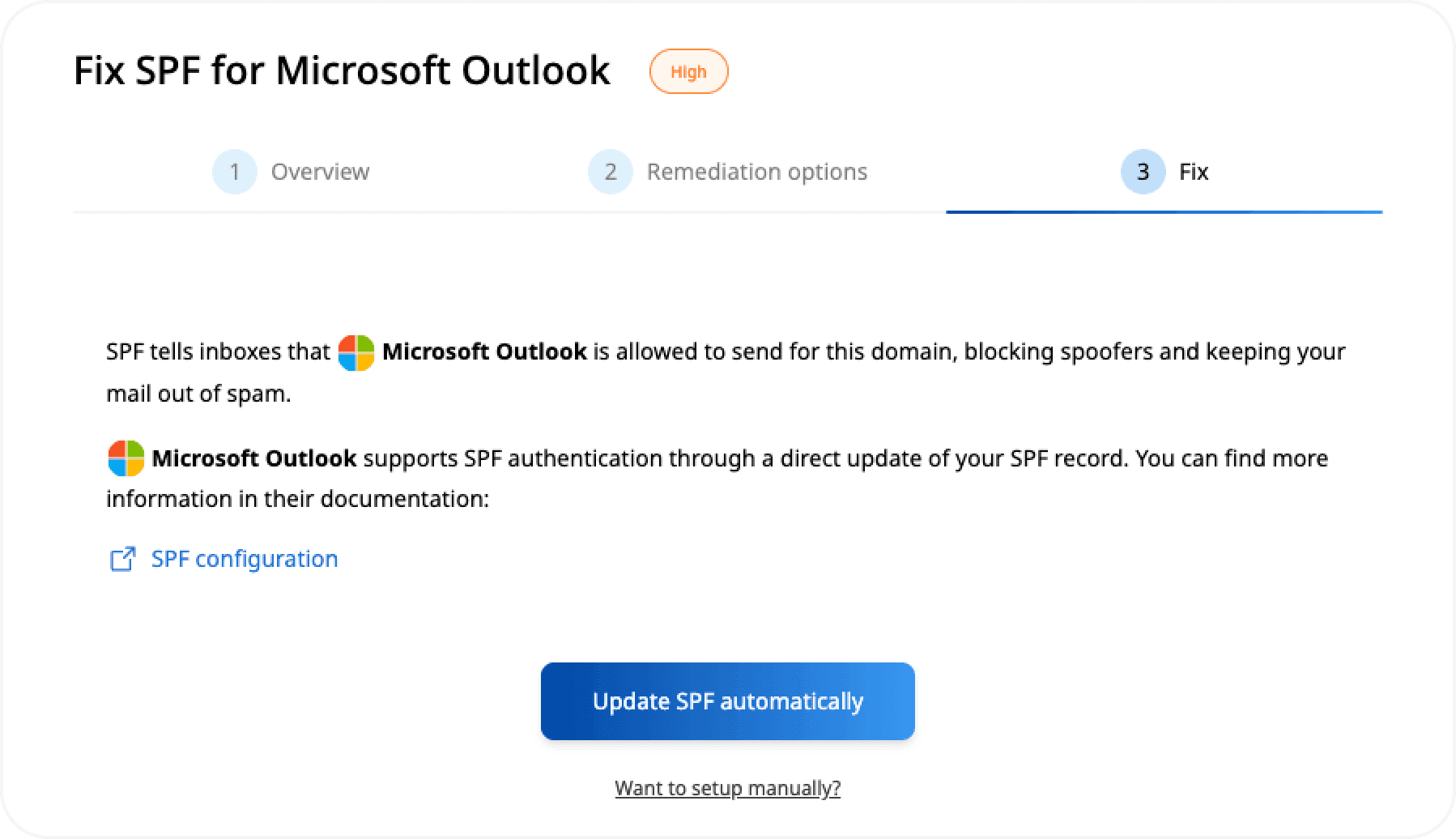
- AI agent that investigates senders and carries approved SPF, DKIM, and DMARC steps toward p=reject: Agent drafts and proposes
- Guided SPF, DKIM, and DMARC record creation and setup: Agent drafts proposed records
Palisade is built around a different handoff. Its AI agent investigates the senders behind the report, prepares SPF and DKIM work, and proposes each DMARC policy step. Your team remains the approval gate, but the recurring investigation and fix preparation do not stay as a manual checklist. That distinction matters most when the same process repeats across a portfolio.
Investigation context vs remediation
EmailAuth.io's Threat Map adds investigation context to a DMARC report
EmailAuth.io says its dashboard turns processed DMARC reports into plain-English answers and downloadable reports for a chosen timeline. Its Threat Map is positioned as a way to identify potentially malicious IPs, and the features page names additional investigation such as forward/reverse DNS matching, IP Whois, and spam-listing checks. The product therefore covers more than a raw XML inbox, with threat context and recurring alerts around the evidence. Source (2026-08-26) Source 2 (2026-08-26)
EmailAuth.io
A relevant product screenshot was not available in the reviewed evidence.
Palisade
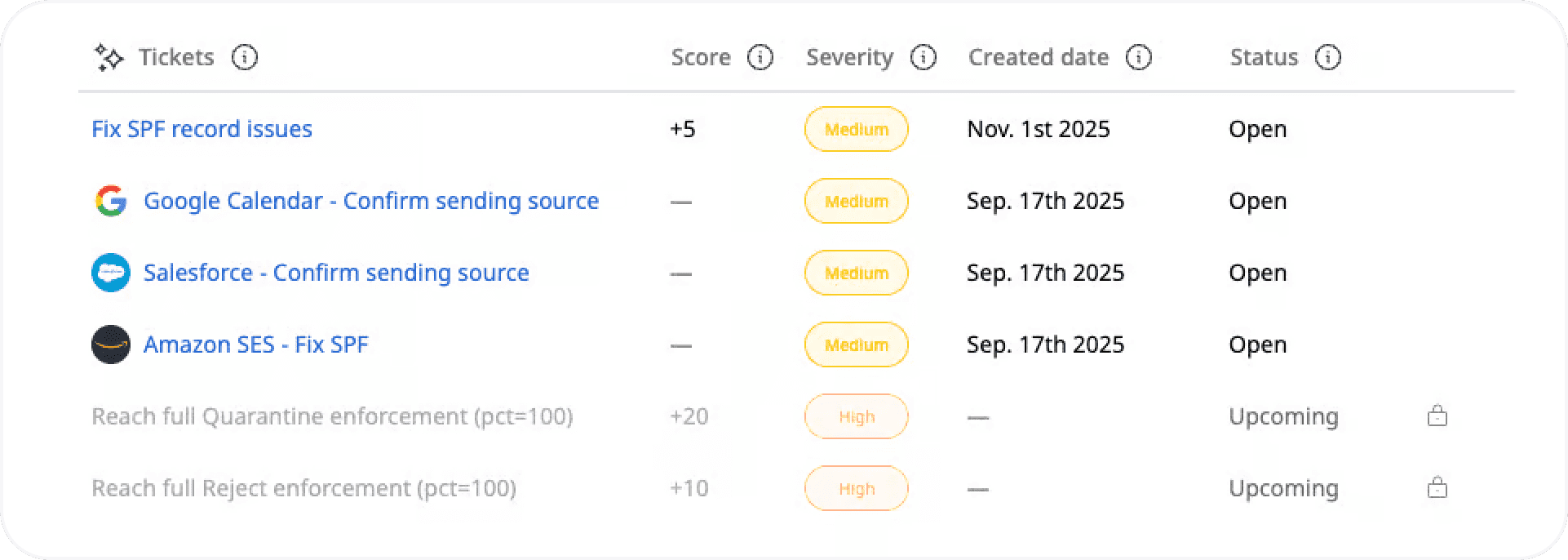
- DMARC aggregate report monitoring and analytics: Agent analyzes reports
- Threat map with IP reputation and investigation context: Not listed
- Configurable alerts for email-authentication threats: New-ticket alerts
That is real parity on the evidence layer. A team that wants analysts to inspect report data, investigate suspicious infrastructure, and receive threat notifications can find those surfaces in EmailAuth.io's public product description. Palisade's advantage is downstream: its agent turns sender evidence into proposed authentication work and a policy path that an operator can approve, instead of stopping at the investigation view.
Quote-led pricing vs published tiers
What EmailAuth.io publishes about pricing, deployment, and scale
EmailAuth.io's public buying path is a free-demo or contact conversation. The site asks for company and domain details, and the setup guide refers to tailor-made services with a customized plan and quote. It does not publish a rate card, named plan tiers, domain ceilings, volume bands, retention windows, or overage rules. That does not tell you what a custom proposal cannot include; it tells you which questions a buyer must take to sales before comparing total cost. Source (2026-08-26) Source 2 (2026-08-26) Source 3 (2026-08-26)
EmailAuth.io
A relevant product screenshot was not available in the reviewed evidence.
Palisade
A relevant product screenshot was not available in the reviewed evidence.
- Customer-authorized DNS deployment that writes approved records to the provider: Customer-approved DNS deployment
- Hosted SPF, DKIM, DMARC, BIMI, and MTA-STS records: CNAME-delegated hosted records
- SPF flattening: One-lookup hosted SPF
The deployment choice is more explicit than the commercial model. EmailAuth.io advertises both SaaS and on-premise options, which can matter to a security team with a specific data-residency or procurement requirement. Palisade's public model is easier to price for an IT team: a 15-day full-product trial, volume-sized monthly tiers, defined setup-domain allowances, and a separate portfolio-based MSP offer with a minimum of 5 client domains. The right comparison is not a guessed EmailAuth.io number against a Palisade number. Ask for the same domain count, sending volume, retention, deployment, support, and implementation scope in writing.
What each side charges
Three points on each published range: the cheapest plan, one in the middle, and the top of what the vendor publishes. Every plan on both sides is in the pricing section further down.
- EmailAuth SuiteNot published: request a free demo or quote
Public pages describe DMARC, SPF, DKIM, and BIMI support, SaaS and on-premise deployment options, threat investigation, alerts, and API or STIX/TAXII integration language; plan limits and included service scope require confirmation
- IT teams: up to 100,000 emails/mo$19/mo ($15/mo billed annually)
2 set-up domains (adding is unlimited), unlimited retention, every core feature
- IT teams: up to 1,000,000 emails/mo$99/mo ($79/mo billed annually)
Same product: 10 set-up domains, pick the tier that matches your sending
- Enterprise (more than 2.5M / month)Custom
Custom volume, retention, and terms
Security workflow vs MSP operations
EmailAuth.io's SOAR language is useful for security teams, while PSA coverage stays unverified
EmailAuth.io's features page describes SOAR capability and says the product can use API or STIX/TAXII-based integrations to share indicators of compromise with other platforms in real time. That gives a security-led team a documented integration direction, especially if the requirement is to move threat data into an existing security workflow rather than keep it in a DMARC dashboard. Source (2026-08-26)
EmailAuth.io
A relevant product screenshot was not available in the reviewed evidence.
Palisade
- API-based security integrations and indicator sharing: API on every plan
- Named ConnectWise, HaloPSA, and Autotask integrations: Native PSA integrations
The same public material does not name ConnectWise, HaloPSA, or Autotask. Treat that as an unanswered MSP integration question, not proof that a custom connector is impossible. Palisade publishes those three native PSA integrations, multi-tenant client management, white-label reporting, and portfolio-based client-domain pricing. If your work is organized around tickets, client handoff, and repeatable remediation, confirm EmailAuth.io's tenant model and connector scope before treating its SOAR description as equivalent to an MSP operating workflow.
Native PSA integrations
Palisade imports client domains straight from these three. EmailAuth.io's own coverage is stated above, from their site.
- ConnectWise PSA
- Autotask
- HaloPSA


Dashboard access vs programmatic access
EmailAuth.io advertises API integrations, not a public API reference or MCP server
EmailAuth.io says its SOAR capability can use API or STIX/TAXII-based integrations to share indicators of compromise with other platforms in real time. Its public features page also says report answers can be downloaded for a selected timeline. The current public page sitemap does not list a developer portal, API reference, or integrations index, and the public DMARC page at api.emailauth.io is a lookup and record generator rather than a customer API reference. EmailAuth.io does not advertise an MCP server, an AI-assistant connection, product AI or machine-learning features, scheduled exports, webhooks, or a data feed on those public pages (checked 2026-08-27). Source (2026-08-27) Source 2 (2026-08-27) Source 3 (2026-08-27)
EmailAuth.io
A relevant product screenshot was not available in the reviewed evidence.
- Documented REST or GraphQL API reference for customer-built integrations: No public API referenceSource 1, Source 2, Source 3
- MCP server for connecting AI assistants to domain data: No MCP server listedSource 1, Source 2
- Advertised AI or machine-learning features inside the product: No product AI listedSource
Palisade
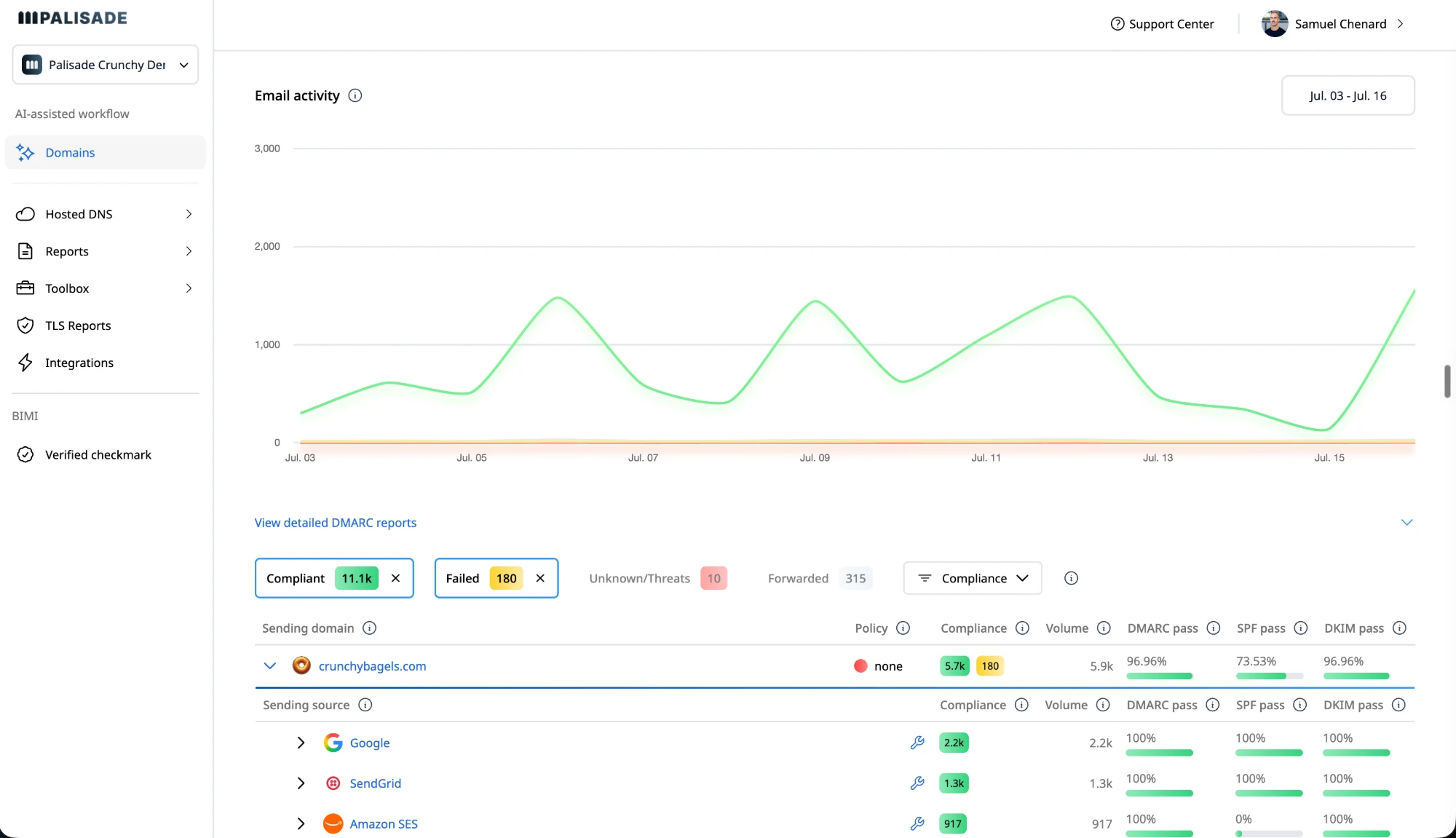
- Documented REST or GraphQL API reference for customer-built integrations: REST API published
- MCP server for connecting AI assistants to domain data: MCP server published
- Advertised AI or machine-learning features inside the product: Approval-gated agent work
Palisade publishes an MCP server and a REST API. Its agent investigates senders, drafts SPF and DKIM fixes, and proposes each policy step. A human approves before anything ships.
Reachable from your own AI tools
Palisade's MCP server exposes 42 tools over OAuth, so the assistant your team already uses can read domains, pull the exact records to publish and work the task queue. These are the clients the connection guide walks through.
- ChatGPT
- Claude
- Codex
- Cursor
- Windsurf
- Any MCP client





Still deciding between EmailAuth.io and Palisade? See what changes with Palisade.
15-day full-product trial. Nothing is charged until it ends.


 Microsoft 365
 Zoho Mail

The agent does the heavy lifting
Sources identified, SPF and DKIM fixes drafted, each policy step proposed. You approve; nothing ships on its own.
Connect your AI with MCP
42 tools over MCP, so your assistant reads your domains and works the queue.
Connect your DNS manager directly


One-time sign-in supports 64 providers without retaining credentials. Optional account connections support Cloudflare, GoDaddy and Route 53. You approve every change.
“We evaluated many DMARC providers before choosing Palisade. The quality of their product, the responsiveness and friendliness of their team and their rapid progress on their product roadmap made it a no-brainer for us to move forward.”
EmailAuth.io pricing explained (and how Palisade compares)
EmailAuth.io does not publish a public rate card. Its site offers a free demo, and its setup guide mentions tailor-made services with a customized plan and quote. The /pricing URL returned 404 when checked on 2026-08-26, so the row below describes the public buying path rather than estimating a price.
What you'd actually pay
The same five buyer sizes on every comparison, so a shape carries from one page to the next.
1 domain, up to 1,000 emails a month
2 set-up domains, up to 100K emails a month
10 set-up domains, up to 1M emails a month
20 set-up domains, up to 2.5M emails a month
Client domains under management, any volume
Palisade’s figures are derived from its published tiers. EmailAuth.io pricing or licensing source reference: vendor source citation date 2026-08-28. Plans and prices may have changed since.
How EmailAuth.io prices
- No public pricing page or monetary rate card was available on the EmailAuth.io pages checked on 2026-08-26; /pricing returned 404.
- EmailAuth.io advertises a free demo, but the public site does not state a self-serve free-plan limit, trial length, report-retention window, or email-volume allowance (checked 2026-08-26).
- The setup guide mentions tailor-made DMARC services and a customized plan and quote. It does not publish a per-domain, per-user, or volume-based price (checked 2026-08-26).
- The public pages do not publish overage rules, annual discounts, named plan tiers, or a separate MSP rate card (checked 2026-08-26).
How Palisade prices
- Palisade publishes flat monthly IT-team plans sized by sending volume from $19/month. Annual billing is 20% lower.
- Paid IT tiers include a defined number of set-up domains by volume tier. Adding domains is free and unlimited; only domains you set up count against the tier.
- MSPs pay per client domain, with a rate that improves as the portfolio grows and a minimum of 5 client domains. Client email volume is not metered, and the MSP's own domain is included as a free Not-For-Resale license.
- Palisade offers a 15-day full-product trial. IT-team and MSP plans keep unlimited report history (Enterprise retention follows custom terms), and API access is available on every plan.
EmailAuth.io source reference: primary reference citation date 2026-08-26.Palisade source reference: the public pricing page citation date 2026-08-30.Plans and prices may have changed since.
Start a 15-day full-product trial of Palisade. Nothing is charged until it ends.
What each one covers, and where it stops
Published facts only, read from each vendor's own material. Neither column describes a hands-on trial, because we have not run one.
EmailAuth.io combines DMARC reporting with threat investigation, alerts, BIMI, and API or STIX/TAXII-based security integrations. It is aimed at security teams that need investigation context alongside reporting and can use either the SaaS application or an on-premise deployment described on its public pages.
Its setup guide directs operators through DMARC record creation and manual DNS changes, while its Threat Map adds IP and DNS investigation context to report data. The public buying path is a free demo or customized quote rather than a published rate card.
Palisade is built around an agent that does the DMARC work rather than reporting on it. It identifies every sending source, drafts the SPF and DKIM changes each one needs, and proposes the next policy step when the evidence supports it.
The agent investigates every sender, drafts every fix, and proposes each policy step, you approve before anything ships.
- Provides personalized SPF, DKIM, and DMARC record setup guidance
- Provides source and report analysis for DMARC data
- Provides Threat Map investigations with IP reputation and investigation context
- Provides configurable threat alerts
- Supports API and STIX/TAXII-based indicator sharing
- The agent investigates senders and drafts the fix, so the work arrives prepared rather than as a list of findings
- Hosted SPF, DKIM and DMARC records, so an approved change can be carried out rather than handed off
- Portfolio workflow for MSPs, with ConnectWise, HaloPSA and Autotask integrations and a free NFR domain
- An MCP server and a REST API, so the same data and workflow are reachable from the AI tools a team already uses
- Does not advertise an agent that investigates senders and carries approved SPF, DKIM, and DMARC steps toward p=reject
- Does not advertise hosted SPF, DKIM, DMARC, BIMI, and MTA-STS records
- Does not advertise a customer-authorized DNS deployment that writes approved records to the provider
- Does not advertise SPF flattening
- Does not advertise named ConnectWise, HaloPSA, and Autotask integrations
- Every policy change waits for a human approval, by design: nothing ships on the agent's own authority
- MSP pricing is portfolio-based per client domain, with a minimum of 5 client domains
- Plans are sized by monthly email volume, so a low-domain, high-volume sender lands on a higher tier than domain count alone suggests
- Starts at
- Not published: request a free demo or quote
- Free tier
- No self-serve free-plan limit published
- Deployment
- SaaS and on-premise
- Rate card
- Not published; /pricing returned 404
- MSP model
- No separate MSP rate card published
- Starts at
- IT plans from $19/mo by email volume; 15-day trial
- Trial
- 15 days, full product
- MSP model
- Portfolio-based per client domain; minimum of 5 client domains
What Palisade customers say
5.0 out of 5 on G2Trusted by over 10,000 domains
“Palisade made it so easy for us to get our blue verified checkmark and achieve our BIMI compliance”


Sources and further reading
Source checks run through 2026-10-14; every entry keeps its individual check date.
- EmailAuth.io home
Checked 2026-08-28
- EmailAuth.io features: API and STIX/TAXII integration language, downloadable reports, and product-feature scope
Checked 2026-10-14
- EmailAuth.io DMARC setup guide
Checked 2026-08-28
- EmailAuth.io DMARC benefits
Checked 2026-08-28
- EmailAuth.io free demo: public buying path
Checked 2026-08-26
- EmailAuth.io contact
Checked 2026-08-28
- EmailAuth.io robots file: public sitemap locations and restricted paths
Checked 2026-08-27
- EmailAuth.io sitemap index: current public sitemap inventory
Checked 2026-08-27
- EmailAuth.io public page sitemap: listed product, guide, tool, and contact pages
Checked 2026-08-27
- EmailAuth.io public DMARC tool: record lookup and generator
Checked 2026-08-27
- Source
Checked 2026-10-13
- Source
Checked 2026-08-28
- Source
Checked 2026-08-30
Palisade vs EmailAuth.io: FAQ
What is the main difference between EmailAuth.io and Palisade?
EmailAuth.io publicly describes DMARC reporting, threat investigation, alerts, authentication setup guidance, BIMI, and security integrations. Palisade adds an agentic operating model: its agent investigates senders, drafts SPF and DKIM fixes, and proposes each policy step toward p=reject while your team approves before anything ships. The choice is mainly about who carries the recurring remediation work.
Does EmailAuth.io support DMARC reporting and analysis?
Yes. EmailAuth.io says it reads and processes DMARC reports, provides visibility into authorized and unauthorized sending sources, offers downloadable reports, and publishes weekly, monthly, and annual progress reporting. Its features page also describes Threat Map and investigation context for items such as IP Whois and spam listings (checked 2026-08-26).
Does EmailAuth.io offer SaaS and on-premise deployment?
Yes. EmailAuth.io's homepage lists both an on-premise deployment and a SaaS application. The public page does not explain the commercial or infrastructure boundaries of each option, so confirm data handling, support, upgrades, and implementation scope for the deployment you are considering (checked 2026-08-26).
What does EmailAuth.io cost?
EmailAuth.io does not publish a public rate card or plan limits. Its site offers a free demo, and its setup guide mentions tailor-made services with a customized plan and quote. The /pricing URL returned 404 on 2026-08-26. Request a quote using the same domain count, sending volume, retention, deployment, and support assumptions you use for Palisade.
Does EmailAuth.io integrate with ConnectWise, HaloPSA, or Autotask?
EmailAuth.io's public features page describes API and STIX/TAXII-based integrations, but it does not name ConnectWise, HaloPSA, or Autotask. That is an unverified fit question, not a claim that a custom integration is unavailable. Palisade publishes native integrations with all three PSA platforms (checked 2026-08-26).
Can I run EmailAuth.io and Palisade during a migration?
Yes. DMARC reporting supports multiple recipients, so both platforms can receive reports during an evaluation period. Keep the DNS and policy owner clear, compare the sender findings, and retire the old reporting path only after your team is comfortable with the new workflow.
Switching from EmailAuth.io takes three steps
- 1
Inventory the current report destination
List each domain, its DMARC rua and ruf destinations, the senders already identified in EmailAuth.io, and any manual DNS changes still in flight.
- 2
Run the reporting paths in parallel
DMARC reporting supports multiple recipients, so you can add Palisade alongside EmailAuth.io during an evaluation window. Compare sender evidence while keeping one clear owner for each DNS and policy change.
- 3
Approve the new DNS and policy path
Let Palisade's agent prepare the authentication work, review each proposed change, and move the reporting and hosted-record path over when your team is satisfied with the evidence.
15-day full-product trial. Nothing is charged until it ends.
Source citations on this page run through 2026-10-14; individual claims retain their dates and evidence limitations. Spotted something out of date? Tell us and we'll fix it.