
DMARC-SRG vs Palisade in 2026
DMARC-SRG is an open-source PHP parser, viewer, and summary-report generator for incoming DMARC reports. Palisade takes the same reporting evidence into an agentic workflow: its agent investigates senders, drafts authentication fixes, and proposes each policy step for your approval.
Our verdict: Choose DMARC-SRG if you want to run a GPL-3.0 PHP application on infrastructure you control, connect it to MySQL or MariaDB, and own the mailbox, web server, scheduled jobs, and DNS follow-up. Choose Palisade if you want a hosted DMARC program whose agent investigates senders, drafts SPF and DKIM fixes, and carries domains toward p=reject with you approving each step.
 Samuel Chenard · CEO & Co-Founder, PalisadeSource checks through 2026-10-14
15-day full-product trial. Nothing is charged until it ends.
 ChatGPT
 Claude
 Gemini
 Perplexity
 Grok
Grok DMARC-SRG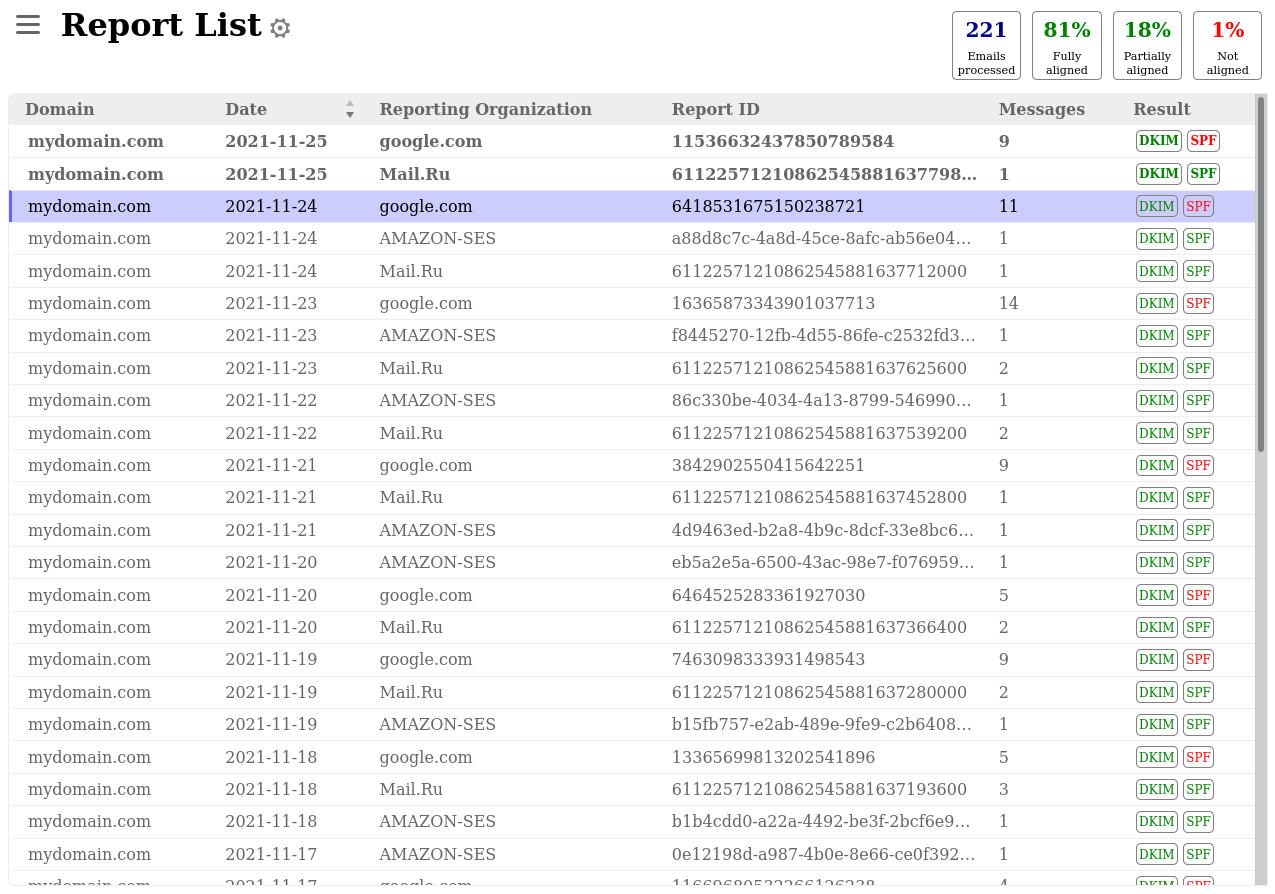
 Palisade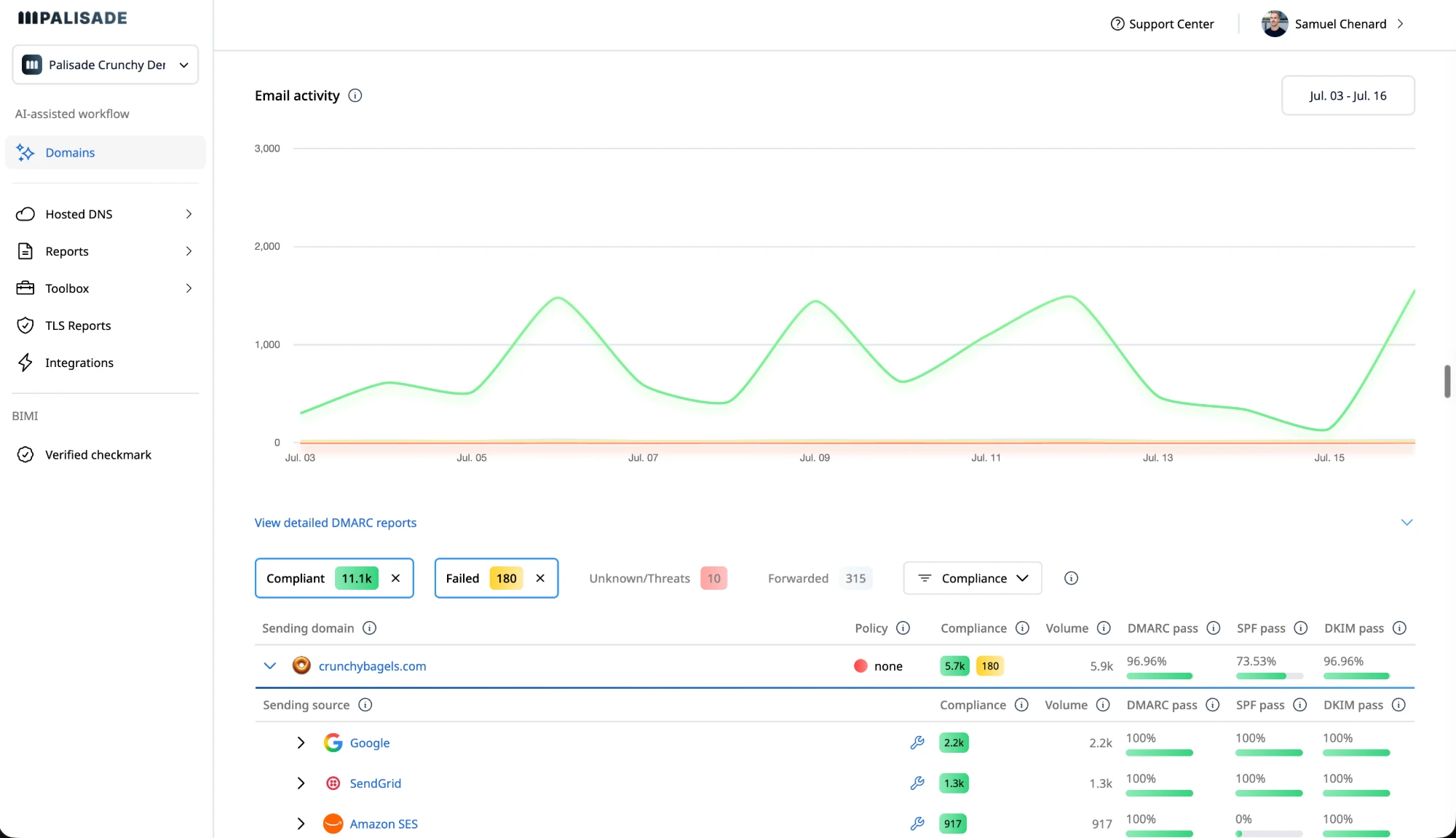
Full rubric · 8/8 dimensions established
Full rubric · 8/8 dimensions established
Palisade's IT-team plans start at $19 a month, sized by email volume. Start with a 15-day full-product trial; nothing is charged until it ends.
Which one is right for you?
Best for Teams operating their own PHP and MySQL or MariaDB environment
Best for MSPs and IT teams responsible for multiple domains
- You want a GPL-3.0 project that your team can install and operate on its own PHP and MySQL or MariaDB environment.
- You already have an operator who can configure a report mailbox or local report directory, run the scheduled PHP utilities, protect the web interface, and maintain the deployment.
- Your requirement is centered on parsing, filtering, viewing, and emailing DMARC summaries rather than a managed enforcement workflow.
- You want an AI agent to investigate senders, draft SPF and DKIM fixes, and propose each policy step instead of stopping at report collection and visualization.
- You want hosted SPF, DKIM, DMARC, BIMI, and MTA-STS records, or Smart DNS Deployment through your DNS provider.
- You manage internal or client domains and want native ConnectWise, HaloPSA, or Autotask integrations for the service workflow.
IT-team plans start at $19 a month, sized by email volume. Start with a 15-day full-product trial; nothing is charged until it ends.
Where the day-to-day work actually differs
| Feature | DMARC-SRG | Palisade |
|---|---|---|
| Report collection and analysis | ||
| DMARC aggregate report parsing and a report-list viewWhether aggregate reports are parsed into a browsable list.The project describes a PHP parser and viewer for incoming DMARC reports, including a table of parsed reports (checked 2026-08-26). Source (2026-08-26) | PHP parser and viewer | Agent analyzes reports |
| Filter reports by domain, month, reporting organization, and other fieldsWhether reports can be narrowed by domain, date, and reporting organization.The README documents filtering the report list by domain, month, reporting organization, and more (checked 2026-08-26). Source (2026-08-26) | Report list filters | Agent analyzes reports |
| DKIM and SPF details for each reportWhether each report exposes SPF and DKIM results.The project's feature list explicitly includes viewing DKIM/SPF details for each report (checked 2026-08-26). Source (2026-08-26) | Per-report SPF/DKIM details | Agent analyzes reports |
| Automatic collection from mailboxes and server-local directoriesWhether reports can be automatically collected from mailboxes or local directories.The README and setup guide document incoming reports from configured mailboxes and local server directories, with a fetch utility for saving reports to the database (checked 2026-08-26). Source (2026-08-26) Source 2 (2026-08-26) | Mailboxes and local directories | Hosted report collection |
| Web upload of incoming DMARC report filesWhether incoming DMARC report files can be uploaded in a browser.DMARC-SRG documents uploading and processing incoming report files through its web interface (checked 2026-08-26). Source (2026-08-26) | Web report upload | Hosted report collection |
| Configurable cleanup of old reports, mailbox messages, and log entriesWhether old reports, mailbox messages, and logs can be configured for removal.The project lists configurable deletion of old reports from the database and mailboxes, and provides mailbox, report, and report-log cleaner utilities (checked 2026-08-26). Source (2026-08-26) Source 2 (2026-08-26) | Configurable cleanup utilities | Unlimited IT/MSP; Enterprise customSource |
| Scheduled summary reports sent to a chosen mailboxWhether summary reports can be delivered to a chosen mailbox on a schedule.The README documents weekly, monthly, or last-N-days summary reports sent to a specified mailbox, and the setup guide shows cron jobs for fetching and summaries (checked 2026-08-26). Source (2026-08-26) Source 2 (2026-08-26) | Scheduled email summaries | Agent flags issues |
| Password-protected web interfaceWhether the web interface requires password-based access.Password protection for the web interface is listed as a DMARC-SRG feature; the setup guide also describes an admin password for the web UI (checked 2026-08-26). Source (2026-08-26) Source 2 (2026-08-26) | Password-protected web interface | Managed app access |
| Deployment and enforcement | ||
| AI agent that investigates senders, drafts authentication fixes, and proposes policy steps toward p=rejectWhether an agent can investigate senders, draft fixes, and propose policy steps for approval.DMARC-SRG advertises parsing, viewing, collection, cleanup, and summaries, but does not advertise an AI enforcement agent or a workflow that drafts SPF/DKIM changes (checked 2026-08-26). Source (2026-08-26) | —Not advertised | Agent drafts and proposes |
| Hosted SPF, DKIM, DMARC, BIMI, and MTA-STS recordsWhether the service hosts the listed email-authentication records.The project documents software that runs on your PHP, database, web-server, mailbox, or local-directory infrastructure, but does not advertise hosted DNS records (checked 2026-08-26). Source (2026-08-26) Source 2 (2026-08-26) | —Not advertised | Hosted on managed DNS |
| Native ConnectWise, HaloPSA, or Autotask integrationsWhether named PSA tools connect to the service workflow.The first-party project documentation describes PHP utilities, mailboxes, local directories, S3, a database, and a web interface, but does not advertise those PSA integrations (checked 2026-08-26). Source (2026-08-26) Source 2 (2026-08-26) | —Not advertised | Native PSA integrations |
| Service model and scale | ||
| Portfolio-oriented multi-tenant client management and white-label reportingWhether client domains can be managed across separate workspaces with white-label reports.DMARC-SRG documents a standalone application with a domain list and users administration, but does not advertise multi-tenant client workspaces or white-label reporting (checked 2026-08-26). Source (2026-08-26) Source 2 (2026-08-26) | —Not advertised | Multi-tenant client management |
| Published commercial subscription plans and vendor SLAWhether commercial plans and a service-level agreement are publicly published.The project publishes GPL-3.0 source code and installation requirements, but does not advertise commercial subscription plans or an SLA in its published project materials (checked 2026-08-26). Source (2026-08-26) Source 2 (2026-08-26) | No published pricing | Published plans and trial |
| AI and automation access | ||
| Documented public API for programmatic accessWhether a customer can build against a documented REST or GraphQL API.DMARC-SRG does not advertise a customer REST or GraphQL API reference in its published README or setup guide; those pages describe PHP utilities and a self-hosted web interface (checked 2026-08-27). Source (2026-08-27) Source 2 (2026-08-27) | —No public API listed | REST API published |
| MCP server for connecting AI assistants to domain dataWhether an AI assistant can reach the product's data directly.DMARC-SRG does not advertise an MCP server or an AI-assistant integration in its published README or setup guide (checked 2026-08-27). Source (2026-08-27) Source 2 (2026-08-27) | —No MCP server listed | MCP server published |
| Advertised AI assistance for investigating and drafting fixesWhether the vendor advertises AI that investigates senders or prepares authentication changes.DMARC-SRG does not advertise an AI or machine-learning feature in its published feature list, which describes PHP parsing, web views, report collection, and email summaries (checked 2026-08-27). Source (2026-08-27) | —No AI features listed | Agent drafts fixes |
| Report output outside the dashboardWhether report information can leave the product without using the web interface.DMARC-SRG documents creating weekly, monthly, or last-N-days summary reports and sending them to a specified mailbox. Its published project documentation does not advertise webhooks or a data-feed endpoint (checked 2026-08-27). Source (2026-08-27) Source 2 (2026-08-27) | Scheduled email summaries | REST API published |
Want to compare the workflow yourself? Start a 15-day full-product trial of Palisade.
Palisade 86 vs DMARC-SRG 46, and why
Both products are scored on the same eight dimensions the comparison hub uses, so the figures here are the figures there. Four are derived from vendor facts that each carry a source and a checked date. Four are editorial, marked as such below, and each states its reasoning and its source.
Each dimension is out of 10 and the total is the raw sum out of 80, rescaled to 100 — the raw figure is printed beside it so the conversion is checkable rather than a black box. Scored on what each vendor publishes, not on how the product feels in use. Unknown scoring dimensions are shown as Not established; provisional scores average only established dimensions and show coverage. They may change as remaining dimensions are verified. Current ranks include full and provisional scores; equal displayed scores share a rank. Historical assessments are separate. Editorial dimensions last reviewed 2026-10-15.
Full rubric · 8/8 dimensions established
Full rubric · 8/8 dimensions established
How reachable the vendor's DMARC data is from your own software and AI tools. Two paths count, an API and an MCP server, and each only if it reaches DMARC data (domains, records, reports or sending sources). A path is open when it is documented and included from the cheapest paid plan; gated when it needs a higher tier, an add-on, a sales call or a request, or the vendor does not say which plans include it. 10 = both open. 9 = one open, one gated. 8 = both gated. 7 = one open, the other absent. 6 = one gated, the other absent. 5 = access claimed in marketing only, with no docs or plan listing. 4 = reachable only through a self-hosted tool's own interface or a host platform's API, such as parsedmarc's library or Splunk's REST API; a dashboard over a database you run yourself does not count. 3 = no API or MCP server reaches DMARC data.
DMARC-SRG does not publish a documented API or an MCP server (checked 2026-08-28). Source (2026-08-28)
Palisade publishes a REST API and a remote MCP server on every plan, making the same domain data and remediation workflows available to connected software. Source (2026-08-30)
How much of the report analysis is done for you. 10 = the platform turns raw report data into a prioritised, actionable queue on its own.
Scheduled jobs fetch, deduplicate, store, filter, and summarize aggregate reports, while interpretation and remediation remain with the operator. Source (2026-08-28)
Report data is analysed into a prioritised list of sender, SPF, DKIM and DMARC issues, so nobody reads raw XML. Source (2026-08-30)
How much of the work the vendor's own software does. 10 = it identifies the sending sources, drafts the SPF and DKIM fixes each one needs, and proposes the next policy step. 6 = it applies the records for you, but a person decides what to fix and when to advance. 3 = it reports, and every change is yours to make. A vendor whose team does the work rather than its software scores here on the software alone.
DMARC-SRG fetches, parses, and summarizes aggregate reports, but the operator must interpret the results and make every authentication or policy change. Source (2026-08-28)
The agent investigates each sender, drafts the SPF and DKIM changes it needs, and proposes the next policy step; a human approves before deployment. Source (2026-08-30)
10 = full pricing published. 6 = some tiers published, rest quote-gated. 3 = quote only.
The complete project is published under GPL-3.0 without a software subscription fee. Source (2026-08-28)
Self-service IT-team prices are published by email volume from $19/month; MSP pricing is portfolio-based per client domain, and Enterprise pricing is custom. Source (2026-08-30)
10 = hosts the records for you. 6 = partial or add-on. 3 = you manage your own DNS.
The application parses reports and does not host or manage authentication records. Source (2026-08-28)
Yes: hosted DMARC, SPF, DKIM, BIMI & MTA-STS Source (2026-08-30)
10 = a genuine free plan. 6 = time-limited trial only. 3 = no free access.
The full self-hosted project is available under GPL-3.0. Source (2026-08-28)
No free plan: a 15-day full-product trial; nothing is charged until the trial ends Source (2026-09-25)
10 = a real MSP program with multi-tenant management. 6 = partial. 3 = none.
No commercial MSP programme or hosted partner service is published for the self-hosted project. Source (2026-08-28)
Yes: MSP-first, multi-tenant with native PSA integrations Source (2026-08-30)
How much work it takes to get a domain from p=none to p=reject. 10 = the platform (or the vendor's team) gets you there without manual DNS edits.
DMARC-SRG parses and presents reports but does not host records, change DNS, simulate policy, or track an enforcement rollout. Source (2026-08-28)
The DMARC Agent detects when a domain's authentication and alignment are ready for the next policy stage and proposes the move, but a human still approves and applies it, so it is not fully hands-off. Source (2026-08-30)
Where Palisade and DMARC-SRG actually differ
Each argument keeps the product screens, sourced comparison points, and supporting analysis together.
Report visibility vs remediation
DmarcSrg's mailbox-and-database report loop, versus an agent that carries the fix
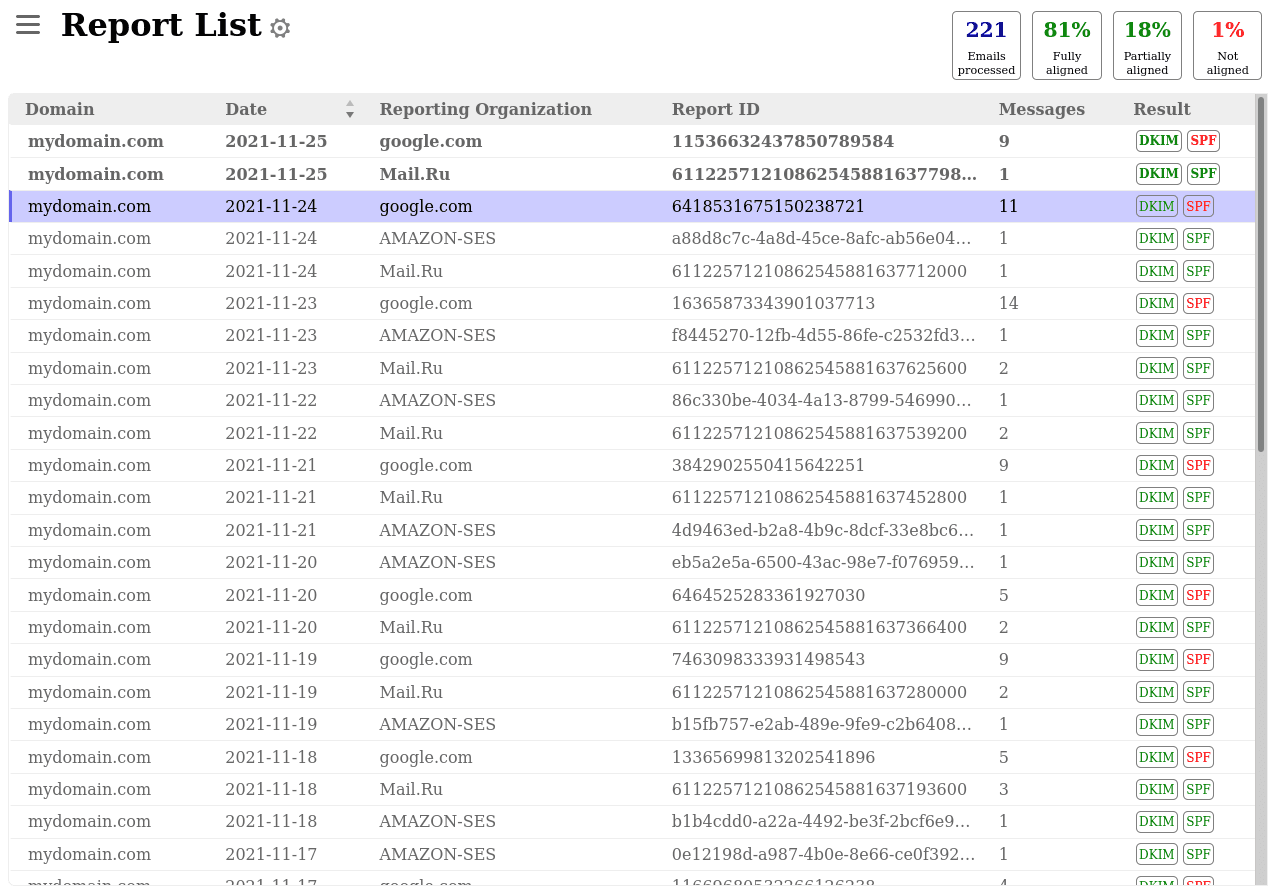
DMARC-SRG covers the evidence-gathering portion of a DMARC program. Its README describes a PHP parser and viewer that receives incoming reports, stores parsed data in a MySQL or MariaDB database, and exposes a report list. Operators can filter reports by domain, month, reporting organization, and other fields, then open DKIM and SPF details for individual reports. The related dmarc.pl domain also currently presents a DMARC Report Visualizer for uploading ZIP and TGZ report archives, so the public presence is clearly centered on getting DMARC report data into a viewable form. Source (2026-08-26) Source 2 (2026-08-26)
DMARC-SRG
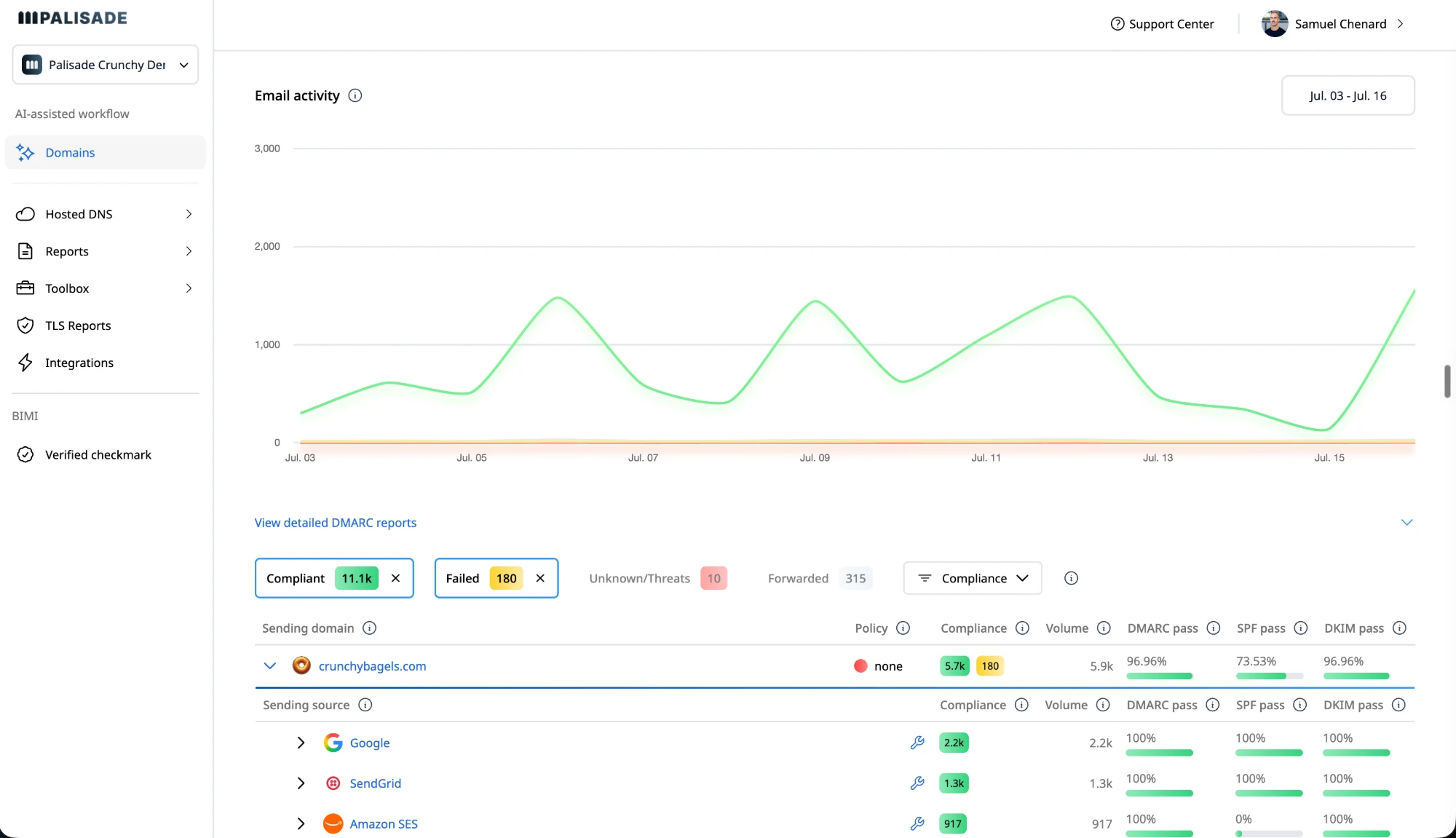
Palisade
- DMARC aggregate report parsing and a report-list view: Agent analyzes reports
- Filter reports by domain, month, reporting organization, and other fields: Agent analyzes reports
- DKIM and SPF details for each report: Agent analyzes reports
That is a useful boundary for a technically staffed team, but it is not the same as carrying a domain through enforcement. The project documentation does not advertise an AI agent that investigates whether each sender is legitimate, drafts the SPF or DKIM change, or proposes the next DMARC policy step. Palisade starts with the same kind of sender and alignment evidence, then its agent investigates every sender, drafts every fix, and proposes each policy step; you approve before anything ships. Source (2026-08-26) Source 2 (2026-08-26)
License cost vs operating work
The GPL-3.0 download has no published subscription tier
The commercial comparison is straightforward but easy to oversimplify. DMARC-SRG's composer manifest describes a GPL-3.0-only project requiring PHP 8.1 or newer, JSON, mbstring, PDO MySQL, XML, ZIP, PHPMailer, an S3 filesystem package, and the ImapEngine library. The license does not create a monthly vendor bill. It does, however, leave the buyer with a software deployment to assemble and maintain. The project does not publish a SaaS plan, included domains, email-volume cap, paid support package, or service-level agreement. Source (2026-08-26) Source 2 (2026-08-26)
DMARC-SRG
A relevant product screenshot was not available in the reviewed evidence.
Palisade
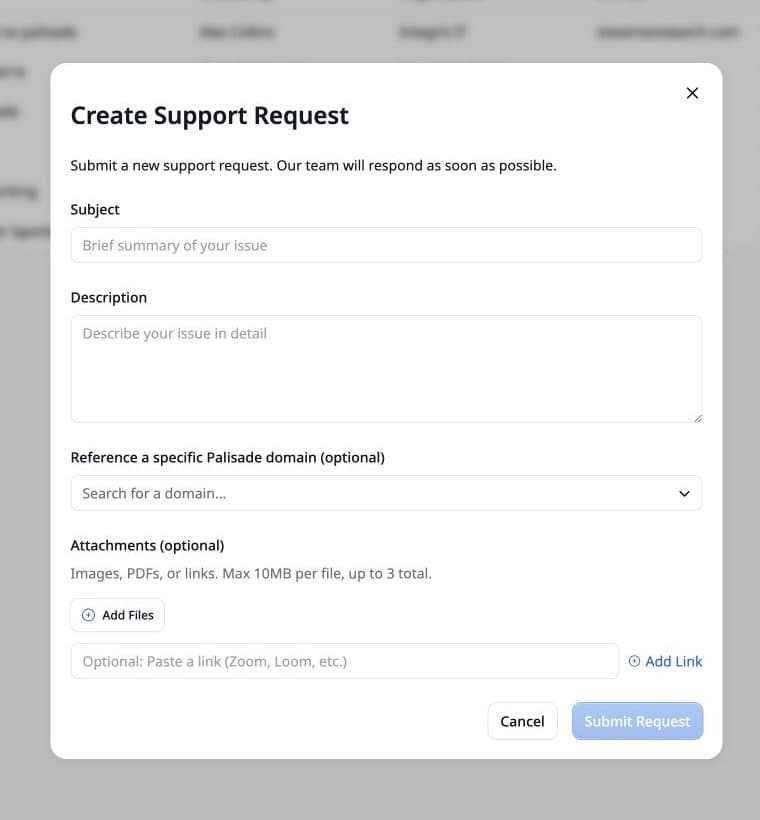
- Portfolio-oriented multi-tenant client management and white-label reporting: Multi-tenant client management
- Published commercial subscription plans and vendor SLA: Published plans and trial
The setup guide makes the operational boundary concrete. It walks through installing the application on a Debian-like system or from a Git checkout, configuring Apache and PHP, creating a database and database user, setting an admin password, initializing tables, and scheduling report-fetch and summary jobs. A $0 license can be the right choice when those responsibilities already belong to your team. Palisade's paid surface is a different purchase: a hosted service with flat monthly IT-team pricing from $19/month, a 15-day full-product trial, and an agent that works through the investigation and configuration work before human approval. Source (2026-08-26) Source 2 (2026-08-26)
What each side charges
Three points on each published range: the cheapest plan, one in the middle, and the top of what the vendor publishes. Every plan on both sides is in the pricing section further down.
- Self-hosted GPL-3.0 project$0 license fee published
PHP application source, the web interface, report-processing utilities, and the right to use and modify the GPL-3.0-only project; you provide PHP, MariaDB or MySQL, required extensions, a mailbox or report directory, web-server configuration, scheduled jobs, and maintenance
- IT teams: up to 100,000 emails/mo$19/mo ($15/mo billed annually)
2 set-up domains (adding is unlimited), unlimited retention, every core feature
- IT teams: up to 1,000,000 emails/mo$99/mo ($79/mo billed annually)
Same product: 10 set-up domains, pick the tier that matches your sending
- Enterprise (more than 2.5M / month)Custom
Custom volume, retention, and terms
Owned infrastructure vs MSP operations
DmarcSrg's PHP/MariaDB deployment fits an owned server, not an MSP control plane
DMARC-SRG gives an operator several ways to feed the report loop. The README documents mailboxes and server-local directories; the setup guide adds the ImapEngine dependency for mailbox processing and the Flysystem package for S3 filesystem processing. The web interface can accept uploaded report files, and the command-line utilities can fetch reports, clean old data, manage domains and users, and generate summaries. This makes the project adaptable to an organization that wants to own its database and decide how the scheduled jobs run. Source (2026-08-26) Source 2 (2026-08-26) Source 3 (2026-08-26)
DMARC-SRG
Palisade
A relevant product screenshot was not available in the reviewed evidence.
The public materials do not advertise client workspaces, role boundaries for separate customers, white-label reports, PSA ticket creation, or a partner billing model. That does not prove an engineer could never build an MSP layer around the code; it means those service features are not part of the published product promise checked here. Palisade explicitly targets internal IT teams and MSPs with multi-tenant client management and native ConnectWise, HaloPSA, and Autotask integrations, so its distinction is the managed operating workflow around each domain rather than only the report parser. Source (2026-08-26) Source 2 (2026-08-26)
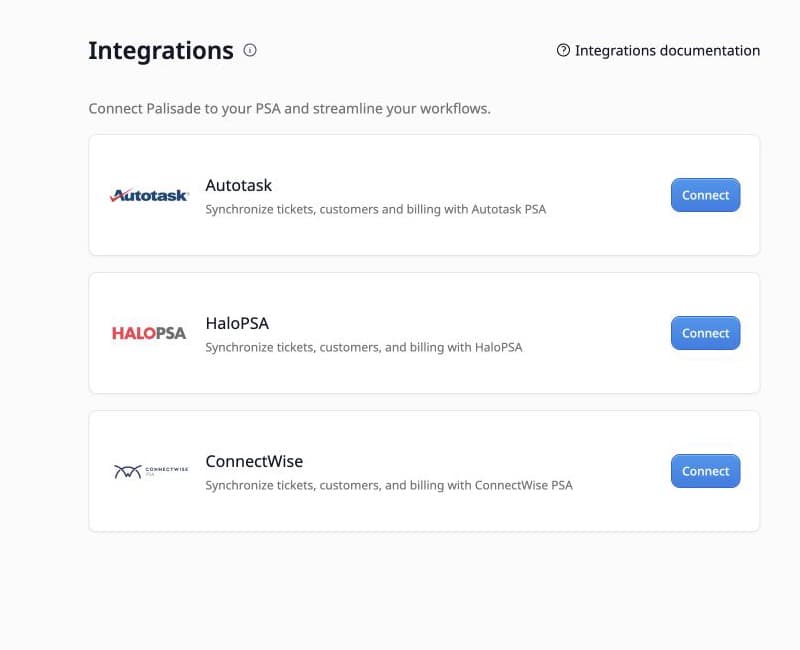
Native PSA integrations
Palisade imports client domains straight from these three. DMARC-SRG's own coverage is stated above, from their site.
- ConnectWise PSA
- Autotask
- HaloPSA


Scheduled summaries vs DNS action
DMARC-SRG's scheduled summaries stop before the DNS change
The summary-report feature is the most operational part of DMARC-SRG. Its documentation says the application can create summaries for the last week, last month, or last N days and send them to a chosen mailbox. The setup guide shows hourly report collection and weekly summary jobs, while the cleanup utilities can remove old mailbox messages, reports, and log entries. An operator can therefore create a repeatable receive, parse, store, summarize, and clean cycle without opening the browser for every report. Source (2026-08-26) Source 2 (2026-08-26)
DMARC-SRG
A relevant product screenshot was not available in the reviewed evidence.
Palisade
- AI agent that investigates senders, drafts authentication fixes, and proposes policy steps toward p=reject: Agent drafts and proposes
- Hosted SPF, DKIM, DMARC, BIMI, and MTA-STS records: Hosted on managed DNS
- Native ConnectWise, HaloPSA, or Autotask integrations: Native PSA integrations
The next step remains outside that documented cycle. DMARC-SRG's instructions show the operator how to create a DMARC TXT record and point its rua mailbox at the deployment, but they do not advertise direct DNS deployment, hosted authentication records, sender-by-sender remediation, or a policy-readiness workflow. Palisade separates hosted records from Smart DNS Deployment: its agent drafts the work, and the customer approves the changes before they ship. That is the deciding distinction for teams whose bottleneck is acting on reports rather than receiving another summary. Source (2026-08-26)
Dashboard access vs programmatic access
DMARC-SRG's PHP utilities send summaries, but no public API or MCP server is listed
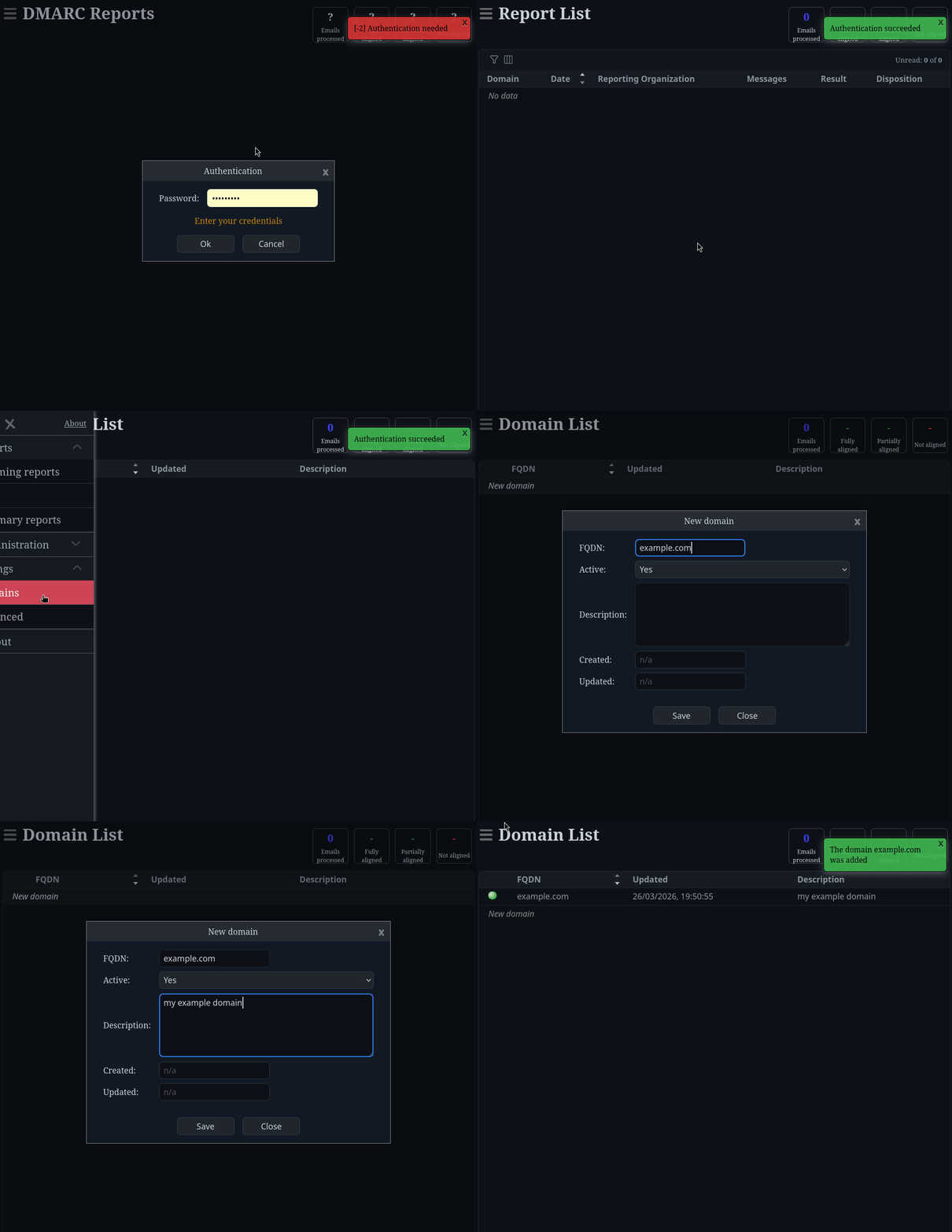
DMARC-SRG's published README describes PHP utilities that fetch reports from mailboxes or local directories, store data in MySQL or MariaDB, and send scheduled summary reports by email. It also describes a password-protected web interface, while dmarc.pl currently offers a browser-based visualizer for uploaded ZIP and TGZ report archives. The published README and setup guide do not advertise a customer REST or GraphQL API, an MCP server, an AI-assistant integration, webhooks, or an AI or machine-learning feature (checked 2026-08-27). Source (2026-08-27) Source 2 (2026-08-27) Source 3 (2026-08-27)
DMARC-SRG
Palisade
A relevant product screenshot was not available in the reviewed evidence.
- Documented public API for programmatic access: REST API published
- MCP server for connecting AI assistants to domain data: MCP server published
- Advertised AI assistance for investigating and drafting fixes: Agent drafts fixes
Palisade publishes an MCP server and a REST API. Its agent investigates senders, drafts SPF and DKIM fixes, and proposes each policy step. A human approves before anything ships.
Reachable from your own AI tools
Palisade's MCP server exposes 42 tools over OAuth, so the assistant your team already uses can read domains, pull the exact records to publish and work the task queue. These are the clients the connection guide walks through.
- ChatGPT
- Claude
- Codex
- Cursor
- Windsurf
- Any MCP client





Still deciding between DMARC-SRG and Palisade? See what changes with Palisade.
15-day full-product trial. Nothing is charged until it ends.


 Microsoft 365
 Zoho Mail

The agent does the heavy lifting
Sources identified, SPF and DKIM fixes drafted, each policy step proposed. You approve; nothing ships on its own.
Connect your AI with MCP
42 tools over MCP, so your assistant reads your domains and works the queue.
Connect your DNS manager directly


One-time sign-in supports 64 providers without retaining credentials. Optional account connections support Cloudflare, GoDaddy and Route 53. You approve every change.
“We evaluated many DMARC providers before choosing Palisade. The quality of their product, the responsiveness and friendliness of their team and their rapid progress on their product roadmap made it a no-brainer for us to move forward.”
DMARC-SRG pricing: a GPL-3.0 project, not a published SaaS rate card
DMARC-SRG does not present a commercial subscription table. Its public project files identify a GPL-3.0-only PHP application with dependencies and self-hosted installation instructions. That makes the license fee distinct from the infrastructure and operator work required to run the report pipeline.
What you'd actually pay
The same five buyer sizes on every comparison, so a shape carries from one page to the next.
1 domain, up to 1,000 emails a month
GPL-3.0 covers the self-hosted software license only
2 set-up domains, up to 100K emails a month
GPL-3.0 covers the self-hosted software license only
10 set-up domains, up to 1M emails a month
GPL-3.0 covers the self-hosted software license only
20 set-up domains, up to 2.5M emails a month
GPL-3.0 covers the self-hosted software license only
Client domains under management, any volume
GPL-3.0 covers the self-hosted software license only
Palisade’s figures are derived from its published tiers. DMARC-SRG pricing or licensing source reference: vendor source citation date 2026-08-28. Plans and prices may have changed since.
How DMARC-SRG prices
- DMARC-SRG does not publish a hosted subscription price, paid support tier, per-domain rate, usage allowance, or SLA on the public pages checked on 2026-08-26.
- The $0 figure describes the published license boundary, not a promise that operating the software costs nothing. The setup guide requires a PHP web environment, MySQL or MariaDB, PHP extensions, an admin password, and a configured report source.
- The project does document cleanup utilities for old mailbox messages, reports, and log entries, but it does not publish a fixed retention period or storage tier. The retention behavior therefore depends on the configuration and jobs you operate.
- The public dmarc.pl page currently exposes a browser-based DMARC Report Visualizer that accepts ZIP and TGZ uploads; it does not show a subscription checkout or a commercial rate card (checked 2026-08-26).
How Palisade prices
- Palisade publishes flat monthly IT-team plans sized by email volume from $19/month. Paid IT tiers cap set-up domains at 2, 3, 6, 10, or 20 by tier; adding domains is free and unlimited.
- Palisade's MSP model is priced per client domain, with a rate that improves as your portfolio grows and a minimum of 5 client domains. Client email volume is not metered, and your own MSP domain is included as a free Not-For-Resale license.
- Palisade is hosted, so the price covers a managed reporting and DNS surface rather than a PHP runtime, database, mailbox, web server, scheduled jobs, and upgrade process assembled by your team.
- Palisade offers a 15-day full-product trial. IT-team and MSP plans keep unlimited report history (Enterprise retention follows custom terms).
DMARC-SRG source reference: primary reference citation date 2026-08-26.Palisade source reference: the public pricing page citation date 2026-08-30.Plans and prices may have changed since.
Start a 15-day full-product trial of Palisade. Nothing is charged until it ends.
What each one covers, and where it stops
Published facts only, read from each vendor's own material. Neither column describes a hands-on trial, because we have not run one.
DMARC-SRG is an open-source PHP parser, viewer, and summary-report generator for incoming DMARC reports. It receives reports from configured mailboxes or local directories, stores parsed data in MySQL or MariaDB, and presents a filterable report list with per-report SPF and DKIM details. The related DMARC Report Visualizer also accepts ZIP and TGZ uploads.
DMARC-SRG is aimed at technical teams that can operate their own PHP and MySQL or MariaDB environment. The GPL-3.0 project has no published hosted subscription, domain allowance, support tier, or SLA. Operators configure the web server, report source, database, scheduled report jobs, cleanup process, and follow-up DNS changes.
Palisade is built around an agent that does the DMARC work rather than reporting on it. It identifies every sending source, drafts the SPF and DKIM changes each one needs, and proposes the next policy step when the evidence supports it.
The agent investigates every sender, drafts every fix, and proposes each policy step, you approve before anything ships.
- Includes a PHP parser and viewer for incoming DMARC reports
- Provides report-list filters by domain, date, reporting organization, and other fields
- Displays per-report SPF and DKIM details
- Collects reports from mailboxes and local directories
- Sends scheduled email summaries to a chosen mailbox
- The agent investigates senders and drafts the fix, so the work arrives prepared rather than as a list of findings
- Hosted SPF, DKIM and DMARC records, so an approved change can be carried out rather than handed off
- Portfolio workflow for MSPs, with ConnectWise, HaloPSA and Autotask integrations and a free NFR domain
- An MCP server and a REST API, so the same data and workflow are reachable from the AI tools a team already uses
- Does not advertise an AI agent that investigates senders, drafts authentication fixes, or proposes policy steps toward p=reject
- Does not advertise hosted SPF, DKIM, DMARC, BIMI, or MTA-STS records
- Does not advertise named ConnectWise, HaloPSA, or Autotask integrations
- Does not advertise portfolio-oriented multi-tenant client management or white-label reporting
- Does not publish commercial subscription plans or a vendor SLA
- Every policy change waits for a human approval, by design: nothing ships on the agent's own authority
- MSP pricing is portfolio-based per client domain, with a minimum of 5 client domains
- Plans are sized by monthly email volume, so a low-domain, high-volume sender lands on a higher tier than domain count alone suggests
- Starts at
- $0 license fee published
- License type
- GPL-3.0-only
- Hosted tier
- Not published
- Support tier
- Not published
- Domain limits
- Not published
- Starts at
- IT plans from $19/mo by email volume; 15-day trial
- Trial
- 15 days, full product
- MSP model
- Portfolio-based per client domain; minimum of 5 client domains
What Palisade customers say
5.0 out of 5 on G2Trusted by over 10,000 domains
“Palisade made it so easy for us to get our blue verified checkmark and achieve our BIMI compliance”


Sources and further reading
Source checks run through 2026-10-14; every entry keeps its individual check date.
- DMARC-SRG README: AI and access review
Checked 2026-08-27
- DMARC-SRG setup guide: AI and access review
Checked 2026-08-27
- DMARC-SRG Composer manifest
Checked 2026-08-26
- DMARC-SRG GPL-3.0 license
Checked 2026-08-28
- DMARC Report Visualizer: AI and access review
Checked 2026-08-27
- DMARC-SRG repository and README
Checked 2026-08-28
- DMARC-SRG releases
Checked 2026-08-28
- DMARC-SRG configuration documentation
Checked 2026-08-28
- Source
Checked 2026-10-13
- Source
Checked 2026-10-14
Palisade vs DMARC-SRG: FAQ
What is DMARC-SRG?
DMARC-SRG, also called DmarcSrg in its public repository, is a GPL-3.0-only PHP parser, viewer, and summary-report generator for incoming DMARC reports. It can receive reports from configured mailboxes or local directories, store parsed data in MySQL or MariaDB, show report and DKIM/SPF details, and send summaries. The public project materials were checked on August 26, 2026.
How does DMARC-SRG collect DMARC reports?
Its README documents configured mailboxes, server-local directories, and web uploads. The setup guide describes the ImapEngine dependency for mailbox processing and scheduled PHP utilities for fetching reports. It also documents Flysystem support for S3 filesystem processing. Accepted report files are parsed into the database; rejected mailbox messages can remain unread and move to a failed folder.
Does DMARC-SRG change DNS or move domains to p=reject?
The public documentation shows how an operator can create a DMARC TXT record and configure the report mailbox, but it does not advertise a DNS deployment service or an AI enforcement agent. You should expect to interpret the report evidence and make authentication and policy changes through your own process. Palisade's agent drafts the fixes and proposes each policy step, with your approval required before anything ships.
How much does DMARC-SRG cost?
The project publishes GPL-3.0-only source code rather than a commercial subscription rate card, so it has a $0 license fee in the public materials checked on August 26, 2026. It does not publish a hosted plan, paid support price, or SLA. You provide the PHP and database environment, report source, web-server security, scheduled jobs, backups or retention process, and maintenance.
Can an MSP use DMARC-SRG for multiple clients?
The public project documentation does not advertise multi-tenant client workspaces, white-label reporting, PSA integrations, or per-client billing. It documents domain and user administration in a standalone deployment, so an MSP would need to design and operate the customer separation, reporting handoff, and service-management layer around the project. Palisade includes multi-tenant client management and native ConnectWise, HaloPSA, and Autotask integrations for MSP accounts.
Can I run DMARC-SRG and Palisade at the same time?
Yes. DMARC reporting supports multiple recipients, so you can route reports to both systems during an evaluation period. Keep policy changes coordinated, compare the sender and alignment evidence, and move the DNS and remediation workflow only after you know which system will own the next approved change. DMARC-SRG can remain your self-hosted report view while Palisade's agent works through proposed fixes. Source (2026-10-14)
Switching from DMARC-SRG takes three steps
- 1
Batch-import your domains
Bring your client domains into Palisade in bulk, or let your ConnectWise, HaloPSA, or Autotask integration sync them automatically.
- 2
Run both platforms in parallel
Keep both reporting destinations configured during the overlap, verify external-report authorization where required, and confirm reports arrive in both platforms before retiring DMARC-SRG. Review hosted-record dependencies before changing DNS.
- 3
Cut DNS over on your schedule
Point records at Palisade's hosted infrastructure, then retire the old setup when you're satisfied.
15-day full-product trial. Nothing is charged until it ends.
Source citations on this page run through 2026-10-14; individual claims retain their dates and evidence limitations. Spotted something out of date? Tell us and we'll fix it.