Email blocklist · Cloudmark, Inc. (a Proofpoint company)
Cloudmark CSI: why your sending IP is listed, and how to reset it

By Samuel Chenard · CEO & Co-Founder, Palisade · Reviewed July 19, 2026
Cloudmark Sender Intelligence (CSI) is an IP reputation service, not a blacklist: Cloudmark scores your sending IP and its customers (mail providers) decide whether to reject you. If a bounce cites CSI, stop the spam, fix reverse DNS and authentication, then submit the reset request at csi.cloudmark.com/en/reset. Cloudmark publishes no fixed removal time.
| Cloudmark Sender Intelligence at a glance | |
|---|---|
| Operator | Cloudmark, Inc. (a Proofpoint company) |
| Type | IP blocklist (DNSBL) |
| IP lookup zone | No free public query zone (licensed DNSBL data feed) |
| Query method | IP reputation distributed to Cloudmark's customers as a DNSBL data feed for their edge MTAs and SIEM, not a free public lookup. A sender learns of a listing when a receiver that enforces CSI rejects the mail; there is no self-serve 'am I listed' portal. |
| Who uses it | Cloudmark licenses CSI to communications service providers, email service providers, and web hosting providers, who run it inside their own filters; Cloudmark does not publish which named receivers enforce it. Cloudmark is a Proofpoint company, and Proofpoint says its Cloudmark network spans 100+ ISPs and 20+ mobile operators. |
| Reach | Moderate to high, and hard to scope precisely. Proofpoint puts the Cloudmark network at 100+ ISPs and 20+ mobile operators, but because Cloudmark names no enforcing receivers, one listing's blast radius depends on whose filters query it. |
| Removal cost | Free on every list (paid delisting offers are scams) |
Check if you're on Cloudmark Sender Intelligence
CSI scores the IP your mail leaves from, not your domain or your website's IP. Before you touch the reset form, look at that sending IP: its reverse DNS, its recent spam-complaint and spamtrap exposure, and the reputation of the block it sits in. Check the sending IP below, and use the DNS lookup to confirm its PTR record.
Is your IP or domain on Cloudmark Sender Intelligence?
Enter your sending IP or domain and the check runs instantly on the next page. Free, no signup.
Related free tools: DNS lookup (check your PTR / reverse DNS) · Full blocklist checker · Domain reputation · Email security score
What is Cloudmark Sender Intelligence?
Cloudmark Sender Intelligence is a reputation service, not a list you sit on. In Cloudmark's own words it "is a service that provides data about the reputations of message-sending servers to messaging service providers", and it is explicit that "Cloudmark is not a messaging service provider and does not block your messages, but your service provider may choose to do so". So the rejection you are looking at came from a receiver that buys CSI data, not from Cloudmark. Cloudmark also draws the distinction directly: "CSI is not a blacklist; it is an IP reputation system."
CSI ships as a licensed DNSBL data feed that Cloudmark's customers plug into their own mail filters, delivered in tiers. The one that blocks senders is CSI Global: "IP address lists of known mail forwarders, poor quality senders, and suspect senders derived from the Cloudmark Global Threat Network". The other tiers (Local, Cloud, ESP) are data products for specific customer networks, not separate lists you delist from. Cloudmark is a Proofpoint company, and CSI sits inside Proofpoint's service-provider email security.
Two practical consequences follow. First, there is no free public zone to query and no whitelist to request, so you usually find out you are listed only from a bounce that names "Cloudmark CSI" or "CSI-Global". Second, because CSI is IP reputation, the fix is about the sending IP: its reverse DNS, and stopping whatever generated the spam complaints and spamtrap hits that moved its score.
The Cloudmark Sender Intelligence lists, and what each one covers
Cloudmark Sender Intelligence is not one list. Identify the exact zone that flagged you: it decides what you fix and how you get removed.
| List | What it covers | Where it's queried | Getting off |
|---|---|---|---|
CSI Global CSI Global: Cloudmark Sender Intelligence Global IP | IP addresses of known mail forwarders, poor-quality senders, and suspect senders, scored in near real time from the Cloudmark Global Threat Network. This is the CSI tier that produces sender-facing 'Cloudmark CSI-Global' rejections. | No free public query zone. Cloudmark licenses CSI Global to receivers as a DNSBL data feed; a listing surfaces as an SMTP rejection, not a public lookup result. | Removal web form Cloudmark publishes no fixed processing time. You submit the reset request form, respond to the automated confirmation email, and Cloudmark reviews the request case by case before it messages you that the request has been processed. |
Why your IP or domain got listed
A listing is a reputation verdict. These are the situations Cloudmark Sender Intelligence lists senders for:
Your mail reached addresses Cloudmark uses as spamtraps.
Enough recipients hit the 'This is spam' button on your mail (Cloudmark calls these trusted end-user complaints).
The sending IP has poor reverse-DNS reputation: missing, generic, or invalid rDNS.
The wider IP block your address sits in has a poor reputation.
Traffic volume over time looks like snowshoe spreading across many IPs.
You share the IP with other senders and one of them sent the spam.
A compromised account, malware-infected host, or hijacked app on your network sent spam without your knowledge.
Most common reasons senders land here, ranked
| Likely cause | What's happening |
|---|---|
| A compromised mailbox or host started sending spam from your IP | The most common trigger. Cloudmark notes you "could have a compromised user account being used to send mail" or malware on the network. That traffic hits spamtraps and draws complaints, and CSI moves your IP's score. Check your mail logs for unusual activity. |
| Recipients keep marking your mail as spam, or you hit spamtraps | CSI weighs the volume of 'This is spam' clicks and spamtrap hits heavily. Sending to old or unused lists, or more often than people expect, drives both. Cloudmark's guidance is blunt: review your sending behaviour and apply proper list hygiene. |
| Your sending IP has missing, generic, or invalid reverse DNS | Cloudmark treats reverse DNS as a reputation signal and says a sending IP with no rDNS "may negatively affect your Cloudmark reputation score". Generic PTR names and inconsistent nameserver answers hurt too. Fix the PTR before you request a reset. |
| SPF, DKIM, and DMARC are missing, so you cannot see who sends as you | CSI scores your sending IP on the spamtrap hits and complaints its own mail generates, and a compromised host or shadow app on your network is the fastest way to rack those up unnoticed. DMARC aggregate reporting surfaces every sender using your domain, unauthenticated traffic leaving your own IPs included, so you can shut it down before CSI scores it. Enforcing to `p=reject` also stops spoofers getting mail accepted as your domain, which protects your domain's reputation. This is the seam Palisade closes. |
| A shared or recycled IP arrived with baggage | Cloudmark points out that on a shared IP another tenant's sending "could be the reason for the poor reputation". A dirty surrounding IP block drags a clean address down, and a freshly reassigned IP can inherit its previous owner's history. |
How to delist from Cloudmark Sender Intelligence
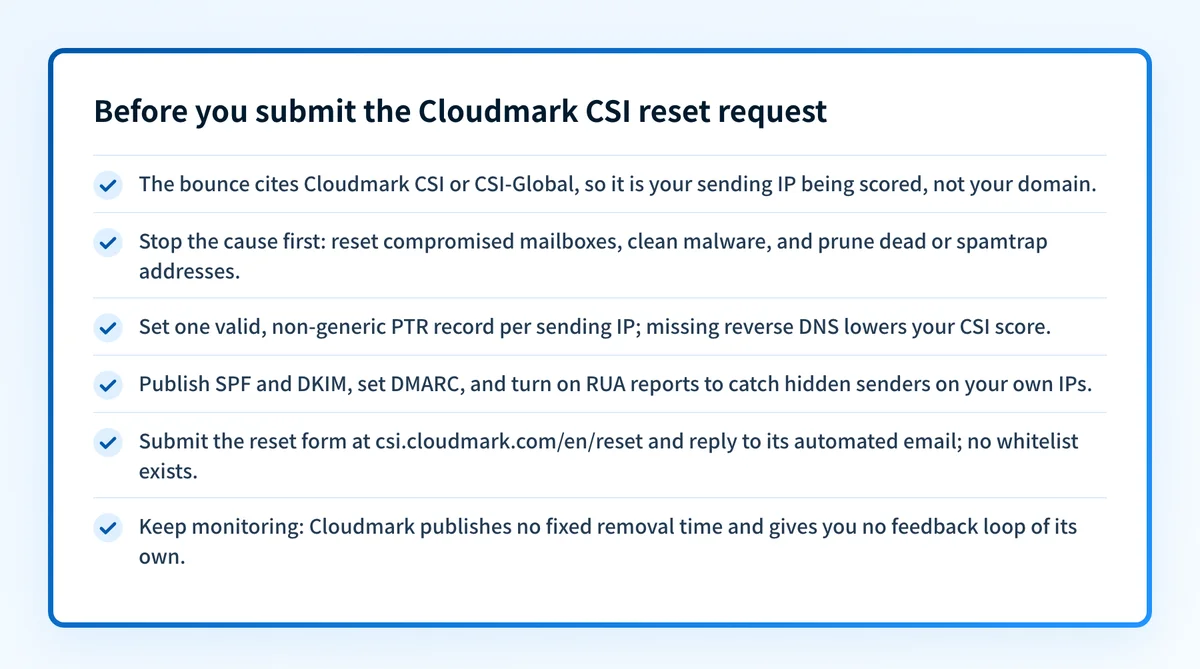
A reset only sticks if you fix the cause first, because CSI keeps scoring your traffic in near real time. There is no whitelist to buy and no fast-track: Cloudmark states "All remediation requests are reviewed on a case by case basis and we may adjust our heuristics accordingly." Work the steps in order, then submit the request.
Confirm the signals on your sending IP
Run the IP your mail actually leaves from through the free IP reputation check below, and use the DNS lookup to confirm its PTR record. Note that the bounce named Cloudmark CSI or CSI-Global, and that it is the sending IP being scored, not your domain.
Stop the abuse at the source
Before you ask for a reset, end whatever caused it: reset any compromised mailbox, clean malware-infected hosts, close an open relay or vulnerable form, and fix list hygiene by removing dead and spamtrap-prone addresses. CSI re-scores you on live traffic, so a request submitted while spam still flows will not hold.
Fix reverse DNS on the sending IP
Cloudmark requires it: "Do I need to configure reverse DNS? Yes. You must." Set one valid, non-generic PTR record per sending IP, make sure every authoritative nameserver returns the same answer, and avoid names like example.local that are not real hostnames.
Authenticate and turn on DMARC reporting
Publish correct SPF, turn on DKIM for each service that sends as you, and set DMARC. Verify with the free SPF, DKIM, and DMARC checkers. Aggregate (RUA) reports then surface every source sending as your domain, so a compromised host or shadow sender on your own IPs shows up in a report instead of as fresh complaints and spamtrap hits against your CSI score.
Submit the CSI reset request and confirm it
Complete the IP statistics reset request form at csi.cloudmark.com/en/reset (it is gated by a reCAPTCHA), then respond to the automated email it sends you. If the IP was recently reassigned to you, include your full IP allocation and the dates it was assigned, as Cloudmark asks.
Monitor the IP so the next problem is an alert
Cloudmark publishes no fixed processing time and offers no feedback loop of its own, so keep watching the sending IP and keep DMARC reports flowing. A new compromise then shows up as an alert instead of a fresh CSI listing and a wave of bounces.
Removal is free
The reset request form is free to submit, and Cloudmark publishes no paid delisting option and no whitelist for sale. It reviews each request case by case and may adjust its heuristics accordingly, so removal depends on that assessment and cannot be rushed or bought. Ignore any third party that offers to fast-track a Cloudmark removal for a fee.
Open csi.cloudmark.comWhen a Cloudmark Sender Intelligence listing isn't your fault
A CSI hit is not always your own sending. Because CSI is IP reputation, the listed address may be shared, and Cloudmark says another tenant's sending "could be the reason for the poor reputation". A poor surrounding IP-block reputation can drag a clean address down, and a recently reassigned IP can inherit history you did not create. And since Cloudmark names no enforcing receivers, one provider's CSI-based rejection is not proof every mailbox sees you as bad. Confirm the sending IP's signals before you act.
How to stay off Cloudmark Sender Intelligence
Authenticate everything: SPF that lists every real sender, DKIM signing on each service, and DMARC that you actually move to enforcement.
Watch your DMARC aggregate reports and act on them: they surface unauthenticated senders and compromised hosts on your own IPs before those rack up the complaints and spamtrap hits CSI scores, and moving every domain to
p=rejectstops spoofers getting mail accepted as your domain.Set one valid, non-generic PTR record per sending IP with a matching HELO, and send from static IPs meant for mail.
Watch spam-complaint rates, spamtrap exposure, and IP reputation continuously, so a compromise surfaces as an alert, not a bounce.
Keep list hygiene tight: retire dead addresses, honour unsubscribes fast, and warm new IPs deliberately.
The real fix: enforce authentication, don't just monitor
A CSI listing means your sending IP emitted the spamtrap hits, complaints, or snowshoe-pattern traffic CSI scores, usually because a compromised host, shadow app, or careless sender on your own infrastructure was sending mail you could not see. Checking your reputation tells you that you are listed; it does nothing to surface that hidden sender. DMARC aggregate reporting does: it shows every source sending as your domain, unauthenticated traffic leaving your own IPs included, so you can shut it down before it moves your score. Host correct SPF, DKIM, and DMARC, work the reports for senders you missed, and move every domain to p=reject so spoofers cannot get mail accepted as you and drag down your domain's reputation too.
DMARC software that does the work
Palisade's AI agent takes domains all the way to enforcement: hosted SPF, DKIM, DMARC, and MTA-STS records on paid plans, DMARC reports monitored continuously, and every policy step drafted for your approval on the way to p=reject. The full product is open for a 15-day trial, and nothing is charged until it ends.
15-day full-product trial. Nothing is charged until it ends.
Watching Cloudmark Sender Intelligence across every client domain
One client's IP on CSI is an afternoon; a book of clients each one compromise away from it is the job. Checking every tenant's sending IP and reverse DNS by hand does not scale, and CSI gives you no public feed to watch and no whitelist to lean on, so the only durable defence is stopping the spam-as-your-client traffic before it starts. Palisade hosts and manages SPF, DKIM, and DMARC for every client domain, surfaces unauthenticated senders in the DMARC reports before they turn into complaints, and carries each domain to p=reject, with your team approving each step. It watches every domain from one console and opens tickets in ConnectWise, HaloPSA, and Autotask, and your own MSP domain is a free NFR domain to prove it on.
Questions readers ask
Frequently asked questions
How do I remove my IP from Cloudmark CSI?
How long does Cloudmark CSI removal take?
Is Cloudmark CSI a blacklist?
Which email providers use Cloudmark CSI data?
Why is my sending IP listed on Cloudmark CSI?
Can I check my IP's Cloudmark reputation or get it whitelisted?
Do I need reverse DNS to get off Cloudmark CSI?
Sources and last verified
Every Cloudmark Sender Intelligence fact on this page is drawn from the operator's own documentation, last checked 2026-07-19. Blocklist policies change; if a detail looks off, the linked source is authoritative.
- CSI provides reputation data on sending servers to messaging service providers.“Cloudmark Sender Intelligence (CSI) is a service that provides data about the reputations of message-sending servers to messaging service providers.”csi.cloudmark.com · checked 2026-07-19
- Cloudmark does not block messages itself; the sender's service provider does.“Cloudmark is not a messaging service provider and does not block your messages, but your service provider may choose to do so.”csi.cloudmark.com · checked 2026-07-19
- CSI is an IP reputation system, not a blacklist.“CSI is not a blacklist; it is an IP reputation system, based on data such as user feedback from the Cloudmark community, email sent to spamtraps, heuristics regarding reverse DNS and nearby IP addresses, and other factors, which is used by our customers to assist them in making policy decisions on how they handle inbound mail.”csi.cloudmark.com · checked 2026-07-19
- Removal is a reviewed request form with an automated confirmation and no published timeframe.“Fill out the CSI remediation form. Respond to the automated message you will receive when you have completed the remediation form. You will receive another message when your request has been processed.”csi.cloudmark.com · checked 2026-07-19
- The reset path is the IP statistics reset request form, used when you are sure you are not sending spam.“If you are certain that you are not responsible for the sending of any spam, you may complete the IP statistics reset request form.”csi.cloudmark.com · checked 2026-07-19
- A shared IP can be listed because of another sender on the same address.“If other users are sending mail out from the same IP address as you, their sending patterns could be the reason for the poor reputation.”csi.cloudmark.com · checked 2026-07-19
- Reverse DNS is required; missing rDNS lowers the Cloudmark reputation score.“Sending messages from an IP address with no rDNS may negatively affect your Cloudmark reputation score, as well as your reputation with ISPs and DNS blacklists.”csi.cloudmark.com · checked 2026-07-19
- Cloudmark provides no whitelisting and reviews remediation requests case by case.“No, we do not provide any whitelisting services. All remediation requests are reviewed on a case by case basis and we may adjust our heuristics accordingly.”csi.cloudmark.com · checked 2026-07-19
- For a recently reassigned IP, Cloudmark asks for the full IP allocation and assignment dates.“please complete the IP statistics reset request form and also provide us with details of your full IP allocation along with the date when these IPs were assigned to you.”csi.cloudmark.com · checked 2026-07-19
- CSI Global is the IP list tier; CSI ships as a DNSBL data feed for edge MTAs and SIEM.“IP address lists of known mail forwarders, poor quality senders, and suspect senders derived from the Cloudmark Global Threat Network”www.cloudmark.com · checked 2026-07-19
- CSI data is consumed by communications, email, and web hosting service providers.“This data can be used by communications service providers, email service providers, web hosting providers, or other Internet services companies”www.cloudmark.com · checked 2026-07-19
- The Cloudmark Global Threat Network observes traffic destined for over 12% of the world's Internet users.“Collecting data associated with traffic destined for over 12% of the world's Internet users across a variety of communications channels”www.cloudmark.com · checked 2026-07-19
- CSI scores IP reputation from spamtrap hits, end-user complaints, reverse-DNS reputation, IP-block reputation, and snowshoe-like traffic volume.“take into account many different factors, including both spam trap hits and volume of trusted end user complaints (hitting the "This is spam" button), reputation of the reverse DNS of the IP, reputation of the IP block that the IP is part of, and traffic volumes over time which help measure likely use of the IP in a snowshoe attack.”www.cloudmark.com · checked 2026-07-19
- Cloudmark is a Proofpoint company, and Proofpoint's Cloudmark network spans 100+ ISPs and 20+ mobile operators.“100+ ISPs and 20+ mobile operators in our network”www.proofpoint.com · checked 2026-07-19