SMS Spoofing: Understanding and Mitigating Risks
 ChatGPT
 Claude
 Gemini
 Perplexity
 Grok
GrokIn brief
SMS spoofing lets attackers fake sender IDs in text messages. Learn how smishing works and how to protect your business and customers.
SMS spoofing is the practice of altering the sender information on a text message so it appears to come from someone else, usually by supplying a fake number or an alphanumeric sender ID such as "AMAZON" or "BANK". It works because that sender field is a label the sender chooses rather than a verified identity, and many SMS gateways pass it through untouched. Businesses use it legitimately for branded messaging. Fraudsters use it for smishing, fake transfer confirmations, and harassment.
Defining SMS Spoofing
When we talk about SMS spoofing, we're referring to the act of sending text messages using another person's number or a made-up sender ID. The objective? To make the recipient think that the message has come from a trusted person or organization.
Spoofing vs Smishing
It's important to clarify the difference between SMS spoofing and smishing. While the former involves changing the sender's details, smishing is a technique used to deceive individuals into sharing confidential information or performing certain tasks through deceptive text messages. This often involves scams similar to phishing, where the fraudster attempts to gather personal or financial details from the victim.
Deciphering SMS Spoofing
The weakness that makes SMS spoofing possible is that the "from" field of a text message: especially an alphanumeric sender ID, the short brand name like "AMAZON" or "BANK" shown instead of a phone number. Is often just a label the sender chooses, not a cryptographically verified identity. Bulk-messaging platforms connect to carrier networks over the SMPP protocol through an SMS gateway, and historically many gateways passed whatever sender ID they were given straight through. That is the same class of trust gap that plagues email, which is why the fix parallels the SPF, DKIM and DMARC controls used to authenticate the "from" address of email. Here's a simple breakdown of how SMS spoofing functions:
- Sender sets up the spoofing software or online service: This involves defining parameters like the desired sender's name or number, the recipient's number, and the message content.
- Message goes to the SMS gateway: The altered message is sent to an SMS gateway, which acts as a mediator between the sender and the recipient's mobile network, typically over SMPP.
- SMS gateway forwards the message: The SMS gateway processes the message and forwards it to the recipient's mobile network, carrying whatever sender ID was supplied.
- Recipient receives the altered message: The recipient's phone gets the message, displaying the modified sender details.
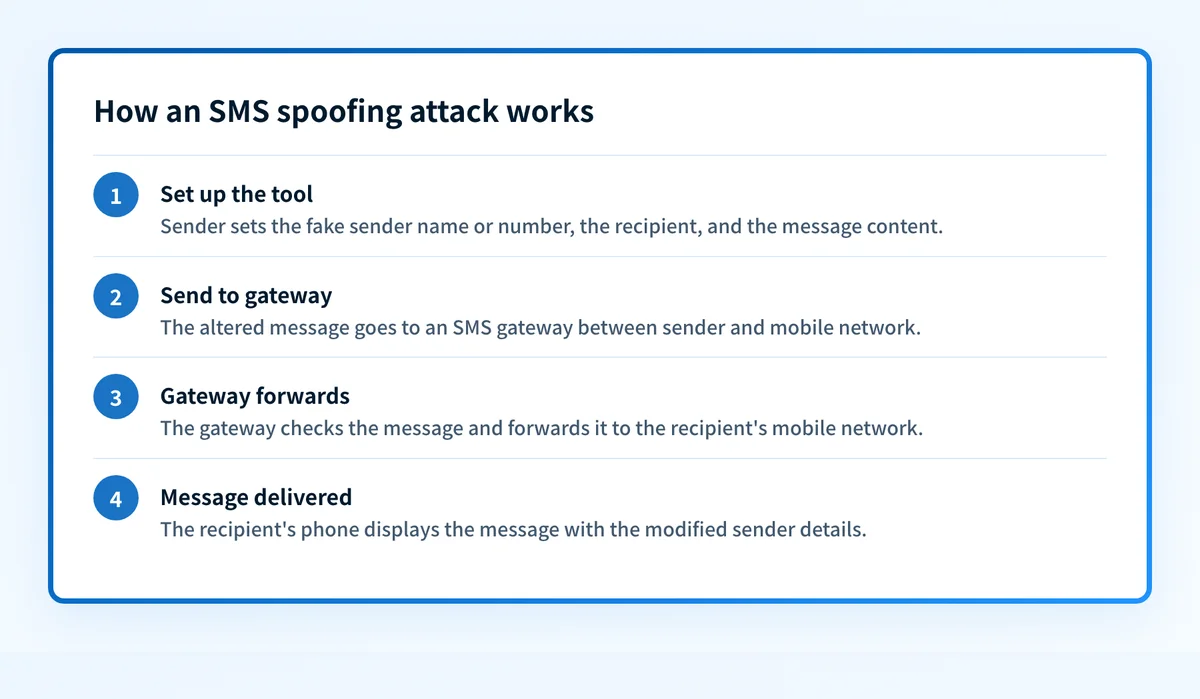 The path of a spoofed text message, from setup to delivery.
Spoofing: A Tool for Fraudsters
Fraudsters often use SMS spoofing to gather sensitive user information or to mislead individuals for their personal gain. Here are a few ways this can be done: Phishing scams: Fraudsters may send spoofed messages pretending to be legitimate institutions, like banks or government agencies, tricking recipients into revealing their personal or financial information. The text-message flavour of this is called smishing. Social engineering attacks: By pretending to be someone the recipient trusts, fraudsters can manipulate the individual into providing sensitive information or performing actions they wouldn't ordinarily do. Malware distribution: Spoofed messages may include harmful links or attachments, tricking recipients into downloading malware that can compromise their devices or steal their data.
Diverse Forms of SMS Spoofing
SMS spoofing can take many shapes, each with its unique objective. Here are some typical forms of SMS spoofing:
Counterfeit Money Transfers
Here, fraudsters send texts to individuals, falsely claiming to have transferred money to their account. The message often requests the recipient to confirm or provide personal banking details, enabling the fraudster to gain unauthorized access to their finances.
Imitation Sender IDs
Fraudsters can alter the sender's name or number to fool recipients into thinking they are receiving messages from a trustworthy source. By disguising their identity, they can manipulate individuals into revealing sensitive information or performing specific actions.
Harassment (Stalking, Pranks, Fake Emergencies, etc.)
SMS spoofing can also be used for harmful activities like stalking, pranks, or creating panic. By pretending to be someone the recipient knows, the fraudster can cause distress or manipulate the person into behaving in ways they wouldn't normally.
Recognizing Spoofed Messages
Identifying spoofed messages can be tricky as fraudsters are becoming more sophisticated in their approach. However, there are some red flags to watch out for: Odd or unusual message content: Look out for unusual requests, spelling errors, or grammatical mistakes in the message. Authentic organizations typically maintain a professional tone and strive for error-free communication. Unexpected sender: Be cautious if you receive a message from someone unfamiliar or an unexpected sender. Always confirm the sender's identity through other means before responding or providing any personal information. Suspicious URLs or attachments: Be wary of messages that contain suspicious links or attachments. Avoid clicking on them unless you are certain of their legitimacy.
Mitigating SMS Spoofing
Though it's difficult to completely eliminate the risk of SMS spoofing, there are steps you can take to reduce your exposure: Stay vigilant with personal information: Refrain from sharing sensitive personal or financial details over text messages. Reputable organizations typically use secure channels or alternate methods for verification. Use reliable security software: Install trustworthy mobile security applications that can detect and protect against potential spoofing attempts. Educate yourself and your team: Stay informed about the latest spoofing techniques and share this information with your team. Train your team to identify potential spoofing attempts and follow cybersecurity best practices, the same discipline that defends against social engineering more broadly.
On the carrier side, the ground has shifted. As of February 1, 2025, the major US carriers, AT&T, T-Mobile and Verizon, block unregistered application-to-person (A2P) traffic, so businesses must register their sending numbers and campaigns through The Campaign Registry (the 10DLC process) to reach US phones at all. US networks have effectively moved away from free-form alphanumeric sender IDs for A2P messaging in favour of registered numbers and vetted brands, which removes much of the easy sender-ID forgery that older gateways allowed. RCS for Business (the carrier-backed successor to SMS) goes further with verified-sender profiles that show a checkmark and a vetted brand identity, making the sender far harder to impersonate. One point of confusion worth clearing up: STIR/SHAKEN, the caller-ID authentication framework you may have read about, applies to voice calls, not text messages, so it is not the mechanism protecting your SMS channel.
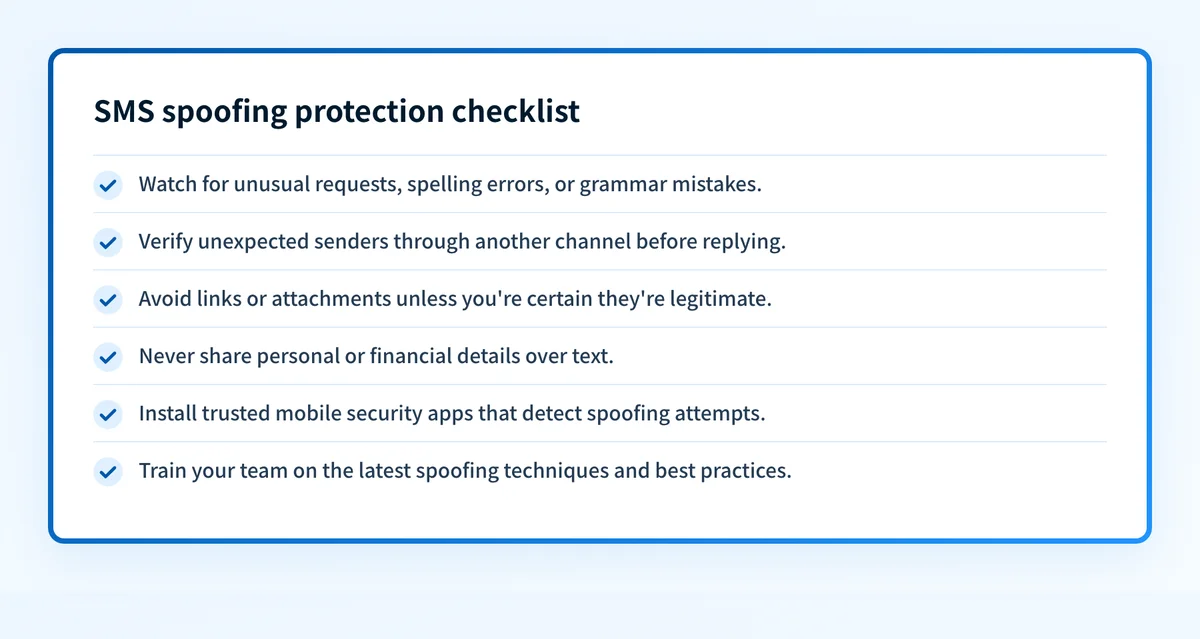 Red flags to watch for and habits that reduce SMS spoofing risk.
Legitimate branded sender IDs in business
It is worth separating criminal spoofing from the legitimate practice of sending messages under a recognised brand name. When a business texts you as "AMAZON" rather than a random number, it is using a registered, branded sender ID, not forging an identity, but claiming one it has been vetted and approved to use. The mechanics look similar; the difference is authorisation and registration. Here are the honest business use cases:
Branded bulk campaigns
Businesses run bulk promotional and transactional messaging (marketing offers, order confirmations, appointment reminders) under a registered brand name so customers instantly recognise the source. In the US this requires 10DLC registration through The Campaign Registry; free-form, unvetted sender IDs are increasingly rejected by carriers.
Official and public-service messages
Government agencies and institutions send official notices under an approved sender ID so the message is reliably attributed to the correct authority. The value here comes precisely from the identity being verified, not hidden.
Consistent, recognisable identity
Rather than "maintaining anonymity," the legitimate goal is the opposite: a consistent, recognisable sender identity across every message, ideally reinforced by a verified profile such as an RCS for Business checkmark. Deliberately concealing or falsifying the sending identity to reach consumers is what regulators and carriers now restrict, so it is not a business use case to build on.
Wrapping Up
SMS spoofing is a growing concern in our increasingly digital world, offering an easy route for fraudsters to trick individuals and gather sensitive data. It's essential to stay alert and use preventive measures to protect yourself and your organization. The legitimate business practice (sending under a registered, vetted brand sender ID) is deliberately the opposite of spoofing, and the carrier registration rules now in force are steadily closing the gap that made forgery easy. By staying informed and vigilant, we can ensure safe and secure digital communication.
How Palisade fits in
Palisade does not send or police SMS traffic. It protects the email channel, which is where most brand-impersonation attacks against your customers still land. The same instinct that makes SMS spoofing dangerous, a "from" line anyone can fake, is exactly what DMARC, SPF and DKIM fix for email. Palisade's agent handles that side of the problem: it monitors the authentication of mail sent from your domain, proposes each DMARC policy step from monitoring to enforcement for your approval, and flags spoofed senders trying to impersonate your brand over email. You can start with our free DMARC checker and SPF checker to see where your domain stands, or measure your overall posture with the email security score.
If you want the whole process handled (records generated, reports read, and each step to p=reject proposed for your approval) Get started with Palisade or Book a demo to see it on your own domain.
Related reading
Questions readers ask
Frequently asked questions
Can SPF, DKIM and DMARC stop SMS spoofing?
No. SPF, DKIM and DMARC authenticate the "from" address of email, not text messages, which travel over a completely different carrier network. They will not touch smishing directly. What they do stop is the closely related email-based brand impersonation that usually accompanies an SMS scam campaign, so hardening your email authentication removes one of the attacker's two channels.
Is sending under a spoofed sender ID legal?
Sending under an approved, registered brand sender ID is a normal, legal business practice. Deliberately falsifying sender information to deceive a recipient is a different matter and is increasingly restricted: US carriers block unregistered A2P traffic, and impersonation for fraud is illegal under consumer-protection and anti-fraud laws. The dividing line is authorisation and intent, not the technique itself.
What role do STIR/SHAKEN and RCS play?
STIR/SHAKEN is a caller-ID authentication framework for voice calls, so despite the buzz it does not authenticate SMS. The modern equivalent for messaging is RCS for Business, the carrier-backed successor to SMS, which adds verified-sender profiles (a vetted brand name and checkmark that make impersonation far harder) alongside the carrier registration rules that now govern text traffic.
How does a business register a legitimate sender ID in the US?
Through the 10DLC process: you register your brand and each messaging campaign with The Campaign Registry, providing details like your brand name, address and EIN, and describing how the numbers will be used. Since February 1, 2025 the major US carriers block unregistered A2P messages, so registration is effectively mandatory to reach US phones at scale.
Does BIMI help against spoofing?
BIMI is an email standard, not an SMS one, but it is the closest email analogue to a verified SMS sender: once you reach DMARC enforcement, BIMI can display your verified logo beside authenticated mail, giving recipients a visual trust signal that a spoofed sender cannot replicate.

Written by
Ian BussieresCTO & Co-Founder, Palisade
Ian Bussieres is the CTO and co-founder of Palisade, agentic DMARC software for IT teams and MSPs.
More from Ian →