8 DMARC tools for MSPs compared in 2026
 ChatGPT
 Claude
 Gemini
 Perplexity
 Grok
GrokIn brief
Compare eight DMARC platforms for MSP workflows, with verified details on multi-tenancy, integrations, hosted records, reporting, and pricing.
MSPs comparing DMARC tools should evaluate Palisade, EasyDMARC, Valimail, Red Sift OnDMARC, dmarcian, Fortra Agari, Postmark DMARC Digests, and DMARCLY. The right choice depends on whether the MSP needs multi-tenant administration, PSA and billing integration, hosted authentication records, operator-led reporting, or agent-assisted remediation across client domains.
This comparison uses current vendor-controlled documentation and published pricing where available. A feature checkbox cannot prove that a platform fits an MSP's approval process, staffing model, or client portfolio, so shortlist candidates and test them with representative domains before committing.
Quick answer: which DMARC tools fit different MSP workflows?
Different DMARC tools fit different MSP workflows. Use the shortlist below to match each platform's publicly documented strengths to the service the MSP intends to deliver.
- Palisade: Consider it when multi-tenant operations, PSA-connected billing, hosted authentication records, and technician-approved remediation need to live in one MSP-oriented workflow.
- EasyDMARC: Consider it when white-label reporting, broad integration coverage, and pay-as-you-go domain management are priorities.
- Valimail: Consider it when the team wants automated authentication workflows, portfolio administration, and a free monitoring entry point.
- Red Sift OnDMARC: Consider it when security teams want source investigation, API access, alerting, and broader domain-security tooling.
- dmarcian: Consider it when operators value established DMARC analysis, centralized domain visibility, and service-provider support.
- Fortra Agari: Consider it for enterprise-led evaluations that emphasize sender intelligence and managed authentication workflows.
- Postmark DMARC Digests: Consider it for straightforward, per-domain monitoring when a full MSP control plane is unnecessary.
- DMARCLY: Consider it when published domain and message allowances, client switching, and hosted authentication features match the portfolio.
At-a-glance comparison
| Tool | Publicly verified MSP or portfolio signals | Public pricing path |
|---|---|---|
| Palisade | Multi-tenant dashboard, role controls, white-labeling, PSA integrations, and hosted SPF, DKIM, DMARC, BIMI, and MTA-STS | Per client domain, with a free NFR account and unlimited client email volume |
| EasyDMARC | Multi-tenant management, per-client permissions, white-labeling, managed records, API and webhook access, and MSP integrations | Pay as you go per domain through its MSP plan |
| Valimail | Native multi-tenancy, tenant separation, role access, team alerts, and automated SPF, DKIM, and DMARC workflows | Per-domain resale through its MSP program; Free Monitor is available |
| Red Sift OnDMARC | Multi-domain administration, partner licensing, reporting, alerts, API access, and source classification | Flexible MSP licensing; public organization plans start separately at $9 per month when billed annually |
| dmarcian | Centralized multi-domain analysis, reporting, issue identification, and enforcement guidance | Custom service-provider pricing; public organization tiers are priced separately |
| Fortra Agari | Hosted DMARC, sender intelligence, analytics, EasySPF, EasyDKIM, and enforcement workflows | Quote or demo request |
| Postmark DMARC Digests | Per-domain dashboard, source history, recommendations, and email reports | Free weekly monitoring or $14 per month per domain for DMARC Digests |
| DMARCLY | MSP dashboard, client switching, Safe SPF, reporting, API access on the Enterprise tier, and portfolio limits | Published tiers from $17.99 per month; allowances and overages vary by plan |
 Palisade
 EasyDMARC
 Valimail
 DMARCLY
Pricing and product pages were checked on September 9, 2026. Confirm contract terms, data retention, overage rules, support, and the exact capabilities included in an MSP quote before purchase.
How this comparison was researched
We reviewed current product pages, MSP program pages, pricing pages, official documentation, and the DMARC, SPF, and DKIM standards. We looked for answers to five operational questions:
- Can technicians separate clients, domains, users, and permissions?
- Does the platform connect to the MSP's PSA, billing, DNS, or security workflow?
- Can operators investigate senders and prepare or publish record changes with appropriate approval and rollback controls?
- Can the MSP produce client-ready evidence, alerts, and an audit trail?
- Are the portfolio economics understandable at the domain and message volumes the MSP manages?
1. Palisade
Palisade's MSP platform is an email-authentication system for managing client domains from one workspace.
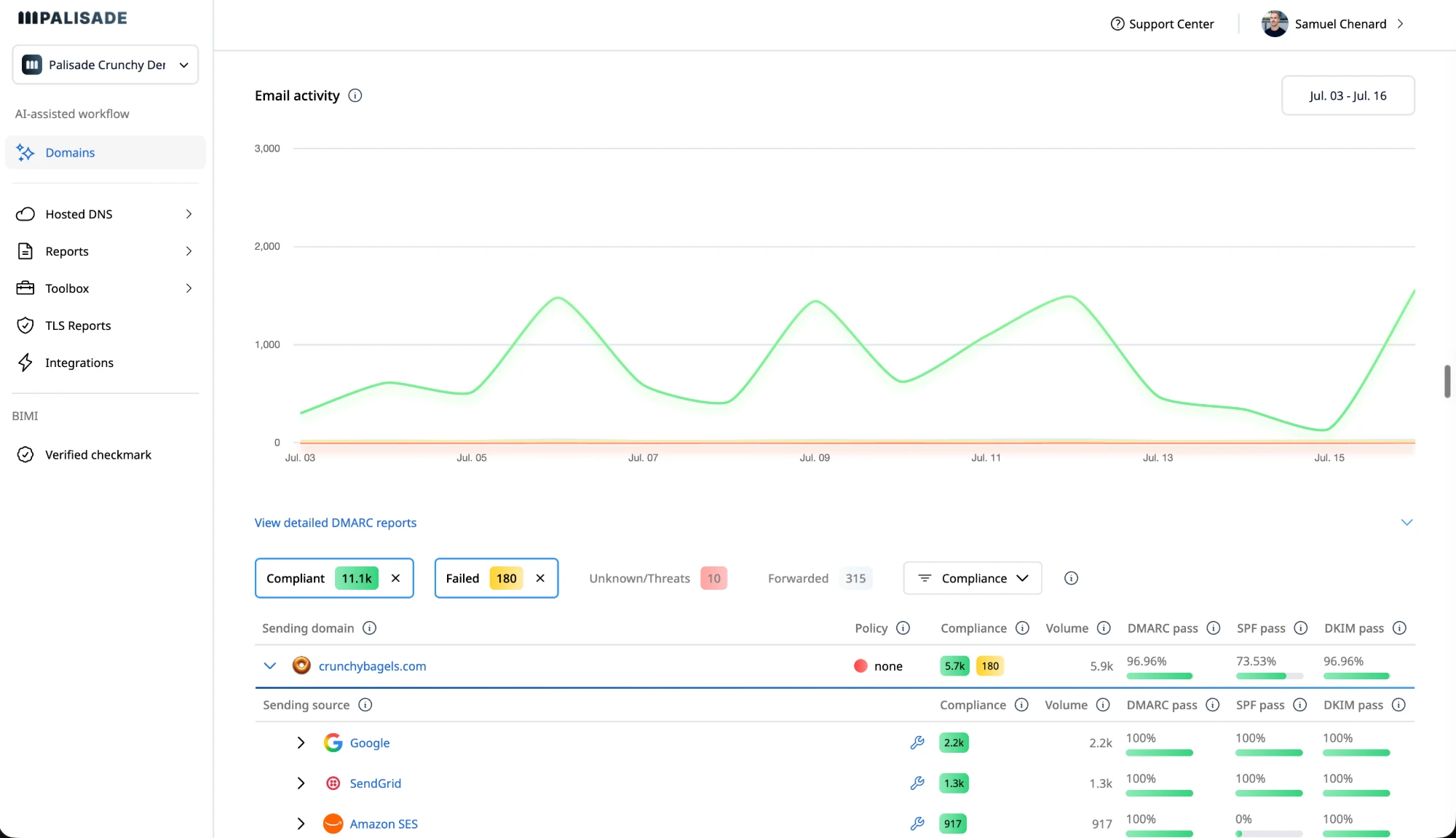
Palisade's domain overview brings email activity and authentication results into one operating view.
What Palisade publishes for MSPs
- Multi-tenant administration, granular roles, and white-label client reporting.
- Integrations with HaloPSA, Autotask, and ConnectWise for operational and billing workflows.
- Hosted SPF, DKIM, DMARC, BIMI, and MTA-STS records. When hosted DKIM is used, the sender still signs the message; the hosted record provides the public-key lookup through DNS.
- Agent-assisted source classification, investigation, and proposed fixes that technicians can review before deployment.
- Per-client-domain MSP pricing with a minimum of 5 client domains, a free not-for-resale account, and unlimited client email volume on the published MSP offer.
Consider Palisade when
The MSP wants one system for tenant administration, PSA-connected operations, reporting, and controlled record changes. During a pilot, verify the desired PSA workflow, technician approval path, DNS delegation model, and client-facing report output.
2. EasyDMARC
EasyDMARC's MSP program is built around multi-tenant email-authentication management.
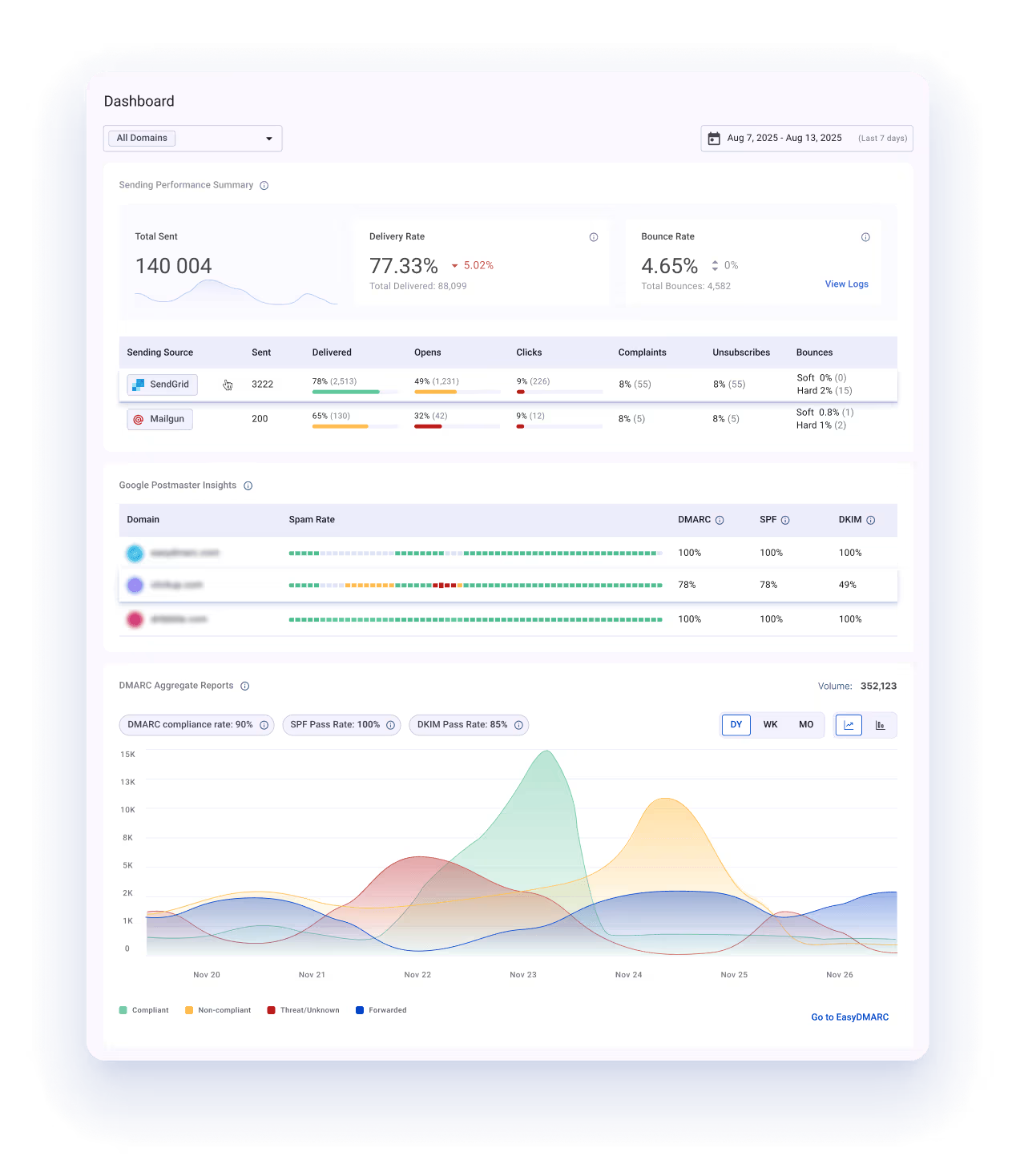
EasyDMARC provides portfolio-level access to client authentication data.
What EasyDMARC publishes for MSPs
- A multi-tenant console with per-client permissions and white-label options.
- Managed SPF, DKIM, DMARC, BIMI, and MTA-STS capabilities.
- Integrations that include ConnectWise, Autotask, HaloPSA, Syncro, Pax8, DNS providers, and SIEM tools.
- API and webhook access for teams that need workflow automation.
- Pay-as-you-go MSP pricing based on managed domains.
Consider EasyDMARC when
The team needs broad integration options, client branding, and domain-based portfolio economics. Test how the platform represents shared senders, how technicians approve changes, and whether the PSA and billing integration covers the exact fields the MSP relies on.
Full comparison: EasyDMARC vs Palisade.
3. Valimail
Valimail's MSP program manages authentication across customer tenants.
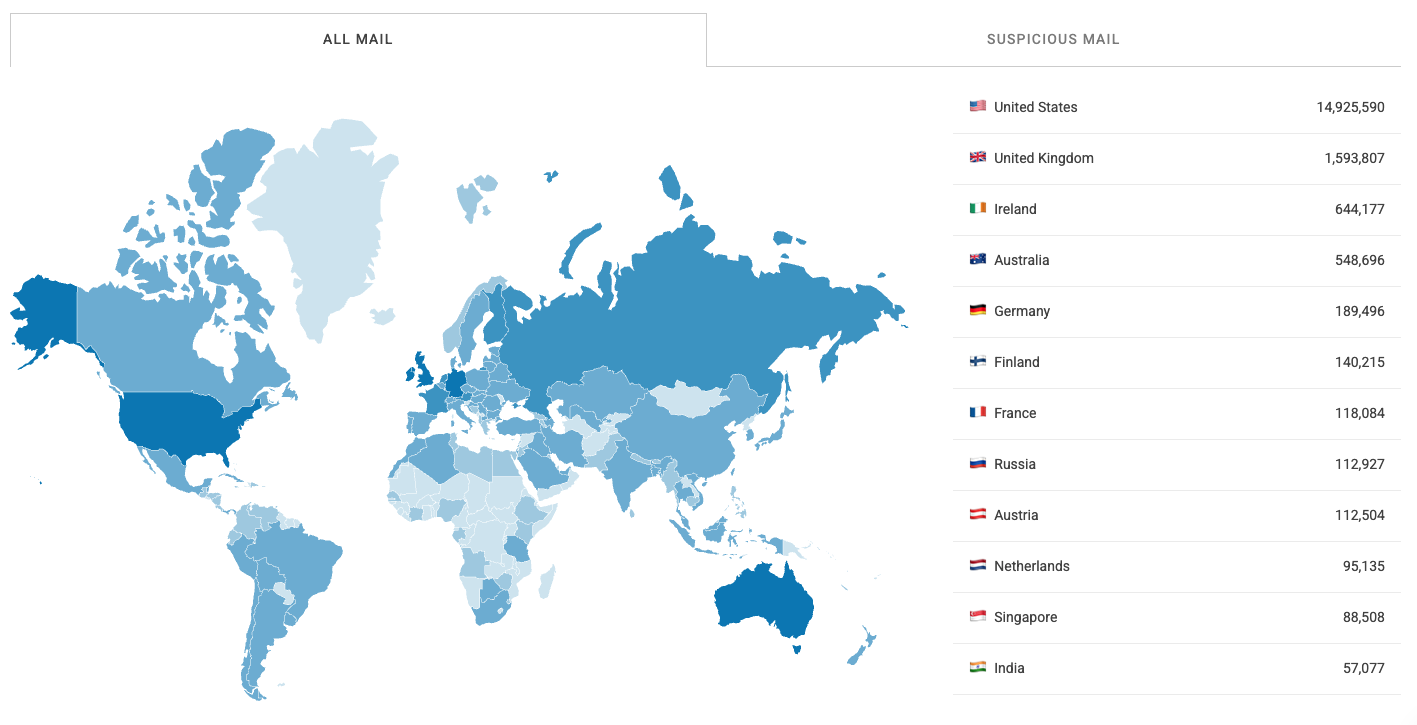
Valimail's interface surfaces sending activity and authentication evidence.
What Valimail publishes for MSPs
- Native multi-tenancy, tenant separation, role-based access, and team alerting.
- Automated SPF, DKIM, and DMARC workflows.
- Per-domain resale and a Pax8 channel option.
- Free Monitor as an entry point, with paid Core and Pro capabilities for enforcement and expanded controls.
- On its current product comparison, Pro adds capabilities such as BIMI, MTA-STS, advanced alerts, and API access.
Consider Valimail when
The MSP wants automated authentication workflows and clear tenant separation, or needs a free monitoring path before a wider rollout. Confirm which controls sit in Core versus Pro, how delegated DNS changes are reviewed, and how reseller billing maps to the client portfolio.
Full comparison: Valimail vs Palisade.
4. Red Sift OnDMARC
Red Sift OnDMARC combines DMARC operations with investigation and domain-security capabilities.
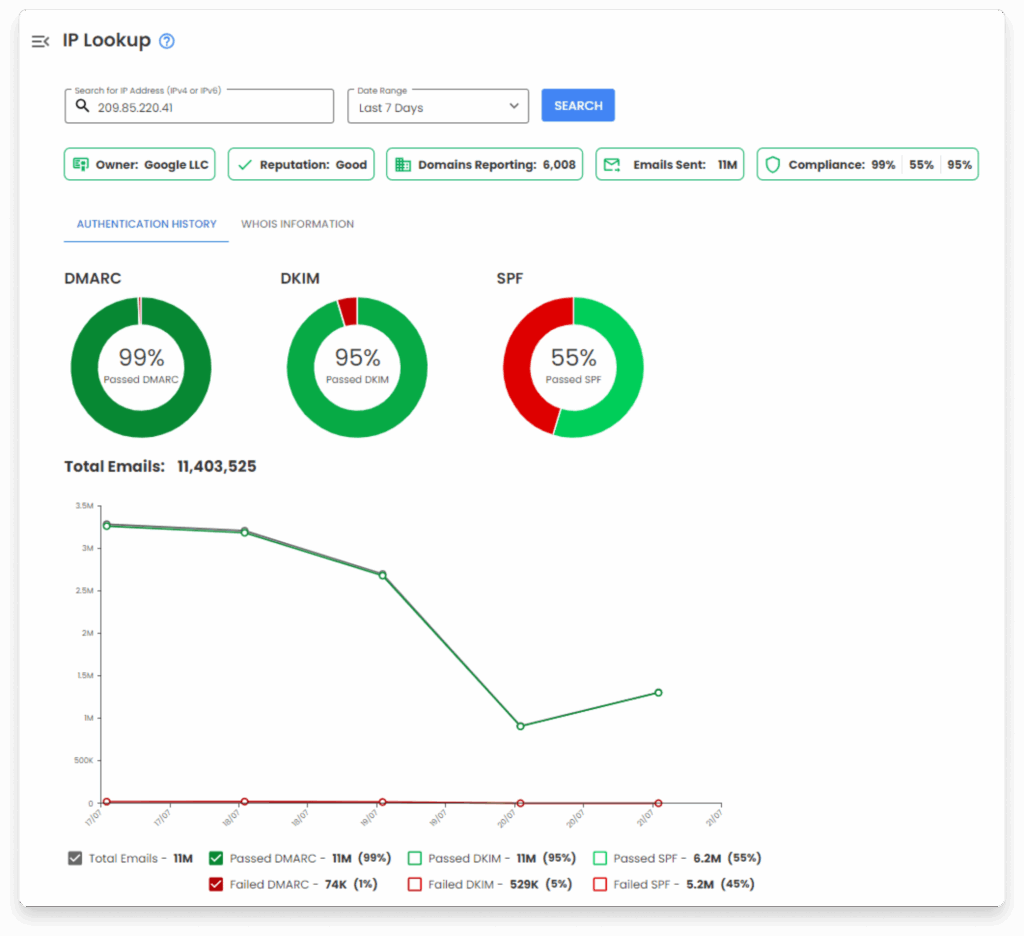
OnDMARC includes tooling for examining sending sources and authentication results.
What Red Sift publishes for MSPs
- An MSP partner program with multi-tenant and multi-domain administration.
- Flexible partner licensing and availability through Pax8.
- Domain management, source classification, reporting, alerts, and API access.
- Bulk services, dynamic services, DNS Guardian, and investigation features in its OnDMARC documentation.
Consider Red Sift OnDMARC when
The service includes security investigation and domain-risk work alongside DMARC operations. Validate the tenant model, licensing unit, analyst workflow, and the specific reporting and integration features included in the proposed MSP package.
Full comparison: Red Sift OnDMARC vs Palisade.
5. dmarcian
dmarcian's service-provider program provides DMARC analysis and resources for teams managing many domains.
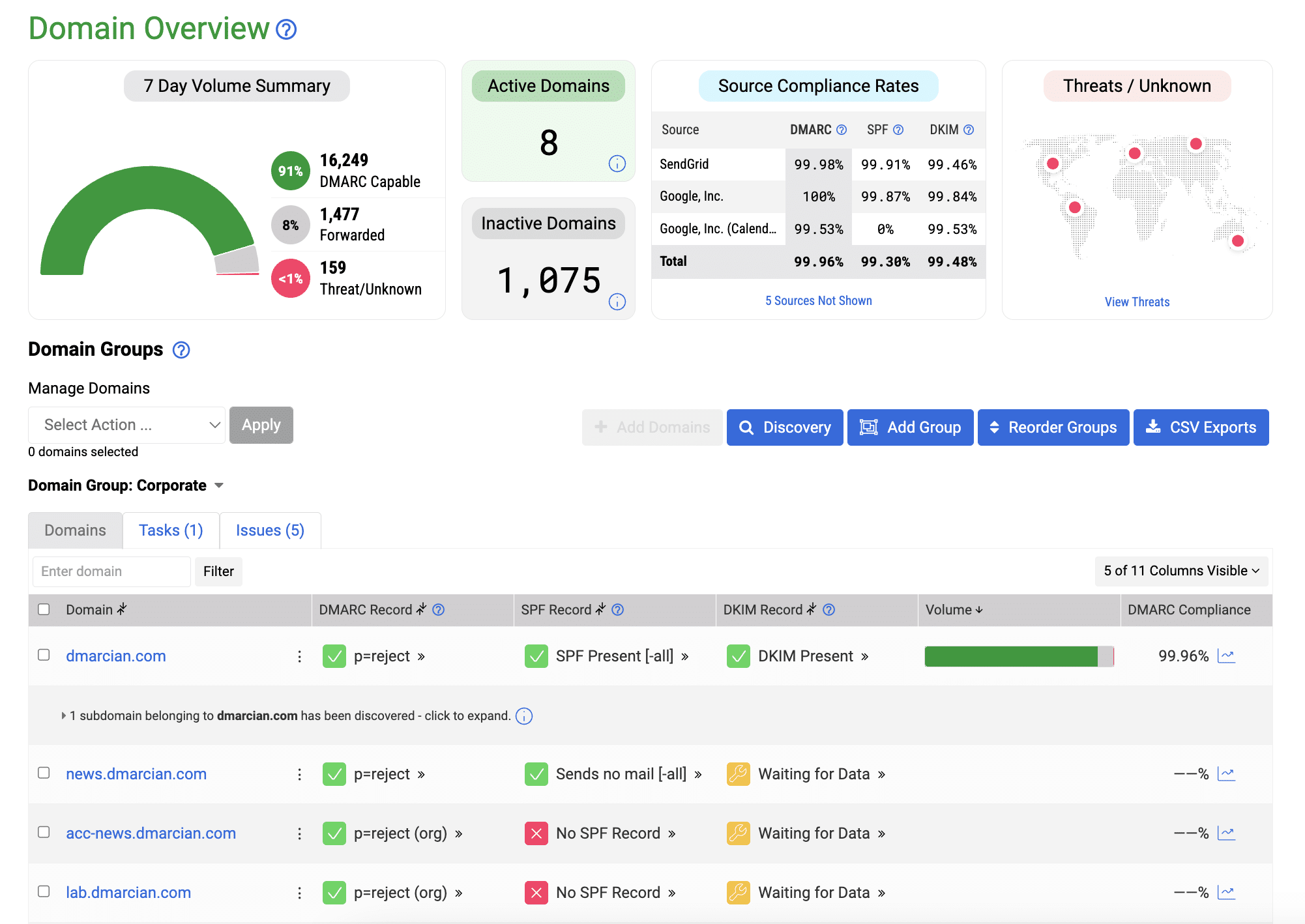
dmarcian organizes authentication evidence by domain and sending source.
What dmarcian publishes for MSPs
- Centralized visibility for service providers managing dozens or hundreds of domains.
- Aggregate-report analysis, issue identification, and guidance toward enforcement.
- Service-provider support and resources for multi-domain operations.
- Public annual-billing organization plans listed at $19.99, $199, and $499 per month for Basic, Plus, and Enterprise.
Consider dmarcian when
The MSP values an established DMARC analysis workflow and wants a service-provider arrangement rather than a standard single-organization account. Ask how client separation, technician permissions, branding, billing, and change approvals operate at the proposed tier.
Full comparison: dmarcian vs Palisade.
6. Fortra Agari
Fortra Agari is an enterprise email-authentication and sender-intelligence offering.
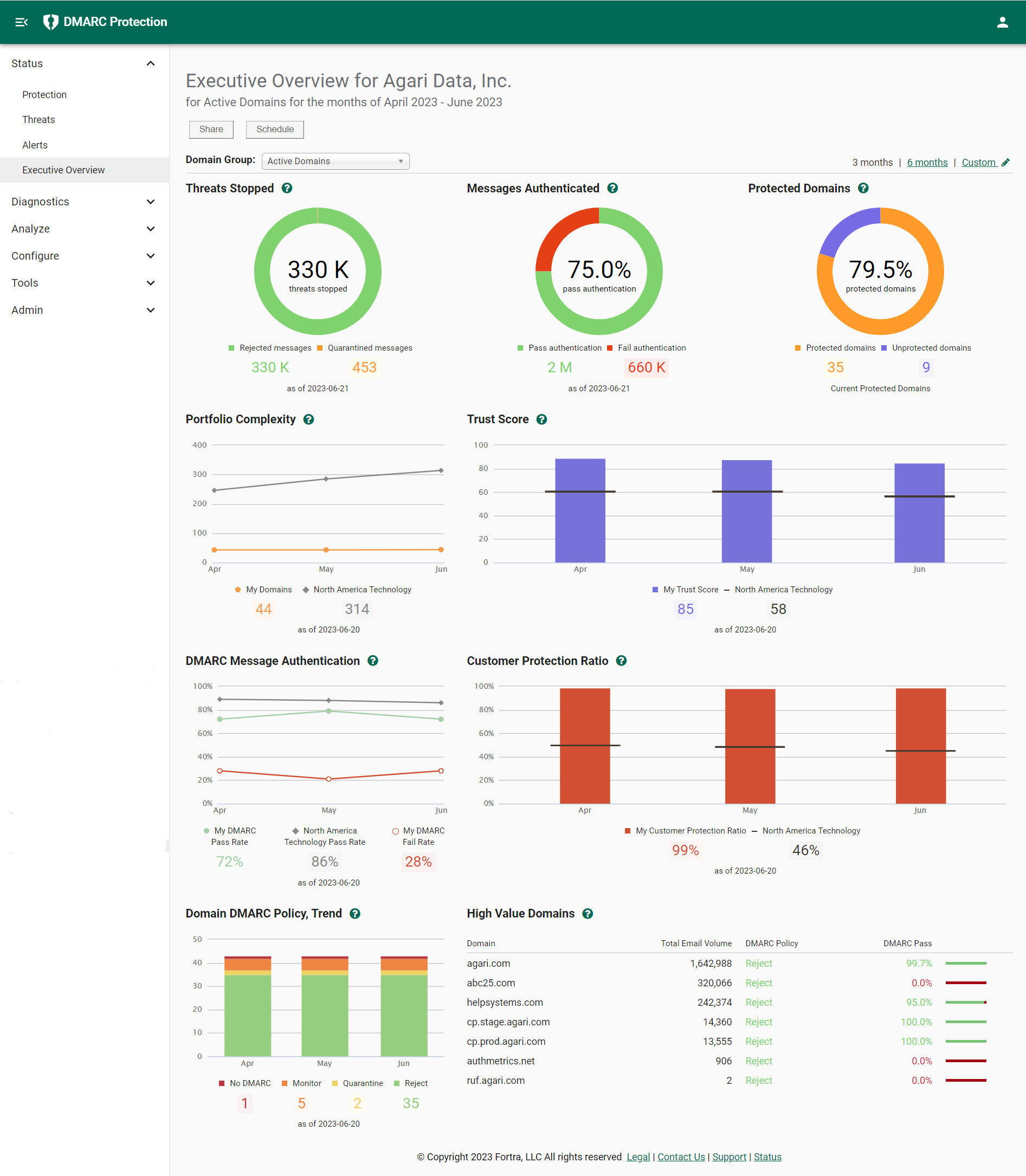
Agari's reporting is oriented toward enterprise sender and authentication analysis.
What Fortra publishes for Agari
- Hosted DMARC and analytics for identifying sending sources.
- EasySPF and EasyDKIM workflows for authentication management.
- Sender intelligence and a guided path toward stronger DMARC policy.
- Quote-led enterprise sales rather than public MSP pricing.
Consider Fortra Agari when
The evaluation is enterprise-led and sender intelligence or hosted authentication workflows matter more than a publicly documented MSP package. Require a demonstration of tenant separation, operational delegation, client reporting, integrations, and portfolio pricing before treating it as an MSP fit.
Full comparison: Agari vs Palisade.
7. Postmark DMARC Digests
Postmark DMARC Digests is a simpler per-domain monitoring service rather than a full MSP management platform.
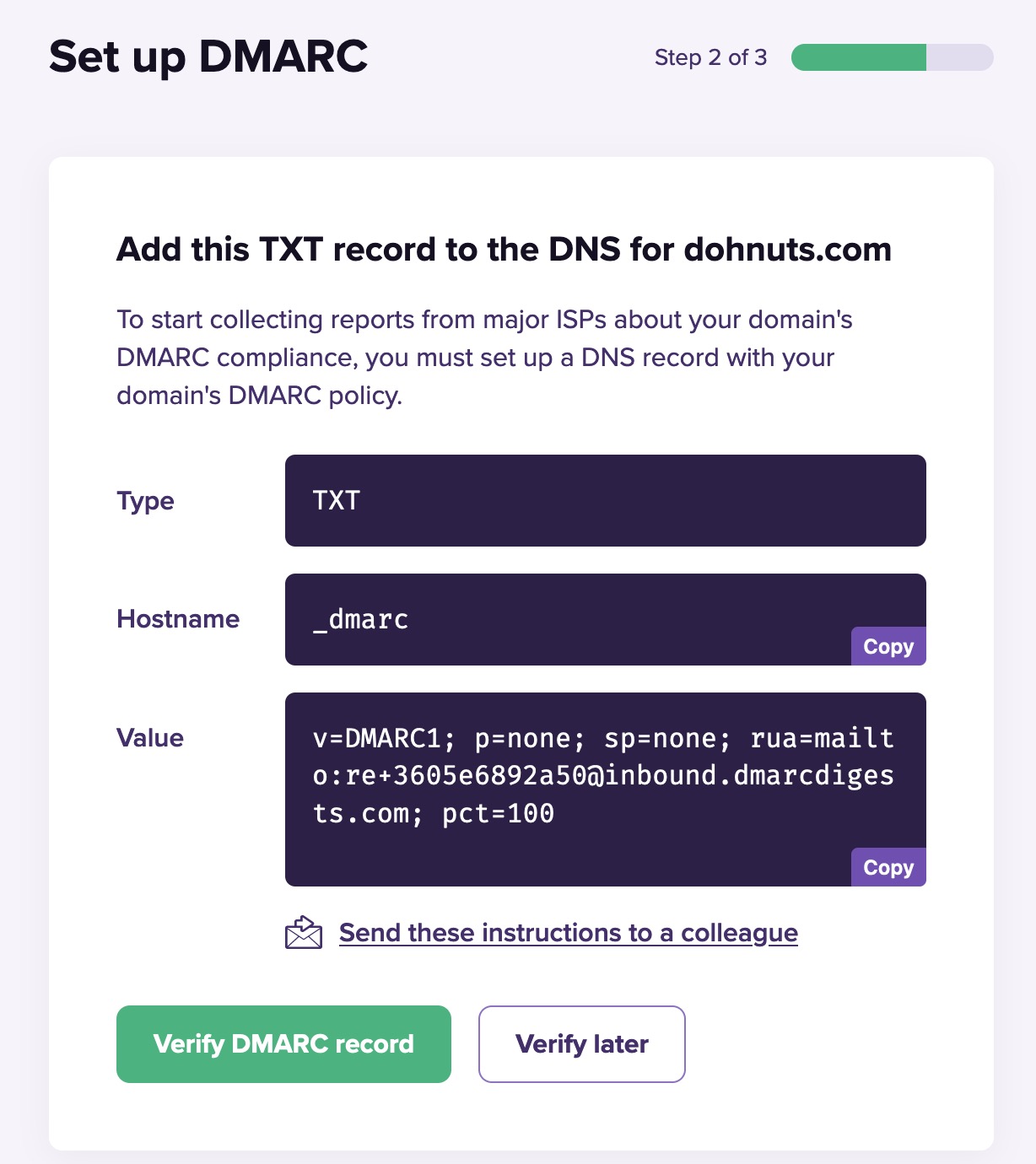
Postmark guides a domain owner through DMARC record setup and report collection.
What Postmark publishes
- Free weekly email monitoring that shows the top 10 mail sources from the previous seven days.
- A $14-per-month, per-domain DMARC Digests plan with all sources and IPs, 60 days of history, a dashboard, recommendations, user management, and weekly or monthly reports.
- A 14-day trial for the paid service.
Consider Postmark DMARC Digests when
The requirement is inexpensive, understandable monitoring for a small number of independent domains. For a larger portfolio, compare the per-domain total and the manual work needed to switch clients, control access, investigate senders, and maintain records.
Full comparison: Postmark DMARC Digests vs Palisade.
8. DMARCLY
DMARCLY combines DMARC reporting with portfolio and hosted authentication features.
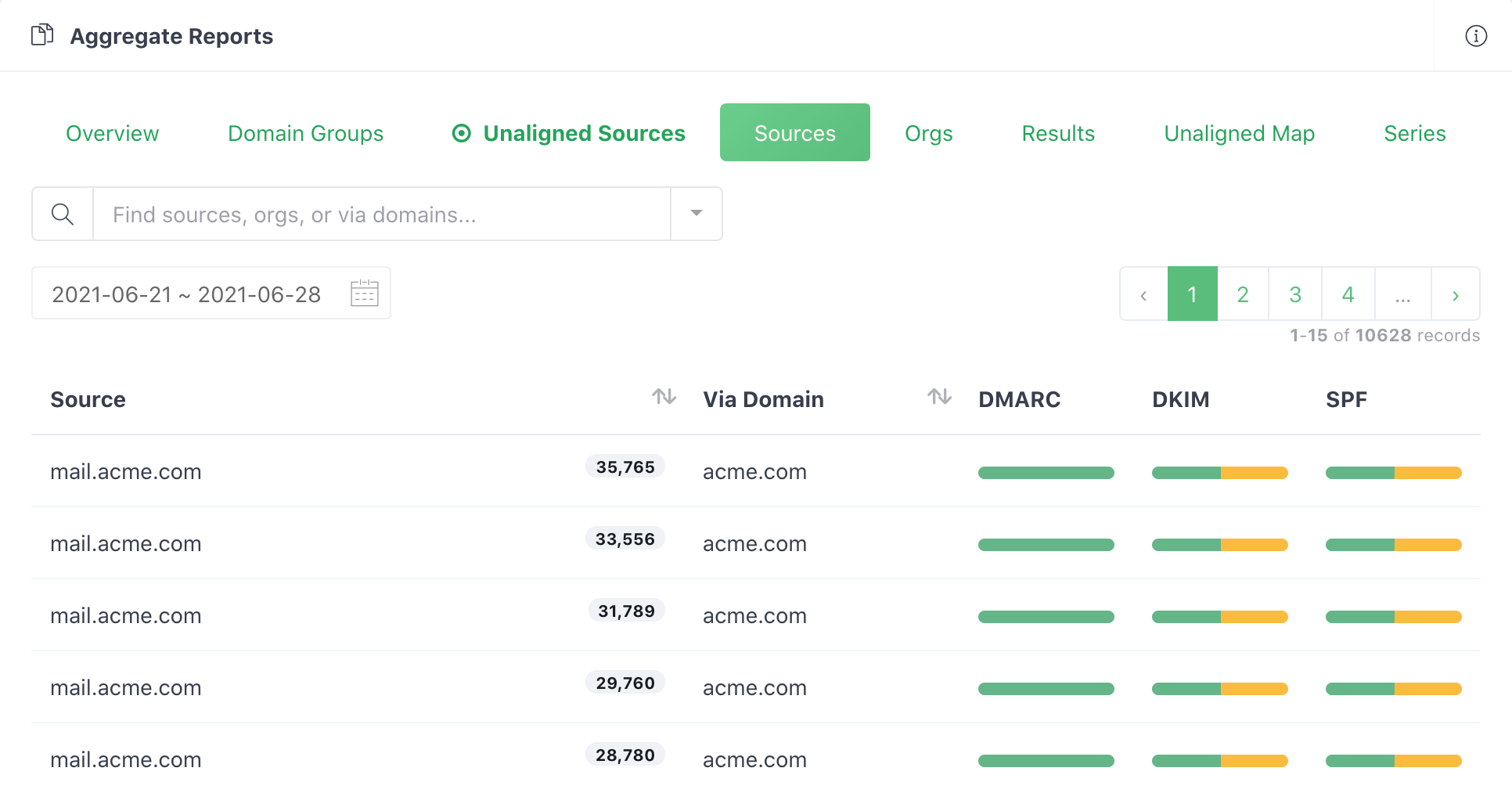
DMARCLY groups aggregate-report data by sending source.
What DMARCLY publishes
- An MSP dashboard for switching among managed clients.
- DMARC aggregate-report processing, Safe SPF, ARC, MTA-STS, TLS reporting, and reputation monitoring.
- Published monthly plans: Professional at $17.99 for two domains, Growth at $39.99 for eight, Business at $69 for 15, and Enterprise at $199 for 200 domains.
- The published Enterprise allowance includes five million messages, unlimited users and groups, four Safe SPF domains, SAML, and API access. Overage charges apply when plan allowances are exceeded.
Consider DMARCLY when
The published domain and message allowances align with the portfolio and the team wants client switching plus hosted record features. Model costs with real report volume, Safe SPF usage, retention needs, and overages instead of comparing only the headline monthly price.
Full comparison: DMARCLY vs Palisade.
How should an MSP choose between these DMARC tools?
An MSP should choose between DMARC tools by running a time-boxed pilot with a small but representative set of client domains. Include a simple cloud-mail tenant, a domain with several legitimate third-party senders, and a domain with messy or incomplete authentication. Then answer six questions with evidence:
- Tenant control: Can the MSP grant the right access to technicians and clients without exposing another tenant?
- Sender investigation: How quickly can an operator identify a legitimate service, an unknown source, and a forwarding-related result?
- Approval and deployment: Who approves DNS changes, what is published, and how is a change rolled back?
- PSA and billing: Do the integration and licensing unit match the MSP's actual service catalog?
- Client evidence: Can the team produce reports that explain risk, progress, and unresolved work without overstating protection?
- Economics: What is the total cost at the portfolio's domain count, message volume, retention period, and staffing level?
DMARC policy is evidence that a receiver considers during message handling. Section 7.4 of RFC 9989 explicitly allows receivers to apply local policy, so no platform can guarantee that every failing message will be blocked or that every legitimate message will be delivered.
For the operating model behind a managed service, read DMARC monitoring for MSPs. If the immediate need is basic visibility rather than a portfolio platform, use the Free plan filter on the DMARC tools comparison instead.
Sources
- Palisade for managed service providers
- Palisade pricing
- EasyDMARC for MSPs
- EasyDMARC MSP pricing
- Valimail for MSPs
- Valimail Monitor
- Red Sift MSP program
- Red Sift OnDMARC pricing
- Red Sift OnDMARC getting-started guide
- dmarcian for service providers
- dmarcian pricing
- Fortra Agari product line
- Fortra Agari DMARC Protection solution brief
- Postmark DMARC monitoring
- DMARCLY features
- DMARCLY pricing
- RFC 9989: Domain-based Message Authentication, Reporting, and Conformance
- RFC 7208: Sender Policy Framework
- RFC 6376: DomainKeys Identified Mail Signatures
Questions readers ask
Frequently asked questions
What should an MSP require from a DMARC platform?
At minimum, require tenant separation, role-based access, source-level reporting, an auditable change process, client-ready evidence, and pricing that can be mapped to the service catalog. PSA integration, white-labeling, hosted records, APIs, and automated investigation may matter depending on how the MSP delivers and bills the service.
Is a free DMARC checker enough for an MSP?
A free checker can validate a record or provide limited monitoring for one domain. It usually does not replace continuous portfolio reporting, tenant permissions, investigation, change controls, client reporting, or billing workflows. Use it for the narrow job it documents.
Do DMARC tools automatically stop spoofed mail?
DMARC tools do not automatically stop every spoofed message. A tool can collect reports, identify sources, help operators publish authentication records, and support movement toward an enforcement policy. The DMARC standard's receiver policy section allows receiving systems to override the requested disposition under local policy.
Does an MSP need hosted SPF, DKIM, or DMARC records?
Not always. Hosted records can reduce manual DNS work and help manage record complexity, but they also change the operational dependency and approval path. Confirm delegation, access controls, failure behavior, audit history, and rollback before using hosted records for client domains.
How long does it take to move a client to DMARC enforcement?
There is no universal timeline. The work depends on the number of legitimate senders, the quality of the inventory, third-party support for SPF and DKIM alignment, DNS ownership, change approvals, and the client's risk tolerance. A responsible rollout uses report evidence and controlled policy changes instead of a fixed deadline.

Written by
Taylor TabusaCo-Founder & Head of Business Development, Palisade
Taylor Tabusa is the co-founder and Head of Business Development at Palisade, helping managed service providers turn email security into a practical, valuable service.
More from Taylor →