How did the 2024 DMARC rules change MSP email protection for SMBs?
 ChatGPT
 Claude
 Gemini
 Perplexity
 Grok
GrokIn brief
The 2024 DMARC rules pushed MSPs from passive monitoring to active enforcement for SMB clients: quarantine or reject policies, reports, and alignment.
Introduction
Email authentication tightened in 2024 forces MSPs to shift from passive monitoring to active enforcement to protect SMB clients. This Q&A guide outlines practical steps, operational playbooks, and communication tips to implement stronger DMARC policies while keeping business mail flowing.
At a glance
Quick Takeaways
- 2024 DMARC guidance favors enforcement (quarantine/reject) over monitor (p=none).
- MSPs must manage aggregate reporting and automate parsing to scale across SMBs.
- Inventorying all senders and aligning SPF/DKIM is essential before enforcement.
- Third-party senders need verification or subdomain delegation to avoid delivery loss.
- A staged rollout (monitor → quarantine → reject) reduces operational risk.
- Palisade provides tools and templates to audit and improve email authentication posture.
Q&A
1. What exactly changed in the 2024 DMARC requirements?
The 2024 updates press domain owners to adopt enforcement policies (p=quarantine or p=reject) instead of just monitoring. Reporting obligations are stricter, requiring regular collection and review of aggregate DMARC data. Third-party sender rules were tightened so that every service sending mail on a domain’s behalf must align with SPF/DKIM. For MSPs, this means ongoing operations, not one-time configuration, across multiple SMB clients. Automated tooling is now a practical necessity to handle scale.
2. Why should MSPs care about these new DMARC rules?
Because the new rules move responsibility for active protection onto MSPs managing SMB email, they directly affect client security and reputation. Without enforcement, spoofed or phishing emails can reach users and cause financial and brand damage. MSPs that deliver reliable enforcement reduce incident risk and can offer DMARC management as a paid service. Proper execution also improves deliverability since mailbox providers treat enforced domains as more trustworthy. In short, it’s both risk and opportunity.
3. How does DMARC work and how should MSPs assess a client’s posture?
DMARC tells receivers how to handle messages that fail SPF or DKIM checks: monitor, quarantine, or reject. MSPs should start with a comprehensive sender inventory, verify SPF records and DKIM signing for each mail stream, then publish a baseline DMARC record. Collect and parse aggregate reports to identify failing senders and misconfigurations. To speed up assessments, use Palisade’s Email Security Score to map gaps and prioritize fixes: Check your DMARC posture with Palisade. Schedule staged enforcement once failures are resolved.
4. What technical steps are needed to move a domain to p=reject safely?
Moving a domain to p=reject safely starts at p=none, which gathers reports and discovers every legitimate sender. Implement DKIM for all streams and tighten SPF to list only authorized IPs and includes. Use p=quarantine as an intermediate testing phase (see reject vs quarantine for how each policy is treated) and monitor reports closely to catch edge cases. Prepare rollback plans and communicate windows with stakeholders to avoid disrupting transactional mail. Automate report ingestion to accelerate detection and remediation of newly failing senders.
5. How should MSPs handle third-party sending platforms?
Treat each external sender as a likely source of DMARC failures until validated. Get a vendor inventory from the client, verify that each platform can sign with DKIM or send from an aligned subdomain, and work with vendors to correct misalignment. For services that can’t align, use subdomain delegation or dedicated sending domains to isolate risk. Document approved vendors centrally and re-audit on a schedule or after major changes. This governance prevents unexpected delivery issues when enforcement is raised.
6. What does mandatory DMARC reporting mean for daily operations?
It means MSPs must collect XML aggregate reports and convert them into actionable insights regularly rather than occasionally. Manual review won’t scale across many SMBs. Automated ingestion and parsing are required. Reports show who’s sending mail for a domain and whether it passed authentication, revealing misconfigurations, spoofing, or unauthorized senders. Use this data to prioritize fixes and demonstrate to clients that enforcement won’t break legitimate flows. Retain reports (90 days minimum) to spot trends and regressions.
7. Which tools and workflows work best for scaled DMARC enforcement?
Platforms that automate reporting, parsing, visualization, and alerting are essential, combine them with ticketing and change-control workflows. Look for tooling that integrates SPF/DKIM checks and recommends policy changes. Palisade offers auditing and orchestration features designed for multi-client operations, plus playbooks to standardize rollouts. Standardized dashboards and SLAs help turn DMARC into a repeatable managed service offering. Automate remediation where possible to reduce manual toil and error.
8. Will stricter DMARC hurt email deliverability?
If you inventory and align senders first, stronger DMARC improves deliverability because mailbox providers gain confidence in your domain. The main risk is moving to reject before all legitimate senders are aligned. This can block transactional or marketing messages. A phased approach (monitor → quarantine → reject) minimizes surprise drops and gives time to fix exceptions. Always notify internal teams and vendors before policy changes so they can prepare. Post-change monitoring should be continuous to detect and correct issues quickly.
9. How should MSPs plan a rollout for SMB clients?
MSPs should plan an SMB client rollout as a four-step program: discover, remediate, test, enforce. Start with a reporting window to discover senders, fix SPF/DKIM problems for core systems, test in quarantine, then move to reject when stable. Keep communication lines open with clients and vendors and schedule rollback windows as a precaution. Pilot the process on a handful of clients to tune the playbook before broad rollout. Use automated reports and SLAs to prove value and reduce friction.
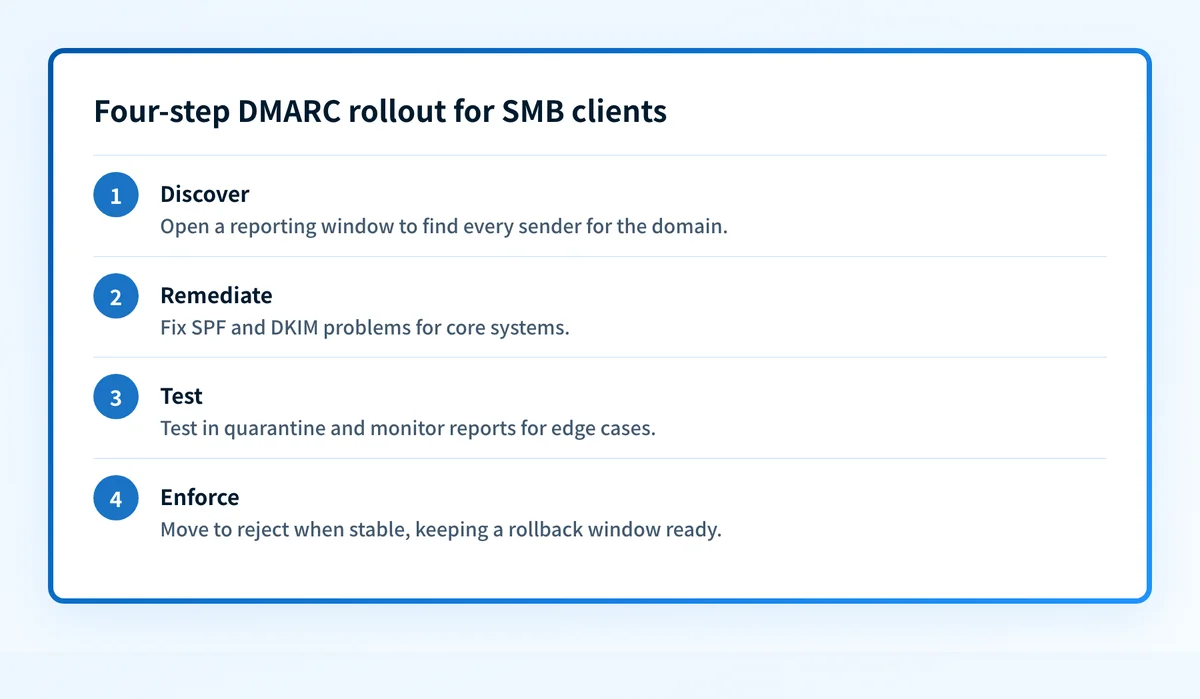 A staged rollout, discover, remediate, test, enforce, reduces operational risk.
10. What common mistakes must MSPs avoid?
The common mistakes MSPs must avoid are skipping a full sender inventory, neglecting DKIM signing, and relying on manual report review. Overlooking marketing platforms or transactional services can cause major delivery failures after enforcement. Too-fast policy changes without alerts and rollback options increase client disruption. Treat DMARC as an operational service: automate, document, and test. Tailor policies per domain rather than applying a one-size-fits-all approach.
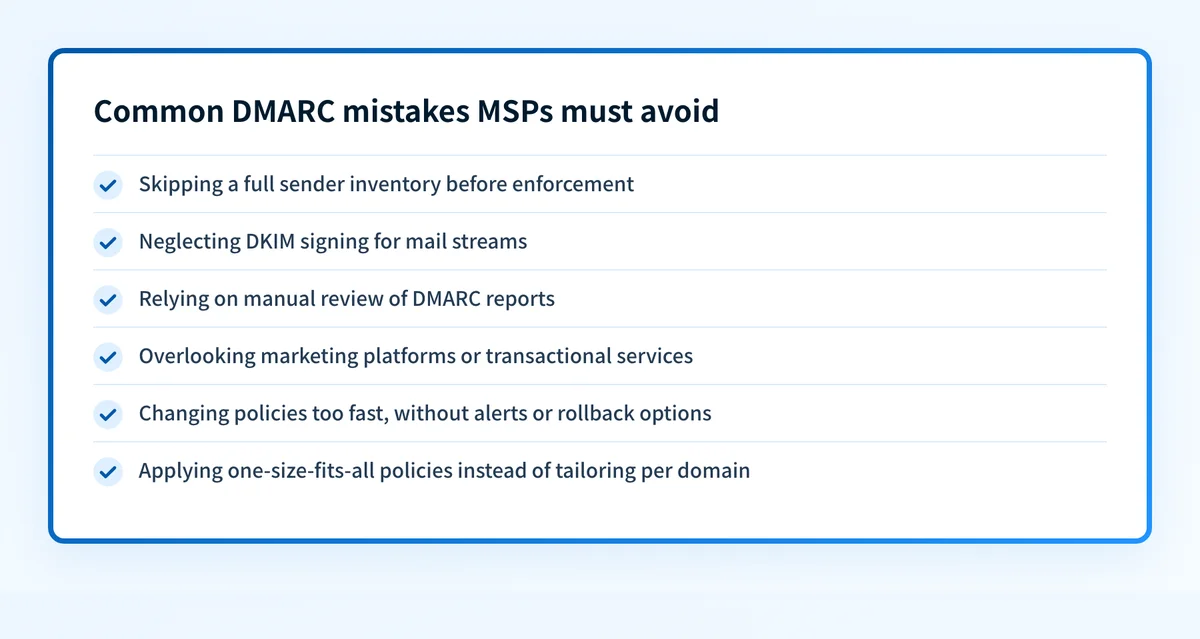 Frequent errors that cause delivery failures and client disruption after enforcement.
11. How can MSPs demonstrate DMARC value to SMB owners?
MSPs demonstrate DMARC value to SMB owners by leading with measurable risk reduction: show how enforcement reduces impersonation and phishing attempts that lead to fraud or data loss. Use report data to quantify spoofed message volumes and how many were blocked during testing. Offer enforcement as a managed service with reporting dashboards and SLA commitments for remediation time. Emphasize brand protection and improved deliverability as additional benefits. Packaging DMARC with monitoring and incident response makes it easier for SMBs to buy and trust the service.
12. What ongoing maintenance does DMARC enforcement require?
Daily ingestion and analysis of DMARC reports, alerts for new failing senders, and scheduled audits of authorized services are the core tasks. Rotate DKIM keys regularly and keep SPF records concise to avoid DNS lookup limits. Integrate changes into your ticketing and change-control systems and produce regular client reports that show improvements and any actions taken. Treat DMARC as a continuous operational control, not a one-off project. Periodic re-validation after marketing campaigns, vendor changes, or mergers is critical.
Evidence
Sources and further reading
- RFC 9989 defines DMARC, including the policy values and the aggregate reporting that enforcement depends on.
- RFC 7208 defines SPF, including the 10 DNS-lookup limit that keeps include chains short.
- RFC 6376 defines DKIM signing and key management.
- Email sender guidelines set out the bulk sender authentication requirements that pushed domains toward enforcement in 2024.
- Sender Best Practices documents the matching bulk sender requirements on the other side.
Questions readers ask
FAQs
Q: How long does it typically take to move from p=none to p=reject?
Expect 4–12 weeks for most SMBs, depending on the number of sending services and vendor responsiveness. Complex environments can take longer due to legacy systems and multiple vendors. Planning staged changes and automation shortens the timeline. Communication with stakeholders is essential to prevent surprise delivery issues. Factor in time for report analysis and repeated remediation cycles.
Q: Can strict DMARC block marketing emails?
Yes: if marketing platforms aren’t configured to sign mail or send from an aligned domain, enforcement can block those messages. Verify marketing providers beforehand, or use subdomain delegation to isolate marketing sends. Use quarantine testing to identify issues before moving to reject. Vendor collaboration and a documented inventory prevent major disruptions. Automation helps detect blocked streams fast so fixes can be applied quickly.
Q: Will DNS SPF changes cause downtime?
Direct downtime is uncommon if changes are validated and rolled out with care, but misconfigured SPF records can cause authentication failures. Use low TTLs during testing, validate records before propagation, and avoid long include chains that exceed DNS lookup limits. Monitor reports immediately after changes and have a rollback plan. Treat DNS updates as controlled change requests to reduce risk.
Q: Does DMARC stop all phishing?
No: DMARC prevents domain spoofing for properly configured domains but doesn’t stop phishing from look-alike domains or compromised accounts. Combine DMARC with user training, inbound filtering, and threat detection for a layered defense. Regular monitoring and rapid incident response are still required. DMARC is a critical control, not a silver bullet.
Q: Where can MSPs get help implementing DMARC at scale?
Use platforms that automate reporting, parsing, remediation workflows, and integrate with ticketing systems to manage many clients simultaneously. Palisade provides tools, templates, and playbooks to accelerate audits and enforcement rollouts for MSPs. Focus on standardization, automation, and documented SOPs to reduce time to enforcement. Partner with vendors that offer multi-tenant visibility and clear SLAs for remediation support.
For a quick check of domain posture, start here: Palisade Email Security Score.

Written by
Taylor TabusaCo-Founder & Head of Business Development, Palisade
Taylor Tabusa is the co-founder and Head of Business Development at Palisade, helping managed service providers turn email security into a practical, valuable service.
More from Taylor →