Yahoo bulk sender requirements
 ChatGPT
 Claude
 Gemini
 Perplexity
 Grok
GrokIn brief
Yahoo bulk sender requirements: authentication, DMARC alignment, unsubscribe, complaint-rate, DNS, and validation checks for Yahoo Mail senders.
Yahoo requires bulk senders to use SPF and DKIM, publish a valid DMARC policy of at least p=none, and pass DMARC with alignment to the visible From domain. Marketing and subscribed bulk mail also needs List-Unsubscribe support, a visible unsubscribe link, and processing within two days. Yahoo does not publish a numeric threshold for bulk-sender status. Its Sender Hub requirements are the controlling public guidance.
At a glance
Quick takeaways
- Last checked: August 12, 2026
- Next review: October 28, 2026
- Content owner: Palisade editorial
- Yahoo describes bulk mail as "significant volume" but does not publish a numeric threshold in its Sender Hub FAQ.
- Bulk senders need SPF, DKIM, DMARC, and alignment between the visible From domain and a passing SPF or DKIM identifier.
- Yahoo says bulk marketing and subscribed mail needs a functioning unsubscribe process. A body link alone does not meet the requirement.
Who is affected
Yahoo's sender guidance applies to mail sent to Yahoo Mail-hosted consumer domains. The Yahoo Sender Hub FAQ says Yahoo evaluates a sender using the authenticated domain or From-header domain and other available information, including content and IP addresses.
Yahoo calls bulk sending "significant volume" and says it will not specify a threshold. Treat recurring promotional and subscribed traffic as in scope unless you have a documented reason to classify it differently. This is a cautious operating decision, not a published Yahoo threshold.
Transactional mail, such as password-reset and order-confirmation messages, is outside Yahoo's stated one-click unsubscribe scope. It still needs the applicable authentication, DNS, and message-format controls.
For background on the authentication controls, see the email authentication learning hub, what SPF is, what DKIM is, and what DMARC is.
Current requirements
Authentication and DMARC alignment
- Applies to: Yahoo bulk senders.
- Effective: February 2024, according to the Yahoo Sender Hub FAQ, checked July 28, 2026.
- Required evidence: A delivered production message shows SPF and DKIM results, and DMARC passes with the visible From domain aligned to either the SPF domain or DKIM domain. Public DNS must also show the relevant records.
- Consequence: Yahoo's sender requirements, checked July 28, 2026, list SPF, DKIM, a valid DMARC policy of at least
p=none, DMARC pass, and alignment for bulk senders.
Unsubscribe for marketing and subscribed messages
- Applies to: Yahoo bulk marketing and subscribed messages. Transactional mail is excluded from Yahoo's stated one-click requirement.
- Effective: June 2024 for List-Unsubscribe enforcement, according to the Yahoo Sender Hub FAQ, checked July 28, 2026.
- Required evidence: A marketing or subscribed message has a functioning
List-Unsubscribeheader, a clearly visible body unsubscribe link, and suppression evidence showing the request was honored within two days. - Consequence: Yahoo's sender requirements, checked July 28, 2026, require the unsubscribe controls and two-day handling period.
List-Unsubscribe and List-Unsubscribe-Post. It says the RFC 8058 POST method is highly recommended, while mailto: is acceptable. RFC 8058 defines the one-click header mechanism.
Complaint rate, DNS, and message compliance
- Applies to: Complaint-rate guidance applies to Yahoo bulk senders. Valid forward and reverse DNS and RFC compliance apply as Yahoo states in its sender guidance.
- Effective: February 2024 for the sender-requirements rollout, according to the Yahoo Sender Hub FAQ, checked July 28, 2026.
- Required evidence: Yahoo Sender Hub or ESP complaint evidence, forward and reverse DNS results for each sending IP, and a delivered-message or MTA record showing the production path meets applicable RFC requirements.
- Consequence: Yahoo says bulk senders should keep spam rates below
0.3%. Its FAQ says Yahoo continuously evaluates mail and may defer mail from domains with high complaint rates.
0.3% complaint rate is a provider threshold, not an inbox-placement guarantee.
Yahoo's SMTP error-code reference shows that permanent errors can have authentication, RFC, policy, or other causes. Do not diagnose an individual SMTP reply as a complaint-rate issue without matching provider evidence.
Implementation and validation
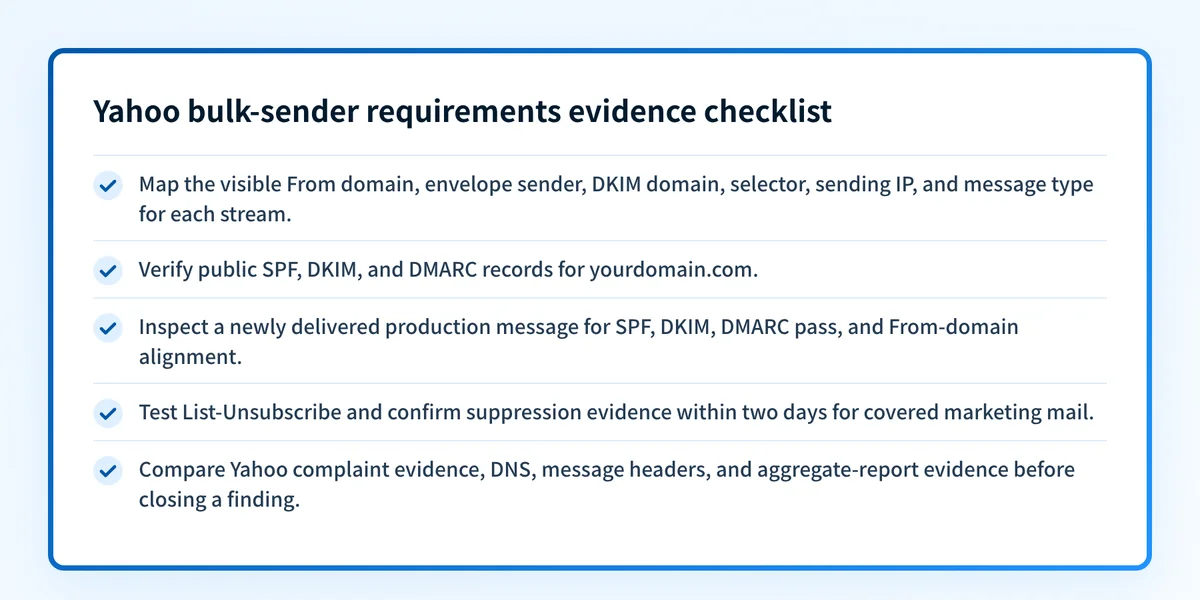
1. Map each production sending identity
Record the visible From domain, envelope sender, DKIM d= domain and selector, sending IP, message type, sending platform owner, and Yahoo-recipient volume for every production stream.
Include low-volume systems such as support, billing, recruiting, and incident notifications. The map identifies who can repair an alignment or unsubscribe problem.
2. Check DNS and a delivered production message
Inspect the public DMARC, SPF, and DKIM records. Then send a representative message through the exact production route to a Yahoo-hosted test mailbox and retain its full headers.
Confirm SPF and DKIM results. Confirm that DMARC passes because either the SPF identifier or DKIM identifier aligns with the visible From domain. Receiver-added Authentication-Results are message evidence. An ESP status indicator is not a delivered-message check.
3. Test each marketing unsubscribe path
Inspect a marketing or subscribed message for the header and visible body link. Use a test recipient to submit the unsubscribe request, then confirm the address is suppressed within Yahoo's two-day period.
Yahoo bulk-sender evidence record
From domain: <visible-from-domain>
Envelope sender: <smtp.mailfrom-domain>
DKIM d=: <signing-domain>
DMARC result: <pass/fail>
Aligned identifier: <SPF or DKIM domain>
List-Unsubscribe test: <endpoint and request time>
Suppression evidence: <system event within two days>
Complaint-rate evidence: <Yahoo or ESP metric and denominator>
PTR and forward DNS evidence: <sending IP and lookup result>
Do not use a real recipient address, opaque unsubscribe URL, token, private header, or customer data in shared evidence records.
A header shape for an RFC 8058-capable endpoint is:
List-Unsubscribe: <https://example.com/unsubscribe/opaque-id>
List-Unsubscribe-Post: List-Unsubscribe=One-Click
The endpoint and opaque identifier are illustrative only. Generate real values in the sending platform that owns recipient suppression.
4. Review complaint and delivery evidence
Review the applicable Yahoo complaint evidence and any Complaint Feedback Loop enrollment or ESP-provided equivalent. Compare the same DKIM domain, campaign, time period, and denominator before interpreting a rate.
Keep SMTP responses separately. They document a delivery attempt, while complaint data and Yahoo Sender Hub data address different provider signals.
5. Retest after a scoped repair
Repair one confirmed cause, such as an unsigned stream, an unaligned identity, or an unsubscribe endpoint that does not create a suppression event. Repeat the same-path message and unsubscribe tests.
Complete the four layers before marking a stream ready:
- DNS: Verify authoritative DNS and at least one public resolver.
- Vendor: Review the sending platform's current authentication or suppression status.
- Message: Inspect a newly delivered message from the exact production path.
- DMARC: Review aggregate-report data after it accumulates.
Change log
August 12, 2026
Confirmed unchanged against Yahoo's public Sender Hub requirements, FAQ, Subscription Hub guidance, and SMTP error reference. The tracker retains Yahoo's unpublished bulk threshold, February 2024 sender-requirements rollout, June 2024 List-Unsubscribe enforcement, 0.3% complaint-rate guidance, and two-day unsubscribe handling requirement. The next scheduled review remains October 28, 2026.
July 28, 2026
Established the maintained tracker from Yahoo Sender Hub guidance. Recorded that Yahoo does not publish a numeric bulk-sender threshold, bulk authentication requires SPF, DKIM, DMARC, and alignment, and marketing or subscribed bulk mail needs List-Unsubscribe support, a visible body link, and processing within two days.
Check the public authentication posture before comparing message evidence
Use the Email Security Score to inspect the sending domain's public authentication controls before changing DNS. Compare the result with the production headers, sending-path inventory, and unsubscribe test collected above. A public check cannot prove that Yahoo received the message, that every production stream signs and aligns, that an unsubscribe request created suppression, or that Yahoo will take a particular future delivery action.
Evidence
Sources and further reading
Questions readers ask
Frequently asked questions
Does Yahoo publish a bulk-sender volume threshold?
No. Yahoo describes bulk mail as significant volume but says it does not specify a numeric threshold. Plan recurring promotional and subscribed traffic as in scope unless documented facts support a different classification.
Does Yahoo require DMARC enforcement at p=quarantine or p=reject?
No. Yahoo's published bulk-sender guidance requires a valid DMARC policy of at least p=none, plus DMARC pass and alignment. A stricter policy can be an organization decision after legitimate sending paths are validated.
Is a visible unsubscribe link enough for Yahoo bulk mail?
No. Yahoo says bulk marketing and subscribed mail needs a functioning List-Unsubscribe header and a clearly visible body unsubscribe link. The request must also be honored within two days.
Does a passing DNS check prove Yahoo bulk-sender compliance?
No. Public DNS can show published records, but it cannot prove that the production platform signs the message, that DMARC aligns on the delivered path, or that an unsubscribe request creates suppression.
Does a complaint rate below 0.3% guarantee inbox placement at Yahoo?
No. Yahoo's 0.3% guidance is not an inbox-placement guarantee. Yahoo evaluates mail continuously and can use other information, including authenticated-domain, From-domain, content, and IP signals.

Written by
Johanie DupontBrand & Ecommerce Email
Johanie Dupont works on brand and ecommerce email at Palisade: BIMI and verified marks, sender requirements, and getting marketing mail into the inbox.
More from Johanie →