Does email warmup work?
 ChatGPT
 Claude
 Gemini
 Perplexity
 Grok
GrokIn brief
Does email warmup work? A gradual ramp of authenticated real mail can help, but it cannot prove inbox placement or replace direct sender evidence.
Yes, email warmup can help when it means gradually increasing legitimate, authenticated mail from a new or inactive sending identity while measuring real outcomes. It does not prove that automated warmup activity earns inbox placement. Recipient consent, authentication, complaint rates, content, sending history, and each mailbox provider's filtering still affect where production mail lands.
At a glance
Quick takeaways
- A controlled ramp is relevant for a new dedicated IP or a materially changed sending path.
- Gmail advises large senders to begin with low volume, use engaged recipients, increase slowly, and avoid sudden bursts.
- SPF, DKIM, and DMARC support an authenticated sending path, but they do not guarantee inbox placement.
- Warmup-tool opens, replies, and scores do not establish how a production campaign will perform.
- Use real SMTP responses, delivered-message authentication, complaints, and recipient outcomes to assess a volume increase.
- A current spam or rejection problem needs diagnosis from its own production evidence.
How email warmup works in the limited case
Email warmup is useful when an operator uses it as a controlled sending ramp. Google's email sender guidelines tell large senders to start at a low volume with engaged users, increase volume slowly, avoid bursts, and monitor delivery, spam rate, and sending-domain reputation. Google also uses the term "warming up" for a sending domain or IP after a spam-related error in its Postmaster Tools dashboard guidance.
That supports a narrow operational conclusion. A steady increase gives a sender a way to observe what happens as real volume changes. It does not reveal a mailbox provider's private filtering rules or establish that inbox placement will improve.
Twilio SendGrid's dedicated-IP guidance recommends warming an IP by stepping up volume over time. Its guidance is specific to SendGrid's service and dedicated IP use. It should not be treated as evidence that every mailbox-account warmup product has the same effect.
Authentication remains a prerequisite. Google's sender guidelines require SPF or DKIM for mail sent to personal Gmail accounts, and require SPF, DKIM, and DMARC for bulk senders. Review the protocol role in the email authentication learning hub. A passing authentication result confirms part of the sending path. It does not determine a receiver's folder decision.

When the answer changes
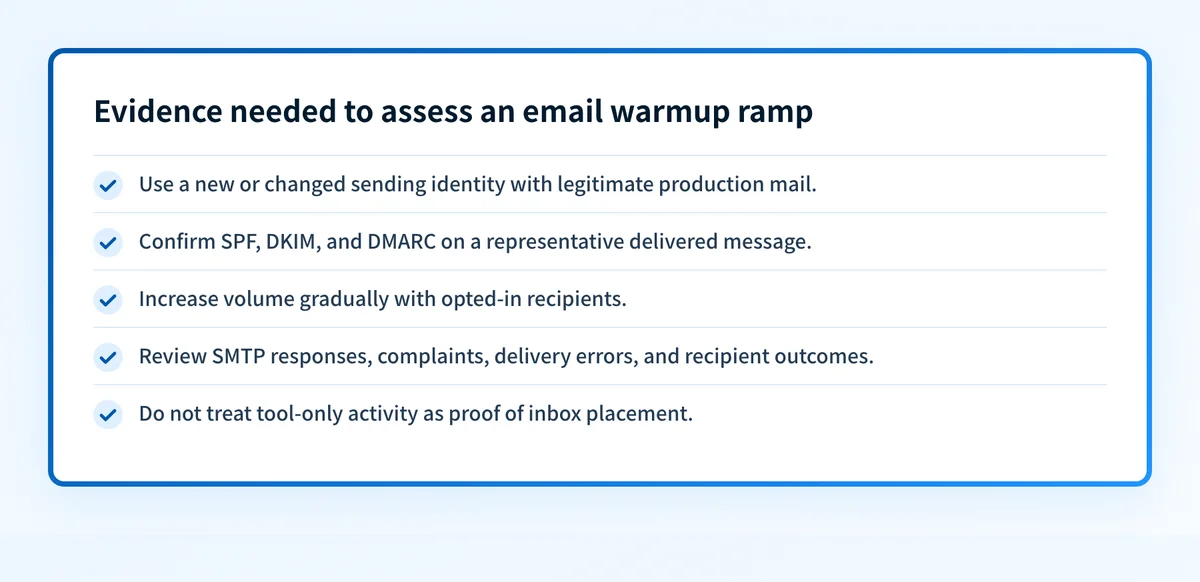
Use a controlled ramp when all of these conditions are true:
- The sending identity is new, inactive, or materially changed, such as a new dedicated IP or a changed production sending path.
- The messages are real mail for opted-in recipients, with an audience that normally receives the program.
- The actual production path has working authentication.
- The sender can measure outcomes as volume changes.
Do not treat warmup as the first repair when production mail already has clear filtering symptoms. An unaligned sender, a complaint increase, an unconsented list, or changed content can each require separate investigation. Use the evidence-led guide to why emails go to spam when actual messages are filtering.
Shared infrastructure changes the interpretation as well. Google states that activity from any sender using a shared IP can affect the reputation of all senders on that IP. A sender on shared infrastructure therefore cannot attribute every outcome to its own ramp activity.
A practical warmup decision record
Use one record for each controlled volume change. It keeps the decision tied to real mail rather than a generic warmup completion date.
WARMUP DECISION RECORD
Sending identity: new dedicated IP, inactive domain, or changed production path
Authentication: SPF, DKIM, and DMARC checked on a representative delivered message
Audience: opted-in recipients from the normal sending program
Volume change: small, steady increase with no sudden burst
Observe: SMTP responses, delivery errors, complaints, Gmail sender data when available, and recipient outcomes
Decision: continue only when the production evidence remains acceptable
Boundary: tool-only opens, replies, or scores do not prove inbox placement
The decision rule is:
- Authenticated real mail, gradual steady volume, and observable recipient and receiver outcomes: assess the ramp.
- Missing authentication, a sudden burst, or only automated tool activity: make no inbox-placement conclusion.
What to do next with the evidence you have
If you have a representative delivered message, inspect its SPF, DKIM, and DMARC results before changing volume. Compare those results with the visible From domain and the actual sending service. Authentication is one part of the evidence, not a placement guarantee.
If you have Gmail-specific sender data, use Google Postmaster Tools dashboard documentation to understand the available data, including spam rate, reputation, authentication, and delivery errors. Google notes that low volume can limit what appears in the dashboards. Absence of a dashboard signal is not proof that all recipients received mail in the inbox.
If the question is whether to purchase or compare warmup services, that is a separate buyer decision. See Email warmup service: compare the evidence before choosing or the vendor-specific Instantly email warmup guide. Neither replaces testing the exact production path, audience, and message type you intend to use.
A controlled ramp cannot observe future campaigns, control a mailbox provider's private placement decision, or repair authentication and list-quality problems by itself.
Evidence
Sources and further reading
Questions readers ask
Frequently asked questions
Does email warmup guarantee inbox placement?
No. A gradual ramp can avoid a sudden volume increase, but inbox placement remains a mailbox provider decision. Authentication, recipient consent, complaints, content, and sender reputation still affect the result.
Is automated email warmup the same as IP warm-up?
No. Twilio SendGrid documents IP warm-up as a gradual increase in mail volume for a dedicated IP. Automated mailbox activity is a different mechanism and does not, by itself, show how real production mail will be placed.
How long should email warmup take?
There is no universal duration. Increase volume only when the sending identity, real audience, authentication results, and observed outcomes support the next change. A separate infrastructure or audience change can require a new assessment.
Can I warm up a sender without SPF, DKIM, and DMARC?
No. Do not use a ramp as a substitute for authentication. Verify authentication on a representative production message before evaluating volume or placement outcomes.
Should I reduce volume after deferrals or complaints?
Yes. Reduce or pause the affected segment, inspect the SMTP responses and recent changes, then identify the cause before increasing volume again. Google recommends monitoring delivery, spam rate, and sender reputation as volume grows.

Written by
Johanie DupontBrand & Ecommerce Email
Johanie Dupont works on brand and ecommerce email at Palisade: BIMI and verified marks, sender requirements, and getting marketing mail into the inbox.
More from Johanie →