Instantly email warmup
 ChatGPT
 Claude
 Gemini
 Perplexity
 Grok
Grok

Instantly email warmup is an account-level feature that exchanges automated warmup messages within Instantly's pool and reports activity through a health signal. It can show how those warmup exchanges performed, but it does not prove the authentication or inbox placement of a real campaign. Google's sender guidelines treat sender authentication as a separate requirement. Use warmup as context, then inspect a message from the production sending path before changing a campaign.
At a glance
Quick takeaways
- Instantly describes Warmup as automated exchanges among enabled accounts in its pool.
- Its health score concerns recent warmup activity, not every message you send.
- Instantly's readiness guidance is useful operational advice, not a mailbox-provider guarantee.
- Production-message evidence remains separate from the Warmup signal.
- Investigate a real message when the problem is spam placement, rejection, or poor campaign response.
What Instantly Warmup is
According to Instantly's Warmup documentation, an enabled account sends warmup emails to other accounts in its pool and receives them in return. Instantly says the exchanges are automatically opened and that many receive replies. That describes the feature's own pool activity. It does not describe how a specific mailbox provider will classify a production campaign sent to your recipients.
This distinction matters because email deliverability covers more than whether a message was accepted by a server. A Warmup result describes the feature's exchanges, while a production message supplies evidence about the sending path a reader actually needs to assess.
What the health signal can and cannot tell you
Instantly describes the score as the share of warmup emails that reached the inbox instead of spam during the previous seven days. That makes it an account-level signal about the Warmup exchanges it observed, not a measurement of a real prospect campaign.
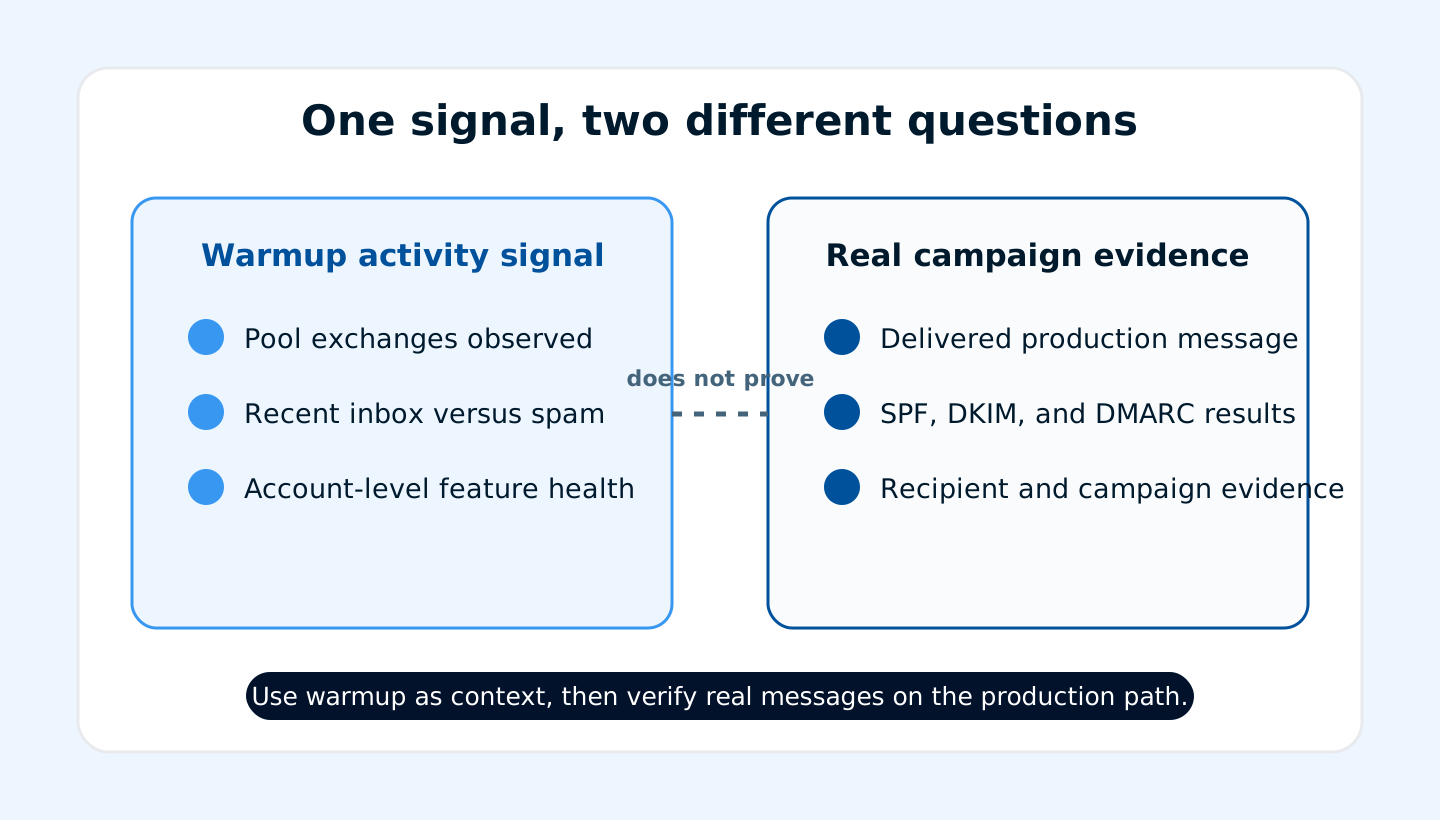
The diagram is intentionally an evidence boundary, not a model of an inbox provider. Google separately requires senders to authenticate mail and gives senders their own spam-rate guidance in its Email sender guidelines. The conclusion that a Warmup score cannot prove campaign placement is an inference from those separate scopes, not a claim that Google evaluates Instantly Warmup in a particular way.
WARMUP REVIEW RECORD
Signal: Warmup health score
Scope: Instantly pool activity during the stated recent window
Not established: SPF, DKIM, DMARC, list quality, recipient consent, or campaign inbox placement
Next evidence: a delivered production-path message and its authentication results
Decision: investigate the real message before changing campaign volume or copy
How to use the signal without treating it as proof
Instantly's campaign-readiness guidance recommends at least two weeks of warmup and a health score above 90%, with an exception for its pre-warmed accounts. Use that as the vendor's current operating guidance for its feature. Do not turn it into a promise that a campaign will reach the inbox or get replies.
When a real campaign is filtering, rejected, or underperforming, collect a delivered message from the same sender and route. Check its authentication results and the recipient-provider evidence available for that message. For an evidence-led repair path, see why outbound email goes to spam. If the question is whether warmup is even the service category you need, the email deliverability service guide separates authentication monitoring, placement monitoring, list validation, and consulting.
Where warmup fits beside authentication
Warmup activity does not publish, sign, or align your domain's mail. Those are separate technical controls. As RFC 7489's DMARC overview describes, receivers compare the visible From domain with available SPF and DKIM results and the published DMARC policy. A healthy warmup signal cannot show what happened for a particular production message.
That is why the most useful next evidence is a message from the production path. If the real message fails authentication or lands in spam, work from the headers and the receiver response instead of changing settings based only on an account-level warmup metric. A warmup feature can be active while another sender, campaign, or configuration still needs separate investigation.
Evidence
Sources and further reading
Questions readers ask
Frequently asked questions
Keep going with AI
Ask AI how this applies to you
Take this guide to your assistant — each question opens pre-filled, with a link back to this page so it can read the details.
- What is Instantly email warmup?


- How does this apply to my domain?
- What should I do about it, step by step?

Written by
Samuel ChenardCEO & Co-Founder, Palisade
Samuel Chenard is the CEO and co-founder of Palisade, AI-first DMARC software for IT teams and MSPs, from one domain to thousands.
More from Samuel →