Sender reputation in email marketing
 ChatGPT
 Claude
 Gemini
 Perplexity
 Grok
GrokIn brief
Sender reputation in email marketing is an assessment of how mailbox providers may view a sender. Learn what it can show and how to check it.

Sender reputation in email marketing is an assessment of whether mailbox providers may view a sender as reputable or as a spammer. It is relevant to email-program health, but it is not a universal score that proves inbox placement or explains every delivery outcome. Treat reputation as one evidence stream alongside blocklist status, bounce evidence, and the delivered message path.
At a glance
Quick takeaways
- Sender reputation is an email-program assessment topic that can be monitored.
- A reputation assessment can help establish the current state of an email program.
- A Sender Score assessment accepts an IP address as its input.
- Sender reputation and blocklist status are separate checks.
- A reputation result does not prove how every mailbox provider will handle a future message.
- Email deliverability includes more than sender reputation alone.
How sender reputation works in email marketing
Sender Score describes its service as a way to "Monitor your sender reputation". Its own framing asks: "Do mailbox providers view you as a reputable sender or a spammer?" That makes sender reputation useful as an assessment of how a sender may be viewed, rather than a promise about a specific campaign's outcome.
The available evidence does not establish one shared scoring formula across mailbox providers. It also does not establish that every provider evaluates the same identity. A Sender Score lookup explicitly asks for an IP address through the prompt, "Enter your IP to find out." That supports an IP-based assessment in that tool. It does not prove that a reputation system always assigns one score to an IP, a visible From domain, a DKIM domain, or another identifier.
Sender reputation is therefore best read as a diagnostic signal. It can help a marketing team decide that an email program needs closer review. It cannot, by itself, show why a particular message was filtered, accepted, deferred, or rejected.
For the broader result a sender is trying to influence, see email deliverability. Deliverability is the outcome of getting mail accepted and placed as intended. Sender reputation is one area to inspect when that outcome needs investigation.
When sender reputation is not the answer
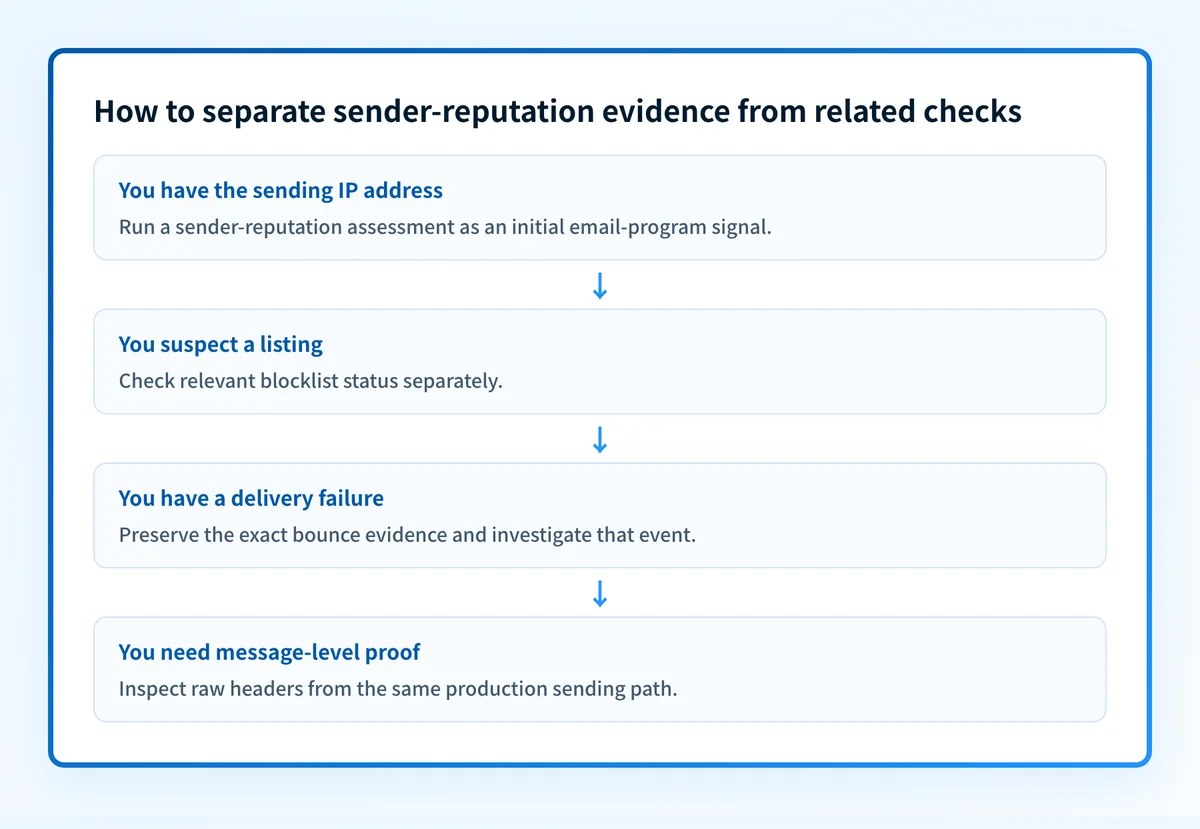
Do not treat a reputation assessment as a blocklist lookup. Sender Score presents "Sender Score," "Blocklist Lookups," and "Bounce Lookups" as distinct tools. That separation supports a practical rule: inspect each evidence stream on its own terms.
Use this decision rule:
- If you have an IP address and need an initial assessment of the email program, use a sender-reputation assessment.
- If you need to know whether an IP or domain appears on a relevant blocklist, run a blocklist check.
- If recipients report non-delivery or a campaign produces bounce messages, preserve and investigate the bounce evidence.
- If you need to understand a delivered message's authentication result, inspect that message's raw headers and the exact production sending path.
The distinction also matters when comparing sender reputation with domain reputation. Domain reputation is related subject matter, but this page does not assume that a sender-reputation result maps to a domain. The cited Sender Score input is an IP address, and providers' broader identity and scoring methods are not established here.
Worked diagnostic example
Suppose a marketing team has an IP address, a reported delivery problem, and a concern that recipients may view its messages poorly. The evidence should remain separated:
Reputation assessment input:
198.51.100.25
Blocklist question:
Does the relevant IP or sending domain appear on the blocklist being checked?
Bounce evidence:
Preserve the exact bounce message, receiving domain, timestamp, and sending IP.
Delivered-message evidence:
Preserve the raw headers from a message sent through the same production path.
The IP address above is illustrative only. Do not publish a customer IP address, recipient address, or unredacted message headers in a public ticket or article.
The first line supports a sender-reputation assessment because the cited service asks users to enter an IP. The second line is a separate question because blocklist lookup is a separate service category. The remaining evidence may be needed to investigate a campaign-specific problem, but a reputation lookup cannot replace it.
This approach prevents a common overreach: treating one public diagnostic result as an explanation for all mailbox-provider behavior. A public check can offer a current signal. It cannot prove the receiver's private decision process, the exact production path used by every campaign, or future inbox placement.
What to check next
Start with the evidence you actually have. If you have the sending IP, assess sender reputation as an initial view of the email program. If you have a suspected listing, check blocklist status separately. If you have a bounce, retain the exact bounce text and investigate that event separately.
For marketing authentication work, how to authenticate email for marketing covers the related task of establishing authenticated sending. Do not use reputation as a substitute for checking the message path and authentication evidence.
A warmup claim should also be treated carefully. AI email warmup: what it is and what it cannot prove explains why a warmup activity does not establish how mailbox providers will handle all future mail.
Inspect your email security posture
Use Palisade's email security score tool to inspect the public security posture of the domain involved before deciding which evidence to collect next. Compare that public result with the sending IP, any relevant blocklist result, and real bounce or message-header evidence.
Inspect email security posture
A public check cannot prove a mailbox provider's private reputation decision, repair a sending problem, monitor future changes, or guarantee inbox placement. For teams that need to inventory sending sources and work through DMARC remediation over time, Palisade is AI-first, agent-first DMARC software that analyzes DMARC aggregate-report data and proposes prioritized remediation work. A human reviews the evidence and applies DNS or policy changes.
Evidence
Sources and further reading
Questions readers ask
Frequently asked questions

Written by
Samuel ChenardCEO & Co-Founder, Palisade
Samuel Chenard is the CEO and co-founder of Palisade, AI-first DMARC software for IT teams and MSPs, from one domain to thousands.
More from Samuel →