Which domain reputation statement is correct?
 ChatGPT
 Claude
 Gemini
 Perplexity
 Grok
GrokIn brief
Which statement about domain reputation is correct? It reflects observed harmful activity and can change as internet activity changes over time.
The correct statement is that domain reputation is evidence about a domain's observed association with harmful activity, such as spam-related or malicious activity, and it can change over time. It is not a permanent label or a universal score that predicts one fixed email outcome. Spamhaus publishes IP and domain reputation data and notes that internet traffic and adversary activity change daily.
At a glance
Quick takeaways
- Domain reputation data can relate to spam-related and malicious domain activity.
- A reputation result is a current signal to investigate, not a permanent verdict.
- Daily reputation statistics can fluctuate as internet activity changes.
- A blocklist or reputation result does not document how a specific mailbox provider will handle a message.
- No universal score, threshold, or recovery period applies to every domain.
- Reputation investigation is one part of the broader email deliverability picture.
How domain reputation works
Domain reputation is a category of data about a domain's observed activity or association with harmful activity. Spamhaus describes its data as IP and domain reputation and publishes statistics for both spam-related domains and malicious domains.
That definition has an important limit. The available public information does not establish one vendor-neutral formula that every reputation service, security product, or mailbox provider uses. It also does not establish that a reputation result causes acceptance, spam-folder placement, or rejection at a particular provider.
Spamhaus states: "Global internet traffic changes daily, as do the activities of adversaries." It also states that its statistics are daily-average indicators and that actual daily figures fluctuate. Those statements support a practical interpretation: reputation data reflects changing observations, rather than an irreversible property attached to a domain.
For a broader explanation of the term, see what a domain reputation is. This page answers the narrower question of which statement is safe to treat as correct.
When the answer changes
The answer changes when a statement claims more certainty than the available evidence supports.
Treat these statements differently:
- Correct: domain reputation data can concern a domain's association with spam-related or malicious activity.
- Correct: domain-related activity can change, so reputation data is not necessarily static.
- Correct as an inference: a current reputation result should prompt investigation rather than a permanent conclusion.
- Unverified: every provider uses the same domain reputation score or threshold.
- Unverified: a poor result guarantees rejection, spam placement, or another specific mailbox-provider decision.
- Unverified: every domain improves after a fixed number of days.
Spamhaus offers a Domain Blocklist and a Reputation Checker, but its public homepage does not document how a mailbox provider uses those resources in delivery decisions. That gap matters when investigating reputation as part of deliverability work: a public check can identify a signal, but it cannot reveal a receiver's internal filtering logic.
A worked decision example
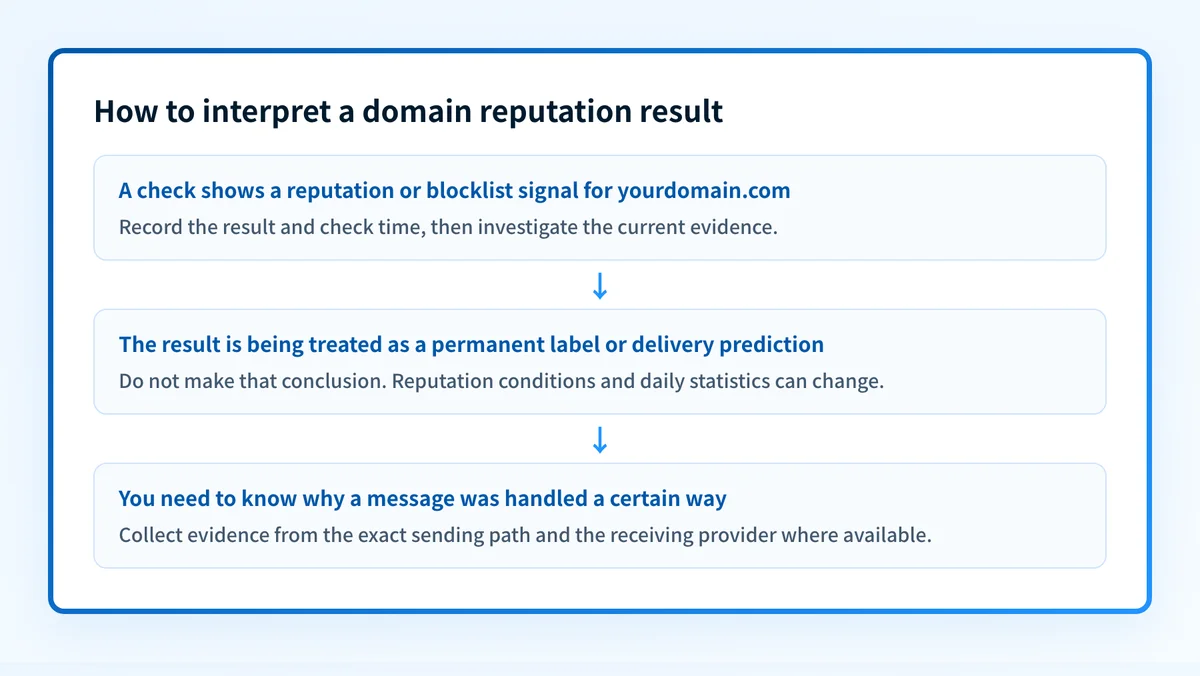
Suppose a domain check returns a result associated with harmful domain activity. The correct operational conclusion is not "the domain can never send email successfully." The correct conclusion is that there is evidence worth reviewing.
Domain checked: yourdomain.com
Observed result: reputation or blocklist signal
Check time: 2026-08-13T12:00:00Z
Decision: investigate the current signal
Do not conclude: permanent reputation status or provider-specific delivery outcome
This is a record of what the check showed at one time. It does not establish why the result exists, which activity caused it, whether an individual message will be accepted, or how long the result may remain relevant.
If the concern is a Spamhaus listing, use a focused Spamhaus blacklist check guide for that investigation. Keep the scope narrow. A domain reputation result and a message-delivery diagnosis are related topics, but they are not interchangeable evidence.
What to do next with the evidence you have
Start with the type of evidence available:
- If you have only a domain name, run a domain reputation check to inspect current public reputation evidence.
- If you have a blocklist result, record the domain, the result, and when you checked it. Then use the relevant provider or blocklist operator's published process to investigate that specific result.
- If you have a delivery problem, collect evidence from the exact sending path and the receiving provider where possible. A public reputation lookup alone does not explain the provider's decision.
- If you need to understand delivery outcomes more broadly, separate reputation signals from authentication results, message content, and receiver-specific policy.
Investigate recurring domain reputation signals
A one-time result can identify current public evidence, but it does not show which sending sources create ongoing authentication or alignment issues across a domain portfolio. Palisade is agentic DMARC software that analyzes DMARC aggregate-report data, identifies sending sources and authentication or alignment issues, and creates prioritized remediation tickets. A human reviews the evidence and applies any change.
Palisade does not change a receiver's private reputation decision, delist an IP, guarantee delivery, or prove that every future message will authenticate.
Evidence
Sources and further reading
Questions readers ask
Frequently asked questions
What is domain reputation in cyber security?
Domain reputation in cyber security is data about a domain's observed association with harmful activity, such as spam or malicious behavior. Spamhaus publishes this kind of data as IP and domain reputation and reports on both categories. Because it reflects recent observations, the data can change.
What is poor reputation of a domain used in message transfer?
A poor reputation for a domain used in message transfer means reputation data links that domain to spam or malicious activity. It describes observed behavior at a point in time, not a fixed property of the domain. Mailbox providers do not publish how they use that signal in a delivery decision, so a poor result does not tell you what will happen to a specific message.
Why is my domain reputation bad?
No public checker publishes the reason behind an individual domain's result, so you have to work it out from evidence you collect. Run a domain reputation check and record the result along with the time you ran it. If the domain appears on a blocklist, follow that operator's published process, which is the documented route to the reason for that listing.
Does a domain reputation check prove inbox placement?
No, because a reputation check reports public evidence about a domain rather than a mailbox provider's private decision. It shows what a checker recorded at the moment you ran it. It cannot tell you where a future message will land.

Written by
Dominic LandryDeliverability & DNS
Dominic Landry works on email deliverability and DNS configuration at Palisade, from SPF and DKIM records through to DMARC enforcement.
More from Dominic →