Proofpoint vs Mimecast: how the two compare
 ChatGPT
 Claude
 Gemini
 Perplexity
 Grok
GrokIn brief
Proofpoint vs Mimecast compared on their own documented terms: deployment, coverage, pricing transparency, and where DMARC sits for each vendor.
Choose Proofpoint if your buying process values its published enterprise package structure and you may need its Prime package with Email Fraud Defense services. Choose Mimecast if its current threat-protection plans and its stated MX-based or API-based deployment options fit your mail environment. Neither vendor publishes enough first-party pricing to make a complete cost comparison, so the decision should turn on the quoted scope, DMARC needs, deployment path, and contract terms.
At a glance
Quick takeaways
- Proofpoint publishes dated list pricing for its small-business Essentials line, but not for its enterprise packages.
- Mimecast publishes plan families and plan names, but replaces list prices with sales-contact language.
- Proofpoint says its enterprise budgetary pricing depends on user licences and contract term, with consumption-based exceptions.
- Mimecast says its new customers buy the new email-security plans introduced on August 15, 2025.
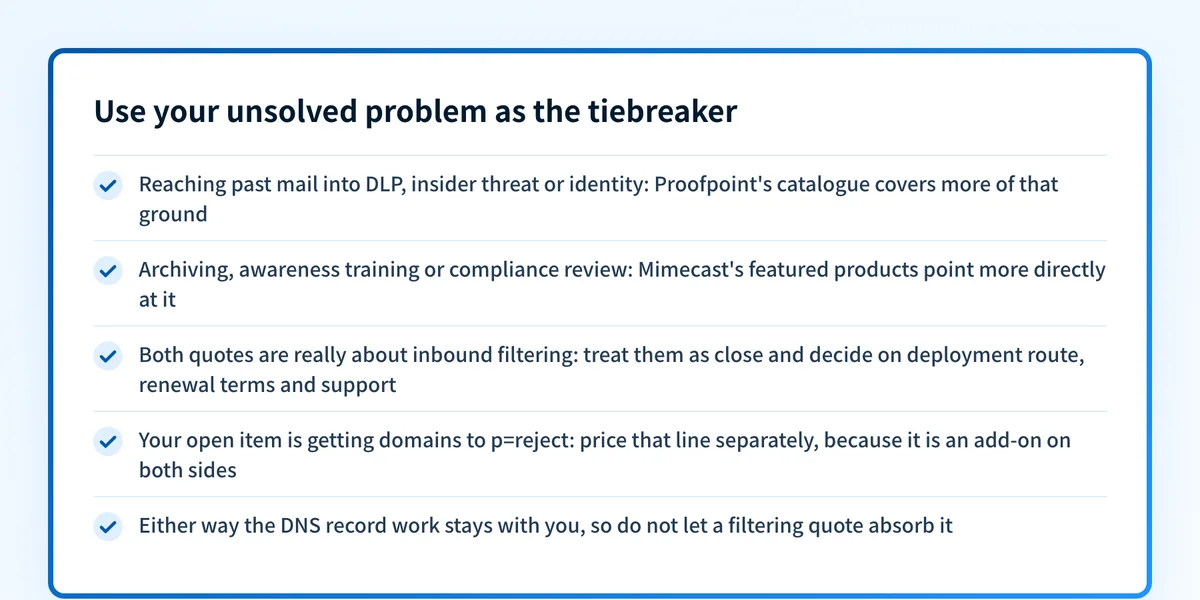
- DMARC is a separate path in both vendors' offerings, rather than a standard capability of every core mail-filtering package.
- Palisade is a DMARC automation layer that works alongside an email gateway. It does not filter inbound mail.
Who this comparison is for
This comparison is for an IT team evaluating Proofpoint or Mimecast for email security, and trying to understand what each vendor publicly discloses before requesting a quote. It also applies when DMARC enforcement is part of the buying requirement rather than an unrelated future project.
Proofpoint and Mimecast both sell secure email services, but their public materials organize products and pricing differently. That makes a direct price table misleading. The useful comparison is whether the quoted package covers the mail-security functions, DMARC work, deployment model, and commercial terms your team needs.
If DMARC is the main decision, the related Proofpoint DMARC alternative and Mimecast DMARC alternative pages cover that narrower operating question. For broader vendor evaluation, use the Palisade comparison hub.
How the options were evaluated
The criteria below were checked against each vendor's own public product, pricing, and purchase pages on August 12, 2026.
- Published commercial evidence: list prices, package names, pricing drivers, and whether the vendor directs buyers to sales.
- Email-security scope: the vendor's stated primary email-protection products and proof points.
- DMARC scope: whether DMARC appears in a standard package, an add-on, hosted service, or managed offering.
- Deployment evidence: only deployment statements published by the relevant vendor.
- Open questions: capabilities or commercial terms that public materials do not specify.
Proofpoint
- Best fit: Teams that want Proofpoint's published enterprise package structure and are prepared to obtain a quote based on licences, term, and required services.
- Relevant evidence: Proofpoint's Collaboration Security buying page lists Core, Tier 2, Tier 3, and Prime packages. It describes Core as email security alone, while Prime adds impersonation protection, domain fraud and spoofing prevention, hosted DMARC, DKIM and SPF services, and lookalike-domain detection. The same page says budgetary pricing can be determined by the number of user licences and contract term, single-year or multi-year, with exceptions based on consumption.
- Relevant evidence: Proofpoint's dated Essentials price list, stamped 10/21, lists Business at $2.75, Advanced at $3.75, and Professional at $5.33 per active user per month. That document is for the Essentials line and is not a current published enterprise rate. Proofpoint Essentials MSRP price list.
- Relevant evidence: Proofpoint says Email Protection stops 99.999% of email-security threats. This is a vendor claim and should not be compared as though it measures the same thing as Mimecast's customer count or analyst recognition.
- Tradeoff: Public enterprise package prices are unavailable. A buyer must request a quote to assess the actual cost of Core, Tier, Prime, or attached services.
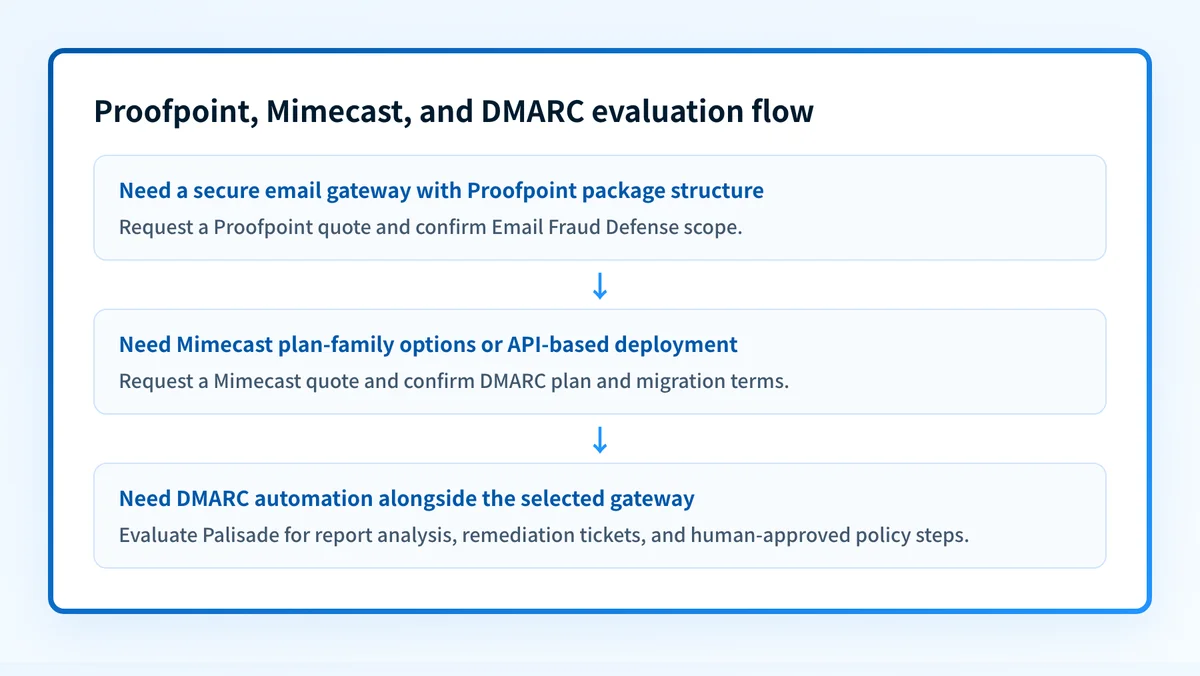
This is a specific DMARC model: hosted records plus a consultant-led rollout. Confirm in a quote whether the proposed package includes Email Fraud Defense, which hosted services apply, who owns DNS changes, and what work remains with your team.
Mimecast
- Best fit: Teams that want to evaluate Mimecast's current threat-protection plan family and its documented MX-based or API-based deployment choices.
- Relevant evidence: Mimecast's plans page lists Critical, Advanced, and Premium for threat protection; Professional, Enterprise, and Gov for insider risk management; and Core and Pro for security behaviour management. The page uses "Contact for pricing", "Custom pricing available", or "Custom options available" rather than published list prices.
- Relevant evidence: Mimecast says new customers must buy its new email-security plans as of August 15, 2025. It says existing purchases continue unchanged, and warns that migration can carry an additional cost under standard price-increase terms. The page also says customers must sign a one-page legal agreement about AI use in Mimecast products.
- Relevant evidence: Mimecast's Integrated Cloud Email Security page says MX-based deployment routes all inbound mail through its gateway first. It says API-based deployment connects in minutes without MX record changes or mail-flow disruption. These are Mimecast deployment statements, not a comparison claim about Proofpoint.
- Relevant evidence: Mimecast says it was named a Leader in the 2025 Gartner Magic Quadrant for Email Security and protects more than 42,000 organisations. Those are vendor-published claims with different measures than Proofpoint's threat-stopping claim.
- Tradeoff: Mimecast does not publish list prices or a public formula for the cost drivers behind a final quote. Buyers need to establish which plan families and add-ons are included.
Mimecast's service matrix states that DMARC visibility and reporting is standard in one plan and available for an additional fee in four others. Confirm the exact plan, reporting scope, managed-deployment fee, and DNS responsibilities before treating DMARC as included in the gateway purchase.
Palisade for DMARC automation alongside either gateway
- Best fit: IT teams and MSPs that choose Proofpoint or Mimecast for email filtering, but want an agentic DMARC software layer to analyze reports and organize the work required for DMARC enforcement.
- Relevant evidence: Palisade pricing describes plans for one-domain use, IT teams, MSPs, and enterprise deployments. The page lists DMARC report parsing and sender classification, hosted DMARC and SPF, MTA-STS hosting, and SPF flattening.
- Relevant evidence: Palisade's product documentation describes an AI agent that analyzes DMARC aggregate-report data, identifies sending sources and authentication or alignment issues, creates prioritized remediation tickets, and proposes the next policy step for human review.
- Tradeoff: Palisade does not filter inbound email. It is not an alternative to Proofpoint or Mimecast's secure email gateway. A human reviews the evidence and applies any DNS or DMARC policy change.
How to choose
Start with the gateway requirement, then isolate DMARC as its own buying line item. Proofpoint fits a team that wants its stated package path and can evaluate a licence-and-term quote. Mimecast fits a team that needs its stated plan-family structure or prefers to evaluate its MX-based and API-based deployment models. Palisade fits when DMARC work needs a separate automation layer alongside the chosen gateway.
Before buying, ask each vendor:
- Which named package and add-ons are included in the quote?
- Is DMARC reporting standard, separately priced, or attached through another product?
- Who publishes, validates, and changes DMARC, SPF, and DKIM DNS records?
- What deployment method will carry production mail, and what validation is required before cutover?
- Which licence, contract-term, consumption, migration, or managed-service assumptions drive cost?
- What evidence will show that real production mail authenticates after deployment?
option: Proofpoint
checked_on: 2026-08-12
best_fit: "Enterprise buyers evaluating Core through Prime and Email Fraud Defense services."
verified_evidence:
  - "Core, Tier 2, Tier 3, and Prime package structure is published."
  - "Budgetary pricing is tied to user licences and contract term, with consumption exceptions."
  - "Essentials has a dated 10/21 MSRP sheet, not enterprise list pricing."
open_question: "Quoted enterprise price and the exact services included for this deployment."option: Mimecast
checked_on: 2026-08-12
best_fit: "Teams evaluating current threat-protection plans and MX-based or API-based deployment."
verified_evidence:
- "Critical, Advanced, and Premium threat-protection plans are published."
- "Public pages use custom-pricing and contact-sales language."
- "DMARC visibility and reporting varies by plan and can require an additional fee."
open_question: "Quoted pricing, included plan families, and managed-deployment cost."option: Palisade
checked_on: 2026-08-12
best_fit: "Teams that need DMARC automation alongside a selected secure email gateway."
verified_evidence:
- "Palisade analyzes DMARC aggregate reports and identifies authentication or alignment issues."
- "Palisade proposes the next DMARC policy step for human review."
- "Palisade provides hosted DMARC and SPF capabilities."
open_question: "Whether the team's gateway, DNS ownership model, and approval process fit the rollout."Check the public email-security baseline before requesting quotes
If you already have a domain in scope, run it through the Email Security Score before comparing proposals. The result can help you record the public DMARC, SPF, DKIM, BIMI, MX, MTA-STS, and TLS-RPT state that a vendor quote needs to address.
A public DNS check does not prove which production senders use the domain, whether a gateway is filtering live traffic, a receiver's private reputation decision, or future inbox placement. Compare the scan with a real delivered message's authentication results and later with DMARC aggregate-report evidence.
Evidence
Sources and further reading
Questions readers ask
Frequently asked questions
Does Proofpoint publish enterprise pricing?
No. Proofpoint publishes a dated list-price document for its Essentials small-business line, but its enterprise Collaboration Security packages direct buyers to request a quote. Proofpoint says budgetary pricing depends on user licences and contract term, with consumption-based exceptions.
Does Mimecast publish list pricing?
No. Mimecast's plans page lists product families and uses "Contact for pricing", "Custom pricing available", and "Custom options available" instead of a public list price. A buyer needs a quote to compare actual commercial terms.
Is DMARC included with Proofpoint and Mimecast email security?
Not across every core package. Proofpoint places hosted DMARC, DKIM, and SPF services in its Prime package through Email Fraud Defense. Mimecast's service matrix indicates that DMARC visibility and reporting is standard in one plan and available at an additional fee in others. Confirm the precise quoted scope.
Should an API-based Mimecast deployment avoid all validation work?
No. Mimecast says API-based deployment requires no MX record changes and no mail-flow disruption, but that does not prove a particular production configuration is correct. Validate DNS where applicable, the vendor's status, a real delivered message's authentication results, and DMARC aggregate reports once data accumulates.
Can Palisade replace Proofpoint or Mimecast email filtering?
No. Palisade does not filter inbound mail and is not a secure email gateway. It can operate alongside either vendor to analyze DMARC reports, identify authentication and alignment issues, and propose a next policy step for human approval.

Written by
Johanie DupontBrand & Ecommerce Email
Johanie Dupont works on brand and ecommerce email at Palisade: BIMI and verified marks, sender requirements, and getting marketing mail into the inbox.
More from Johanie →