EasyDMARC vs dmarcian: how the two compare
 ChatGPT
 Claude
 Gemini
 Perplexity
 Grok
GrokIn brief
EasyDMARC vs dmarcian: EasyDMARC publishes your DNS records, dmarcian stays read-only. Sourced comparison of pricing, domain ceilings and MSP fit.
EasyDMARC publishes DNS records on your behalf and automates the work of getting to enforcement. dmarcian stays read-only by design and hands your team analysis plus guidance instead. That single architectural difference decides most shortlists, and it matters more than any price on either page. Pick EasyDMARC if you want the platform to do the configuration work across many domains. Pick dmarcian if you want deep report analysis and your team keeps control of every DNS change.
At a glance
Quick takeaways
- dmarcian describes a "read-only design that safeguards your client's DNS integrity" and does not publish records for you, checked August 17, 2026.
- EasyDMARC offers managed DMARC and managed BIMI on every plan including Free, managed DKIM on Enterprise, and hosted SPF with flattening from Premium, checked August 17, 2026.
- dmarcian's highest published tier tops out at 15 active domains. Any MSP with a real client book is in a sales conversation immediately.
- EasyDMARC's headline price is a floor that rises with volume. Plus is $35.99 per month billed annually at 100,000 emails and $111.99 per month at 1,000,000, checked August 17, 2026.
- Neither vendor publishes MSP pricing. Both require a sales call for per-domain rates, so no public per-domain cost comparison is possible.
- dmarcian declines to build SPF flattening on principle. EasyDMARC includes it. Neither position is wrong, but they produce very different amounts of manual work.
Who this comparison is for
This is for an IT owner or an MSP technician shortlisting the two platforms for a real domain estate. It compares what each vendor publishes about its own product on its own site, with the date each fact was checked.
Two things it deliberately does not do. It does not rank the products on a score, because the public evidence bases are not comparable. It does not reproduce discussion threads about either vendor, because the ones commonly cited could not be retrieved and verified.
The difference that decides most shortlists
Start here, because it determines how much work lands on your team.
dmarcian is read-only. Its managed service provider page describes a "read-only design that safeguards your client's DNS integrity and doesn't introduce critical path dependencies", checked August 17, 2026. dmarcian reads your aggregate reports, shows you what is failing, and gives you step-by-step remediation guidance. Your team makes every DNS change. dmarcian has also declined to build SPF flattening, stating that it "has resisted the urge to turn SPF Flattening into a product or service, mainly because the need for SPF Flattening goes away when an organization adopts best practices and segments their vendors and email streams." Its position is not absolute: the same page accepts flattening as a stop-gap for teams that lack the authority to make those wider changes, while warning that a stop-gap tends to become permanent.
EasyDMARC writes records for you. Managed DMARC and managed BIMI appear on every plan including Free. EasyDMARC's SPF product monitors lookup counts in real time and manages SPF macros to stay under the 10-lookup limit. Managed DKIM is reserved for Enterprise, and hosted MTA-STS starts at Premium.
Neither approach is a defect. A team with change-control discipline and DNS expertise may prefer that no vendor touches its zone. A team running dozens of client domains usually cannot absorb that much manual work.
One nuance the table below flattens: dmarcian not offering managed BIMI does not mean it ignores BIMI. It ships free BIMI Inspector, Builder and SVG validation tools. The difference is who publishes the record, not who helps you build it.
Comparison at a glance
Every row below reflects what each vendor publishes for its self-serve plans, checked August 17, 2026.
| Capability | dmarcian | EasyDMARC |
|---|---|---|
| Aggregate (RUA) reporting | All plans | All plans |
| Forensic (RUF) reporting | All paid plans | Plus and above |
| Publishes DMARC records for you | Not offered | All plans including Free |
| Hosted SPF and flattening | Declined by policy | Premium and above |
| Managed DKIM | Not offered | Enterprise only |
| Managed BIMI | Not offered | All plans including Free |
| Hosted MTA-STS | Self-hosting guides only | Premium and above |
| TLS reporting | All plans | Premium and above |
| API and SSO | Enterprise only | Enterprise only |
| Highest self-serve domain count | 15 active domains | 4 domains, unlimited on custom-priced Enterprise |
| Free option | Non-business use only | 1 domain, 1,000 emails per month |
Where each one fits an MSP book
This is where the two diverge hardest, and where the published evidence is thinnest for one of them.
EasyDMARC publishes an MSP track. Its MSP page names four PSA integrations by vendor: ConnectWise PSA, HaloPSA, Autotask PSA and SyncroMSP. It names four DNS providers for its Direct Connect onboarding, and puts a figure on what that buys: "Most MSP partners complete a 100-domain onboarding in a single day using Direct Connect for supported DNS providers (Cloudflare, GoDaddy, Route 53, Ionos) and bulk domain import. For clients using other DNS providers, records are published through your existing DNS change workflow in about 20 minutes per client." White label reporting appears on the MSP plan, described as co-branded or fully white-labeled depending on plan. All checked August 17, 2026.
dmarcian's MSP material is thinner. It has an MSP portal, domain groups, and a partner program that offers "special partner pricing". Searching its public pages, no white labeling, no PSA integrations, and no bulk onboarding automation were found. Absence from a public page is not proof a capability does not exist, so treat this as a question to put to dmarcian rather than a settled fact.
Two ceilings deserve attention before you shortlist either.
dmarcian's published plans stop at 15 active domains on Enterprise, at $499 per month billed annually. An MSP with 40 client domains has no published plan to buy.
EasyDMARC's self-serve plans carry a subtler trap. Plus covers two domains and Premium covers four, and on those self-serve tiers the API, SSO, audit logs, every DNS integration, Slack and Teams, and managed DKIM are all Enterprise-only. An MSP who signs up self-serve gets the dashboard without the automation that makes multi-tenant work viable. The MSP track exists precisely to solve that, and it is priced by sales.
What each one costs
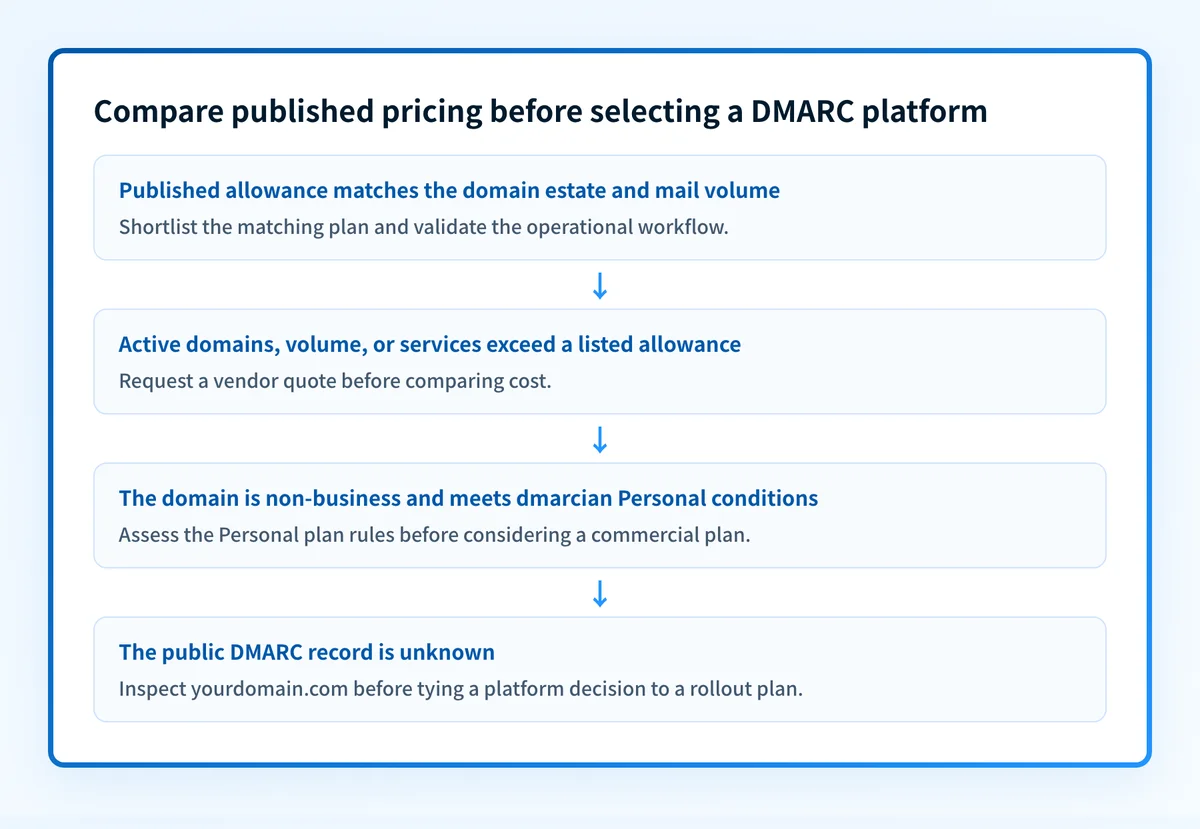
Both vendors publish list pricing for business plans. Compare annual against annual, since both discount for the yearly commitment.
dmarcian, from its pricing page, checked August 17, 2026: Basic at $19.99 per month billed annually covers up to 2 active domains and 100,000 DMARC-capable messages. Plus at $199 covers up to 8 domains and 1,000,000 messages. Enterprise at $499 covers up to 15 domains and 5,000,000 messages. A Personal plan at $0 is restricted to non-business domains sending fewer than 1,250 emails per month, and dmarcian states it audits those accounts. Trials run 30 days on any plan.
dmarcian meters what it calls DMARC-capable messages, and explains the choice directly: "We base our pricing on the volume of legitimate traffic that is reported to dmarcian via DMARC reports. We don't want to charge our users for forwarded or fraudulent traffic."
EasyDMARC, from its pricing page, checked August 17, 2026: the advertised figure is a starting point, not the price. Plus at 100,000 emails per month is $35.99 billed annually, and the same plan at 1,000,000 emails is $111.99. Premium runs from $71.99 to $191.99 across the same range, and reaches $299.99 at 5,000,000. Plus includes 2 domains and Premium includes 4. Enterprise is custom priced.
One EasyDMARC behavior is worth knowing before you size a plan. Exceeding your quota is not an overage charge. EasyDMARC states you "lose access to your reports/dashboard" until you upgrade, which makes volume estimation an availability question rather than only a billing one.
What neither vendor publishes
Both gaps fall on the same side, and they matter most to the buyer this page is written for.
Neither dmarcian nor EasyDMARC publishes MSP pricing. dmarcian asks service providers to "get in touch for pricing options". EasyDMARC describes its MSP model as pay-as-you-go per client domain per month with volume pricing at MSP scale, then directs you to its MSP team for a package. No public per-domain rate exists for either, so any MSP cost comparison you read that quotes one is not sourced from the vendor.
The units also differ in ways a table cannot fix. dmarcian bills active domains, meaning those that send legitimate mail, and counts parked domains separately. EasyDMARC's pricing page does not define what counts as a domain. dmarcian excludes forwarded and fraudulent traffic from its message count; EasyDMARC does not say. Setting 1,000,000 beside 1,000,000 implies an equivalence neither vendor claims.
What the review data does and does not show
The headline scores are the least useful thing here. On G2, EasyDMARC carries a review base in the hundreds while dmarcian's sits in the single digits. Those samples are not comparable, and a star rating drawn from five reviews cannot establish a product's quality in either direction. Treat any side-by-side score you see for these two, including on G2 itself, as a statement about how many customers left reviews rather than about which product is better.
The tagged themes are more useful than the scores. EasyDMARC reviewers most often cite ease of use and customer support as strengths, and cost and limited functionality as weaknesses. On Capterra, reviewers praise fast setup and documentation while describing shallow drill-down and a slow interface. dmarcian's small Capterra sample praises report depth, with reviewers noting the reports "present more details than other solutions", and criticizes a confusing interface and steep prerequisite knowledge.
G2's own comparison summary captures the split: reviewers felt EasyDMARC better meets their business needs, while preferring dmarcian's product direction. Read both sets of themes before either sales call, and weigh the ones that describe daily use over the ones that describe a score.
How to choose
Choose dmarcian if your team owns DNS change control and wants it to stay that way, you value depth of report analysis over automation, your estate fits inside 15 active sending domains, and you are willing to buy support sessions separately. dmarcian sells dedicated support in metered blocks of 5, 16 or 40 sessions, and its deployment services are quoted rather than listed.
Choose EasyDMARC if you manage many domains and need the platform to publish and maintain records, you want PSA integration and white labeled client reporting, and you can either commit to the MSP track or accept that the self-serve tiers withhold the automation. Size your plan against real annual volume, not today's volume, because the price scales and the quota cuts off access.
Ask both for a quote if you are an MSP. Neither published plan is built for a client book, and the published prices will not tell you what you would actually pay.
Check the record behind the buying decision
Before either sales call, inspect what a domain publishes today. Use the DMARC checker to read the live record for a sending domain, then bring that to the conversation instead of a feature checklist.
A record check shows the policy in place at one moment. It cannot list every production sender or prove how either vendor will handle your workflow. That evidence only arrives once aggregate reports accumulate.
Buyers weighing a third option can read the EasyDMARC alternative guide and the dmarcian alternative guide, or see the full set of DMARC platform comparisons. The question worth carrying into any of those conversations is who does the work: a platform that hands your team a task list, or one that does the analysis and drafts the change for a person to review.
Evidence
Sources and further reading
- dmarcian pricing, plan allowances, and pricing FAQ, checked August 17, 2026
- dmarcian for managed service providers, checked August 17, 2026
- dmarcian on SPF flattening, checked August 17, 2026
- EasyDMARC pricing, checked August 17, 2026
- EasyDMARC for MSPs, checked August 17, 2026
- dmarcian dedicated support tiers, checked August 17, 2026
- G2 comparison: EasyDMARC vs dmarcian, checked August 17, 2026
Questions readers ask
Frequently asked questions
Is EasyDMARC cheaper than dmarcian?
At the entry point, no. dmarcian Basic is $19.99 per month billed annually against EasyDMARC Plus at $35.99, both checked August 17, 2026. The comparison inverts as you grow: dmarcian's next tier jumps to $199 per month for 8 domains, while EasyDMARC Plus at 1,000,000 emails is $111.99. Price the tier that matches your real domain count and volume rather than comparing the first number on each page.
Does dmarcian publish DNS records for me?
No. dmarcian describes a read-only design that leaves DNS integrity with the customer, and it does not offer hosted SPF, DKIM or DMARC records. It provides remediation guidance and your team applies the changes. EasyDMARC offers managed DMARC and BIMI on every plan, managed DKIM on Enterprise, and hosted SPF from Premium.
Which one is better for an MSP with 40 client domains?
Neither published plan covers that estate, so both routes lead to a sales conversation. On published evidence EasyDMARC is further along for MSP operations, naming PSA integrations, bulk onboarding and white labeled reporting on its MSP page. dmarcian's highest listed plan stops at 15 active domains and its public pages do not describe white labeling or PSA integration. Ask dmarcian directly rather than assuming the absence is definitive.
Does dmarcian have a free plan for businesses?
No. dmarcian's $0 Personal plan is for non-business domains, limited to two active domains sending fewer than 1,250 emails per month, and dmarcian states it audits those accounts. EasyDMARC's free tier does allow business use, covering one domain, 1,000 emails per month and 14 days of history.
What happens if I exceed my plan's email volume?
The two behave differently. EasyDMARC states you lose access to your reports and dashboard until you upgrade. dmarcian describes its tier volumes as default allowances with custom pricing available for overages, and does not describe cutting off access. Confirm the current behavior with each vendor before sizing a plan close to a limit.
Do either of them publish MSP or partner pricing?
No. dmarcian offers partner pricing and asks service providers to contact them. EasyDMARC describes per-domain monthly pricing that scales with client count, then directs MSPs to its team for a tailored package. Any per-domain figure quoted publicly for either vendor did not come from the vendor.

Written by
Johanie DupontBrand & Ecommerce Email
Johanie Dupont works on brand and ecommerce email at Palisade: BIMI and verified marks, sender requirements, and getting marketing mail into the inbox.
More from Johanie →