Is DMARC the email security game-changer organizations need?
 ChatGPT
 Claude
 Gemini
 Perplexity
 Grok
GrokIn brief
DMARC is a major email security control for domain spoofing, but it needs aligned SPF or DKIM, careful validation, and ongoing review in practice.
Yes, DMARC is a major email security control for organizations that need to reduce spoofing of their visible email domain. It tells receiving mail systems how to handle messages that fail DMARC after checking aligned SPF or DKIM authentication. DMARC is not a complete email-security program or a guarantee of inbox placement. Its value depends on identifying legitimate senders, validating their real message paths, and moving policy carefully.
At a glance
Quick takeaways
- DMARC helps domain owners request handling for messages that fail aligned SPF and DKIM authentication.
- A DMARC pass requires an aligned SPF or DKIM pass for the visible From domain.
p=nonerequests reporting without a handling preference, whilequarantineandrejectrequest stronger treatment for failures.- A published DMARC record does not prove that every legitimate application is authenticated correctly.
- Receiving mail systems make their own final delivery and filtering decisions.
- DMARC works best when teams use reports and message headers to identify every production sender before enforcement.
How DMARC changes email-domain protection
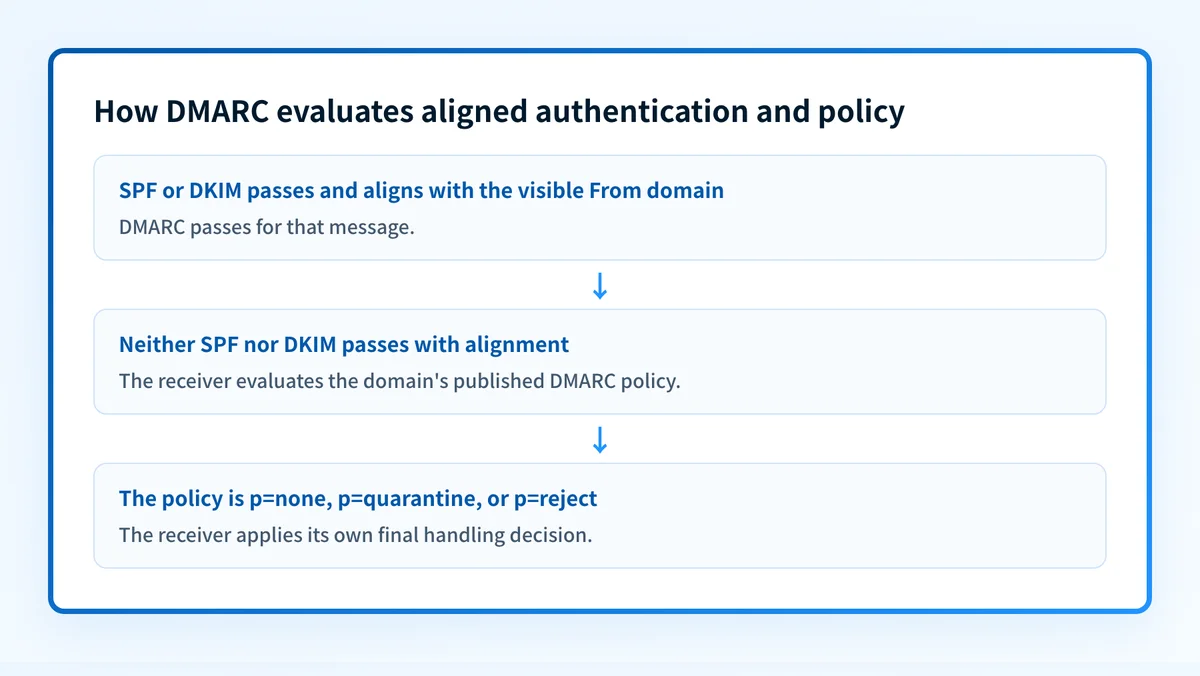
DMARC, defined in RFC 9989, gives a domain owner a way to publish a DNS policy for mail that uses the domain in the visible From field. A receiver evaluates SPF and DKIM, checks whether either passing identifier aligns with that visible From domain, then applies the domain's requested DMARC policy after a failure.
That alignment requirement is the part that makes DMARC more useful against straightforward domain spoofing than SPF or DKIM alone. A message can pass SPF for one domain or carry a DKIM signature for another domain without passing DMARC for the visible From domain.
The policy has three familiar values:
p=nonerequests no specific handling for DMARC failures and can request aggregate reports.p=quarantineasks receivers to treat failing messages as suspicious.p=rejectasks receivers not to accept failing messages.
p=reject record is a strong request, but it does not prove every receiver will reject every failing message. It also does not override a receiver's own spam, reputation, or local-policy decisions.
For broader protocol context, the email authentication learning hub covers the related roles of SPF, DKIM, and DMARC.
When DMARC is the right answer, and when it is not enough
DMARC is a strong answer when the problem is unauthorized mail that impersonates your domain in the visible From field. It gives receivers an authenticated policy signal and gives the domain owner aggregate feedback that can reveal sending sources using the domain.
The answer changes when the organization has not yet mapped its real senders. Marketing platforms, support systems, billing applications, and older internal services may all send mail using the same domain. A policy change can affect legitimate mail if those paths do not produce an aligned SPF or DKIM pass.
Use this decision rule:
- If the concern is visible-domain spoofing, publish and mature DMARC.
- If the concern is whether one specific message authenticated, inspect that message's raw headers and its
Authentication-Resultsfield. RFC 8601 defines this field for reporting authentication results. - If the concern is delivery or inbox placement, investigate the receiver's result and the actual message path. DMARC authentication supports trustworthy mail, but it does not guarantee inbox placement.
- If the concern is a new sender, validate its configuration and a real delivered message before relying on the domain's enforcement policy.
A worked DMARC policy example
This illustrative record asks for aggregate reports while the domain owner inventories senders:
v=DMARC1; p=none; rua=mailto:dmarc-reports@yourdomain.comDo not copy the reporting address into production until the reporting destination is authorized and owned by your organization.
In this example:
v=DMARC1identifies the record as a DMARC policy record.p=nonerequests no specific receiver handling for failures.ruarequests aggregate feedback at the listed destination.
_dmarc.yourdomain.comThe next evidence should come from four layers:
- DNS: query the authoritative DNS service and at least one public resolver to confirm the intended record is published.
- Vendor: confirm each sending service reports its configured authentication status.
- Message: send a real message through each production path and inspect its
Authentication-Resultsheader. - DMARC: review aggregate reports after data accumulates to identify sources and authentication or alignment failures.
Do not move top=quarantineorp=rejectuntil important production paths have been tested. An unverified sender can fail DMARC after enforcement and disrupt legitimate mail.
Are DMARC failure reports worth the trouble for email security? explains why aggregate data matters after publication.
Take the next practical step from the evidence you have
If you have only a domain name, inspect its public DMARC record first. Use the Palisade DMARC checker to check the currently published policy and tags, then compare the result with the DNS change your team intended to deploy.
If you have a message that failed or was filtered, start with its raw headers instead. Look for Authentication-Results and compare the visible From domain with the SPF and DKIM identifiers reported by the receiving system. A public-record check cannot explain an individual receiver decision.
If the record is present but your organization cannot account for every sender, keep the policy transition under review until reports and delivered-message tests identify the remaining paths. The case for DMARC is strongest when it becomes an operating process, not a one-time DNS edit.
Continue the DMARC review after the record check
A record lookup can confirm the public policy, but it cannot show which production systems still fail alignment or whether a later sender change will introduce a new gap. When that ongoing review needs a defined owner, start a Palisade account to continue the work with your domain evidence and approval process.
Palisade does not replace message-header testing, change your DMARC policy without human review, or guarantee delivery or inbox placement. For the business case around that work, see how to win over execs to invest in DMARC and email security.
Evidence
Sources and further reading
Questions readers ask
Frequently asked questions
Does DMARC stop all phishing?
No. DMARC addresses unauthorized use of a domain in the visible From field when receivers evaluate and apply the domain's policy. Attackers can use unrelated domains, compromised accounts, or other techniques that DMARC does not prevent.
Does DMARC require both SPF and DKIM to pass?
No. DMARC can pass when either SPF or DKIM passes and the passing identifier aligns with the visible From domain. Using both authentication methods can provide useful resilience across different sending paths.
Can a domain use DMARC with p=none?
Yes. p=none is a valid DMARC policy that requests no particular handling for failures. It can be used with aggregate reporting while the organization identifies legitimate senders and fixes alignment issues.
Does p=reject guarantee that spoofed mail is rejected?
No. p=reject asks receivers to reject messages that fail DMARC, but each receiver makes its own final handling decision under its local policies.
Should an organization check headers after publishing DMARC?
Yes. A real delivered message's Authentication-Results field provides evidence about the exact sending path. DNS publication and vendor configuration indicators do not prove the authentication result of a delivered production message.

Written by
Samuel ChenardCEO & Co-Founder, Palisade
Samuel Chenard is the CEO and co-founder of Palisade, agentic DMARC software for IT teams and MSPs, from one domain to thousands.
More from Samuel →