How can you win over execs to invest in DMARC and email security?
 ChatGPT
 Claude
 Gemini
 Perplexity
 Grok
GrokIn brief
You win over execs to invest in DMARC and email security with real numbers: breach costs, ROI, and reports of current gaps, tailored to each exec's goals.
At a glance
Quick Takeaways
- Translate DMARC into revenue protection and brand trust.
- Show real-world breach costs to highlight ROI.
- Use data-driven reports to quantify email security gaps.
- Tailor your pitch to each executive’s priorities (CFO, CIO, CEO).
- Leverage Palisade’s free domain checker to demonstrate current exposure 👉 https://www.palisade.email/tools/email-security-score
You’ve probably seen phishing attempts slip through, watched competitors scramble after domain-spoofing scandals, and know it’s only a matter of time before someone exploits that gap. The good news? With the right approach, gaining buy-in doesn’t have to feel like pushing a boulder uphill.
Building a business case that resonates
Focus on real numbers, tangible risks, and clear business opportunities. Data is your friend.
The FBI's Internet Crime Complaint Center attributes more than \$55 billion in losses to business email compromise between 2013 and 2023, and IBM put the average data-breach cost at \$4.88 million in 2024. Those figures are the wake-up calls that make executives sit up and listen.
Your current email security might catch 99% of threats, but with 100,000 monthly emails that 1% gap equals 1,000 potential security holes – each an opportunity for impersonation, payment redirection, or brand damage.
The hidden costs you’re already paying
Model the ongoing cost with your own numbers, not ours:
- Security team hours spent manually investigating suspicious emails.
- IT help desk fields tickets about legitimate messages landing in spam.
- Marketing suffers from poor deliverability, missing revenue opportunities.
Connecting DMARC to business goals
- Ensure sales emails reach prospects, boosting conversion.
- Secure payment processes and prevent invoice fraud.
- Maintain customer trust by guaranteeing authentic communications.
- Protect brand reputation before a scandal erupts.
- Strengthen partner relationships by demonstrating robust email authentication.
Numbers that matter: ROI breakdown
The cost of doing nothing
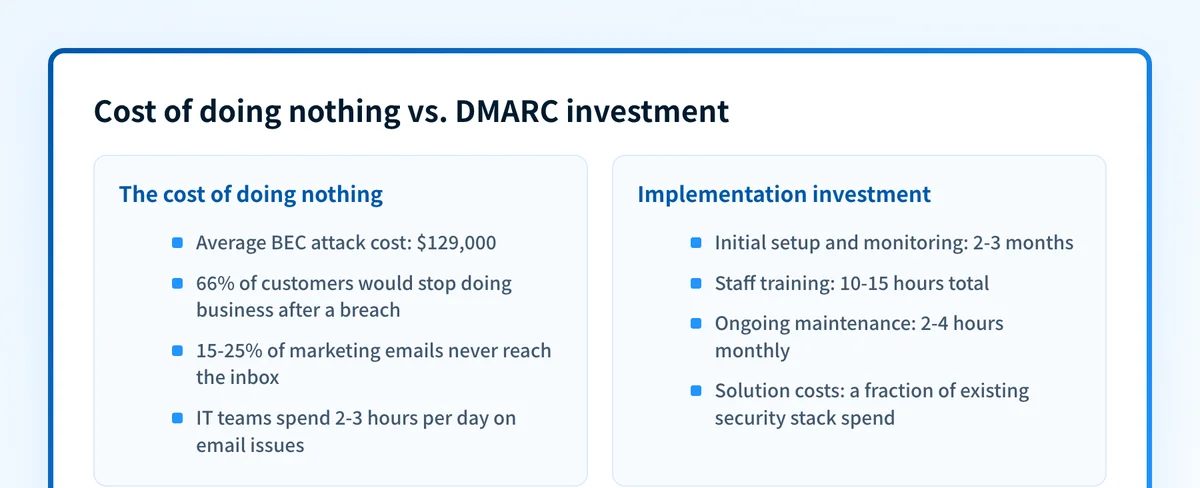 BEC losses, customer churn, and lost deliverability vs. modest setup and upkeep.
- Business Email Compromise (BEC) losses, which frequently run into six figures per incident.
- Brand reputation damage, as a meaningful share of customers walk away after a breach.
- Lost revenue when legitimate marketing email fails to reach the inbox.
- IT team time spent triaging deliverability and spoofing tickets.
Implementation investment
- Initial setup & monitoring: 2-3 months.
- Staff training: 10-15 hours total.
- Ongoing maintenance: 2-4 hours monthly.
- Solution costs: a fraction of existing security stack spend.
Payoff timeline
- Month 1: Full visibility into email sources, early detection of unauthorized senders.
- Month 3: 90-100% of legitimate email authenticated, fewer help-desk tickets, improved deliverability.
- Month 6: Full enforcement, elimination of spoofing attempts, measurable boost in email marketing ROI.
Crafting your pitch
Start with a story, not just stats. Example: “Last month a competitor’s domain was spoofed to send fake invoices, damaging customer trust overnight.” Then tailor the message:
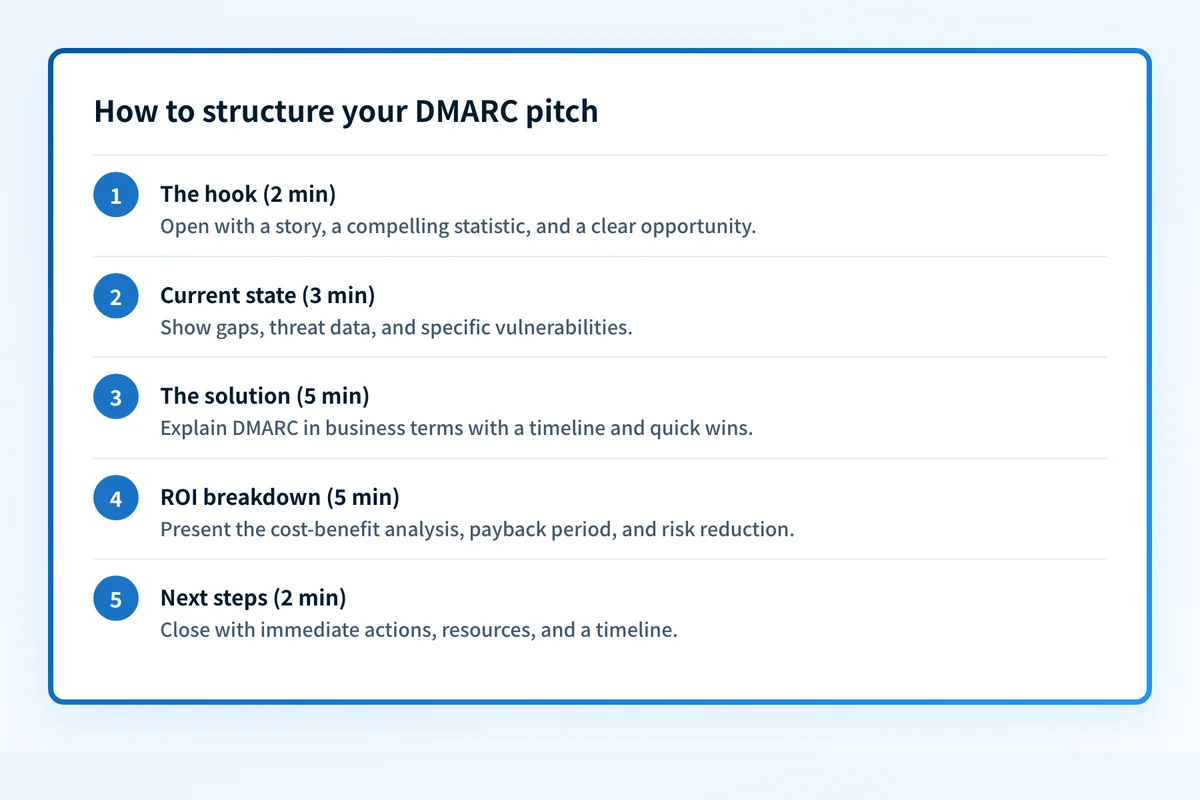 Five timed sections take executives from hook to next steps.
- CFO: Emphasize cost avoidance, ROI, and fraud protection.
- CIO/CISO: Highlight integration, technical resources, and compliance benefits.
- CEO: Connect DMARC to growth, competitive advantage, and brand protection.
- The hook (2 min): Story, compelling statistic, clear opportunity.
- Current state (3 min): Show gaps, threat data, specific vulnerabilities.
- The solution (5 min): Explain DMARC in business terms, timeline, quick wins.
- ROI breakdown (5 min): Cost-benefit analysis, payback period, risk reduction.
- Next steps (2 min): Immediate actions, resources, timeline.
Getting started with Palisade
Before the meeting, run Palisade’s free domain health check to see your current authentication status across SPF, DKIM, and DMARC. Use the results to quantify risk and showcase immediate improvement opportunities.
When budget is tight, a pilot on one domain shows who is sending on your behalf before anyone commits to a plan.
Common objections and how to answer them
"Our current gateway already blocks phishing"
Secure email gateways scan for malware and known-bad domains, but they do not stop a perfectly clean message sent from a spoofed version of your own domain. DMARC is the control that closes exact-domain spoofing. It complements the gateway rather than duplicating it. Show the gap with a live email security score.
"We tried DMARC and it blocked our own email"
That happens when enforcement is switched on before every legitimate sender is authenticated. The fix is a phased rollout: start at p=none, use aggregate reports to find every sender, publish SPF and DKIM for each, then move to p=quarantine and p=reject. Framed this way, execs hear "managed rollout," not "risky switch."
"There's no budget for another security tool this quarter"
Anchor on cost avoidance, and lead with a small pilot: a pilot on one domain surfaces who is sending on your behalf before anyone signs a purchase order, and turns an abstract request into evidence.
"Leadership doesn't see email as a real risk"
Translate the threat into their language: business email compromise is a finance and fraud problem, not just an IT one. Pair the FBI's multi-billion-dollar BEC totals with your own exposure numbers so the risk lands as a board-level concern.
Evidence
Sources and further reading
Questions readers ask
Frequently asked questions
What is DMARC and why does it matter for my business?
DMARC (Domain-based Message Authentication, Reporting, and Conformance) is an email-authentication protocol that helps prevent attackers from spoofing your domain. It protects revenue, brand trust, and reduces fraud risk.
How can I calculate the ROI of a DMARC implementation?
Start by estimating costs of BEC attacks, lost deliverability, and IT time spent on email issues. Then compare against the modest implementation and maintenance costs of a DMARC solution like Palisade.
Do I need to change my existing email infrastructure to adopt DMARC?
No. DMARC works with your current SPF and DKIM records. Palisade can guide you through a phased rollout that aligns with your existing stack.
What’s the difference between DMARC monitoring and enforcement?
Monitoring (p=none) lets you gather data without affecting delivery. Enforcement (p=quarantine or reject) actively blocks unauthenticated emails, providing stronger protection.
How long does it take to move from DMARC monitoring to full enforcement?
Most organizations see a transition within 3-6 months, depending on the complexity of their email ecosystem and the speed of stakeholder alignment.
Ready to protect your brand and boost email performance? 👉 Check your domain’s email security score now
Read more in our guide to email security best practices.

Written by
Taylor TabusaCo-Founder & Head of Business Development, Palisade
Taylor Tabusa is the co-founder and Head of Business Development at Palisade, helping managed service providers turn email security into a practical, valuable service.
More from Taylor →