What can we learn from Will Boyd about deliverability?
 ChatGPT
 Claude
 Gemini
 Perplexity
 Grok
GrokIn brief
Deliverability expert Will Boyd on permission, data, and explaining DMARC simply, plus how those lessons translate into authentication that reaches the inbox.
Deliverability rarely comes down to one clever trick. It comes from fundamentals applied consistently: earning permission, reading the data, and authenticating your mail so receivers trust it. In this interview, email deliverability expert Will Boyd shares how he stays motivated, why he treats permission as non-negotiable, and how he explains DMARC to a non-technical audience. Below the highlights, we translate his themes into the concrete authentication steps that put them into practice.
At a glance
Quick Takeaways
- Will Boyd emphasizes continuous learning and data analysis for better deliverability.
- Permission collection is the foundation of successful email campaigns.
- DMARC can be explained with an airport security metaphor.
- Understanding SQL and data can break down deliverability walls.
- Palisade simplifies DMARC implementation with the Email Security Score tool.
Interview Highlights
How do you stay motivated when learning something challenging?
Will reminds himself of past successes, recognizing that he's overcome similar frustrations before, which fuels confidence.
What was the last wall you crashed through?
He taught himself SQL and data analysis to better understand client data, expanding his deliverability expertise.
What's your favorite way to show gratitude?
He publicly acknowledges teammates' strengths, helping them gain visibility with leadership.
What's the funniest mistake you've made?
He mistakenly thought a new client employee was a familiar colleague, leading to a light-hearted moment and an introduction.
What's the smallest hill you're willing to die on?
He stands firm on the importance of obtaining proper permissions before sending email.
How would you explain DMARC to a non-technical audience?
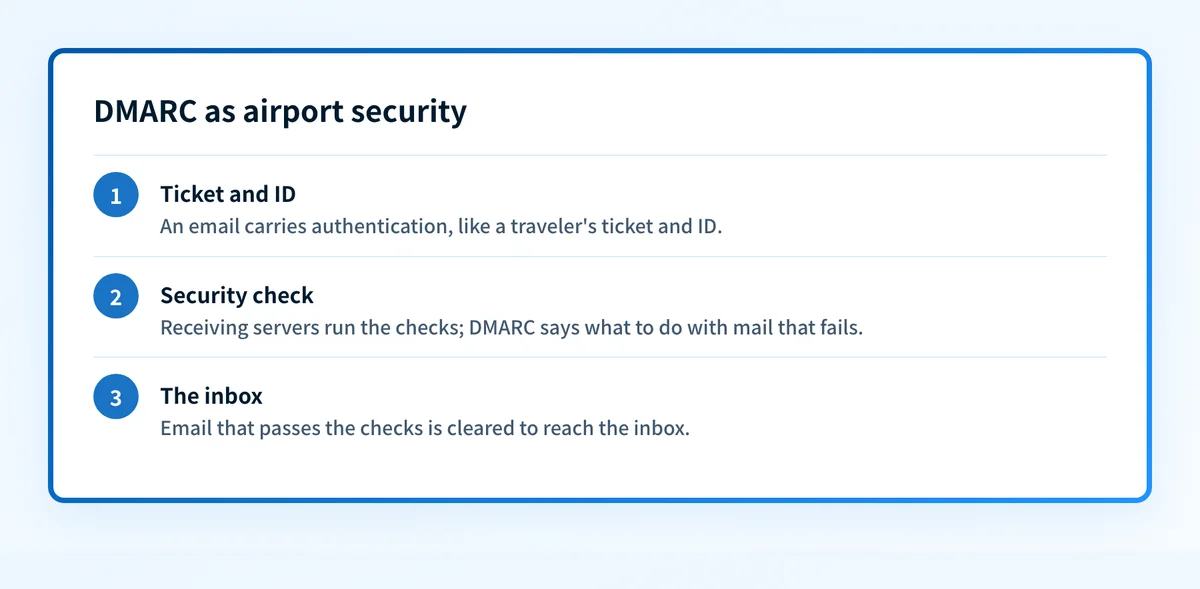
He likens DMARC to airport security: an email needs a ticket and ID (authentication) to pass checks before reaching the inbox.
The deliverability lessons behind the interview
Permission is the foundation
Will's "smallest hill" (always get permission before sending) is also the first rule of email deliverability. Recipients who expect your mail open it and rarely mark it as spam; recipients who did not consent generate complaints that teach mailbox providers to distrust your domain. No amount of authentication rescues a list that never opted in, which is one of the most common reasons emails go to spam.
Data beats guesswork
Teaching himself SQL was not a detour. It was the point. Deliverability problems hide in patterns: which sending sources fail authentication, which segments complain, which domains bounce. The email equivalent of that data is your DMARC reports, which show every source sending as your domain and whether each one passes SPF and DKIM. Reading that data is how you find the broken sender before it drags down the whole domain.
The airport metaphor, unpacked
The metaphor is exact. The "ticket" is SPF, which authorizes the sending server. The "ID" is DKIM, a cryptographic signature that proves the message was not altered. DMARC is the security checkpoint that decides what happens when the ticket or ID does not match the name on the boarding pass: deliver, divert to spam, or turn the passenger away. Only mail that presents valid, aligned credentials walks through to the inbox.
How DMARC turns these lessons into results
Permission earns engagement; authentication earns trust; data keeps both honest. DMARC ties them together by giving receivers a clear instruction for unauthenticated mail and giving you the reporting to prove your legitimate senders pass. Start by publishing a policy and reading the reports, authenticate every real sender into SPF and DKIM alignment, then tighten toward p=reject as the data confirms clean mail flow.
Use Palisade's Email Security Score to identify your senders and begin implementation.
Questions readers ask
Frequently asked questions
What is DMARC?
DMARC is an email authentication protocol that tells receiving servers how to handle messages that fail SPF or DKIM checks, and whether those results align with the visible From domain.
Why are permissions crucial for deliverability?
Collecting consent ensures recipients expect your emails, which reduces spam complaints and signals to mailbox providers that your mail is wanted, the single biggest lever on inbox placement.
Do I need to learn SQL for deliverability?
No, but the instinct behind it matters: deliverability improves when you read your data. DMARC reporting gives you the sender-level view without writing a query.
How does Palisade help with DMARC?
The Email Security Score tool provides a clear view of your domain's sending sources and guides you through enforcement, so you can act on the data instead of parsing raw reports.
How do permission and authentication work together?
Permission earns engagement and authentication earns trust, and mailbox providers weigh both. A permission-based list keeps complaints low, while SPF, DKIM, and DMARC prove the mail is really from you. Weak on either front and inbox placement suffers, no matter how good the other is.

Written by
Dominic LandryDeliverability & DNS
Dominic Landry works on email deliverability and DNS configuration at Palisade, from SPF and DKIM records through to DMARC enforcement.
More from Dominic →