How does DMARC affect cyber insurance and claims?
 ChatGPT
 Claude
 Gemini
 Perplexity
 Grok
GrokIn brief
How DMARC impacts cyber insurance eligibility, claims, and premiums, practical guidance and a checklist for IT teams.
DMARC affects cyber insurance in three places: underwriting, premium, and claims. Insurers increasingly ask for documented email authentication on security questionnaires, and an enforced DMARC policy is the evidence that answers it. A domain sitting at p=none can read as an unmanaged control, which raises the premium or narrows coverage. After an incident involving domain impersonation, DMARC reports are also the record that shows what your domain did and did not send.
What is cyber insurance?
Cyber insurance is a policy that helps cover the costs of recovering from cyber incidents, including data breaches, ransomware, and social engineering. It can include both first-party cover (your immediate remediation costs) and third-party cover (liability to customers or partners). Policies vary, so insurers, brokers, and risk teams will tailor coverage to the organization’s profile and exposures. Common coverages include incident response, legal fees, notification costs, and cyber extortion. Having documented security controls often affects both eligibility and pricing.
How common and costly are cyberattacks?
Cyber incidents are widespread and expensive: many organizations report attacks each year and average breach costs have climbed into the millions. Small and medium businesses can face losses ranging from low hundreds of thousands to over a million dollars depending on the incident. Ransomware remediation averages have been rising substantially, and social engineering remains a frequent cause of claims. These trends drive demand for cyber insurance and stricter underwriting standards.
What do insurers look for during underwriting?
Underwriters evaluate the technical and governance controls you can demonstrate, including email security, patching, backups, access controls, and incident response plans. Insurers expect evidence: policies, logs, testing records, and third-party assessments. Email authentication like DMARC, SPF, and DKIM is increasingly a baseline control because email is a common attack vector for phishing and business email compromise. Demonstrating strong controls can improve your chances of getting coverage and may lower premiums.
Why does DMARC matter to insurers?
DMARC helps prevent attackers from spoofing your domain and is a direct control against phishing and BEC, which are leading causes of cyber claims. Insurers view DMARC in enforcement mode (reject or quarantine policies) and verified alignment as proof you manage email spoofing risk. For many policies, DMARC isn’t just recommended. It can be a documented requirement for eligible coverage or for certain policy limits. Use Palisade’s DMARC tool to check and document your setup: Assess your email authentication with Palisade.
Can DMARC reduce premiums or cover denials?
Yes, having a mature DMARC setup can influence pricing and claim outcomes because it lowers the likelihood of successful spoofing attacks. Insurers may offer more favorable terms to organizations that can demonstrate enforced DMARC, good monitoring, and quick remediation processes. Conversely, lack of basic email authentication or poor documentation can lead to higher premiums, coverage limits, or even claim disputes. Keep records of when controls were implemented and validated to support any claim.
How does DMARC affect claim investigations?
DMARC records, message headers, and authentication reports provide essential evidence for forensic analysis after an incident. These artifacts help determine whether an incident involved domain spoofing, and they speed up root-cause analysis. Insurers and forensic teams use this information to decide which coverages apply and whether third-party liability is involved. Clear DMARC reporting reduces ambiguity in investigations and can shorten resolution time.
Do insurers require DMARC to sell a policy?
Requirements vary by insurer and policy size, but many now list email authentication among required or recommended controls. Small policies may be more lenient, while larger limits often require documented controls, including enforced DMARC. If your organization can’t meet requirements immediately, discuss a remediation timeline with the broker; some insurers accept staged improvements. Always get requirements in writing so you know what to prove at claim time.
What evidence should IT teams keep for insurers?
Keep clear records: DMARC aggregate and forensic reports, SPF/DKIM records, change logs, incident response exercises, and internal policies. Store configuration snapshots and dates when enforcement levels changed (e.g., moved from none to quarantine or reject). Regularly export and archive reports so they’re available for underwriting and investigations. These records are straightforward to collect and help show continuous risk management.
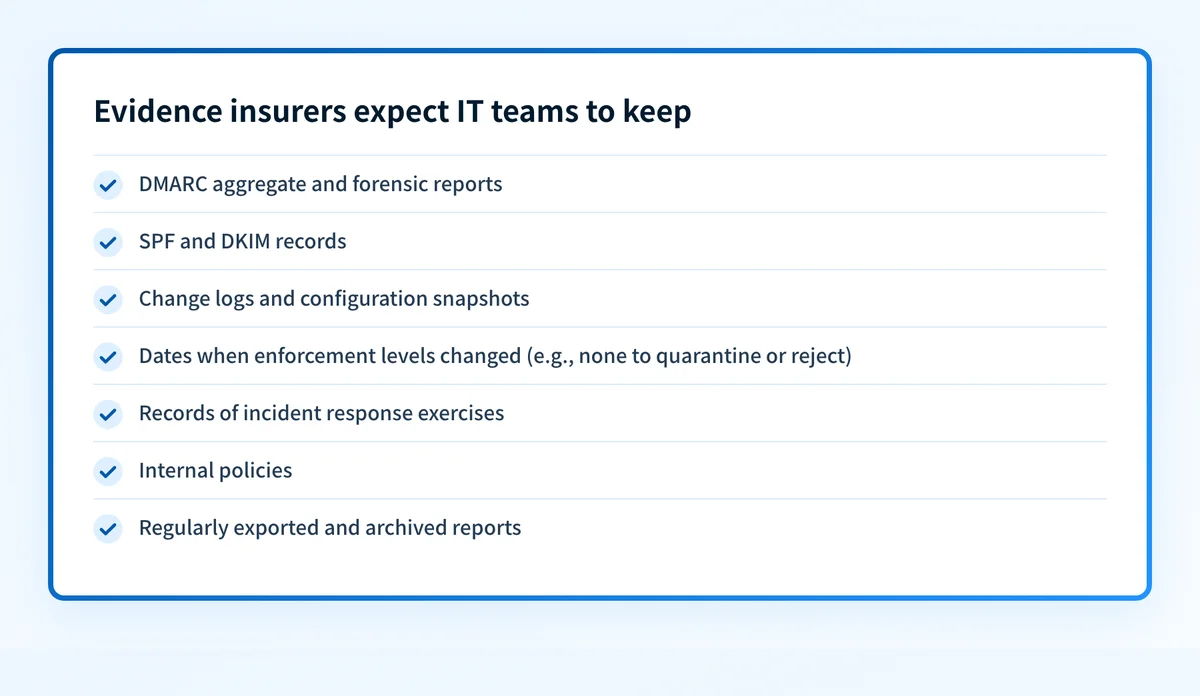 Straightforward records that show continuous risk management to underwriters and investigators.
How should an organization implement DMARC to satisfy insurers?
Start with a monitoring mode (p=none), collect reports, fix legitimate senders, then progress to quarantine and reject once you’ve validated traffic. Use a phased approach: inventory senders, publish SPF and DKIM, enable DMARC reporting, and move enforcement gradually. Communicate the plan to stakeholders and keep documentation of each step. For a fast, automated check and reporting, use Palisade’s DMARC assessment: Run a DMARC check with Palisade.
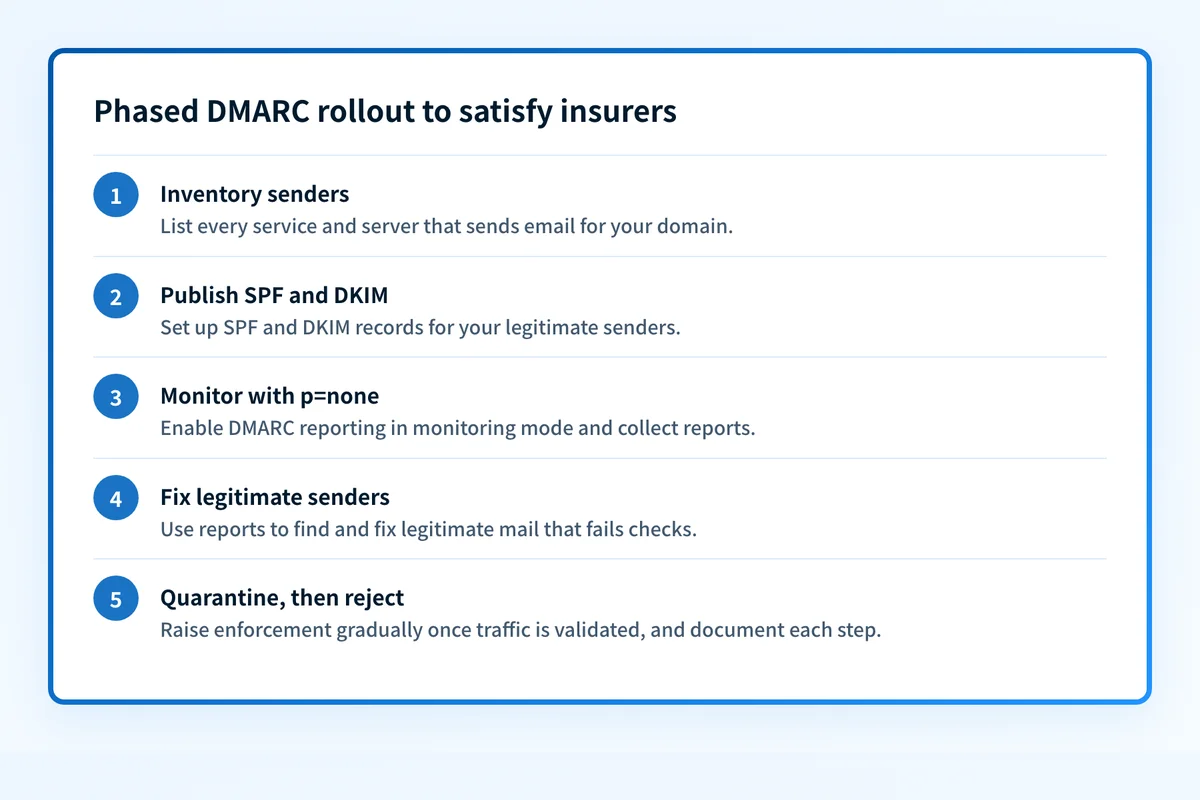 A phased rollout avoids blocking legitimate mail while building documentation for underwriters.
Will DMARC stop all email fraud?
No: DMARC is a powerful control but not a silver bullet; it reduces spoofing risk but doesn’t eliminate phishing via compromised accounts or look-alike domains. Combine DMARC with employee training, anti-phishing tools, two-factor authentication, and monitoring for lookalike domains. Treat DMARC as part of a defense-in-depth strategy that lowers the probability and impact of email-based attacks. Insurers expect this layered approach when evaluating risk.
What are quick next steps for IT and security teams?
Begin with a baseline assessment of your email authentication, document current settings, and build a remediation plan to reach enforcement. Talk to your broker or insurer early, share the plan and timelines to align expectations. Keep regular reports and store evidence of configuration changes. Finally, use Palisade’s tools to automate scoring and reporting so you can demonstrate controls to underwriters.
Common issues when documenting DMARC for insurers
The underwriting questionnaire asks for DMARC evidence we can't produce
Insurers want proof, not assertions. Export your DMARC aggregate reports, a dated record of your current policy, and a change log showing when you moved from p=none toward enforcement. A quick email security score gives you a shareable snapshot to attach.
We're at p=none and the insurer wants "enforcement"
p=none is monitoring only and blocks nothing, so many policies treat it as insufficient. Work through your reports to authenticate every legitimate sender, then move to p=quarantine and p=reject. Keep the dates. The progression itself is evidence of continuous risk management.
SPF or DKIM keeps failing for a legitimate sender
Underwriters read repeated authentication failures as an uncontrolled sending environment. Identify the sender in your reports, publish its SPF include or DKIM key, and re-check with the SPF and DKIM tools before your renewal review.
A claim is under investigation and forensics wants historical records
Retention matters here: if reports were never archived, you can't reconstruct what happened. Store aggregate and forensic reports plus configuration snapshots on a schedule so the history exists before you need it, not after.
Quick Takeaways
- DMARC is now a key control for insurers because it reduces domain spoofing and BEC risk.
- Documented email authentication can influence underwriting, premiums, and claim outcomes.
- Insurers often require evidence: keep DMARC/SPF/DKIM records, logs, and change history.
- Implement DMARC in phases: monitor, fix senders, then enforce (quarantine/reject).
- DMARC complements training, MFA, and anti-phishing tools, it’s not a complete solution.
Questions readers ask
Frequently asked questions
Is DMARC required for cyber insurance?
Not universally, but increasingly common: many insurers list DMARC as required or strongly recommended for larger policies. If in doubt, check policy requirements or consult your broker.
How long does DMARC implementation take?
Implementation ranges from days for simple domains to several weeks for complex email ecosystems. Plan phased rollouts and testing to avoid blocking legitimate mail.
Does DMARC protect against ransomware?
DMARC mainly prevents domain spoofing and some phishing; it does not directly stop ransomware, though it reduces one common initial access vector. Use layered defenses for ransomware prevention.
Will insurers check DMARC during a claim?
Yes: insurers and forensics teams often review email authentication records during investigations to determine scope and liability. Having clear records speeds claims processing.
Where can I get a DMARC report?
You can generate DMARC reports and assessments using Palisade’s tools: Evaluate your email security with Palisade.

Written by
Taylor TabusaCo-Founder & Head of Business Development, Palisade
Taylor Tabusa is the co-founder and Head of Business Development at Palisade, helping managed service providers turn email security into a practical, valuable service.
More from Taylor →