What’s the current state of DMARC adoption in Japan?
 ChatGPT
 Claude
 Gemini
 Perplexity
 Grok
GrokIn brief
DMARC adoption in Japan is accelerating as ministries and mailbox providers press senders to authenticate email. Here’s the current state and how to act.
What’s the current state of DMARC adoption in Japan?
Email fraud and spoofing is a global problem, and Japan is now moving quickly to close the gap. Government ministries, the payments industry, and major mailbox providers have all pushed DMARC up the agenda for organizations that send mail to Japanese recipients.
At a glance
Quick takeaways
- Japan’s Ministry of Internal Affairs and Communications (MIC), National Police Agency (NPA), and Ministry of Economy, Trade and Industry (METI) have publicly asked credit-card companies to strengthen anti-phishing measures, including DMARC.
- The Japan Anti-Abuse Working Group (JPAAWG) has promoted email authentication in Japan through annual meetings since 2018.
- Global bulk-sender requirements from Gmail and Yahoo, in force since 2024, apply to anyone emailing large volumes of Japanese users.
- DMARC only works alongside aligned SPF and DKIM; publishing a record with a
nonepolicy is the safe first step. - Palisade automates the DMARC lifecycle so any organization, in Japan or elsewhere, can reach enforcement without deep in-house expertise.
Why does DMARC matter for Japan’s email ecosystem?
DMARC (Domain-based Message Authentication, Reporting, and Conformance) tells receiving mail servers how to handle messages that fail authentication. Because most phishing and business email compromise relies on forged or look-alike sender addresses, DMARC removes one of the attacker’s most effective tools: the ability to send mail that appears to come from a trusted domain.
It works by letting a domain owner publish a policy, none, quarantine, or reject, that receivers apply to unauthenticated mail claiming to be from that domain. In Japan’s trust-based business culture, where email remains a primary channel for invoices, payments, and official notices, that verification matters. DMARC also generates aggregate reports that show a domain owner exactly which sources are sending on their behalf, which is the raw material for moving safely toward enforcement.
What’s driving DMARC adoption in Japan right now?
Adoption is being pulled forward by three forces at once.
Government pressure on the payments sector. In February 2023, the MIC, NPA, and METI jointly requested that credit-card companies bolster their anti-phishing measures, including introducing DMARC, in response to a rise in credit-card fraud that started with phishing. METI followed with its Credit Card Security Guidelines 5.0 in March 2024, tightening security expectations across the card ecosystem.
Industry coordination. JPAAWG, the Japanese chapter of the global Messaging, Malware and Mobile Anti-Abuse Working Group, has run annual general meetings since 2018 that consistently feature DMARC, DKIM, BIMI, and IETF authentication work. That gives Japanese operators a local venue for the same standards the rest of the world is adopting.
Mailbox-provider requirements. The bulk-sender rules Gmail and Yahoo introduced in 2024 require high-volume senders to authenticate with SPF, DKIM, and DMARC. Any organization sending marketing or transactional mail to Japanese inboxes on those platforms is already in scope, regardless of where the sender is based.
What challenges do Japanese organizations face when adopting DMARC?
Many Japanese firms operate with legacy email infrastructure and multiple third-party senders, which complicates DNS record management. A high baseline of institutional trust can lead to complacency around email security, and local expertise in DMARC, DKIM, and SPF is still limited. Language and documentation gaps slow adoption further when the authoritative references are English-only.
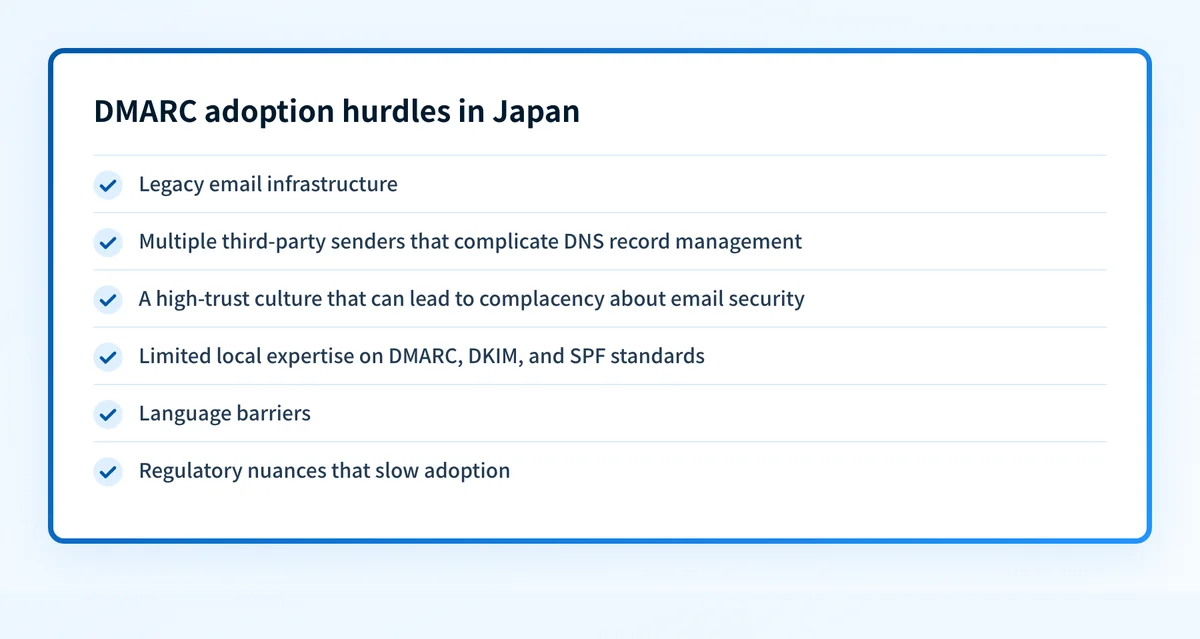 Hurdles that slow DMARC rollouts for organizations with complex sending estates.
How can Palisade help organizations reach DMARC enforcement?
Palisade is agentic DMARC software that does the work of getting a domain to enforcement. Its AI agent investigates sending sources from your DMARC aggregate-report data, identifies SPF and DKIM alignment issues, and proposes the next policy step, moving a domain toward p=reject while your team reviews and approves each change. That reduces the need for specialized email-security staff, the main barrier for organizations without a dedicated deliverability team.
The approach is the same whether you manage one domain or thousands, which is why it fits both internal IT teams and MSPs handling many client domains. Companies can reach DMARC enforcement faster, with far less manual report-reading and less risk of blocking legitimate mail on the way.
How can organizations start protecting their domains today?
You do not need to wait for a mandate to act. Start by assessing your current email authentication posture with Palisade’s free email security score tool, which highlights gaps in SPF, DKIM, and DMARC and gives you a remediation roadmap. You can also publish a DMARC record with a none policy to begin collecting reports without affecting delivery. For deeper checks, use Palisade’s DKIM and SPF tools, and once authentication is solid, consider BIMI to display a verified logo in supporting inboxes.
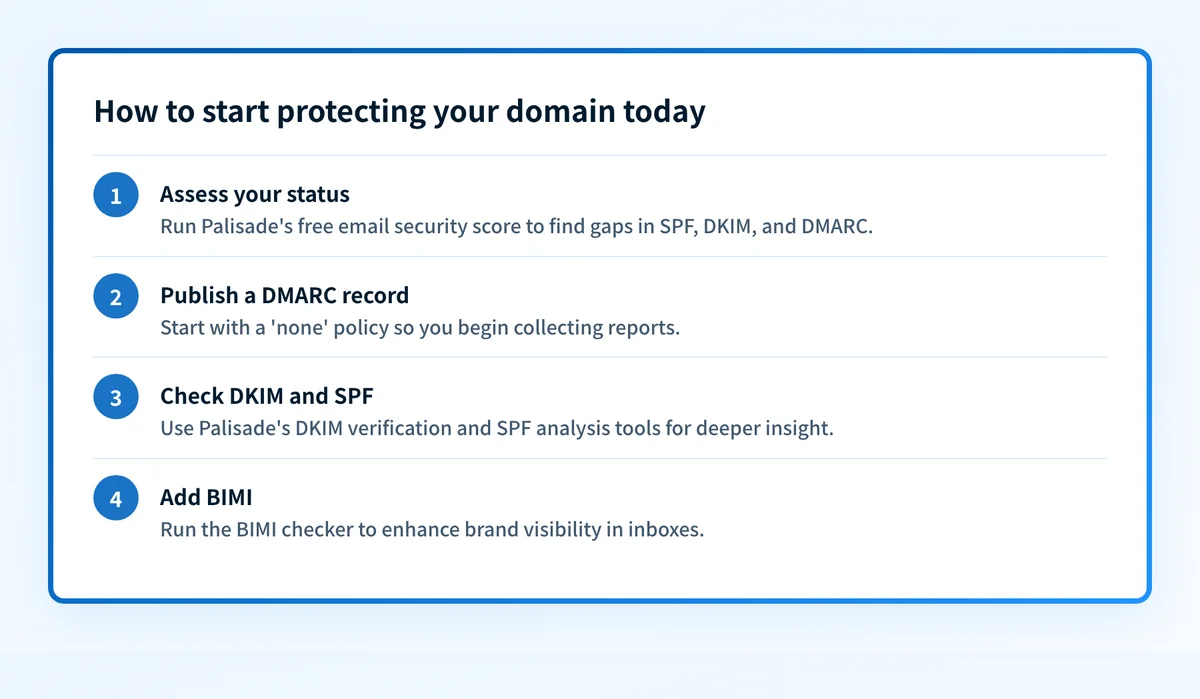 Actions any organization can take today to begin the path to enforcement.
Conclusion
DMARC is a proven defense against email spoofing, and Japan’s combination of government pressure, payments-industry guidelines, and provider requirements makes it a near-term priority rather than a future one. Organizations that start now: assessing their posture, publishing a monitoring policy, and working the reports toward enforcement. Will be ready as expectations tighten. Palisade’s automation removes most of the manual effort on that path.
Questions readers ask
Frequently asked questions
Is DMARC legally required in Japan?
There is no blanket legal mandate, but the pressure is real and sector-specific. Japanese ministries have formally asked credit-card companies to adopt DMARC, and Gmail and Yahoo already require it for bulk senders. For regulated or high-volume senders, DMARC is effectively expected even where no single law names it.
What DMARC policy should a Japanese organization start with?
Start with p=none. It changes nothing about delivery but turns on aggregate reporting, so you can see every source sending as your domain. Once SPF and DKIM align for your legitimate senders, move to quarantine and then reject.
Does DMARC alone stop all email fraud in Japan?
No. DMARC stops unauthorized use of your exact From domain. It does not stop look-alike domains, compromised accounts, or phishing sent from unrelated domains. Pair it with user awareness and, where useful, BIMI so recipients get a visible trust signal.
How long does it take to reach DMARC enforcement?
It depends on how many sending sources a domain has. A simple domain can reach p=reject in weeks; a large estate with many third-party senders takes longer because each source must be authenticated first. Automating the report analysis, as Palisade does, is what compresses that timeline.

Written by
Samuel ChenardCEO & Co-Founder, Palisade
Samuel Chenard is the CEO and co-founder of Palisade, agentic DMARC software for IT teams and MSPs, from one domain to thousands.
More from Samuel →