dmarcian
 pricing: plans, meters and MSP terms
 ChatGPT
 Claude
 Gemini
 Perplexity
 Grok
In brief
dmarcian pricing: four plans metered on active domains and DMARC-capable messages, with partner and overage prices by quote. What MSPs should ask.

dmarcian pricing runs from $24 to $600 a month on its three paid plans, Basic, Plus and Enterprise, or $19.99 to $499 a month billed yearly, plus a $0 Personal plan for non-business domains. Basic covers 2 active domains, Plus 8 and Enterprise 15. Each plan also caps DMARC-capable messages per month, from 1,250 on Personal to 5,000,000 on Enterprise. Partner pricing for MSPs, overages and larger estates are quoted, not published. dmarcian's pricing page was checked on 15 November 2026.
At a glance
Quick takeaways
- Every plan has two meters at once: active domains and DMARC-capable messages per month. You need the plan that covers both.
- An active domain is any domain or subdomain that sends legitimate email, so sending subdomains count. Inactive (parked) domains are unlimited on every plan.
- API access, Domain Discovery and single sign-on are Enterprise only. Alert Central and forensic (RUF) reports start at Basic.
- The yearly price saves $48.12 on Basic, $492 on Plus and $1,212 on Enterprise against twelve monthly payments.
- Partner pricing exists but has no published number, and neither do overage rates or the Custom plan.
- dmarcian's paid plans start with a 30-day trial that needs no credit card. dmarcian audits Personal plans, and one that holds a business domain expires.
What dmarcian publishes for its plans
The table below is dmarcian's own plan matrix, checked on 15 November 2026. Prices are in USD, and dmarcian states parity for CAD and EUR, with the currency set by the regional instance you subscribe to. Prices exclude taxes.
| Personal | Basic | Plus | Enterprise | |
|---|---|---|---|---|
| Monthly billing | $0 | $24/mo | $240/mo | $600/mo |
| Yearly billing | $0 | $19.99/mo ($239.88/yr) | $199/mo ($2,388/yr) | $499/mo ($5,988/yr) |
| Active domains | Up to 2 | Up to 2 | Up to 8 | Up to 15 |
| DMARC-capable messages per month | 1,250 | 100,000 | 1,000,000 | 5,000,000 |
| Users | 1 | 1 | 3 | Unlimited |
| Data history | 1 month | 3 months | 1 year | Unlimited |
| Domain groups | 1 standard | 1 standard | 3 standard | Unlimited |
| Usage | Personal, non-business | Commercial or nonprofit | Commercial or nonprofit | Commercial or nonprofit |
Every plan includes the DMARC Management Platform with source enrichment, automatic subdomain detection, SPF Surveyor, the DKIM tools, BIMI Inspector and Builder, aggregate (RUA) report processing, two-factor authentication, TLS reporting and unlimited inactive domains. The rest is gated by tier:
- Basic and up: Alert Central, forensic (RUF) report processing and the Forensic Viewer.
- Plus and up: IP safelisting and user access controls.
- Enterprise only: Domain Discovery, API access and single sign-on.
How the two meters work
dmarcian bills on volume it calls DMARC-capable: "the volume of legitimate traffic that is reported to dmarcian via DMARC reports." Forwarded and fraudulent mail does not count, which is a fair way to meter, but it means you cannot read your plan off a mailbox count. Look at a month of your own reports first.
The domain meter counts active domains, which dmarcian defines as "Domains or subdomains that are used to send legitimate email from." A company with one domain and three sending subdomains has four active domains, which is past the Basic limit of 2. Domains that send nothing, such as parked or defensively registered ones, are inactive and unlimited on every plan.
Because both meters apply, a small domain count with heavy volume can land on the same plan as a large portfolio. Two domains sending 1,000,000 messages a month need Plus, not Basic. The footnote on the pricing page says message volumes "represent default allowances; custom pricing is available for overages," but the overage rate is not published.
At full use of each plan's domain allowance, the monthly price works out to $12 per active domain on Basic, $30 on Plus and $40 on Enterprise, or about $10, $24.88 and $33.27 on yearly billing. The per-domain figure rises with the tier because the higher tiers also carry more message volume, history, users and the Enterprise-only features. That arithmetic is ours, from dmarcian's published prices.
What dmarcian publishes for MSPs
dmarcian's MSP page lists centralized multi-domain management from one dashboard, an MSP Portal with presentations and sales assets, onboarding help, and "Transparent pricing to support recurring revenue models." It describes the platform's "read-only design that safeguards your client's DNS integrity," which we read as: dmarcian reads reports and does not host your clients' records.
The pricing FAQ says dmarcian offers "special partner pricing" and directs partners to get in touch. Its partner program page says an MSP manages client domains directly and the clients "would not need logins for our platform." Neither page gives a per-domain price, a volume break or a minimum.
What the published pages leave out
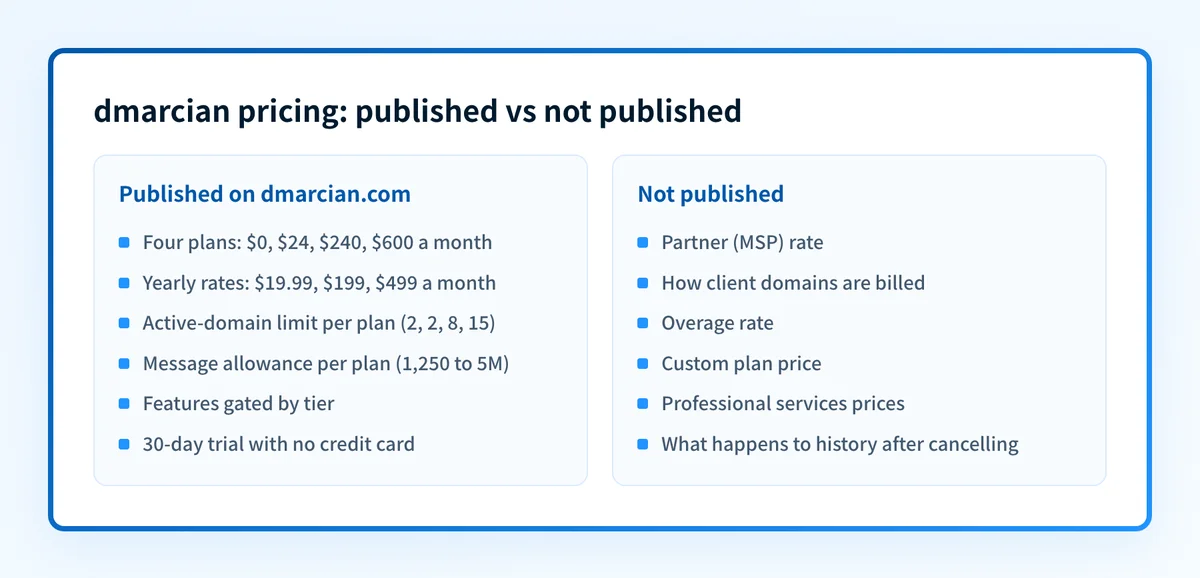
Five things an MSP needs for a margin model are not on dmarcian's public pages:
- The partner rate. "Special partner pricing" has no number, per domain or per account.
- How client domains are billed. The plans are built for one organization. The pricing and partner pages do not say whether an MSP buys one plan for all clients, one per client, or a partner contract with its own meter. dmarcian's changelog mentions Billing and Usage graphs by client group for MSPs, which suggests usage is tracked per client, but no rate is attached to it.
- The overage rate. Message volume past a plan's allowance is custom priced, and the price is not shown.
- How subdomains add up across clients. Each sending subdomain is an active domain, so a client portfolio's real domain count can be well above its count of registered domains.
- The price of professional services. dmarcian's DMARC Services (deployment, support, onboarding and consultation) list no price. Consultation is sold as prepaid blocks of expert time.
Trial, billing and discounts
Paid plans start with a 30-day trial. dmarcian says "We won't ask for credit card details unless you would like a paid subscription." At the end of the trial you choose a plan and monthly or yearly billing on the Billing & Usage page, and its getting started guide says you cannot pick a plan below your current active domains or message volume.
The Personal plan is limited to non-business domains, such as those hosting family photos or hobbies, with a maximum of two active domains sending under 1,250 emails a month. dmarcian's software audits Personal accounts. If one holds a business domain, it expires, and the owner can move to a paid plan without losing data.
Other terms from the pricing FAQ: manual invoicing is available for annual subscriptions only, Plus and Enterprise can be invoiced in euros or Canadian dollars, and there is special pricing for nonprofits, government and education, plus multi-year discounts.
Questions to ask dmarcian's partner team
- What is the partner price per client domain at my current count, and at 2x and 5x that count?
- Is the price per active domain, per message volume, or both, and do sending subdomains count separately?
- What is the overage rate when one client's volume passes its allowance?
- Which plan features do partner accounts get, in particular the Enterprise-only API, Domain Discovery and SSO?
- How much data history is kept for each client, and what happens to it if I cancel?
- Is the contract monthly or annual, and what is the notice period?
How this compares with a published MSP rate
Some DMARC providers publish their MSP rate instead of quoting it. Palisade, for example, publishes a per-client-domain price ladder and includes hosted records and its agent in that price. The dmarcian alternative comparison sets dmarcian's published plans next to Palisade's rates, and the MSP pricing section has the full ladder. If you are already planning a move, the dmarcian migration guide covers running both tools side by side. None of those pages replaces a current dmarcian quote.
Related dmarcian guides
- dmarcian review: what it does and who it fits
- How to migrate from dmarcian without a reporting gap
- dmarcian alternative for MSPs: Palisade compared
- EasyDMARC vs dmarcian compared
- dmarcian DMARC checker: what the public result can tell you
Evidence
Sources and further reading
Questions readers ask
Frequently asked questions
What does each dmarcian plan cost?
dmarcian costs $24 a month on Basic, $240 on Plus and $600 on Enterprise with monthly billing, or $19.99, $199 and $499 a month billed yearly. Basic covers 2 active domains and 100,000 messages a month, Plus 8 and 1,000,000, and Enterprise 15 and 5,000,000. Prices were checked on 15 November 2026 and exclude taxes.
Does dmarcian have a free plan?
Yes, but only for personal use. The Personal plan is $0 for non-business domains, with up to two active domains sending under 1,250 emails a month and one month of history. dmarcian audits these accounts, and one that holds a business domain expires. Businesses get a 30-day trial of a paid plan instead.
Does dmarcian publish MSP pricing?
No. dmarcian's pricing FAQ says it offers special partner pricing and asks partners to get in touch, and its MSP page does not list a price. MSPs get the per-domain or per-account number from dmarcian's partner team.
What counts as an active domain on dmarcian?
An active domain is a domain or subdomain that sends legitimate email. Each sending subdomain counts toward the plan's domain limit. Domains that send no mail, such as parked or defensively registered domains, are inactive, and every plan allows unlimited inactive domains.
What happens if I go over dmarcian's message allowance?
dmarcian's pricing page says its message volumes are default allowances and that custom pricing is available for overages. It does not publish the overage rate, so ask for it in writing before you commit, especially if your volume is seasonal.
Is API access included in dmarcian's price?
Only on Enterprise. dmarcian's plan matrix lists API access, Domain Discovery and single sign-on as Enterprise-only features, while Alert Central, which can send alerts to a webhook, is included from Basic up.

Written by
Johanie DupontBrand & Ecommerce Email
Johanie Dupont works on brand and ecommerce email at Palisade: BIMI and verified marks, sender requirements, and getting marketing mail into the inbox.
More from Johanie →