AI powered email security: what the label actually covers
 ChatGPT
 Claude
 Gemini
 Perplexity
 Grok
GrokIn brief
AI powered email security covers content and behavior models, not domain authentication. See what vendors document, and how to test any AI claim.
AI powered email security is a marketing label, not a product category. Under it sit two documented mechanisms: statistical models that score message content and sender patterns, and learned baselines of who normally emails whom. Both operate on inbound mail, and both sit above authentication rather than replacing it. No model changes what SPF, DKIM, and DMARC cover. Judge any claim by the layer it works in, the data it reads, the action it takes, and who approves that action.
At a glance
Quick takeaways
- The label covers two jobs. Scoring content and sender behavior on inbound mail, and impersonation checks built on learned contact history.
- Authentication is a separate layer. RFC 9989 puts lookalike domains and display name abuse outside DMARC's scope, and Microsoft documents that a lookalike domain with valid records passes SPF, DKIM, and DMARC.
- Deployment mode is not detection method. Gateway or API is a mail flow decision, and vendors document both routes for one product.
- Accuracy comes with a direction, not a number. Microsoft states that raising its phishing threshold increases false positives, and publishes no rate.
- Test a claim by rewriting it. A capability fits in one sentence naming the plan, the inputs, the verdict, and the action. Marketing language does not.
What the term means
Vendors apply the label to statistical models running at different points in mail handling, and the documentation is more specific than the marketing.
Microsoft calls one of these mechanisms implicit email authentication. Its inbound checks add sender reputation, sender history, recipient history, behavioral analysis, and other techniques on top of SPF, DKIM, and DMARC in order to identify forged senders. Microsoft's anti-phishing protection overview lists it among the protections present for every cloud mailbox, names the signal categories, and publishes no model details.
Google describes Gmail's filters as machine learning powered by user feedback, and names the inputs: characteristics of the IP address, domains and subdomains, whether bulk senders are authenticated, and user input. The same Google Workspace post on Gmail's spam filters states that more than 99.9 percent of spam, phishing, and malware never reaches inboxes, with no published methodology or denominator behind it.
Abnormal describes a third shape. Its inbound email security page describes a behavioral baseline for every employee and vendor, scored against signals it says a gateway cannot access: authentication events, calendar activity, and internal threads. It connects by API with no MX changes.
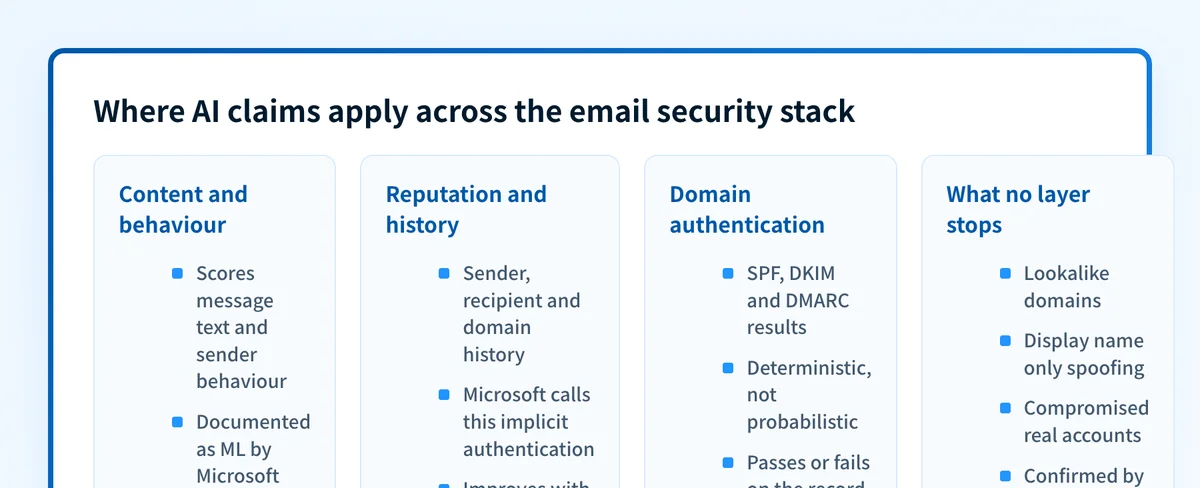
All three share one shape: a model reads signals the protocol layer never looks at, then returns a verdict on one message for one recipient. It aims at the social engineering half of phishing, which authentication was never designed to judge.
What it does and does not do
What it does, in documented terms, is decide about content and sender behavior one recipient at a time.
Mailbox intelligence in Defender for Office 365 is the clearest published example. Microsoft states that it uses artificial intelligence to determine user email patterns with their frequent contacts. The same anti-phishing policies reference documents the failure mode: mailbox intelligence protection does not act when the sender and recipient have exchanged mail before. Two toggles control it, and the second one, which lets it act on impersonation, is off by default.
Deployment mode is a separate axis. Proofpoint documents the same protection through a secure email gateway or through an API integration, and calls the API route the low touch rollout. Where a product sits in mail flow changes your rollback plan, not the quality of its verdicts. Buyers lose that distinction when weighing an API product against a secure email gateway.
What it does not do is change what authentication covers. RFC 9989 section 2.2 states that DMARC can only combat specific forms of exact-domain spoofing directly, and places visually similar domain names (cousin domains) and abuse of the human readable display name outside its scope. Alignment is evaluated against the domain in the From header, exactly in strict mode and at the organizational domain in relaxed mode, so nothing in the DMARC mechanism reads the display name a person sees.
Microsoft states the same boundary from the other side: impersonation can pass SPF, DKIM, and DMARC when the attacker registers a lookalike domain and publishes valid records for it.
So the layers answer different questions. Authentication decides whether a message may claim your domain. Content filtering decides whether this message is trying to defraud this person. An AI claim in one layer is not evidence about the other.
How to evaluate an AI claim
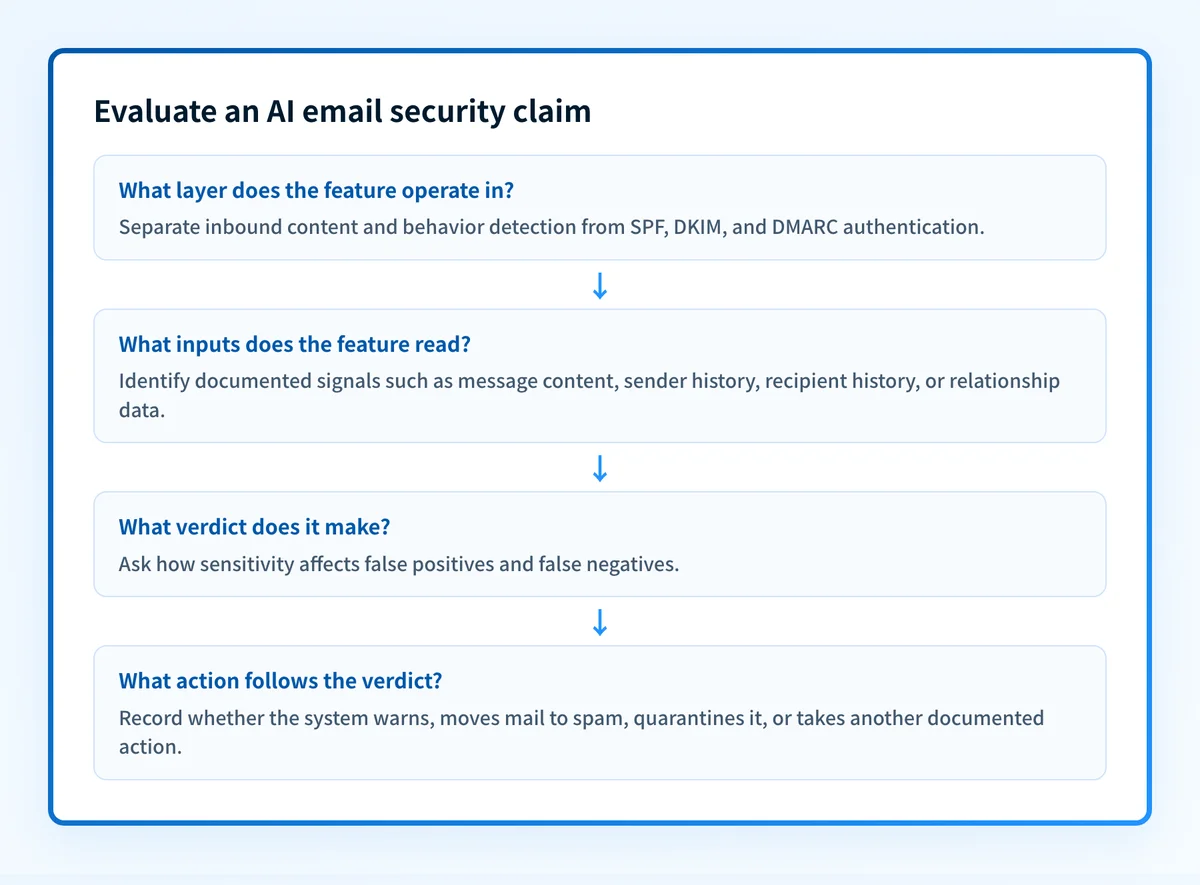
Rewrite the claim as one sentence with four blanks, filled from published documentation rather than a slide:
On plan [name], this feature reads [inputs], decides [verdict], and then [action] without a human.
- Plan. Microsoft's own split shows why this blank comes first. Impersonation settings and phishing email thresholds appear only in the Defender for Office 365 column of its feature comparison, and protection for all cloud mailboxes excludes impersonation protection. Several impersonation features are also unconfigured in the default policy, so an admin has to turn them on.
- Inputs. Named signals beat named intelligence. Proofpoint's Nexus page names separate components with separate jobs: a text model aimed at business email compromise wording, a relationship graph for deviations in normal user communication, computer vision for threats in images and QR codes, a threat intelligence component, and machine learning using supervised and unsupervised methods. Each name is a question you can ask in a demo.
- Verdict. Ask which way the errors go. Microsoft ties its four phishing email thresholds, labelled Standard, Aggressive, More aggressive, and Most aggressive, to the sensitivity of applying machine learning models, and states that the chance of good messages marked as bad rises as you raise the setting. That is a direction, not a rate, and the rate comes from a pilot in your tenant.
- Action. Google's advanced phishing and malware settings show what an operator configures: discrete settings for encrypted attachments, attachments carrying scripts, unusual attachment types, shortened links, similar domain names, employee name spoofing, and unauthenticated mail. Each offers three outcomes: a warning banner, move to spam, or quarantine for review. The page describes no model, which does not prove none runs, but the surface you operate is policy.
NIST's AI Risk Management Framework supplies neutral vocabulary for the governance half. It is voluntary, was released on 26 January 2023 with a generative AI profile added on 26 July 2024, and rests on four functions: Govern, Map, Measure, and Manage. NIST certifies no product, so nothing is compliant with it. Measure gives you a defensible reason to ask how a claim was evaluated, and Manage one to ask who reviews a wrong verdict.
Decision rule
Start from the attack you have, not the label on the box.
- A person is being deceived by a message. Invoice fraud, a cousin domain, a display name copied from your finance lead. The fix belongs in the content layer, so the AI claim matters. Run the four blank rewrite against every shortlisted vendor and get the missing answers in writing before the pilot.
- Other people are receiving mail that claims your domain. The fix is authentication: SPF and DKIM aligned with the From domain, then a DMARC policy telling receivers what to do with the rest. No inbound model changes that, in your tenant or anyone else's.
To measure the authentication half before comparing inbound vendors, run the domain through Palisade's email security score. It reads public DNS and reports what your domain publishes today for SPF, DKIM, and DMARC. It cannot tell you how well an inbound filter performs, and it never sees your mail.
For a provider-specific implementation of these authentication checks, see Barracuda email security.
Evidence
Sources and further reading
- Microsoft, anti-phishing protection in Microsoft 365
- Microsoft, anti-phishing policies
- RFC 9989: scope limits and alignment modes.
- Google Workspace, an overview of Gmail's spam filters
- Google Workspace admin help, advanced phishing and malware protection
- Proofpoint, the Nexus AI platform
- Proofpoint, email protection deployment
- Abnormal, inbound email security
- Mimecast, advanced email security
- NIST, AI Risk Management Framework
- Palisade documentation
Questions readers ask
Frequently asked questions
Does AI powered email security replace DMARC?
No. They work on different layers. DMARC decides whether a message may claim your domain, using SPF and DKIM results aligned against the From domain. An inbound AI product decides whether a message reaching one recipient looks like fraud. RFC 9989 places cousin domains and display name abuse outside DMARC's scope, so each layer leaves work the other has to do.
Is an AI email security product different from a secure email gateway?
Not necessarily, and the label does not settle it. Gateway and API describe where a product sits in mail flow, which is a routing and rollback question. Proofpoint and Mimecast both document the same protection through either route, so ask about the signals and the model independently of the deployment diagram.
Can AI stop lookalike domain attacks?
Only in the content layer, and only for cases its baseline covers. Microsoft's mailbox intelligence learns contact history and can flag a sender who never corresponded with the recipient, but it takes no action once the two parties have exchanged mail. Authentication cannot help here, because the attacker owns the lookalike domain.
What should I ask a vendor about its AI detection?
Ask them to complete one sentence: on this plan, the feature reads these inputs, decides this verdict, and then takes this action without a human. Then ask which plan carries it, whether it is on by default, which way the errors move as sensitivity rises, and who reviews a wrong verdict.
How do I tell a documented capability from a marketing claim?
A documented capability names the mechanism, the signals it reads, and the action it takes, so a pilot can test it. Marketing language pairs an adjective with a technology noun and leaves nothing to test. Most vendor pages carry both registers, so take the named half into your evaluation and treat the rest as a demo question.

Written by
Samuel ChenardCEO & Co-Founder, Palisade
Samuel Chenard is the CEO and co-founder of Palisade, agentic DMARC software for IT teams and MSPs, from one domain to thousands.
More from Samuel →