Why do corporations struggle with DMARC enforcement?
 ChatGPT
 Claude
 Gemini
 Perplexity
 Grok
GrokIn brief
DMARC enforcement stalls when corporations lack verified sender ownership, message evidence, and a safe policy-change process and rollback criteria.
Corporations struggle with DMARC enforcement because a published DNS policy does not identify every legitimate system that sends mail for a domain. Before requesting quarantine or rejection, a team needs evidence that important sending paths pass aligned SPF or DKIM, clear ownership for exceptions, and a controlled way to reverse a harmful change. DMARC aggregate reports help uncover that evidence over time, while a single DNS lookup cannot.
At a glance
Quick takeaways
- DMARC enforcement applies after DMARC evaluation, which requires aligned SPF or DKIM authentication for the visible From domain.
- A
p=rejectrecord is a receiver-handling request, not proof that every receiver will make the same final delivery decision. - Large organizations often separate DNS control from ownership of marketing, support, finance, and acquired-business mail systems.
- A vendor dashboard, public DNS lookup, delivered message, and aggregate report answer different questions.
- A safe policy change needs named owners, message evidence, an exception decision, and a rollback condition.
- Unknown senders should be investigated before a stronger DMARC policy is requested.
Why enforcement becomes an evidence and ownership problem
DMARC lets a domain owner publish a policy for messages that fail DMARC validation. A message can pass DMARC when SPF or DKIM passes and aligns with the domain in the visible From field. The receiving system then applies its own handling decision while considering the domain owner's requested policy.
That protocol sequence explains why record publication is only one part of enforcement. DNS can show that a domain publishes p=none, p=quarantine, or p=reject. It cannot show whether every production application uses an aligned identifier, whether a provider is using the intended configuration, or whether a business-critical sender is still unknown.
Corporations commonly have several teams and providers sending mail under related domains. The DNS administrator may control the DMARC record, while another team owns an invoice system, a marketing platform, a support platform, or a recently acquired business application. This is an operating problem, not a protocol defect.
A delivered message provides a more specific evidence layer. RFC 8601 defines the Authentication-Results header field, which can report the authentication evaluation associated with a message. Inspecting that header from the actual production path helps a team distinguish a configured domain from a message that authenticated as intended.
Mailbox-provider requirements increase the cost of leaving this work unresolved. For example, Google's sender guidelines require bulk senders to Gmail to authenticate email and publish a DMARC record, with enforcement expectations for applicable senders. Those requirements do not inventory a corporation's senders or resolve its ownership gaps.
For the protocol context behind the policy, start with the DMARC learning hub. This page addresses the organizational question that follows: when is the evidence strong enough to request stricter handling?
When the answer changes
A corporation can move closer to enforcement when each important sending path has a known purpose, accountable owner, and evidence from the real production configuration. It should pause when a material sender remains unknown or cannot be tested safely.
Use this Palisade-authored readiness framework:
- Proceed when the approved sender inventory matches the material sources found in DMARC aggregate-report data, each exception has an owner, and important paths have current message evidence.
- Investigate when aggregate reports identify a source absent from the inventory, or when a provider says a domain is configured but a production message does not show the expected authentication result.
- Pause a policy increase when a business-critical sender lacks an owner, a team cannot produce a same-path test message, or the rollback decision has not been approved.
- Scope the change to the evidence available. A result for one domain or subdomain does not automatically establish readiness for another.
- DNS: Query the authoritative DNS service and at least one public resolver to confirm the intended policy is published.
- Vendor: Confirm the sender's current domain-authentication status in the provider's documented interface.
- Message: Send and inspect a real message through the exact production path, including its raw headers or Authentication-Results data.
- DMARC: Review aggregate reports after data accumulates, then reconcile the sources with the approved inventory.
A worked DMARC enforcement readiness record
Use one review record for each domain before proposing a stronger policy. This is an internal operating checklist, not a DNS record and not evidence that a domain is ready by itself.
Domain: yourdomain.com
Current policy: Record the current DMARC TXT value and lookup time
DNS owner: Team authorized to approve DNS changes
Known senders: Production applications and providers using this domain
Message evidence: Redacted delivered-message headers for each important path
DMARC evidence: Aggregate-report sources reconciled to the sender inventory
Open exceptions: Business purpose, accountable owner, and review date
Rollback: Prior approved record and the condition for restoring it
Decision: Proceed, pause, or remediate before the next policy stage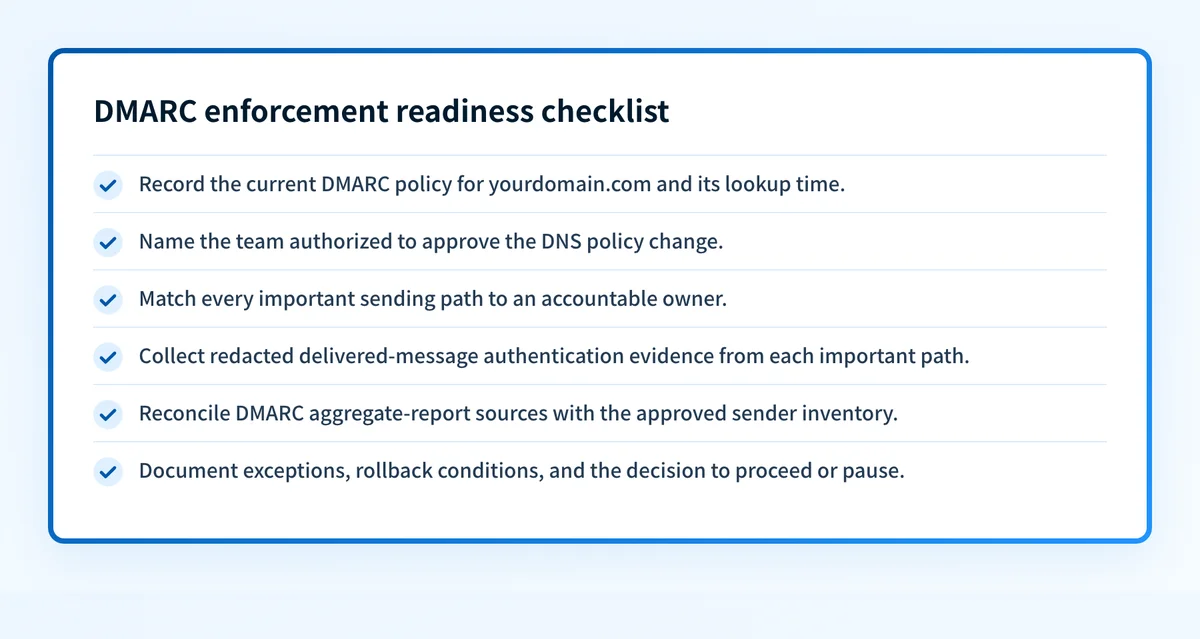
The key decision is whether the team understands the consequences of a failure. RFC 9989's DMARC policy model does not make p=reject a declaration that all mail is safe. It requests handling for messages that fail DMARC under the applicable policy. If a legitimate source is still failing, stronger enforcement can affect that source's mail.
Do not increase a DMARC policy because a public record lookup looks correct. The lookup does not identify every production sender or prove how a receiving mailbox provider will handle a future message.
What to do next with the evidence you have
If you only have a domain name, inspect the currently published policy with the DMARC checker. Compare the result and lookup time with the approved DNS change record. This can reveal a mismatch between the intended policy and the public record.
If you have access to a sending platform, ask its owner for the provider's current authentication status and a test message sent through the same production configuration. Inspect the delivered message headers before treating the vendor status as completion.
If you have DMARC aggregate-report data, reconcile each source with the approved sender inventory. Assign an owner to unmatched sources. The source may be a legitimate system that needs alignment work, a system that should use another domain, or unauthorized use that requires an internal response. Aggregate data makes the source visible. It does not make the business decision for the team.
If the inventory, ownership, and evidence are in place, use How can you simplify the journey to DMARC enforcement? to organize a staged policy proposal and validation plan.
Inspect the policy before assigning ownership gaps
Check the public DMARC record first, then use that result as a shared artifact when the DNS owner and sending-system owners review the gaps.
A public-record check cannot identify every production sender, repair authentication alignment, monitor later DNS changes, or prove a receiver's handling of an individual message. For ongoing evidence across domains and sending sources, Palisade is agentic DMARC software that analyzes DMARC aggregate-report data, identifies sending sources and authentication or alignment issues, creates prioritized remediation tickets, and proposes the next policy step for human review. It does not autonomously apply a DMARC policy change.
Evidence
Sources and further reading
Questions readers ask
Frequently asked questions
Does publishing p=none mean a corporation is ready for DMARC enforcement?
No. p=none publishes a valid DMARC policy with no requested handling preference for failures. It does not prove that legitimate sending sources are known, aligned, or ready for a stronger policy.
Can a corporation move directly to p=reject?
Only when the organization has evidence for the sending paths within the proposed scope and an approved way to respond if a legitimate source fails. RFC 9989 defines p=reject as a requested receiver policy after DMARC failure, so the receiving system still makes the final handling decision.
Are DMARC aggregate reports enough to approve enforcement?
No. Aggregate reports can help identify patterns and sending sources, but they should be reconciled with sender ownership and message-level evidence from important production paths. A report does not replace a real delivered-message check.
Does a passing DMARC check prove that all email will reach the inbox?
No. A public DMARC check can show the published DNS record. It cannot prove every sender's configuration, a receiver's private filtering decision, or future inbox placement.
Who should own a DMARC enforcement change?
The DNS owner should control the approved record change, but each material sending path also needs an accountable application or business owner. The change decision should name the parties responsible for evidence, exceptions, and rollback.

Written by
Samuel ChenardCEO & Co-Founder, Palisade
Samuel Chenard is the CEO and co-founder of Palisade, agentic DMARC software for IT teams and MSPs, from one domain to thousands.
More from Samuel →