Proofpoint competitors: who else serves the same job
 ChatGPT
 Claude
 Gemini
 Perplexity
 Grok
GrokIn brief
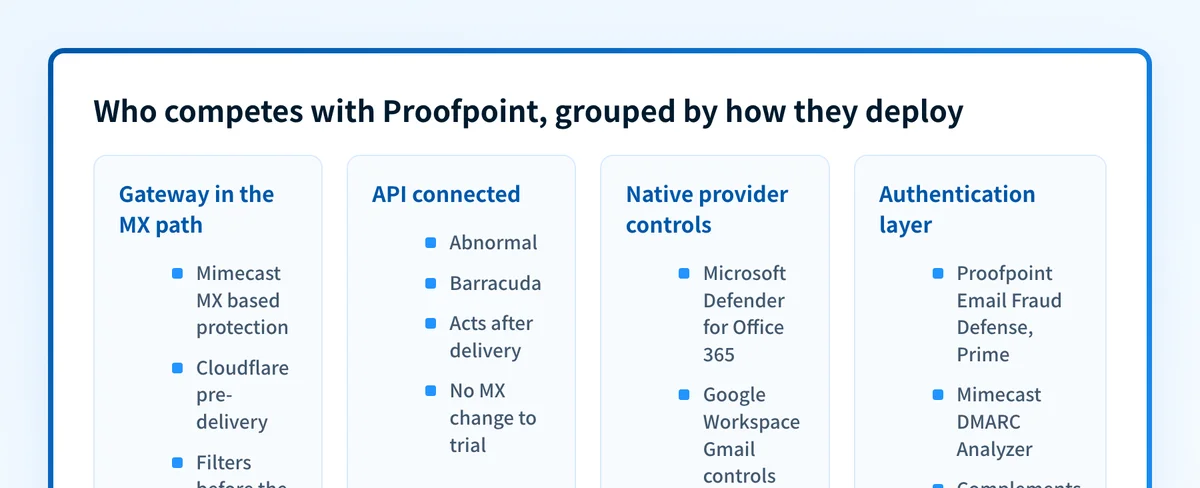
Proofpoint competitors grouped by deployment model: MX gateways, API-connected tools, native Microsoft and Google controls, and the DMARC layer.
Proofpoint's competitors sort by where they sit in the mail path rather than by feature list. Mimecast and Cloudflare document an MX-routed gateway, the placement Proofpoint also supports. Abnormal, Barracuda, Mimecast and Cloudflare all document an API connection that leaves MX records alone. Microsoft and Google run controls inside the platform you already pay for. Authentication products, including Proofpoint's own Email Fraud Defense, work in DNS and sit beside a filter instead of replacing one.
At a glance
Quick takeaways
- Deployment model decides what genuinely replaces Proofpoint. A gateway swap changes mail routing. An API connection does not.
- Microsoft is the only rival here with a published per-user price: Defender for Office 365 Plan 1 at $2.00 and Plan 2 at $5.00 per user per month, paid yearly.
- Proofpoint's own list pricing covers Essentials only, in two data sheets stamped 10/21 and 5/22 whose figures disagree.
- Mimecast, Barracuda, Abnormal and Cloudflare publish no price, so shortlists get built on scope rather than cost.
- DMARC is a separate purchase in Proofpoint's catalog, sold as Email Fraud Defense and packaged in the top Prime tier.
- Every vendor fact below was read from a first-party page on 12 August 2026.
Who this comparison is for
An IT admin, security lead or MSP technician holding a Proofpoint quote or renewal who wants to know which products do the same job. It assumes mail runs on Microsoft 365 or Google Workspace. If the category itself is still fuzzy, the four types of email security software sets out the map first. Head-to-head vendor pages sit on the comparison hub.
How the options were evaluated
Each product was read on its own vendor pages on 12 August 2026. Review sites and reseller catalogs were excluded. Four things were recorded:
- Deployment model. MX-routed gateway, API connection, post-delivery inspection, or a choice among them.
- Replacement or addition. Whether the product takes over the placement Proofpoint occupies, or sits beside it.
- Published price. Whether a figure appears on the vendor's own page.
- Where DMARC sits. Whether domain authentication is included, sold separately, or absent.
What counts as the same job
Proofpoint sells one filtering product with two placements. Its Core Email Protection page lists "Flexible Deployment via API or SEG" and names phishing, business email compromise, ransomware and account takeover. Its buying page packages that into Core, Tier 2, Tier 3 and Prime, adding account takeover protection, then threat-guided training, then impersonation protection with hosted DMARC, DKIM and SPF services. A rival replaces Proofpoint only if it covers the package you were quoted.
Source: Palisade.
Source: Palisade.
Gateways in the MX path
Mimecast's integrated cloud email security page describes MX-based deployment as perimeter protection, with all incoming mail routed through its gateway first and threats blocked in line. Cloudflare's Email Security documentation lists pre-delivery placement through MX or inline as one of three supported approaches, covering phishing, malware, business email compromise, vendor email fraud and spam.
These are the options that take Proofpoint's place in the delivery path. The swap is a routing change, so it brings a cutover window and a period where both vendors' policies apply; check your current MX records before you scope one. If your requirements say mail must be inspected before delivery, this group satisfies them.
Tools connected by API
Abnormal's inbound email security page states "Deploy in 60 seconds via API. No MX changes." and describes the product as built for attacks with no payload and no prior signature. Its platform page lists native API integrations with Microsoft 365, Google Workspace, Okta, CrowdStrike and Splunk, with no agents or proxies.
Barracuda's Email Protection page states the product connects to Microsoft 365 or Google Workspace with no mail exchange (MX) changes and is operational in minutes rather than weeks. Its threat list spans phishing, malware, spam, account takeover, domain fraud with DMARC and post-delivery weaponization.
Mimecast and Cloudflare sell this model too: Mimecast as protection layered into the cloud email platform with no MX record changes and no mail flow disruption, Cloudflare as post-delivery deployment through BCC and journaling. All of them read messages that have already arrived, so the question is what each can do with a message already in a mailbox, and how fast.
Native controls you may already own
Microsoft documents anti-malware, anti-spam and anti-phishing protection as included in all organizations with cloud mailboxes and on by default through the default threat policies. An administrator cannot switch them off, though preset or custom policies can override them, so measure any quote against that baseline. Defender for Office 365 then splits in two: Plan 1 adds Safe Attachments, Safe Links, impersonation protection and real-time detections, Plan 2 adds phishing simulations, post-breach investigation, hunting and automation. Microsoft's pricing page lists Plan 1 at $2.00 and Plan 2 at $5.00 per user per month, both paid yearly.
Google Workspace carries Gmail filtering in the seat price. Every published tier lists phishing and spam protection that blocks more than 99.9% of attacks, which is Google's own figure, while data loss prevention and S/MIME sit under Enterprise. Advanced phishing and malware protection is a set of administrator settings, and for each one the administrator chooses whether a suspicious message arrives with a warning banner, moves to spam, or is held in admin quarantine.
The authentication layer beside the filter
Nothing in this last group filters inbound mail. It governs which senders may use your domain, which is what stops mail sent to other people in your name.
Proofpoint sells this work separately. Email Fraud Defense is its own product, offering hosted SPF, hosted DKIM and hosted DMARC records with dedicated consultants who guide the buyer through each step of the rollout, and those hosted services appear only in Prime. Mimecast's DMARC Analyzer is likewise its own product, built around aggregate, forensic and TLS reports, self-service tools and a recommendation engine; it makes no claim to publish or change a customer's DNS records. Barracuda names domain fraud with DMARC inside its threat list.
A vendor that sells both a filter and a DMARC product is first-party evidence that the two are different purchases. If Proofpoint's DMARC path is what you are pricing, the Proofpoint DMARC alternative comparison covers Email Fraud Defense on its own terms.
What each vendor publishes about price
Proofpoint publishes list prices for the Essentials line only. A US data sheet stamped 10/21 quotes Business at $2.75, Advanced at $3.75 and Professional at $5.33 per active user per month. An EMEA sheet stamped 5/22 adds a Beginner package and shows different USD figures. Both are dated records, not a rate card. For Core, Tier 2, Tier 3 and Prime, Proofpoint states only that budgetary pricing comes from the number of user licences and the contract term, with exceptions that depend on consumption.
Mimecast's plans page names Critical, Advanced and Premium for threat protection and replaces every figure with contact-for-pricing wording. It adds that from 15 August 2025 new customers buy the new email security plans, and that migrating can carry an additional cost. Barracuda's plans page names Advanced, Premium and Premium Plus with a feature comparison and no figure. Abnormal and Cloudflare publish none. Quote-only pricing is normal here and says nothing about cost.
Where Palisade fits
Palisade belongs in the last group and nowhere else. It is DMARC automation, not a gateway: it does not filter, sandbox, rewrite links in or quarantine inbound mail, so it replaces nothing above. Its documentation covers DMARC, SPF, DKIM, BIMI and MTA-STS, hosted records, aggregate report processing, sender classification and PSA ticketing. Hosted DMARC publishes and maintains the record through a CNAME delegation, so a later policy move needs no further DNS edit. The agent investigates every sender, drafts every fix and proposes each policy step, and you approve before anything ships. If Prime is on your quote for its hosted DMARC services, this is the layer to compare it against.
How to choose
- You are replacing a placement, not a product. Only an MX-routed option takes Proofpoint's spot in the delivery path. Mimecast and Cloudflare each document one.
- You cannot touch mail routing. Abnormal, Barracuda, Cloudflare and Mimecast all document a connection that leaves MX records untouched.
- You have not configured what you already pay for. Microsoft's default policies are on and cannot be turned off, so establish that baseline before buying a layer above it.
- Prime is on the quote because of DMARC. That is a separate market, and Mimecast, Barracuda and Palisade sell into it without a gateway attached.
- You do not yet know which layer is failing. Run the domain through the free email security score before shortlisting anyone.
Evidence
Sources and further reading
Every page below was read on 12 August 2026.
- Proofpoint Core Email Protection, the collaboration security buying page and Email Fraud Defense.
- Proofpoint's US Essentials price list and EMEA Essentials price list.
- Mimecast integrated cloud email security, Mimecast plans and Mimecast DMARC Analyzer.
- Barracuda Email Protection and its plans page.
- Abnormal inbound email security and the Abnormal platform page.
- Microsoft Defender for Office 365 overview, built-in protection for cloud mailboxes and Defender for Office 365 plans and pricing.
- Cloudflare Email Security documentation.
- Google Workspace pricing and advanced phishing and malware protection.
- Palisade documentation and hosted DMARC.
Questions readers ask
Frequently asked questions
Who are Proofpoint's main competitors?
Mimecast, Barracuda, Abnormal Security and Cloudflare Email Security compete for the same filtering budget, and the native controls in Microsoft 365 and Google Workspace compete by already being included. On the authentication side, where Proofpoint sells Email Fraud Defense, the rivals are Mimecast DMARC Analyzer and the DMARC platforms.
Can Abnormal or Barracuda replace a Proofpoint gateway?
Only in part. Both connect by API and leave MX records alone, so they take over detection without taking Proofpoint's place in the delivery path. Abnormal states its own position that Abnormal with Microsoft or Google replaces a gateway, which is positioning rather than a tested result.
Is Microsoft Defender for Office 365 enough on its own?
Not automatically, and answering it needs your own data. Microsoft documents anti-malware, anti-spam and anti-phishing filtering as on by default for every organization with cloud mailboxes. Configure those policies, add Plan 1 or Plan 2, then measure what still arrives.
Which Proofpoint competitors publish their prices?
Microsoft publishes per-user list prices for Defender for Office 365, and Google publishes per-seat Workspace prices, though currency and promotional rates vary by region. Mimecast, Barracuda, Abnormal and Cloudflare publish none, and Proofpoint publishes list prices only for Essentials.
Does switching away from Proofpoint fix domain spoofing?
No. Inbound filtering protects the mailboxes you own. Mail an attacker sends to other people using your domain never passes through your filter. Stopping that is the authentication layer: SPF, DKIM and DMARC alignment published in your DNS. It stays a separate purchase after any gateway swap.

Written by
Taylor TabusaCo-Founder & Head of Business Development, Palisade
Taylor Tabusa is the co-founder and Head of Business Development at Palisade, helping managed service providers turn email security into a practical, valuable service.
More from Taylor →