PowerDMARC review: fit, evidence gaps, and next steps
 ChatGPT
 Claude
 Gemini
 Perplexity
 Grok
GrokIn brief
PowerDMARC review for IT teams and MSPs: verified workflows, multi-tenant claims, evidence gaps, and a practical vendor decision rule today.

Choose PowerDMARC if a vendor-described multi-tenant, white-label DMARC service and hosted authentication controls are central to your requirements. Choose Palisade only after you validate its workflow against the same operational evidence. The available PowerDMARC evidence confirms its stated product scope, but it does not establish pricing, plan access, interface behavior, support terms, or comparative outcomes.
At a glance
Quick takeaways
- PowerDMARC describes a four-stage process that starts with DMARC setup, analyzes mail over "1-2 weeks," then moves to
p=quarantine/reject. - PowerDMARC says it provides DMARC aggregate and forensic reporting, header analysis, reputation analysis, DNS history, and Auto DNS Publishing.
- PowerDMARC says its partner offering is a "multi-tenant platform" with white-label resale and billing-system connection options.
- The supplied evidence does not verify PowerDMARC pricing, plan limits, contract terms, API access, integrations, or current dashboard paths.
- A published DMARC record is useful buying evidence, but it does not prove how every production sender authenticates.
- A vendor evaluation should separate public DNS evidence from reporting, remediation, approval, and operational workflow evidence.
Who this comparison is for
This review is for an IT team or MSP evaluating PowerDMARC as a possible DMARC-management provider. You may be deciding whether the vendor's documented reporting workflow, hosted authentication services, partner model, or language support match the way you operate.
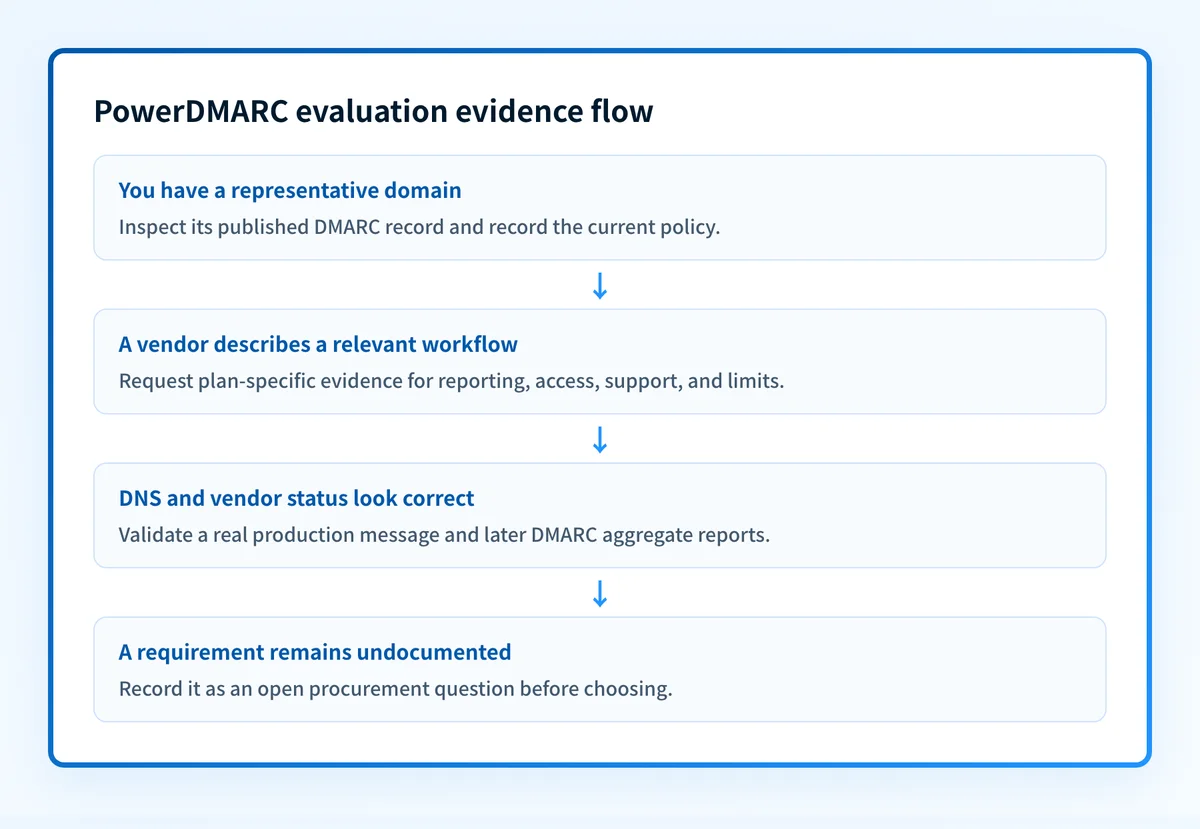
It is also for buyers who need to avoid turning a vendor homepage into a complete procurement decision. A product page can establish that a vendor describes a capability. It cannot establish that the capability is included in your intended plan, works in your environment, meets a service requirement, or produces a particular outcome.
For a broader vendor-shortlisting framework, use the Palisade comparison hub. Keep the evaluation focused on the evidence your team needs to approve a platform, rather than on a general impression of its feature list.
How the options were evaluated
The criteria below were fixed before drawing a recommendation and checked against the supplied first-party PowerDMARC product evidence on July 30, 2026.
- Workflow fit: Whether the documented process matches your DMARC rollout and reporting needs.
- MSP fit: Whether the vendor describes multi-tenant, resale, branding, and billing-related capabilities.
- Authentication scope: Whether the vendor describes adjacent SPF, DKIM, MTA-STS, TLS-RPT, BIMI, or email-service-provider controls.
- Evidence completeness: Whether current documentation establishes pricing, plan inclusion, interface behavior, support, API access, and operational limits.
- Verification path: Whether a buyer can test public DNS claims and then validate production mail, vendor status, and DMARC reports separately.
A DMARC rollout also needs separate evidence at each layer. Check DNS through an authoritative answer and a public resolver. Check the vendor's current status. Send real production mail and inspect its headers. Then use aggregate reports after they accumulate. A green status indicator and a DNS lookup answer do not prove the exact production sending path is aligned.
PowerDMARC
PowerDMARC presents a staged DMARC workflow. Its homepage says customers configure an analyzer and publish a DMARC record, analyze mail over "1-2 weeks," move to p=quarantine/reject, then operate with an enforced policy. That is a recognizable DMARC rollout sequence, but the supplied page does not document how the workflow appears in the current product interface or which plan includes each part.
PowerDMARC also says its offering includes DMARC aggregate and forensic reporting, email-header analysis, domain-reputation analysis, a live threat map, DNS timeline, security-score history, and Auto DNS Publishing. These are PowerDMARC's stated product capabilities, checked July 30, 2026. Treat them as a shortlist signal, then ask the vendor to demonstrate the specific workflows your operators need.
- Best fit: Buyers who specifically need a vendor-described DMARC platform with reporting and adjacent authentication services, especially MSPs evaluating a white-label, multi-tenant operating model.
- Relevant evidence: PowerDMARC says its partner offering is a "multi-tenant platform" with white-label resale, plan customization, billing-system connection, and personalized branding. It also says the control panel supports "11 languages including Japanese, French, German, Italian, Dutch, and more." These are vendor statements, checked July 30, 2026, on the PowerDMARC homepage.
- Tradeoff: Pricing, domain and user limits, retention, support terms, reseller terms, regional availability, API details, integrations, and current interface paths remain unverified in the supplied evidence.
Do not replace an existing SPF record or change a DMARC policy during a vendor evaluation without confirming every authorized sender. A record that looks valid in DNS can still break mail when a production service is omitted or misaligned.
The PowerDMARC homepage also advertises a "15-day trial." Trial eligibility, renewal terms, card requirements, feature access, and plan restrictions were not verified. Confirm those details directly with the vendor before treating the trial as a buying criterion.
Palisade
Palisade should be evaluated under the same criteria, but the supplied evidence does not include Palisade pricing, product documentation, authenticated interface evidence, support terms, integrations, reporting details, MSP workflow evidence, or outcome data. No claim about comparative capability, automation, or fit can be established from this evidence set.
- Best fit: A buyer who has validated Palisade's current workflow against the same requirements used for PowerDMARC.
- Relevant evidence: The first useful comparison input is the domain's published DMARC record. The Palisade DMARC checker can inspect public DMARC DNS evidence for a domain.
- Tradeoff: A public DMARC check does not show all production sending sources, prove message alignment, monitor future changes, or establish what either managed platform includes in a selected plan.
p=none, p=quarantine, or p=reject, but it does not reveal the complete reporting workflow, delegated access model, remediation process, or contract boundary that your team needs.
For adjacent context on reporting-focused vendor selection, see DMARC reporting service: EasyDMARC vs PowerDMARC. If your comparison also includes another traditional DMARC platform, the dmarcian review covers a separate vendor evaluation path.
How to choose
Choose PowerDMARC when your decision depends on its vendor-described multi-tenant, white-label partner model or its stated hosted authentication controls, and the vendor can verify the plan, workflow, support, and contractual details your organization requires.
Keep Palisade in the evaluation when you want to compare it against the same evidence record. Do not choose either option until you can answer the open questions with current first-party documentation, a scoped demonstration, or a trial using a representative domain.
Use this scorecard for each vendor discussion:
option: PowerDMARC
checked_on: 2026-07-30
best_fit: "MSP or IT team assessing vendor-described multi-tenant DMARC and hosted authentication services"
verified_evidence:
  - "Vendor describes a staged DMARC workflow with analysis over 1-2 weeks"
  - "Vendor describes reporting, header analysis, DNS timeline, and Auto DNS Publishing"
  - "Vendor describes a multi-tenant, white-label partner offering"
open_question:
  - "Which plan includes the required capabilities, limits, support, retention, integrations, and reseller terms?"
option: Palisade
checked_on: 2026-07-30
best_fit: "Buyer who can validate Palisade against the same operational requirements"
verified_evidence:
  - "A public DMARC record can be inspected with the Palisade DMARC checker"
open_question:
  - "Current workflow, pricing, reporting, support, integrations, and MSP operating model were not evidenced for this review"
Before comparing demos, record the public DMARC baseline for one representative domain:
Host: _dmarc.yourdomain.com
Record shape: v=DMARC1; p=none; rua=mailto:dmarc-reports@yourdomain.com
Purpose: Illustrative only. Use the record published for your own domain.
Then ask each vendor to show how it handles the same scenario:
- Which sending sources appear after DMARC aggregate reports accumulate?
- Which authentication or alignment issue becomes an actionable task?
- Which user can review evidence and approve a DNS or policy change?
- Which plan includes the reporting, delegation, retention, and support level you need?
- Which evidence proves a production message from your exact sending path passes DMARC?
Check the DMARC record before comparing platform workflows
Start with the public record behind the vendor evaluation. Use the DMARC checker to inspect the domain's currently published DMARC policy, then compare that output with a real message header and the platform's reporting view.
A public record check cannot prove which production sources still fail alignment, repair a sender configuration, monitor later DNS drift, or establish what PowerDMARC or Palisade will include in a plan. Start with Palisade when you want to evaluate its product workflow after collecting that domain-level baseline: Start with Palisade.
Evidence
Sources and further reading
Questions readers ask
Frequently asked questions
Is PowerDMARC a good fit for MSPs?
Only if its vendor-described partner model matches the MSP's commercial and operational requirements. PowerDMARC says its partner offering is a "multi-tenant platform" with white-label resale, plan customization, billing-system connection, and personalized branding. Confirm current reseller terms, limits, support, and plan access before choosing it.
Does PowerDMARC offer DMARC reporting?
Yes. PowerDMARC says its offering includes DMARC aggregate and forensic reporting. The supplied evidence does not verify reporting retention, export options, alert configuration, plan inclusion, or the current reporting interface.
Does PowerDMARC support SPF, DKIM, BIMI, and MTA-STS?
Yes, PowerDMARC advertises hosted SPF, DKIM, MTA-STS, TLS-RPT, BIMI, and email-service-provider compliance capabilities. Verify which controls are available on the intended plan and whether the resulting DNS design fits your existing senders before making changes.
Does a published DMARC record prove a platform will work?
No. A public DNS result proves only what the resolver can retrieve at that time. Validate the vendor's status, inspect headers from real production mail, and review DMARC aggregate-report data after it accumulates.
Can a free DMARC checker replace a DMARC platform trial?
No. A checker can inspect a domain's public DMARC record, which is useful baseline evidence. It cannot prove platform workflow, reporting access, retention, support, integrations, future monitoring, or how the platform handles your sending sources.
Does PowerDMARC's advertised 15-day trial settle its pricing or plan fit?
No. The homepage advertises a "15-day trial," but the supplied evidence does not verify eligibility, feature access, renewal terms, card requirements, pricing, or plan limits. Confirm those details with PowerDMARC before relying on the trial for procurement.

Written by
Johanie DupontBrand & Ecommerce Email
Johanie Dupont works on brand and ecommerce email at Palisade: BIMI and verified marks, sender requirements, and getting marketing mail into the inbox.
More from Johanie →