How can AI and zero trust improve email security?
 ChatGPT
 Claude
 Gemini
 Perplexity
 Grok
GrokIn brief
Email security isn’t what it used to be. Today’s cybercriminals wield AI to craft phishing emails that can fool even senior executives.
How can you layer AI and zero-trust for better enterprise email security?
Email security isn’t what it used to be. Today’s cybercriminals wield AI to craft phishing emails that can fool even senior executives. For enterprises with sprawling multi-cloud environments, legacy MTAs, and dozens of SaaS platforms, the attack surface is massive.
Quick Takeaways
- Exceeding the SPF 10-lookup limit silently breaks authentication and opens exact-domain spoofing.
- Zero-trust DMARC enforcement provides a single source of truth for every sender and vendor.
- Behavioral AI only reaches its full potential when layered after airtight domain authentication.
- Automated sender discovery and disciplined SPF record management are mandatory for modern stacks.
- Continuous monitoring and response workflows turn alerts into actionable intelligence.
- Industry-specific nuances (finance, healthcare, manufacturing, government) demand tailored policies.
- Use Palisade’s free email-security score tool 👉 https://www.palisade.email/tools/email-security-score.
The limitations of single-point email security solutions
Most enterprises treat email security like a game of whack-a-mole: they spot a problem, deploy a solution, and assume they’re covered. This creates a patchwork of tools that work in isolation, each protecting against specific threats while leaving blind spots.
Secure email gateways (SEGs) excel at scanning attachments and blocking known malicious domains, but they struggle with perfectly clean, socially engineered messages. Likewise, traditional antivirus solutions miss phishing attacks that contain no malware at all.
Complex environments (multiple SEGs, cloud email security supplements, and legacy sub-domains) widen the gaps. A false sense of security can develop when a single platform appears to block thousands of threats daily, yet the most dangerous, credential-stealing attacks slip through.
The modern email threat landscape
AI-powered phishing campaigns now mimic the writing style of CEOs, vendors, and HR departments. Business Email Compromise (BEC) attacks involve extensive reconnaissance, making them look authentic. Exact-domain spoofing (where attackers forge the “From” field to appear as a trusted brand) is on the rise, especially against organizations with weak or missing DMARC policies.
Supply-chain attacks compromise smaller vendors to reach larger targets. Industries face unique challenges, from PCI DSS requirements in finance to HIPAA in healthcare.
Industry-specific considerations
- Financial services: PCI DSS 4.0 pushes toward enforcement, yet many finance domains still sit at
p=none, a reporting-only policy that blocks nothing. Moving to enforcement is the priority. - Healthcare: patient-privacy rules make strict email authentication a baseline expectation, and health systems are frequent impersonation targets.
- Manufacturing: supply-chain espionage and vendor-invoice fraud are top threats, so authenticating every legitimate sender matters as much as blocking spoofers.
- Government: frameworks such as FedRAMP expect enforceable DMARC for cloud services, and public-sector domains are among the most heavily spoofed.
How to build your enterprise email security stack
1. Establish zero-trust authentication
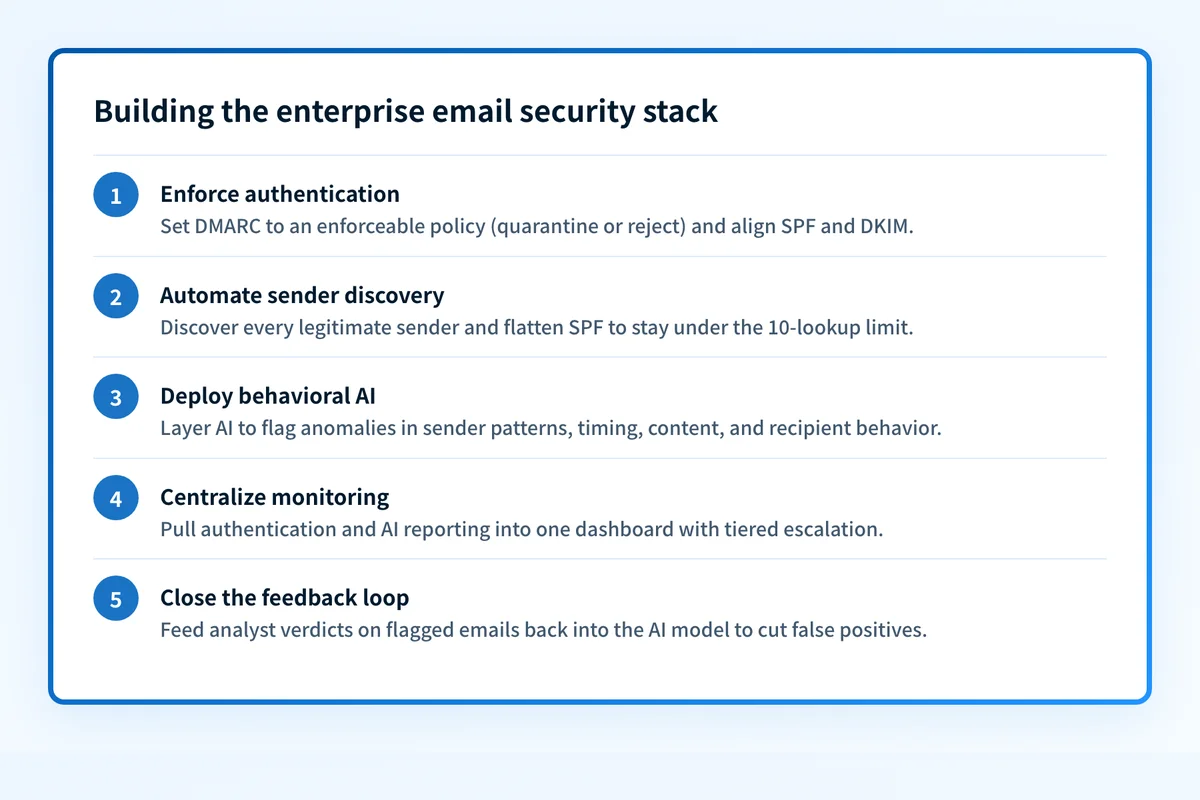 Authentication comes first; AI detection and monitoring layer on top.
Start with robust email authentication: implement DMARC with an enforceable policy ("quarantine" or "reject"), align SPF and DKIM, and continuously monitor for misconfigurations. Remember, a DMARC record set to p=none is merely a compliance checkbox, it won’t protect you.
Automated sender discovery is essential. Palisade's agent investigates every sender in your DMARC reports, drafts the SPF and DKIM fixes, and keeps records within the SPF 10-lookup limit as your senders change, you approve each change before it ships.
Curious about your domain’s current posture? Use Palisade’s free domain checker to get a baseline.
👉 Check your email security score
2. Deploy behavioral AI detection
Once authentication is locked down, layer behavioral AI to catch threats that slip past technical checks. AI analyzes sender patterns, email timing, content structures, and recipient behavior to flag anomalies, like a CEO-type email sent at 3 AM requesting an urgent wire transfer.
Choose AI solutions that provide clear explanations for their decisions, integrate with your existing security stack, and continuously learn from new attack patterns.
3. Create monitoring and response workflows
Centralize reporting from both authentication and AI layers into a single dashboard. Define escalation procedures for different threat tiers, automate quarantine for clear-cut spoofing, and keep humans in the loop for nuanced cases.
Build feedback loops: when analysts mark a flagged email as legitimate, feed that data back into the AI model to reduce future false positives.
Future-proof your business against email threats
The combination of zero-trust authentication and behavioral AI creates a defense greater than the sum of its parts. Start with DMARC enforcement, then augment with AI-driven anomaly detection, continuous monitoring, and automated response.
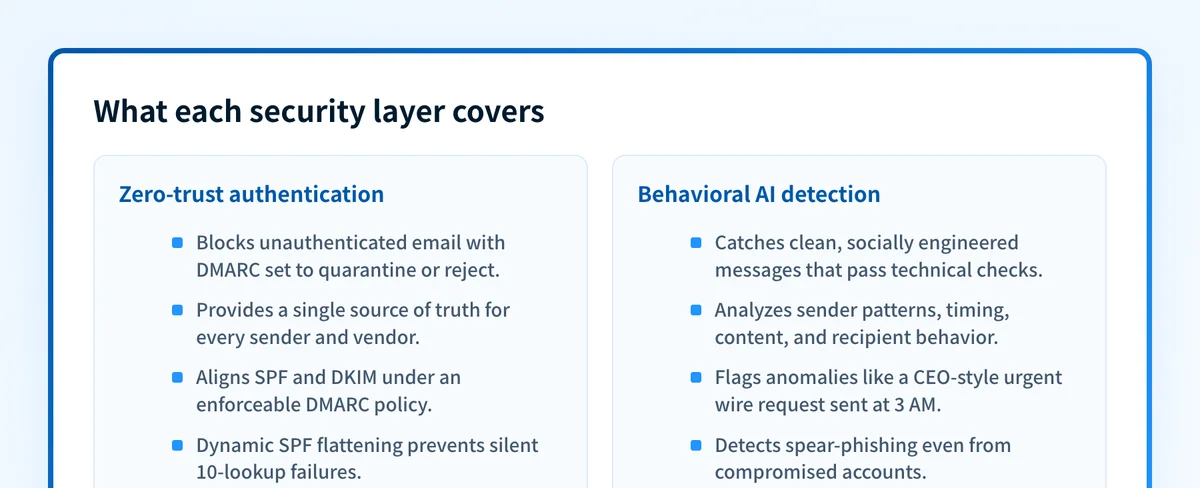 Behavioral AI reaches full potential only when layered after airtight authentication.
Palisade's agent investigates every sender, drafts every fix, and proposes each policy step toward enforcement, and you approve before anything ships. Layered with behavioral AI, that gives enterprises airtight authentication first and anomaly detection on top.
Ready to strengthen your email security stack? Book a demo or get started with a free domain.
Common issues when layering AI and zero-trust
Behavioral AI floods analysts with false positives
If AI anomaly detection fires on legitimate mail, the usual cause is that authentication was not locked down first. Get DMARC to enforcement so the AI layer is scoring already-authenticated senders, not chasing spoofed noise, and feed every analyst "legitimate" verdict back into the model.
SPF passes in testing but breaks in production
A domain that has quietly grown past the 10-lookup limit throws a permerror, and many receivers treat that as an SPF failure. Audit the full include chain, remove senders you no longer use, and re-check with the SPF tool after every vendor change.
DMARC is at p=none and nothing is being blocked
p=none is monitoring only: it reports but never quarantines or rejects. Once your aggregate reports show legitimate senders aligned, move to p=quarantine and then p=reject. Skipping this step leaves exact-domain spoofing wide open.
A newly onboarded SaaS platform starts failing authentication
New marketing, HR, or ticketing tools often send as your domain without SPF or DKIM configured. Run automated sender discovery after each integration, then publish the vendor's authentication records before its mail reaches customers.
Related reading
Questions readers ask
Frequently asked questions
What is the difference between DMARC enforcement and DMARC monitoring?
Enforcement (p=quarantine or p=reject) actively blocks or diverts unauthenticated email, while monitoring (p=none) only reports failures without preventing delivery. Monitoring is where you start; enforcement is where protection actually begins.
Can behavioral AI detect spear-phishing from a compromised account?
Yes. Because the account itself is legitimate, authentication passes, so AI is the layer that matters here. It looks for deviations in sending patterns, timing, tone, and recipient behavior, flagging a message even when it originates from a real, compromised mailbox.
What are the compliance implications of not enforcing DMARC?
Frameworks such as PCI DSS 4.0, HIPAA, and FedRAMP increasingly treat DMARC enforcement as an expected control. Leaving a domain at p=none can surface as an audit finding and weaken a cyber-insurance position, since the policy blocks nothing.
How often should I review my email authentication policies?
Review quarterly, and again after any major SaaS integration, domain acquisition, or change of email provider. Each of those events can introduce a new sender that needs SPF and DKIM before it starts failing DMARC.
Does AI replace SPF, DKIM, and DMARC?
No. AI detection and domain authentication solve different problems: authentication proves who is allowed to send as your domain, while AI catches socially engineered messages that pass every technical check. The two are layers, not substitutes.

Written by
Ian BussieresCTO & Co-Founder, Palisade
Ian Bussieres is the CTO and co-founder of Palisade, agentic DMARC software for IT teams and MSPs.
More from Ian →