Google and Yahoo one-click unsubscribe requirements
 ChatGPT
 Claude
 Gemini
 Perplexity
 Grok
GrokIn brief
Google and Yahoo one-click unsubscribe requirements: who must comply, the RFC 8058 header pair, DKIM coverage, the POST, deadlines, and how to validate.

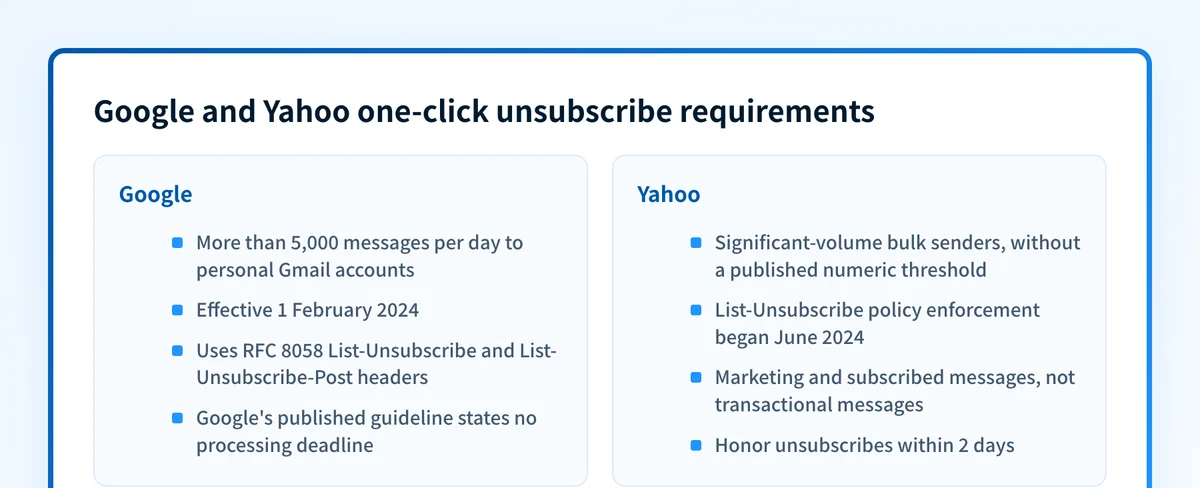
Google and Yahoo both require one-click unsubscribe from bulk senders, but they draw the line in different places. Google applies its rule to senders of close to 5,000 messages or more to personal Gmail accounts in a 24-hour period, on marketing and subscribed messages, from 1 February 2024. Yahoo publishes no volume threshold, began enforcing its List-Unsubscribe policy in June 2024, and requires unsubscribes to be honored within two days. Both point at the same mechanism: the RFC 8058 header pair, covered by DKIM, answered by an HTTPS POST.
At a glance
Quick takeaways
- Google requires one-click unsubscribe for marketing and subscribed messages from senders of close to 5,000 messages or more to personal Gmail accounts in a 24-hour period. Google Workspace recipients are out of scope.
- Google's requirement took effect on 1 February 2024, with a June 1, 2024 deadline for senders that already had an unsubscribe link, and Google says it began ramping up enforcement in November 2025.
- Yahoo does not publish a numeric threshold, requires a functioning list-unsubscribe header for marketing and subscribed messages, excludes transactional mail, and began enforcing in June 2024.
- Yahoo requires unsubscribes to be honored within two days. Google publishes no processing deadline.
- A compliant message carries both
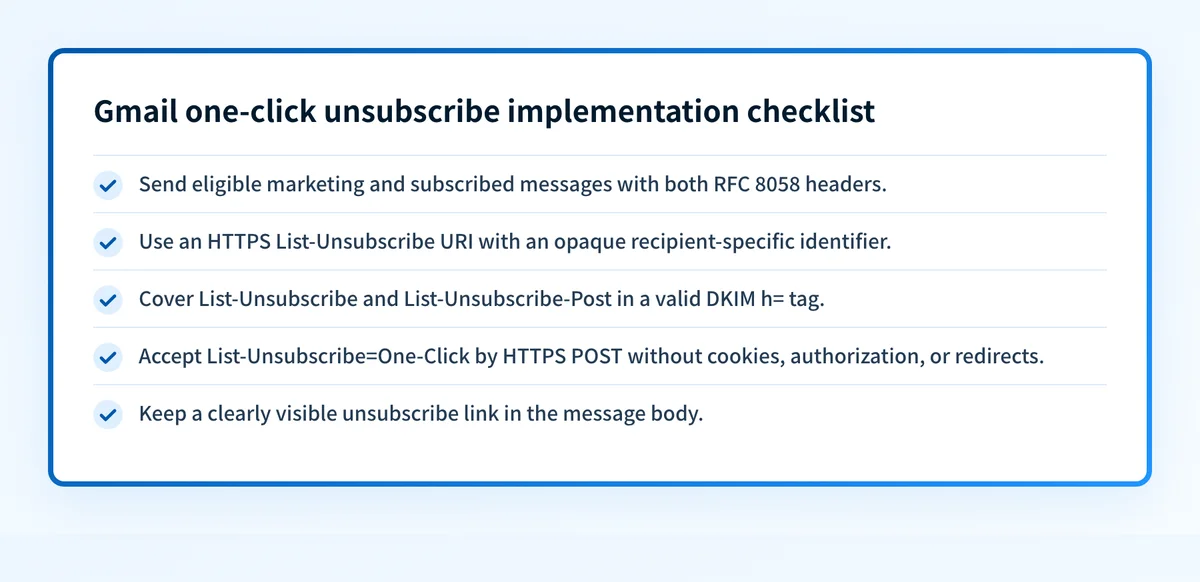
List-Unsubscribewith an HTTPS URI andList-Unsubscribe-Post: List-Unsubscribe=One-Click, both covered by a valid DKIM signature. - The unsubscribe endpoint must accept an HTTPS POST without cookies, HTTP authorization, or redirects. Google also requires a clearly visible unsubscribe link in the message body.
Who is affected?
Google and Yahoo assess their own recipient traffic and publish their own sender requirements. One-click unsubscribe sits alongside authentication and complaint handling in those requirements, and a message can pass SPF, DKIM, and DMARC and still lack the required unsubscribe mechanism. See the deliverability learning center for the surrounding operational context.
Google: close to 5,000 messages or more per day to personal Gmail accounts
Google's email sender guidelines require senders of close to 5,000 messages or more to personal Gmail accounts within a 24-hour period to support one-click unsubscribe on marketing and subscribed messages. Messages from the same primary domain count toward that limit, according to Google's sender-guidelines FAQ.
The guideline applies to mail sent to personal Gmail accounts, not Google Workspace accounts. That qualifier matters for B2B programs: a sender that mails only Google Workspace recipients is outside this specific rule, even though its mail is still subject to authentication, spam, and recipient-policy checks.
Google's FAQ says transactional messages are excluded, giving password resets, reservation confirmations, and form submission confirmations as examples. Google also says recipients, rather than Google, decide whether they regard a message as promotional. When a message mixes an operational notice with promotional content, do not assume its technical purpose alone makes it exempt.
Google's threshold is a daily message volume to Gmail accounts, not a count of subscribers, campaigns, or domains, and not the organization's total volume across all recipients.
Yahoo: significant-volume bulk senders, without a published number
Yahoo uses a different definition. Its sender FAQ states: "A 'bulk' sender is classified as an email sender sending a significant volume of mail. We will not specify a volume threshold."
Do not apply Google's 5,000-message figure to Yahoo. A sender that cannot classify itself from a published cutoff should treat the requirement as an operational standard for any meaningful Yahoo-bound campaign volume.
Yahoo also limits the requirement by message type. Its FAQ states: "One-click unsubscribe is only required for promotional/marketing messages. The requirement does not apply to transactional messages." The requirements apply to every consumer brand Yahoo hosts, which includes AOL and, since their transitions, AT&T Mail and cox.net.
Is one-click unsubscribe mandatory?
One-click unsubscribe is mandatory within the scope each mailbox provider defines, and not as a universal rule. It is a mailbox-provider requirement rather than a law, and it applies to specific senders and message types rather than to every email. The matrix below is the applicability test; the sections that follow give each provider's exact wording.
| Rule | Who must comply | Covered messages | Excluded | Source |
|---|---|---|---|---|
| Senders of close to 5,000 messages or more to personal Gmail accounts in a 24-hour period | Marketing and subscribed messages | Transactional mail; mail to Google Workspace accounts | Google sender guidelines and FAQ | |
| Yahoo | Bulk senders, with no published volume threshold | Promotional and marketing messages | Transactional messages | Yahoo sender best practices and FAQ |
| Other mailbox providers | Whatever each provider publishes | Per provider | Per provider | That provider's sender requirements |
| The law (United States) | Senders of commercial email, at any volume | Commercial email must include a clear and conspicuous way to opt out | Does not require the RFC 8058 headers | FTC CAN-SPAM compliance guide |
A sender below Google's threshold today can cross it during a campaign, so classify message streams before a volume increase rather than after a bounce. The sender or its email service provider adds the headers and runs the endpoint; the mailbox provider decides whether to show an unsubscribe control. For the legal-versus-policy distinction in more depth, see one-click unsubscribe law.
What are the requirements?
Google requires the RFC 8058 header pair on covered messages
Google says qualifying bulk senders must support one-click unsubscribe with the List-Unsubscribe and List-Unsubscribe-Post headers defined in RFC 8058.
List-Unsubscribe: <https://unsubscribe.yourdomain.com/list/opaque-token>
List-Unsubscribe-Post: List-Unsubscribe=One-Click
RFC 2369 defines List-Unsubscribe as a header containing one or more angle-bracket URLs for list commands. RFC 8058, a Standards Track RFC published in January 2017, requires the header to contain one HTTPS URI and adds the fixed List-Unsubscribe-Post value that tells a receiver it may perform a one-click action. Section 5 defines that value as a fixed string, not a free-text field.
The HTTPS URI should contain an opaque, hard-to-forge identifier rather than a plain recipient address or list name. RFC 8058 does not prescribe the token format; the sender is responsible for making it hard to guess and limiting it to the intended unsubscribe operation.
Google's FAQ says a mailto link can still be supported, but it does not meet Google's one-click requirement. A mailto: entry may still appear as an additional RFC 2369 list command; it does not provide RFC 8058 one-click behavior. For the protocol-level distinction, see one-click unsubscribe and the RFC 8058 header pair.
Both headers must be covered by a valid DKIM signature
RFC 8058 requires at least one valid DKIM signature on the message, and the List-Unsubscribe and List-Unsubscribe-Post headers MUST be covered by that signature, listed in the DKIM-Signature header's h= tag.
DKIM-Signature: v=1; a=rsa-sha256; d=yourdomain.com;
 h=from:to:subject:list-unsubscribe:list-unsubscribe-post;
 ...
This is an illustrative header shape only. Inspect the raw headers of a delivered message to confirm the production signature covers both fields. A platform status that says DKIM is enabled does not prove its signing configuration includes these two headers, and a later relay that adds or rewrites headers after signing breaks the coverage.
The endpoint must complete an HTTPS POST without session context
RFC 8058 says a receiving system can perform an HTTPS POST to the URI in List-Unsubscribe and send the key and value from List-Unsubscribe-Post as the request body. Google publishes this example request shape in its sender guidelines:
POST /unsubscribe/example HTTP/1.1
Host: solarmora.com
Content-Type: application/x-www-form-urlencoded
Content-Length: 26
List-Unsubscribe=One-Click
RFC 8058 says the receiver SHOULD send multipart/form-data and MAY send application/x-www-form-urlencoded. An interoperable endpoint accepts both encodings.
The endpoint cannot depend on browser state. RFC 8058 says the POST MUST NOT include cookies, HTTP authorization, or other context, and the sender MUST NOT return an HTTPS redirect, because redirected POSTs have not worked reliably. A preference center, login flow, or confirmation page may sit behind a body link, but it cannot be required to complete the RFC 8058 transaction.
The receiver also MUST NOT make the POST without user consent. The mailbox provider obtains that consent through its own interface. RFC 8058 does not require Gmail, Yahoo, or any other provider to display an unsubscribe control for every message.
Google requires a visible unsubscribe link in the body as well
Google's requirement includes a clearly visible unsubscribe link in the message body in addition to one-click support. The header-based action and the visible link are separate requirements; a List-Unsubscribe header does not replace the visible link, and Google says a preference-center link on its own does not comply with RFC 8058 without the headers.
The visible link may lead to a broader subscription-management experience. The RFC 8058 endpoint has a narrower job: it must process the POST without a web session or redirect. Keep the two paths separate when testing.
Yahoo requires a functioning list-unsubscribe header for covered mail
Yahoo's sender best practices say bulk senders should "Implement a functioning list-unsubscribe header, which supports one-click unsubscribe for marketing and subscribed messages". The same page says the POST method in RFC 8058 is "highly recommended."
Yahoo's sender FAQ describes the requirement more directly: "You must implement the list-unsubscribe header (preferably according to RFC 8058) in order to meet the requirement for one-click unsubscribe." The FAQ also says an unsubscribe link in the body of the message is not sufficient on its own.
Read those statements together. Yahoo requires a functioning list-unsubscribe header for the covered message types and identifies RFC 8058 as the preferred one-click method. Do not turn Yahoo's "highly recommended" wording for the RFC 8058 POST method into a universal Yahoo mandate.
Yahoo requires unsubscribes within two days
Yahoo's best-practices page requires senders to "Honor unsubscribes within 2 days." Its FAQ confirms: "If the unsubscribe is not honored in 2 days, then it would not meet the requirement."
This is a Yahoo-specific processing deadline. Google's sender-guidelines page states no processing deadline, so two days is not a shared Google and Yahoo requirement.
The deadline concerns the durable suppression outcome. An HTTP response from an unsubscribe endpoint does not establish that every campaign system, ESP, and production sending path will stop sending the covered mail.
What happens to noncompliant mail
Yahoo's FAQ states: "If you do not meet the requirements, your mail may be sent to the spam folder or rejected. If mail is rejected, we will return a specific error code with information about the rejection." "May" is important: Yahoo does not say every noncompliant message will be rejected, and it does not enumerate the strings.
Google's FAQ says messages that do not meet the one-click requirement are not automatically rejected or marked as spam for that reason alone. Its enforcement notice says Gmail began ramping up enforcement on non-compliant traffic in November 2025, and that affected messages can experience disruptions, including temporary and permanent rejections. Unwanted mail without an easy unsubscribe path is also more likely to be reported as spam, which feeds the complaint rate both providers cap at 0.3%.
When does the requirement take effect?
Google's sender guidelines state that the requirements for senders of close to 5,000 messages or more took effect on 1 February 2024 for personal Gmail accounts. The sender-guidelines FAQ adds that senders who already included an unsubscribe link had until June 1, 2024 to implement one-click unsubscribe in all commercial and promotional messages, and that enforcement on non-compliant traffic began ramping up in November 2025.
Yahoo's staged timeline is different. Its FAQ states: "Enforcement will begin in February 2024, and we will continue to gradually roll out enforcement as we monitor compliance metrics. Note: Enforcement of the List-Unsubscribe policy will begin in June 2024."
The February 2024 Yahoo date refers to enforcement beginning for its broader requirements. June 2024 is the source-backed enforcement date for Yahoo's List-Unsubscribe policy specifically. Do not collapse those dates into a single shared deadline.
RFC 8058 itself is not a 2024 policy. It has been a final IETF Standards Track RFC since January 2017 and builds on RFC 2369's older list-command syntax. RFC 2369 alone describes list-command links; RFC 8058 adds the signed header signal and the constrained POST flow that make the action one-click.
How do I implement the requirement?
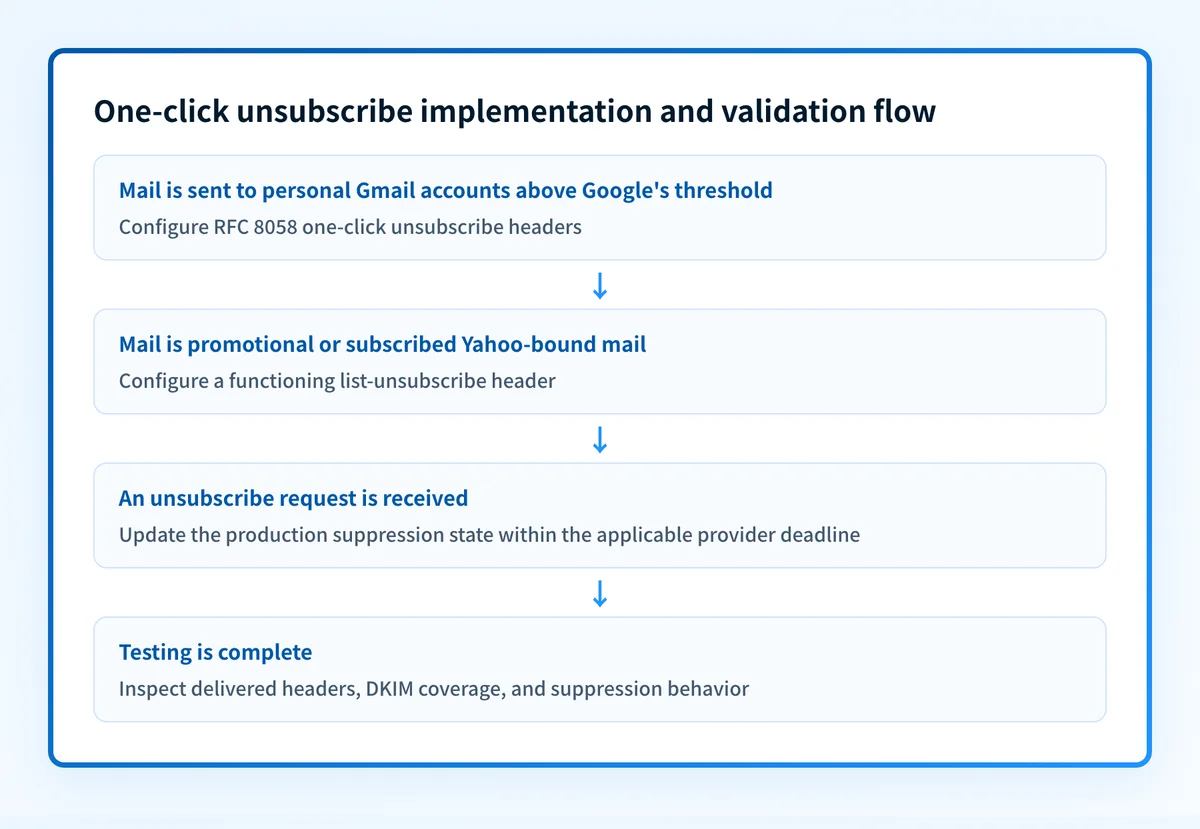
1. Classify the traffic by recipient and message type
Measure daily volume to personal Gmail accounts, by primary domain, separately from Google Workspace recipients. For Yahoo, identify marketing and subscribed mail separately from transactional mail. Inventory every production system that sends promotional mail: ESPs, CRM campaigns, product-notification systems, and custom mail services.
Keep this classification tied to the actual production sending path. A campaign tool's audience estimate may not match final recipient routing or send volume, and a sender over Google's threshold cannot satisfy the rule by adding headers only to its largest newsletter.
2. Generate an opaque HTTPS unsubscribe URI
Configure the sending platform or list system to create a recipient-specific, hard-to-forge HTTPS URI. The endpoint needs enough information to identify the applicable subscription without asking the receiver to sign in, accept cookies, or submit another form.
Do not use a raw recipient address or reusable account identifier in the unsubscribe URI. Treat the URI as sensitive operational data and avoid exposing full values in routine logs or support tickets. Do not copy another tenant's unsubscribe URLs or identifiers.
3. Add both headers before DKIM signing
Add List-Unsubscribe with the HTTPS URI and List-Unsubscribe-Post: List-Unsubscribe=One-Click to each covered message before its DKIM signature is generated. Inspect the generated DKIM-Signature header to confirm its h= list includes both header names.
If another mail relay modifies or adds headers after signing, test the message after the final production hop. The right configuration in an upstream service can still fail if a later hop changes the signed header set.
4. Accept the one-click POST directly
Configure the endpoint to accept the exact List-Unsubscribe=One-Click body with either permitted form encoding. Process a valid request without a redirect, cookie, authorization challenge, or browser JavaScript.
Do not make the endpoint redirect to a login page, confirmation page, consent screen, or preference page. RFC 8058 says an HTTPS redirect is not part of the one-click transaction.
Make repeated valid requests safe to handle. A recipient who is already removed should remain removed after a second request, without a duplicate removal event or an error that obscures the result.
5. Keep a visible unsubscribe link in the template, and connect it to suppression
Place a clearly visible unsubscribe link in the body of every affected marketing and subscribed message. Check the rendered message, not only the template editor, because layout or content conditions can hide the link in a specific campaign.
When either path receives a valid request, remove the recipient from the list covered by that message, and make sure the suppression update reaches every production sender that can send that list's traffic. For Yahoo-covered mail, confirm the recipient is suppressed within two days. The endpoint is not a substitute for consent records or list governance across brands and systems.
For platform-specific patterns, see Mailchimp one-click unsubscribe, SendGrid one-click unsubscribe, or Braze one-click unsubscribe if one of those is part of the sending path.
How do I validate compliance?
Validate one-click unsubscribe compliance by checking four layers in order: the published DNS records, the sending platform's configuration, a delivered production message, and the unsubscribe endpoint together with the suppression list it updates. Each layer proves something the others cannot, and a green result at one layer is not evidence for the next. The message and endpoint layers are the ones that decide whether Google and Yahoo treat the mail as compliant.
- DNS: Confirm the domain's DMARC and DKIM records resolve through the authoritative DNS service and a public resolver. This confirms published DNS, not delivered-message behavior.
- Vendor: Check the sending platform's current authentication and unsubscribe configuration. A green platform status does not prove the production path adds the headers.
- Message: Send a real test message through the exact production path and inspect its raw headers. Confirm
List-Unsubscribecontains an HTTPS URI,List-Unsubscribe-Postcontains the exact fixed value, and a valid DKIM signature includes both header fields in itsh=list. Check the rendered body for the visible link. - Endpoint and suppression: With a safe test recipient, send the fixed POST using both
multipart/form-dataandapplication/x-www-form-urlencoded. Confirm the endpoint completes without a cookie, login, authorization header, redirect, or browser-only dependency, then verify the recipient's suppression status in the source-of-truth list system and confirm the next applicable send excludes them.
A successful unsubscribe test proves the tested path. It does not prove that every future message, recipient system, or mailbox interface will behave the same way.
Check the wider sender posture behind the unsubscribe requirement
One-click unsubscribe is one provider expectation among several. The same covered sending stream also needs authentication, alignment, transport, and spam-rate controls. Use the email security score to inspect the domain's public authentication posture, and the Gmail sender requirements guide to track the rest of Google's policy.
The score cannot verify a list-unsubscribe header, test an unsubscribe endpoint, monitor future sender changes, or prove how Gmail or Yahoo will place an individual message.
Evidence
Sources and further reading
- RFC 8058: Signaling One-Click Functionality for List Email Headers
- RFC 2369: The Use of URLs as Meta-Syntax for Core Mail List Commands
- Google email sender guidelines
- Google email sender guidelines FAQ
- Gmail Help: Unsubscribe from an email
- Yahoo sender best practices
- Yahoo sender FAQs
- FTC CAN-SPAM Act compliance guide
Questions readers ask
Frequently asked questions
Is one-click unsubscribe mandatory?
Yes, for the senders and messages each provider names. Google requires it on marketing and subscribed messages from senders of close to 5,000 messages or more to personal Gmail accounts in a 24-hour period, and excludes transactional mail and Google Workspace recipients. Yahoo requires a functioning list-unsubscribe header on promotional mail from bulk senders, with no published threshold. Neither rule is a law.
Is an unsubscribe option still required below the Google and Yahoo thresholds?
An opt-out method is often still required below the Google and Yahoo thresholds, but for a legal rather than a provider reason. Google and Yahoo only require the one-click mechanism from their bulk senders, yet the FTC's CAN-SPAM guide says commercial email must include a clear and conspicuous way to opt out, and the guide sets no volume threshold. Rules elsewhere differ, so take legal advice for the jurisdictions you send to.
Do Google and Yahoo have the same one-click unsubscribe requirements?
No, their rules differ in scope and timing. Google publishes a threshold of close to 5,000 messages or more per day to personal Gmail accounts, effective 1 February 2024, and also requires a visible body link. Yahoo publishes no numeric threshold, began enforcing its List-Unsubscribe policy in June 2024, and requires unsubscribes to be honored within two days.
Do Google and Yahoo accept the same one-click unsubscribe headers?
Yes. Both providers point at the same RFC 8058 pair: an HTTPS List-Unsubscribe URI and List-Unsubscribe-Post: List-Unsubscribe=One-Click, covered by a valid DKIM signature. Google requires that pair above its threshold; Yahoo requires a functioning list-unsubscribe header and names RFC 8058 as the preferred method. The receiver then sends the POST after the recipient consents.
Does a visible unsubscribe link replace the RFC 8058 headers?
No. Google requires both one-click support and a clearly visible unsubscribe link in the body for covered marketing and subscribed messages, and Yahoo says a body link alone is not sufficient. A body link does not create the signed, receiver-initiated POST flow that RFC 8058 defines.
Does Gmail always show the unsubscribe control?
No. Gmail shows the top-of-message control only for messages that pass its own automated eligibility checks. Correct headers are necessary for one-click unsubscribe, but they do not guarantee that Gmail displays a control on every message you send, and Gmail's unsubscribe help says some senders show Go to website instead because their process requires their site.
How do I unsubscribe from Gmail one-click?
As a recipient, open the message in Gmail and select Unsubscribe next to the sender's name when Gmail shows it, then confirm. As a sender, that control works because your message carries the RFC 8058 headers and Gmail submits the POST on the recipient's behalf. Google does not show the control on every message.
Does Yahoo require one-click unsubscribe for transactional email?
No. Yahoo limits the requirement to promotional and marketing messages and states that it does not apply to transactional mail. Google's FAQ makes the same exclusion for transactional messages such as password resets and reservation confirmations, while noting that recipients decide what they regard as promotional.
What happened to one-click unsubscribe in 2024?
Google made it a requirement for bulk senders to personal Gmail accounts effective 1 February 2024, with a June 1, 2024 implementation deadline for senders that already had an unsubscribe link, and began ramping up enforcement in November 2025. Yahoo began enforcing its List-Unsubscribe policy in June 2024. RFC 8058 itself dates from January 2017.

Written by
Johanie DupontBrand & Ecommerce Email
Johanie Dupont works on brand and ecommerce email at Palisade: BIMI and verified marks, sender requirements, and getting marketing mail into the inbox.
More from Johanie →