Email authentication service: choose the right operating model
 ChatGPT
 Claude
 Gemini
 Perplexity
 Grok
GrokIn brief
Email authentication service options: choose self-management, a DMARC platform, or managed help based on sender ownership and report work for your domains.
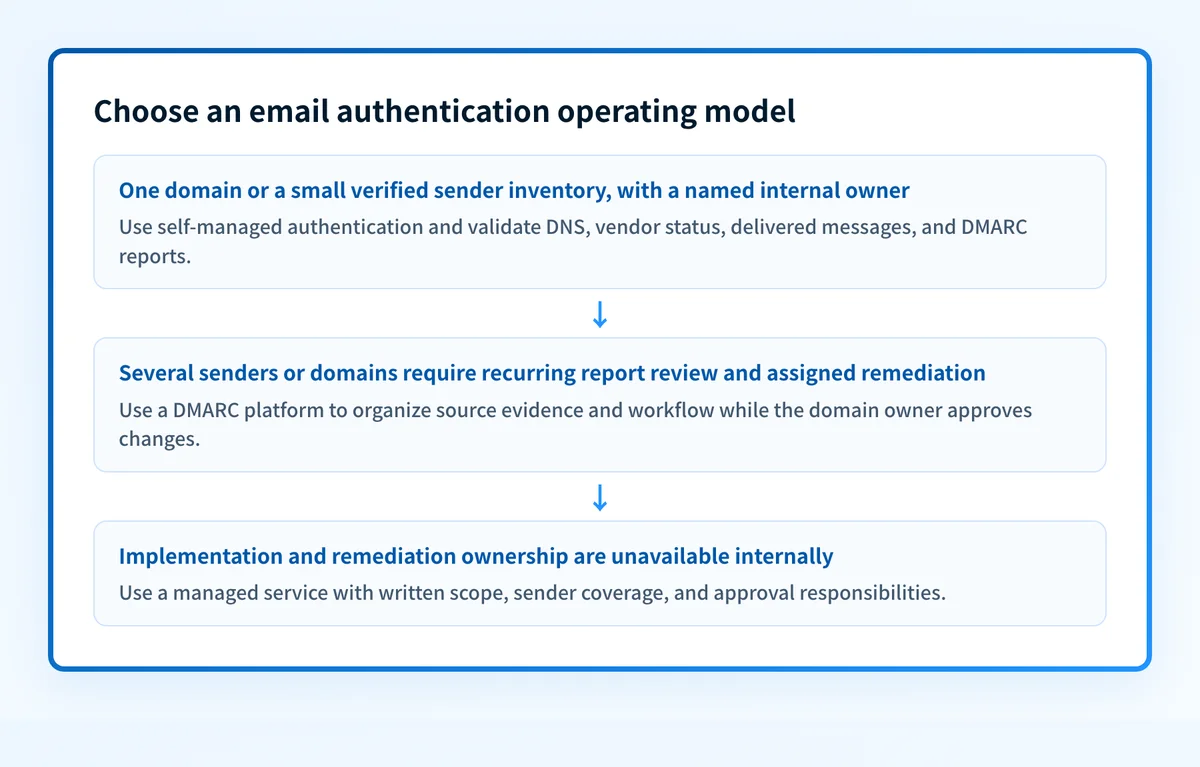
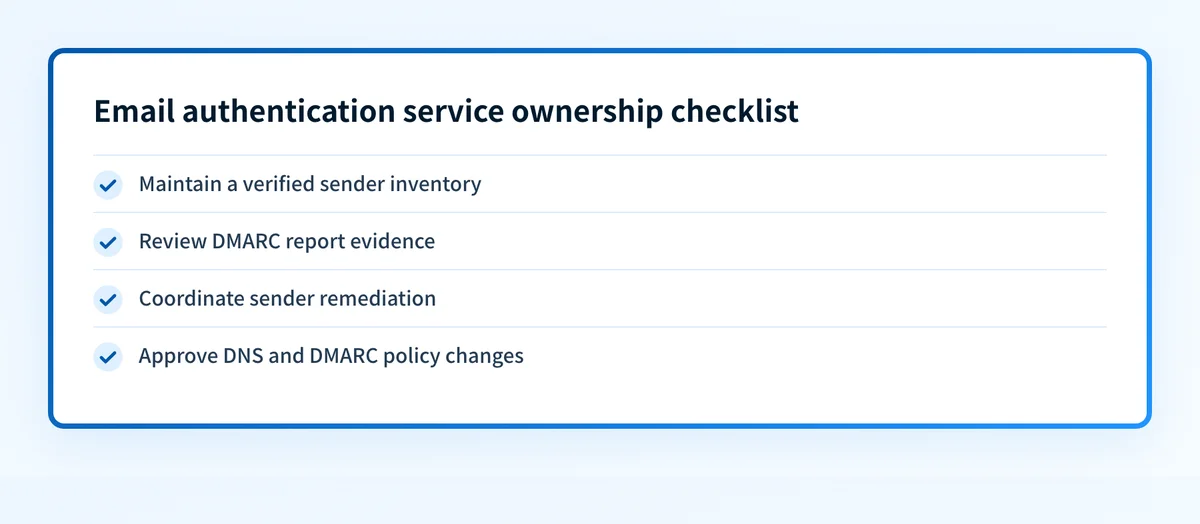
An email authentication service is any arrangement that keeps SPF, DKIM, and DMARC correct for the domains you send from, and it comes in three operating models. Choose self-management when a named internal owner can maintain a verified sender inventory, review DMARC evidence, and approve DNS changes. Choose a DMARC platform when recurring reports and multiple sending sources need an organized workflow. Choose a managed service when implementation and remediation ownership are missing. In every model, the domain owner should keep approval for DNS records and DMARC policy changes.
At a glance
Quick takeaways
- SPF, DKIM, and DMARC are open standards, so a paid service does not replace the domain configuration or message validation they require.
- A public DNS check can show a published DMARC record, but it cannot prove every production sender aligns.
- DMARC reports help identify sending sources, yet receivers are not required to send every requested report.
- A platform fits recurring evidence review and remediation coordination, while a managed service fits teams that need defined delivery of that work.
- A DMARC pass supports authentication decisions but does not guarantee inbox placement at a receiver.
- Provider scope, sender coverage, record ownership, retention, and change approval should remain open questions until confirmed in writing.
Who this comparison is for
This comparison is for IT, security, deliverability, and MSP operators choosing who will operate email authentication for domains that send legitimate mail. It compares operating models, not named vendors or email delivery services.
The decision is broader than publishing a record. The ongoing work can include maintaining a sender inventory, inspecting SPF, DKIM, and DMARC evidence, investigating unknown sources, coordinating with sender owners, and deciding when a DMARC policy can advance. If the protocols themselves are unfamiliar, begin with what email authentication is and why it matters.
This article does not evaluate inbound filtering, consumer account authentication, or an individual ESP setup. Buyers comparing broader platforms can use the Palisade comparison hub alongside this operating-model decision.
How the options were evaluated
The criteria below were defined before selecting a model and checked against current primary sources on August 12, 2026:
- Sender and domain complexity: How many visible From domains, subdomains, ESPs, CRMs, support platforms, transactional systems, and relays need to be accounted for?
- Report evidence and ownership: Who receives and interprets DMARC aggregate-report evidence, and who investigates an unrecognized source?
- Remediation capacity: Who can work with the sender owner to correct SPF, DKIM, or alignment failures without disrupting legitimate mail?
- Policy authority: Who can approve changes to DNS and the DMARC policy?
- Documented scope: Does the proposed service explicitly state the domains, senders, reporting work, implementation work, and approvals it covers?
For senders that send more than 5,000 messages per day to personal Gmail accounts, Google's email sender guidelines require SPF, DKIM, DMARC, and alignment for DMARC. Those requirements make production evidence more useful than a category label. A green setup indicator or a published DNS record is not proof that a real message from every sender uses the intended authenticated path.
Self-managed email authentication
- Best fit: One or a few domains, a short and verified sender inventory, and an internal operator who can coordinate DNS and sender-platform changes.
- Relevant evidence: RFC 7208 defines SPF evaluation, while RFC 6376 defines DKIM signing and verification. Validate both with a delivered message from the production sending path, not only with DNS.
- Tradeoff: The standards do not provide an operating queue. An internal owner still needs to inspect reports, document legitimate sources, resolve failures, and decide when policy changes are safe.
Use four layers to validate a self-managed implementation. Check DNS through the authoritative server and a public resolver. Confirm the sender vendor's verification status. Inspect Authentication-Results from a real message sent through the exact production path. Then review DMARC aggregate reports as data accumulates.
Do not move a DMARC policy toward enforcement based only on a DNS lookup. A published policy cannot show whether every legitimate source is signing or aligned.
DMARC monitoring platform
- Best fit: Multiple sending systems or domains, recurring DMARC report review, or a need to convert source evidence into assigned remediation work before changing policy.
- Relevant evidence: RFC 9989's reporting model lets domain owners request reports, but receivers are not obligated to send every requested report. A platform should therefore make its evidence and unresolved gaps visible.
- Tradeoff: A platform can organize evidence and remediation work, but it cannot make an unconfigured sender authenticate, control a receiver's mailbox decision, or safely approve DNS changes on behalf of the domain owner.
Confirm the service's scope directly. Pricing, report retention, supported integrations, portfolio controls, exports, implementation services, and approval workflows vary by provider and should not be inferred from the phrase "DMARC platform."
A point-in-time public check still has a role. Run the domain through the DMARC checker before making a buying decision to inspect the published record and policy. That result does not prove the production sending path, continuous state, a receiver's private filtering decision, or future delivery.
Managed email authentication service
- Best fit: A team that lacks practical ownership for sender inventory, cross-team remediation, phased DMARC policy work, or multi-domain coordination.
- Relevant evidence: RFC 9989 treats remediation and enforcement decisions as domain-owner responsibilities. A managed provider's statement of work should therefore identify its delivery scope and the domain owner's approval role.
- Tradeoff: A managed service may cover advice, implementation, reporting, remediation coordination, or some combination. Do not assume it covers every ESP, DNS zone, sender, mailbox provider issue, or policy change unless the agreement says so.
For an MSP, also establish the client boundary. Each customer domain needs a named approver, a record of its legitimate senders, and a process for handling sources that are unknown or not yet aligned. A managed engagement without those decisions can produce reports without resolving the operational gap.
How to choose
1. Inventory the real sending paths
List each visible From domain and the systems that send mail for it. Include marketing ESPs, CRMs, support platforms, transaction services, internal relays, and subdomains. Record who owns each system and whether a delivered production message is available for validation.
If a legitimate sender fails DMARC, use email authentication failure guidance to separate DNS, sender-vendor, message, and report evidence before changing a record.
2. Name the recurring owner
Choose self-management if an internal owner can review evidence and coordinate fixes. Choose a platform if source evidence and remediation need a continuing workflow. Choose a managed service if the missing capability is accountable implementation or coordination.
Do not treat a provider label as evidence of policy authority. The domain owner should approve any DNS or DMARC policy change after the relevant sending path has been validated.
3. Validate before changing the DMARC policy
For each legitimate source, confirm the published DNS state, the sender vendor's status, a delivered message's authentication results, and DMARC report evidence once available. RFC 9989 explains DMARC alignment and receiver discretion. A passing DMARC result does not require every receiver to make the same inbox decision.
Use this decision record to make the remaining evidence gap visible:
email_authentication_service_decision:
  checked_on: "2026-08-12"
  domains_in_scope:
    - "yourdomain.com"
  sender_inventory: "verified | incomplete"
  report_review_owner: "named person or team | unassigned"
  remediation_owner: "named person or provider | unassigned"
  policy_approval: "domain owner"
  preferred_model: "self-managed | platform | managed service"
  open_question: "Which legitimate sending path still lacks aligned SPF or DKIM?"
The record is incomplete until the owner confirms the sender list with message evidence. A DNS record can be correct while an application uses a different return path or does not sign with the expected DKIM domain.
Turn report evidence into an owned authentication plan
If recurring report review and sender remediation are the reason for the purchase, evaluate a platform on the evidence it can organize and the approval boundary it preserves. Palisade's pricing page describes DMARC report parsing, sender classification, notifications, reporting, and MSP portfolio features. Its DMARC Agent guidance describes identifying source-specific authentication findings and recommended actions from report evidence.
Palisade is agentic DMARC software for teams that want help doing the report-analysis and remediation-planning work. A human reviews the evidence and applies any DNS or policy change. Start with the public DMARC record, then use an ongoing workflow only when the decision record shows recurring evidence and ownership work.
Palisade does not control a receiver's inbox decision, authenticate an unconfigured sender automatically, or apply DNS and policy changes without human review.
Evidence
Sources and further reading
Questions readers ask
Frequently asked questions
Do I need an email authentication service for one domain?
Not always. One domain can be self-managed when its sender inventory is short, the internal owner can maintain DNS and sender settings, and the team can validate real messages and review DMARC evidence. Reassess the model when new senders appear or report review becomes unowned work.
Is a DMARC platform the same as a managed email authentication service?
No. A DMARC platform organizes evidence, reporting, and remediation workflow. A managed service adds a defined delivery commitment, such as implementation help or remediation coordination. Confirm the provider's exact scope, sender coverage, and approval process before treating either model as a substitute for the other.
Does a published DMARC record prove my email authentication works?
No. A published DMARC record proves only that public DNS returns that record at the time of the lookup. Validate the sender vendor, a delivered production message's authentication results, and DMARC report evidence to determine whether a legitimate sender aligns.
Can a DMARC pass guarantee Gmail inbox placement?
No. DMARC validation supports authentication and policy handling, but mailbox providers retain their own delivery and filtering decisions. RFC 9989 states that a DMARC pass does not guarantee delivery to the inbox.
Who should approve a DMARC policy change?
The domain owner should approve it. A provider or platform can supply evidence and recommend a next policy step, but the owner should confirm that legitimate production sources have been validated before applying a DNS or policy change.

Written by
Samuel ChenardCEO & Co-Founder, Palisade
Samuel Chenard is the CEO and co-founder of Palisade, agentic DMARC software for IT teams and MSPs, from one domain to thousands.
More from Samuel →