Proofpoint pricing: what is published and what drives cost
 ChatGPT
 Claude
 Gemini
 Perplexity
 Grok
GrokIn brief
Proofpoint pricing is quote-only for current enterprise plans. See dated Essentials rates, cost drivers, licensing considerations, and DMARC coverage.
Proofpoint publishes dated list prices for its former Essentials small-business line, but it does not publish enterprise package prices. Choose the published Essentials sheets only as historical reference, then request a quote for current Proofpoint 365 Total Protection or enterprise packages. The documented cost drivers are user licences, contract term, and some consumption exceptions. DMARC-related hosted services also sit behind a separate product and package entitlement.
At a glance
Quick takeaways
- Proofpoint's published US Essentials sheet is stamped October 2021, so it is not evidence of a current 2026 quote.
- The published US sheet lists Business at $2.75, Advanced at $3.75, and Professional at $5.33 per active user per month.
- Proofpoint's published EMEA Essentials sheet uses different package and regional pricing, so the two sheets cannot be combined into one global price list.
- Enterprise packages are quote-based on Proofpoint's buying page, with no public package figures, minimum seat count, or discount ladder.
- Published enterprise budgetary drivers include user licences, single-year or multi-year term, and consumption-based exceptions.
- Hosted DMARC, DKIM, and SPF services are an Email Fraud Defense entitlement, not a published standalone DMARC price.
Who this comparison is for
This comparison is for an IT buyer, procurement owner, or MSP evaluating Proofpoint costs for email security and trying to separate public list-price evidence from quote-only products. It is also relevant when "Proofpoint Essentials pricing" appears in a budget discussion even though Proofpoint now markets that offering as Proofpoint 365 Total Protection.
The decision has two parts. First, establish which Proofpoint product family covers the required job: inbound email security, human-risk controls, archiving, or DMARC operations. Second, establish whether the available published numbers apply to the region, package, date, user count, contract term, and consumption model under consideration.
Palisade belongs in this decision only when the buyer is evaluating DMARC operations. It is not a secure email gateway and does not filter inbound mail, so it is not a replacement for Proofpoint's inbound filtering packages. See the broader DMARC platform comparison guide when the decision is specifically about DMARC software. Buyers can also run the DMARC checker before comparing remediation requirements.
How the options were evaluated
The criteria below were checked against Proofpoint and Palisade first-party pages on August 12, 2026:
- Published price evidence: whether the vendor publishes a figure, currency, unit, date, and product scope.
- Product scope: whether the package covers email security, archiving, human-risk controls, or hosted email-authentication services.
- Cost drivers: whether the vendor documents variables that affect a quote.
- Entitlement boundary: whether a capability is included in a named package, offered as an add-on, or available only through a separate product.
- Purchase path: whether the vendor provides self-serve checkout or directs the buyer to a quote, demo, trial, or assessment request.
Proofpoint Essentials and Proofpoint 365 Total Protection
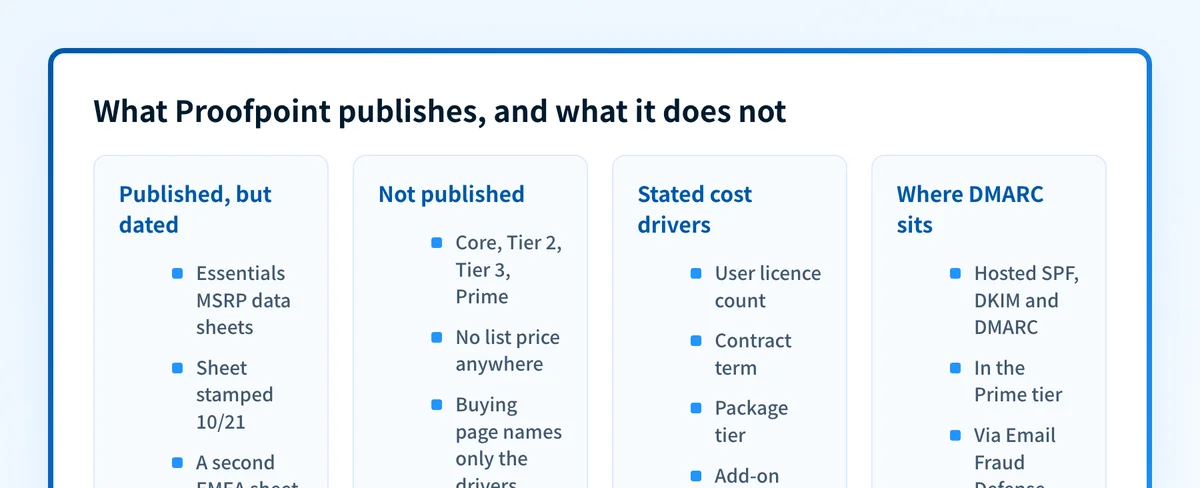
Proofpoint's most specific public price evidence is a US Essentials price list with a footer stamp of 10/21. It lists monthly MSRP per active user for three packages:
- Business: $2.75 per active user per month.
- Advanced: $3.75 per active user per month.
- Professional: $5.33 per active user per month.
- Essentials Security Awareness: $1.00 per active user per month as a separate line item.
A separate EMEA monthly MSRP sheet, stamped 5/22, lists four packages, including a Beginner tier restricted to existing customers. It uses GBP, EUR, and two USD regional price columns. Its USD figures and SKU assignments differ from the US sheet.
Those documents establish that Proofpoint has published historical Essentials pricing. They do not establish a single current global price. A buyer should not select the lower of two figures, convert currencies, or combine package rows from the two sheets.
Proofpoint now presents Proofpoint 365 Total Protection as an all-in-one Microsoft 365 suite for MSPs. That live page refers to flexible packages but does not name public package prices. Treat the older Essentials sheets as dated commercial evidence, then ask Proofpoint which current product and regional terms apply.
- Best fit: A buyer who needs historical, published small-business per-user list-price evidence for the former Essentials line.
- Relevant evidence: The US sheet publishes three package rates, a separate Security Awareness price, and archive import and management charges. The EMEA sheet shows that pricing depends on region and package version.
- Tradeoff: Neither sheet is a current enterprise quote or a reliable global rate card for Proofpoint 365 Total Protection.
Proofpoint enterprise packages
Proofpoint's enterprise collaboration-security buying page names Core, Tier 2, Tier 3, and Prime without attaching a public figure to any package.
- Core: Email security.
- Tier 2: Core capabilities plus account takeover protection.
- Tier 3: Tier 2 capabilities plus human risk education and training.
- Prime: Tier 3 capabilities plus impersonation protection, domain fraud and spoofing prevention, hosted DMARC, DKIM and SPF services, and lookalike domain detection.
Proofpoint does not publish a minimum seat count or a discount ladder on that buying page. Both are commercial questions for the quote process. The page uses "Request a quote" and "Contact us" rather than self-serve checkout.
- Best fit: An organization buying an enterprise email-security package through a Proofpoint sales process.
- Relevant evidence: Proofpoint documents the package names, capability progression, and user-licence, term, and consumption factors for budgetary pricing.
- Tradeoff: Public sources do not provide enterprise list prices, minimums, volume discounts, or a package-specific quote calculator.
Proofpoint Email Fraud Defense for hosted DMARC services
Proofpoint's Email Fraud Defense product page describes hosted SPF, hosted DKIM, and hosted DMARC as part of that product. It describes guided workflows and skilled consultants for DMARC deployment.
This matters because hosted DMARC is not presented as a public standalone price. On the enterprise buying page, hosted DMARC, DKIM, and SPF services appear under Prime. A buyer who needs DMARC operations should ask whether Email Fraud Defense is separately quoted, included through Prime, or subject to another entitlement in the proposed order form.
Proofpoint's Hosted SPF technical overview says the DNS service is available to Email Fraud Defense customers and directs pricing questions to an account manager. The document's technical claims do not create a published price or prove inclusion in another package.
- Best fit: A Proofpoint buyer who requires hosted SPF, DKIM, and DMARC services within Proofpoint's product portfolio.
- Relevant evidence: Proofpoint documents Email Fraud Defense as the product for hosted email-authentication services and lists those services under Prime on its enterprise buying page.
- Tradeoff: The public sources do not publish a standalone Email Fraud Defense price, a hosted-DMARC rate, or the exact commercial entitlement for a proposed account.
Palisade for DMARC automation
Palisade is a fit for IT teams and MSPs that need an agentic DMARC software layer rather than inbound email filtering. Palisade autonomously analyzes DMARC aggregate-report data, identifies sending sources and authentication or alignment issues, and creates prioritized remediation tickets. It can propose the next DMARC policy step when the evidence supports it, while a human reviews the evidence and applies the change.
This is a narrower product decision than enterprise email security. Palisade does not filter inbound email, change a receiver's reputation decision, or autonomously change the DMARC policy. Stronger authentication supports better deliverability, but it does not guarantee inbox placement.
- Best fit: A team or MSP that wants an AI agent to do the DMARC work across one domain or many domains.
- Relevant evidence: Palisade's product documentation describes its DMARC-focused operating model, including analysis of aggregate-report data and remediation workflow.
- Tradeoff: Palisade is not the right product when the core requirement is inbound email filtering, account takeover protection, awareness training, or Proofpoint's wider enterprise security package.
How to choose
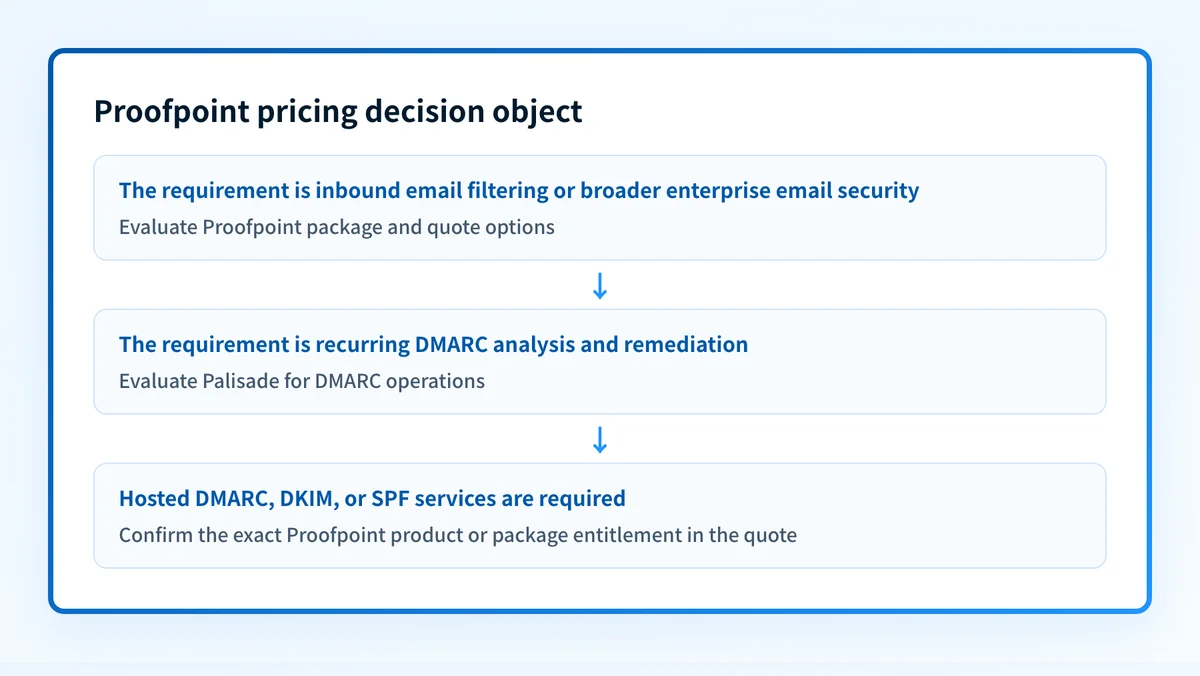
Choose Proofpoint's published Essentials evidence when you need dated historical MSRP for that small-business line. Choose a Proofpoint quote process when the requirement is an enterprise package, Proofpoint 365 Total Protection, or Email Fraud Defense. Choose Palisade when the requirement is recurring DMARC analysis and remediation workflow, while retaining another product for inbound filtering if that is also required.
Use this checklist before accepting any quote:
- Confirm the exact product name and whether it is a current offering or a historical Essentials package.
- Confirm the billing unit, including active users, protected domains, archive data, or another consumption measure.
- Ask which features require Advanced, Professional, Tier 2, Tier 3, Prime, or Email Fraud Defense.
- Ask whether hosted DMARC, DKIM, and SPF are included, separately quoted, or excluded.
- Ask for the contract term, renewal terms, regional currency, minimum commitment, and any consumption exceptions.
- Keep historical list prices separate from the vendor's current written quote.
option: Proofpoint Essentials historical price sheets
checked_on: 2026-08-12
best_fit: Dated small-business MSRP reference
verified_evidence:
  - US sheet stamped 10/21 lists Business, Advanced, and Professional per-active-user monthly MSRP
  - EMEA sheet stamped 5/22 uses different regional figures and package structure
open_question: Which current Proofpoint 365 Total Protection package and regional commercial terms apply
---
option: Proofpoint enterprise packages
checked_on: 2026-08-12
best_fit: Enterprise email-security procurement through a quote
verified_evidence:
  - Core, Tier 2, Tier 3, and Prime are published package names
  - User licences, contract term, and some consumption exceptions affect budgetary pricing
open_question: Package price, minimum commitment, discount structure, and final entitlement
---
option: Palisade
checked_on: 2026-08-12
best_fit: DMARC analysis and remediation workflow for IT teams and MSPs
verified_evidence:
  - DMARC aggregate-report analysis and prioritized remediation tickets are documented
  - A human reviews evidence and applies DMARC policy changes
open_question: Whether inbound email filtering or wider email-security controls are also required
Check the public email-security controls before comparing quotes
Before treating a quoted DMARC or email-security package as the answer, inspect the domain's current public controls with the Email Security Score. Compare the DNS result with the capabilities in the quote, especially if hosted SPF, DKIM, DMARC, archiving, or domain-fraud controls are part of the purchase discussion.
Check your domain's email-security controls
A public DNS scan cannot prove the production sending path, continuous configuration state, a receiver's private filtering decision, or future message placement. It also cannot confirm that a commercial package is licensed or configured for your account.
Evidence
Sources and further reading
Questions readers ask
Frequently asked questions
Does Proofpoint publish pricing?
Yes. Proofpoint publishes dated list-price sheets for its former Essentials line. Its enterprise buying page does not publish prices for Core, Tier 2, Tier 3, Prime, or Email Fraud Defense.
How much did Proofpoint Essentials cost?
The US Essentials sheet stamped October 2021 lists Business at $2.75, Advanced at $3.75, and Professional at $5.33 per active user per month. Those figures are historical published MSRP, not a current universal Proofpoint quote.
Is Proofpoint 365 Total Protection the same as Proofpoint Essentials?
No. Proofpoint markets Proofpoint 365 Total Protection as the current all-in-one Microsoft 365 suite for MSPs. Its live product page does not publish package names or prices, so confirm the current commercial mapping with Proofpoint.
What drives Proofpoint enterprise cost?
Proofpoint states that budgetary pricing depends on the number of user licences and contract term, whether single-year or multi-year, with some exceptions based on consumption. Public sources do not state an enterprise per-user rate, minimum seat count, or discount ladder.
Is hosted DMARC included with Proofpoint?
Only under a documented product or package entitlement. Proofpoint describes hosted DMARC, DKIM, and SPF through Email Fraud Defense, and its enterprise buying page lists those services under Prime. The public sources do not publish a standalone hosted-DMARC price.
Can a public DNS check confirm a Proofpoint deployment?
No. A public DNS check can inspect published records, but it cannot prove that the licensed Proofpoint service is configured, that the exact production sender uses it, or that a mailbox provider will deliver future messages.

Written by
Taylor TabusaCo-Founder & Head of Business Development, Palisade
Taylor Tabusa is the co-founder and Head of Business Development at Palisade, helping managed service providers turn email security into a practical, valuable service.
More from Taylor →