Does PCI DSS 4.0 require DMARC? What requirement 5.4.1 means
 ChatGPT
 Claude
 Gemini
 Perplexity
 Grok
GrokIn brief
PCI DSS 4.0 does not explicitly require DMARC. Requirement 5.4.1 requires automated anti-phishing controls, where DMARC can provide evidence.
No. PCI DSS 4.0 requirement 5.4.1 does not name DMARC or require a particular DMARC policy. It requires processes and automated mechanisms to detect and protect personnel against phishing attacks, and it has been mandatory since March 31, 2025. PCI DSS v4.0 was retired on December 31, 2024; PCI DSS v4.0.1 is the current version. PCI SSC says that limited revision added and deleted no requirements, but an assessment should always use the current document and the assessor's scoped interpretation.
At a glance
Quick takeaways
- PCI DSS v4.0 is retired; PCI DSS v4.0.1 is the current version to use for an assessment.
- PCI DSS 4.0 requirement 5.4.1 requires automated mechanisms that detect and protect personnel against phishing attacks.
- Requirement 5.4.1 was a future-dated best practice until March 31, 2025, and has been mandatory since.
- The requirement does not prescribe DMARC, SPF, DKIM, a vendor, or
p=reject. - Scope follows the assessed environment, and can reach systems that never touch cardholder data themselves.
- DMARC helps receivers identify mail that impersonates a domain when authentication and identifier alignment fail.
- DMARC is one anti-spoofing control, while phishing protection also needs controls for threats DMARC cannot evaluate.
- Evidence for an assessment should connect the control design, its operating status, and the relevant mail flow.
How requirement 5.4.1 and current PCI DSS relate to DMARC
The archived PCI DSS v4.0 text for requirement 5.4.1 states that "Processes and automated mechanisms are in place to detect and protect personnel against phishing attacks." That wording defines an outcome. It does not name an email-authentication protocol or prescribe one implementation.
DMARC, SPF, and DKIM appear alongside the requirement, but in the guidance column rather than the requirement itself:
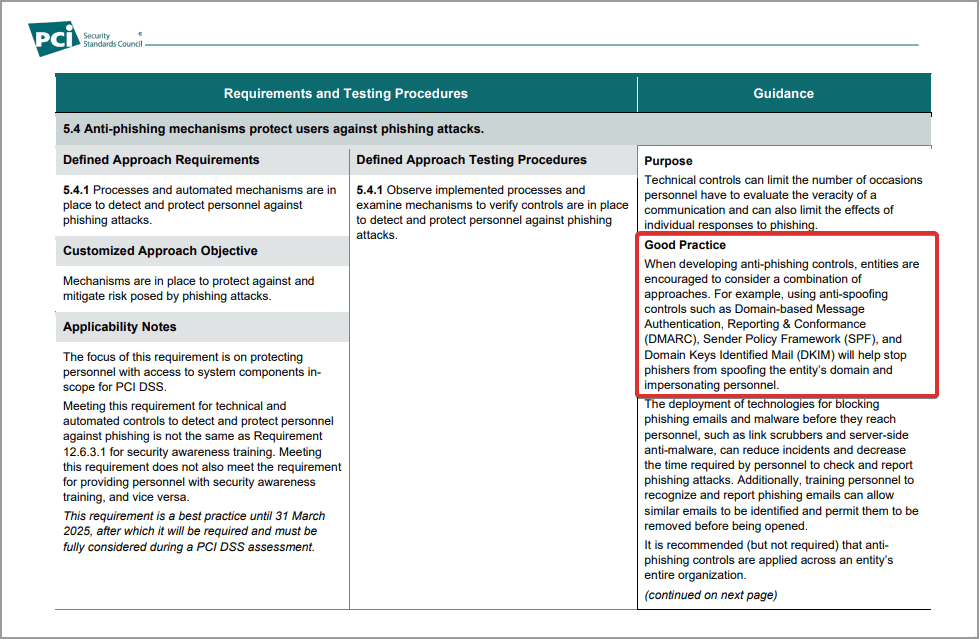
Guidance explains intent and offers examples. It does not create a testable requirement, which is why an assessor tests whether automated anti-phishing mechanisms exist and operate, not whether a _dmarc record is published.
PCI SSC identifies PCI DSS v4.0.1 in its document library as the current standard. Its v4.0.1 release announcement says the limited revision made no additions or deletions to the requirements, while also confirming that v4.0 was retired. This article explains the v4.0 clause behind the query. For a current assessment, work from v4.0.1 and the evidence requirements your assessor applies to the environment in scope.
DMARC is relevant because it lets a domain owner publish a policy for messages that use its visible From domain and fail DMARC evaluation. DMARC evaluation depends on an aligned pass for SPF or DKIM. A receiving system then considers the domain owner's requested policy alongside its own local handling rules. See the Palisade learning center for the broader email-security context.
That dependency is why the three records are assessed together rather than one at a time:
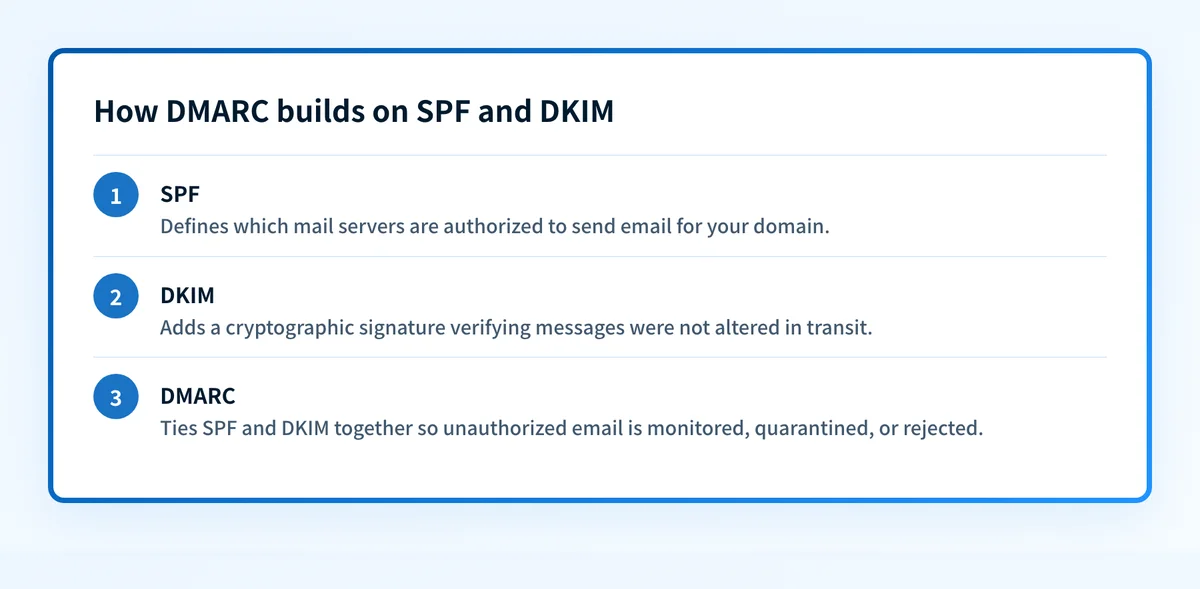
A DMARC record on a domain whose senders fail both SPF alignment and DKIM signing describes a policy that receivers will apply to legitimate mail.
A DMARC policy at p=quarantine or p=reject can reduce successful exact-domain impersonation where receivers apply the policy. It does not inspect the content of a message, determine whether a link is malicious, or stop a message from an attacker-owned lookalike domain. That distinction matters because requirement 5.4.1 concerns phishing protection for personnel, not only protection of a company's own domain from spoofing.
The PCI SSC Phishing Resource Guide discusses phishing controls, including email authentication, in the wider context of phishing defense. Use it as supporting context rather than treating an example control as a literal DMARC mandate.
Who requirement 5.4.1 applies to
Requirement 5.4.1 was listed as a future-dated best practice in PCI DSS v4.0, so assessments before March 31, 2025 could leave it out. That date has passed, and it is now assessed like any other requirement.
Scope follows the assessed environment rather than an industry label. It covers:
- Any entity or service provider that stores, processes, or transmits cardholder data (CHD) or sensitive authentication data (SAD).
- The people, processes, and system components involved in those flows.
- System components with unrestricted connectivity to systems handling CHD or SAD, even when they never touch that data themselves.
Merchants, acquirers, issuers, processors, and their vendors are all covered when they meet those conditions. Your assessor sets the final boundary for the environment in scope.
When the answer changes
The answer remains no if the question is whether PCI DSS 4.0 explicitly requires a DMARC record, a specific tag, or a specific enforcement policy. None is specified in requirement 5.4.1.
The operational answer changes when the question becomes whether DMARC is useful evidence for an anti-phishing control. In that case, DMARC can be relevant if the organization controls the From domain, publishes a valid record, and has verified that legitimate production senders authenticate with aligned SPF or DKIM.
Use this decision rule:
- If the goal is to show that a domain has published a DMARC policy, inspect the DNS record.
- If the goal is to show that an application sends authenticated mail, inspect a real delivered message from that application and its
Authentication-Resultsheader. - If the goal is to show protection against phishing generally, include the automated inbound controls that detect and protect personnel, not only outbound domain authentication.
- If the goal is an assessment conclusion, retain the evidence your assessor requires for the scoped environment.
A DNS result is not proof that a mail platform signs production messages, that receivers apply a requested policy, or that every phishing message is detected.
Requirement 5.4.1 should also not be confused with an SMTP reply code containing 5.4.1. The Microsoft 550 5.4.1 recipient-address guide and Microsoft SMTP relay-error guide concern message-delivery errors, not PCI DSS requirement numbering.
Worked evidence example for DMARC
A DMARC record is published as a DNS TXT record at the _dmarc name for the domain. This is illustrative only. Do not publish another organization's reporting address or reuse its values.
Host: _dmarc.yourdomain.com
Type: TXT
Value: v=DMARC1; p=quarantine; rua=mailto:dmarc-reports@yourdomain.com
This example gives useful evidence about one narrow point: yourdomain.com requests quarantine handling for messages that fail DMARC, and it requests aggregate reports at the listed address.
It does not establish that the reporting mailbox receives or processes reports. It also does not prove that each legitimate sender using yourdomain.com passes DMARC, that a receiver accepted the requested handling, or that inbound phishing defenses detect a lookalike domain.
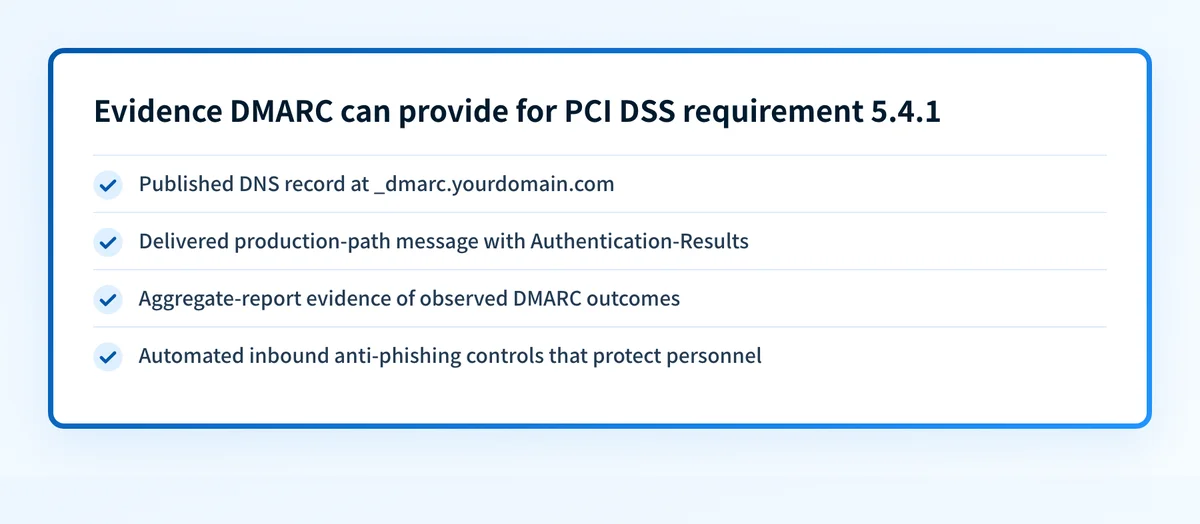
For a meaningful operating check, validate separate layers:
- DNS: query the authoritative DNS server and a public resolver for the intended record.
- Sending platform: confirm the platform's current domain-authentication status.
- Message: send a test message through the exact production path and inspect its
Authentication-Resultsfields. RFC 8601 defines this header field for communicating message-authentication results. - DMARC: review aggregate-report data after it has accumulated to identify sources and authentication or alignment failures.
Rolling out DMARC before an assessment
DMARC becomes useful evidence only once legitimate senders authenticate. Publishing an enforcing policy on a domain whose senders are not aligned tells receivers to act against your own mail, which is a worse outcome than publishing nothing.
Work through it in order:
- Inventory the sending domains in scope and check what each one publishes today with the DMARC checker and the Email Security Score.
- Publish
p=nonewith aruaaddress. Mail flow is unchanged, and aggregate reports start naming the sources sending as your domain. - Read the reports until every legitimate source is accounted for, then fix the SPF and DKIM gaps that surface. Third-party platforms sending on your behalf are the usual source of failures.
- Move to
p=quarantineand watch for legitimate mail landing in spam folders. - Move to
p=rejectonce report data stays clean.
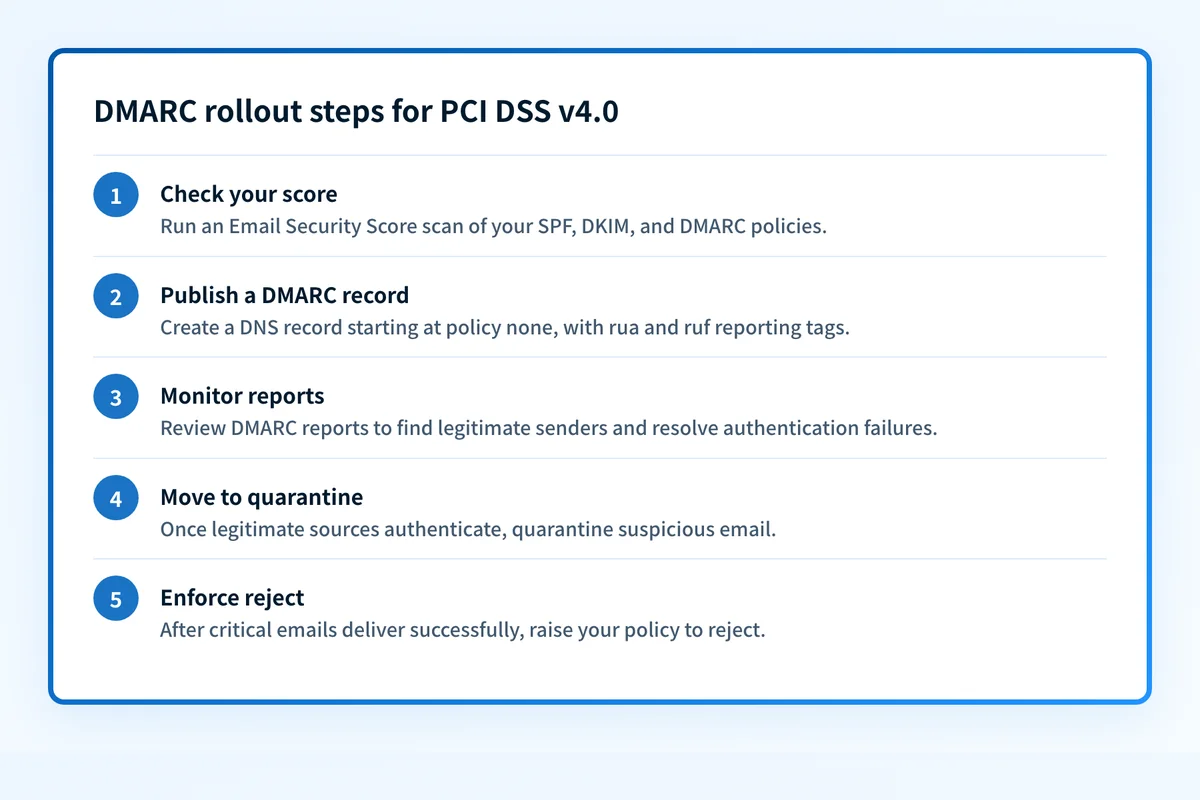
Steps 2 through 5 leave dated artifacts behind: the record as published, the report data behind each policy change, and the date each change took effect. That trail is more useful to an assessment than the record alone. Moving from quarantine to reject is the step to take slowly, and reading aggregate reports is what tells you when to take it.
What to do next
Start with the evidence you have.
If you only know the domain name, use the DMARC checker to inspect the public DMARC record and its policy tags. Compare the result with the record your organization intended to publish.
If you administer the sending path, send a controlled message through each important application, gateway, and provider. Preserve a redacted copy of the delivered headers and compare the visible From domain with SPF and DKIM results.
If you are preparing PCI DSS evidence, document the automated controls that protect personnel from phishing, their owners, and the evidence that they are operating in the relevant environment. DMARC can support that record, but it should remain scoped as an anti-spoofing measure rather than the entire requirement.
Check the DMARC record that supports your evidence
Run the sending domain through Palisade's DMARC checker to inspect the record currently visible in public DNS before comparing it with message-level evidence and your wider anti-phishing controls.
Check the published DMARC record
A public record check cannot prove that every production sender is aligned, repair a phishing-control gap, monitor future DNS changes, or establish a receiver's final message decision. For teams that need to inventory sending sources and work through DMARC remediation over time, Start with Palisade. Palisade analyzes DMARC aggregate-report data and proposes prioritized remediation work, while a human reviews the evidence and applies any change.
Evidence
Sources and further reading
Questions readers ask
Frequently asked questions
Does PCI DSS 4.0 require p=reject?
No. Requirement 5.4.1 does not prescribe DMARC or a specific DMARC policy value. A domain owner should validate legitimate sending sources before requesting stronger DMARC handling.
Is a DMARC record enough to satisfy requirement 5.4.1?
No. A DMARC record can support anti-spoofing controls, but requirement 5.4.1 concerns automated mechanisms that detect and protect personnel against phishing attacks. DMARC does not evaluate every phishing technique.
Does DMARC protect against lookalike domains?
No. DMARC evaluates mail using the visible From domain and its associated authentication results. It does not stop an attacker from sending from a separately registered lookalike domain.
What evidence shows that DMARC works for a production sender?
A public DNS lookup shows the published record. A delivered test message from the exact production path and its Authentication-Results header show whether that message authenticated. Aggregate reports provide later evidence about observed sending sources and DMARC outcomes.
Is p=none enough to satisfy an assessment?
A monitoring record shows the mechanism is published, but p=none requests no action on mail that fails DMARC. As an anti-spoofing measure it does less than quarantine or reject, both of which are worth reaching once legitimate senders are aligned. How the control is documented and scoped is what an assessment examines.
Does requirement 5.4.1 still apply if a third party sends our mail?
What DMARC evidence would an assessor look at?
The published _dmarc record, the policy in effect and the date it took effect, and aggregate-report data showing that authentication results are monitored. Pair those with a delivered-message check, because a DNS record on its own does not show that production mail authenticates.
Is PCI DSS requirement 5.4.1 the same as SMTP 5.4.1?
No. PCI DSS requirement 5.4.1 is an anti-phishing control requirement. SMTP 5.4.1 is part of message-delivery status-code terminology and has no connection to PCI DSS numbering.

Written by
Dominic LandryDeliverability & DNS
Dominic Landry works on email deliverability and DNS configuration at Palisade, from SPF and DKIM records through to DMARC enforcement.
More from Dominic →