Cloud based email security
 ChatGPT
 Claude
 Gemini
 Perplexity
 Grok
GrokIn brief
Cloud based email security adds a cloud-delivered protection layer around cloud mailboxes. Assess the controls included before selecting a service.
Cloud based email security is a cloud-delivered protection layer used with a cloud mailbox environment, such as Microsoft 365 or Google Workspace. In practice, the term does not describe one fixed set of controls or prove a particular security outcome. Treat it as a delivery model and confirm what the selected product and plan actually protect before relying on it.
At a glance
Quick takeaways
- Cloud based email security can supplement a cloud mailbox environment rather than replace it.
- A vendor's feature list is not evidence that every product includes the same controls.
- Inbound threats, outbound controls, human-risk features, and operational workflows need separate evaluation.
- Protection claims should be checked against the selected product and plan.
- Email-borne phishing, malware, and social engineering remain distinct email security threats.
- A domain or public posture check cannot prove what a production mailbox service blocks or permits.
How cloud based email security works
The available evidence supports a narrow, practical description: cloud-email security vendors can offer an additional protection layer around an existing cloud email service.
For example, Guardian Digital's cloud email security page says its solutions can bolster existing email protection in Microsoft 365, Google Workspace, and Microsoft Exchange. Guardian Digital also says its solutions protect against threats "from phishing to ransomware to zero-day attacks." Those are product-specific marketing claims, not a universal definition of cloud based email security or a guarantee of protection.
KnowBe4's Email Collaboration Security offering describes layered cloud defenses intended to block phishing, malware, and social-engineering attacks before inbox delivery. That supports an example of inbound cloud-email protection. It does not establish which controls every cloud security product uses, how each product is deployed, or how it will behave in a particular tenant.
The useful distinction is between the mailbox platform and the added security service. A mailbox platform provides email service. A cloud-based email-security product may add controls around that service, subject to its documented scope and configuration. Teams assessing wider cloud controls can also review how cloud security frameworks protect cloud environments.
When the answer changes
The answer changes when "cloud based email security" is used as shorthand for a specific product capability. The delivery model alone does not tell you whether the service covers inbound messages, outbound messages, employee-focused controls, or the operational work needed to investigate events.
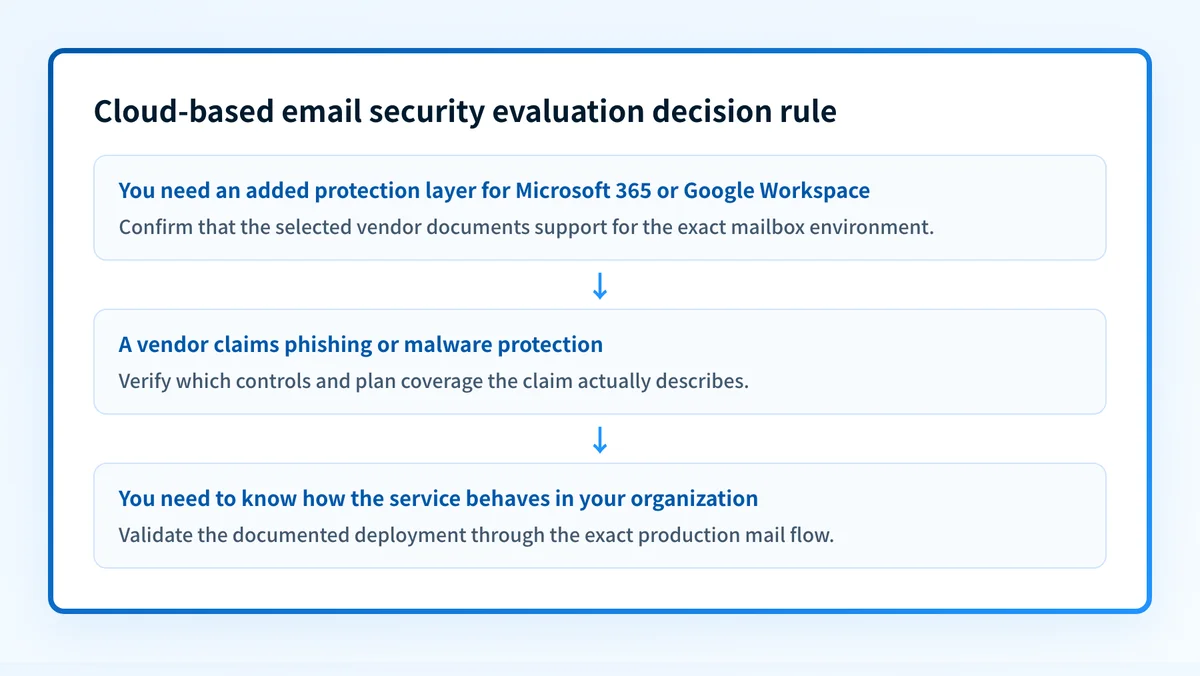
Use this decision rule:
- If the question is "Is this an additional cloud-delivered layer for our mailbox environment?", the vendor descriptions support that framing.
- If the question is "Will it stop a specific threat?", check the product's current documentation for that threat and the plan your organization is considering.
- If the question is "Does it protect our outbound mail or data?", do not infer an answer from an inbound phishing claim.
- If the question is "Will it work with our exact mail flow?", validate that through the vendor's documented deployment path and your own production testing.
- If the question is "Will it guarantee inbox placement or delivery?", the answer is no. Authentication and security controls can support safer email operations, but they do not control a receiver's private delivery decision.
A worked evaluation example
Suppose an IT team uses Google Workspace and is considering a cloud-based email-security service after seeing a vendor claim about phishing protection. The claim establishes only that phishing is within the vendor's stated scope. It does not establish that the service covers every phishing technique, every message path, or every mailbox configuration.
Record the evaluation as a set of questions rather than a broad "protected" status:
Environment: Google Workspace
Primary question: Does the selected service add documented phishing protection?
Vendor evidence: Product documentation for the exact service and plan
Required confirmation: Which inbound controls are included?
Separate questions: Are outbound controls included? Are human-risk features included?
Operational test: Validate the documented deployment in the organization's own mail flow
The example is a decision record, not a configuration. It keeps a vendor claim tied to the condition it supports.
A security team should also keep email authentication separate from threat protection. DMARC, SPF, and DKIM help receivers evaluate whether a message is authorized to use a domain. They do not establish that a cloud security service will detect all malicious content or make a receiver deliver a message. For adjacent context, see whether DMARC failure reports are worth the trouble for email security.
Assess the next evidence you need
Start with the evidence already available:
- If you have a vendor name and plan, review its official documentation and identify the controls it explicitly includes.
- If you have a public domain and need a broad starting point, use the Palisade email security score to inspect the available result before treating additional controls as a substitute for basic email security hygiene.
- If you need a broader foundation before comparing products, read Palisade's email security guide.
- If you are assessing a named product, keep that evaluation tied to the vendor's current documentation. A page about Abnormal email security is a separate product-specific research path.
Build the evaluation around your actual mailbox risk
A cloud-delivered security service should be assessed against the cloud mailbox environment and the specific control area you need to verify. Start with the vendor's documented coverage, then separate inbound, outbound, human-risk, and operational requirements before treating a product claim as a control decision.
An educational guide cannot verify a vendor configuration, prove that a service will block a specific message, or replace testing in your production mail flow.
Evidence
Sources and further reading
Questions readers ask
Frequently asked questions
Is cloud based email security a replacement for a cloud mailbox platform?
No. It can supplement a cloud mailbox environment with an additional protection layer, subject to the selected product's documented scope and configuration.
Does a vendor feature list prove that every product includes the same controls?
No. Product-specific claims do not establish a universal definition or show that every service includes the same controls.
Does inbound phishing protection prove that outbound mail or data is protected?
No. Inbound, outbound, human-risk, and operational controls need separate evaluation.
Can a public domain or email security score prove what a production mailbox service blocks?
No. A public score or DNS result cannot prove which cloud-email controls are active, how a specific message was handled, or what a receiving system will decide later.
Will cloud based email security guarantee inbox placement or delivery?
No. Authentication and security controls can support safer email operations, but they do not control a receiver's private delivery decision.

Written by
Samuel ChenardCEO & Co-Founder, Palisade
Samuel Chenard is the CEO and co-founder of Palisade, agentic DMARC software for IT teams and MSPs, from one domain to thousands.
More from Samuel →