

HaloPSA DMARC integration
Palisade integrates with HaloPSA on MSP accounts to import client domains, create DMARC tickets and synchronize software-license counts. Connect an API-only agent, map HaloPSA customers to Palisade groups, and choose the ticket workflow your technicians use.
By Samuel Chenard, Palisade
Last verified: · Documentation and connector review
On this page
What data flows between Palisade and HaloPSA?
Palisade reads HaloPSA clients and configuration for import and mapping. Palisade sends DMARC task updates and billable domain quantities to the linked HaloPSA records.
| Data | Direction | What happens |
|---|---|---|
| Customers and contact domains | HaloPSA → Palisade | Read customers and users/contacts at each customer’s main site to discover domains from their email addresses. |
| Ticket configuration | HaloPSA → Palisade | Read ticket types, teams, statuses and priorities for mapping in Palisade. |
| DMARC tickets and updates | Palisade → HaloPSA | Create tickets for mapped customers and send task status and priority updates to the linked HaloPSA tickets. |
| Software-license count | Palisade → HaloPSA | Create or reuse the customer’s Palisade software license and synchronize its count with the mapped group’s billable domains. |
Two-way synchronization between Palisade and HaloPSA refers to these different data flows. It does not mean that every ticket field is mirrored in both directions.
How are HaloPSA customers and domains imported?
HaloPSA customers map to groups within your Palisade MSP account. Palisade uses that mapping to put imported domains under the correct client and associate new tickets with the right HaloPSA customer.
Domain discovery reads users/contacts at the customer’s main site. The HaloPSA API application and the agent it runs as both need access to Users/Contacts. A customer without a main site or usable contact email addresses may have no domains to import. Review the results and add missing domains directly in Palisade.
Each HaloPSA client mapping uses a Palisade group to keep its domains together. Review the group and its imported domains before activating the client’s service.
How do HaloPSA tickets and statuses stay connected?
Palisade creates HaloPSA tickets using your selected ticket type and support team, then sends mapped task status and priority updates. New tickets carry the mapped customer, status and priority, the task’s details and a link back to Palisade.
A new Palisade task must hold its state for four hours before it is pushed to HaloPSA. The domain must belong to a group mapped to a HaloPSA customer, and the task type must be enabled for ticket creation. A task that resolves within that window creates no ticket.
Ticket status updates run from Palisade to HaloPSA. Closing a ticket in HaloPSA does not resolve the Palisade task. Resolve the task in Palisade or fix the underlying DNS record, and Palisade moves the linked ticket to your mapped Done status on its next push. Updates to an existing ticket do not wait another four hours.
The HaloPSA status mapping needs to cover deferred and dismissed work as well as open and completed tasks, so your queue reflects how each task is being handled in Palisade.
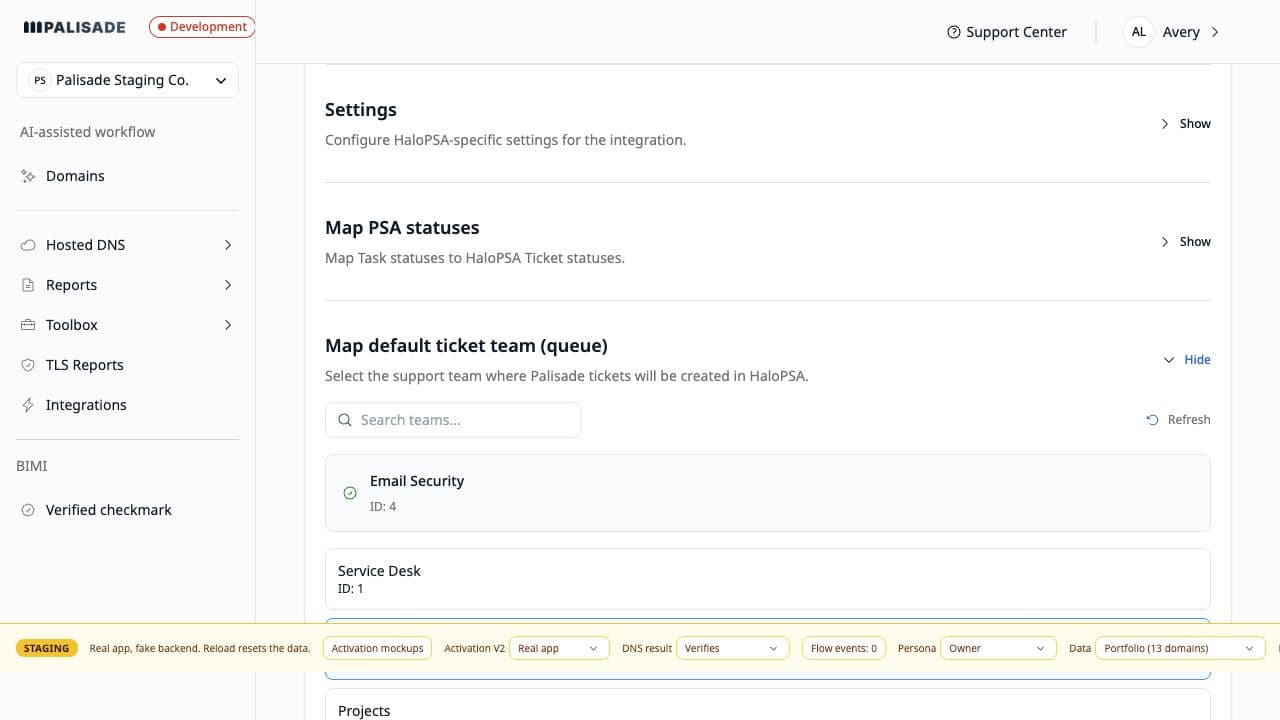
The HaloPSA task configuration guide covers the ticket destination and mappings. Palisade’s task-type controls determine which new tasks open HaloPSA tickets: disabling a type stops new tickets, existing tickets keep receiving updates, and re-enabling a type does not backfill earlier tasks.
The Palisade DMARC agent investigates issues and prepares fixes. Your technician reviews and approves DNS or policy changes; the HaloPSA ticket tracks the work.
What does HaloPSA license synchronization update?
The HaloPSA connector uses a software license named Palisade for each mapped customer. During client synchronization, Palisade creates or reuses that license and stores its association with the client’s Palisade group.
With billing sync enabled, Palisade updates the license count to match the group’s billable domains. This is the quantity supplied to your HaloPSA billing workflow. Configure and verify your own recurring billing and invoice rules in HaloPSA before billing the client.
The HaloPSA API identity needs Software Licences access to read or create the client license during client synchronization and update its count during billing sync. Billing sync can be paused while task updates continue. Review the license count and integration logs after a billable domain change.
Which Palisade plans support HaloPSA?
The HaloPSA connector requires a Palisade MSP account. MSPs pay $9 per client domain per month for up to 100 client domains, $7 up to 1,000, and $5 beyond. New MSP accounts are billed for a minimum of 5 client domains. Your own MSP domain is included as a free Not-For-Resale license. MSP rates apply to client domains you manage for other organizations; your own organization's domains belong on an IT-team plan.
IT-team accounts need MSP enrollment to use PSA integrations. Explore the MSP program or see how MSP pricing works.
What is required to set up HaloPSA?
HaloPSA setup requires a Palisade MSP account, an API-only agent, and a Client ID/Secret API application. Both the application and its agent need the customer, user/contact and ticket access used by the connector; client synchronization also needs software-license read/create access. Keep credentials in your team’s credential manager and enter them only in the integration’s credential form.
- API-only agent
- Create an API Agent in Configuration > Agents and assign its team and department. Use this agent as the API application’s login identity.
- Tickets
- Read and modify tickets; add new tickets and view unassigned and other agents’ tickets. Allow the ticket type and team used for Palisade work.
- Customers and Users/Contacts
- Read customers and users/contacts, including contacts at the customer’s main site. Apply the access to both the application and its agent.
- Software Licences
- Read and create/update the customer’s Palisade software license for quantity synchronization.
The HaloPSA technical guide provides the credential fields and configuration screens. Work through these steps with one test client first.
- Create the HaloPSA API identity.
Create an API-only agent under Configuration > Agents. Grant ticket, customer and user/contact access. Allow software-license reads and creation for client synchronization, plus updates for billing quantities.
- Create an API application.
In Configuration > Integrations > HaloPSA API, create an application using Client ID and Secret authentication. Set it to log in as your API agent and record the Client ID and Client Secret securely.
- Connect the original HaloPSA host.
Select HaloPSA in Palisade Integrations. Enter your original HaloPSA hostname without https:// or /api, plus the Client ID and Client Secret. Use the HaloPSA-provided host rather than a custom domain.
- Map and verify one client.
Choose the ticket type, support team, statuses and priorities. Map a customer to a Palisade group, inspect the imported domains and verify the linked ticket and software-license quantity before extending the rollout.
What should you verify before rolling out to clients?
Start with a test client in HaloPSA and confirm the mapping, ticket and billing results your team will rely on.
- The API application and its agent can read the mapped customer’s main-site contacts, and the expected domains appear in Palisade.
- A Palisade task that has held its state for four hours creates a HaloPSA ticket for the mapped customer, type and team; resolving the task in Palisade updates the linked ticket to the mapped Done status on the next push.
- The customer’s Palisade software-license count matches the group’s billable domains, and your HaloPSA billing rules use that quantity as intended.
HaloPSA integration FAQ
When does a Palisade task create a HaloPSA ticket?
A new Palisade task must hold its state for four hours before Palisade pushes it to HaloPSA. The domain must belong to a group mapped to a HaloPSA customer, and the task type must be enabled for ticket creation. Tasks that resolve within that window create no ticket.
Does closing a HaloPSA ticket resolve the Palisade task?
Closing a HaloPSA ticket does not resolve the Palisade task. Ticket status sync runs from Palisade to HaloPSA. Resolve the task in Palisade or fix the underlying DNS record, and Palisade moves the linked ticket to your mapped Done status on its next push.
Does Palisade integrate with HaloPSA for DMARC?
Palisade integrates with HaloPSA on MSP accounts. The connector imports client domains from contact email addresses, creates DMARC task tickets, sends mapped task updates and synchronizes Palisade software-license quantities.
Which Palisade plan supports HaloPSA?
HaloPSA integration requires a Palisade MSP account. Enroll in the MSP program to use the connector; IT-team accounts do not by themselves enable PSA integrations.
Why does HaloPSA connect but import no client domains?
HaloPSA domain discovery needs a customer main site and readable users/contacts with email addresses. Check both the API application and its agent for Users/Contacts access, then review the client-to-group mapping and retry domain import.
Does Palisade create HaloPSA invoices?
Palisade updates the mapped customer’s Palisade software-license count from billable domains. Your HaloPSA billing configuration determines how that quantity is used on invoices. Verify the license and billing rules together before invoicing.
Sources and related integration guides
- HaloPSA technical documentation: credentials, configuration and setup checks.
- Compare all Palisade PSA integrations.
- ConnectWise PSA integration: data flow and setup.
- Autotask integration: data flow and setup.