
DMARCAnalyzer vs Palisade in 2026
DMARCAnalyzer, now presented by Mimecast as DMARC Analyzer, is a cloud service for DMARC reporting, domain visibility, guided setup, and policy monitoring. Palisade takes an agentic approach: its AI agent investigates senders, drafts SPF and DKIM fixes, and proposes each move toward p=reject for your approval.
Our verdict: Pick DMARCAnalyzer if you want Mimecast's SaaS reporting and guided DMARC program, with optional expert services and Mimecast platform integration. Pick Palisade if you want an AI agent to carry the investigation and authentication work through each approved enforcement step.
 Samuel Chenard · CEO & Co-Founder, PalisadeSource checks through 2026-10-13
15-day full-product trial. Nothing is charged until it ends.
 ChatGPT
 Claude
 Gemini
 Perplexity
 Grok
Grok DMARCAnalyzer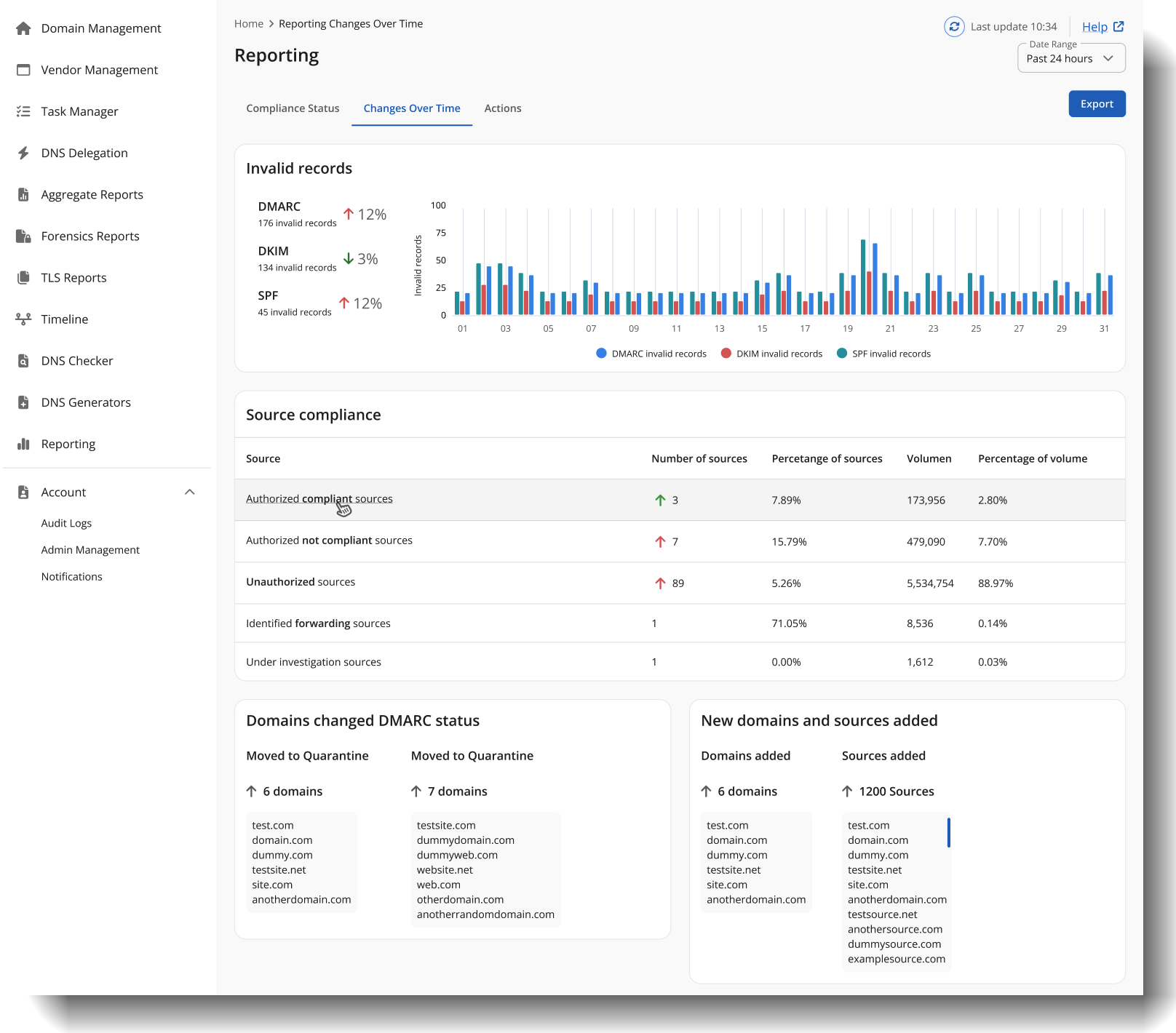
 Palisade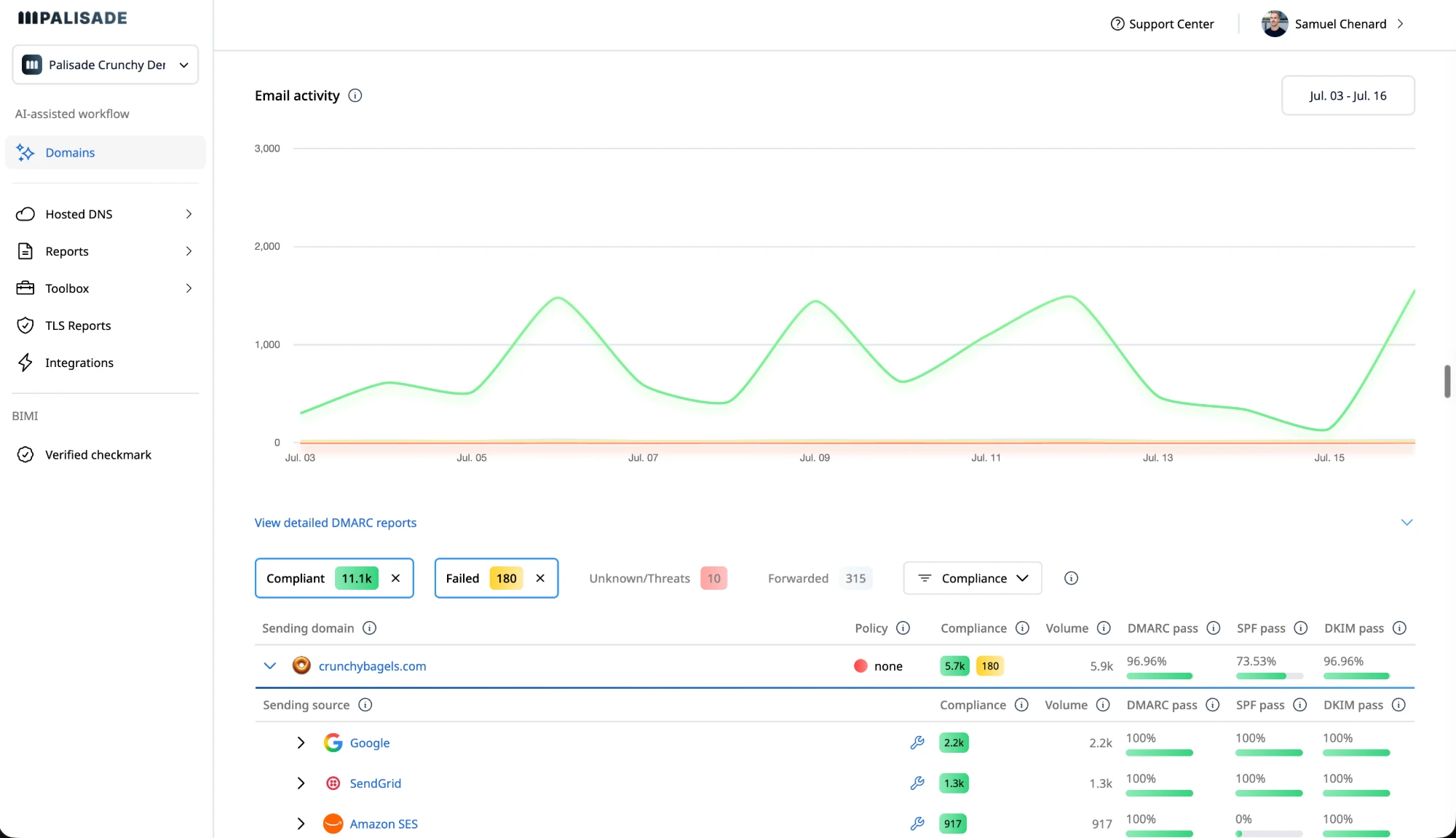
Full rubric · 8/8 dimensions established
Palisade's IT-team plans start at $19 a month, sized by email volume. Start with a 15-day full-product trial; nothing is charged until it ends.
Which one is right for you?
Best for Teams already standardizing on Mimecast
Best for MSPs and IT teams responsible for multiple domains
- The documented DMARCAnalyzer workflow and commercial terms match your operating requirements.
- Your buying criteria center on vendor-specific enterprise requirements.
- You want aggregate, forensic, and TLS reporting, sending-source visibility, charts, alerts, and a setup wizard in one console.
- You are already standardizing on Mimecast and want DNS delegation for centralized SPF, DKIM, and DMARC management.
- You run an MSP, or an internal IT or security team, responsible for multiple domains.
- You want an AI agent to investigate issues, configure authentication, and move domains toward p=reject.
- Teams already using Claude, OpenAI, or other AI tools can bring the same agent-led operating model to DMARC.
IT-team plans start at $19 a month, sized by email volume. Start with a 15-day full-product trial; nothing is charged until it ends.
Where the day-to-day work actually differs
| Feature | DMARCAnalyzer | Palisade |
|---|---|---|
| Enforcement | ||
| AI agent that investigates senders, drafts SPF/DKIM fixes, and proposes each step toward p=rejectWhether the tool investigates senders and prepares fixes for approval.Mimecast advertises self-service tools, a recommendation engine, and optional expert guidance; it does not advertise an AI enforcement agent that drafts and carries each policy step for approval (checked 2026-08-26). Source (2026-08-26) Source 2 (2026-08-26) | —Not advertised | Agent drafts and proposes |
| Reporting & analysis | ||
| DMARC aggregate report monitoring with sending-source visibilityWhether aggregate reports show sending sources and compliance status.Mimecast describes aggregate reports, charts, traffic volume, compliance status, and visibility into who sends on an organization's behalf (checked 2026-08-26). Source (2026-08-26) Source 2 (2026-08-26) | Charts and source visibility | Agent analyzes reports |
| Forensic failure reports with message-level detailWhether failure reports expose message-level detail for investigation.Mimecast advertises forensic reports for tracking malicious email sources and lists forensic reports among its advanced reporting surfaces (checked 2026-08-26). Source (2026-08-26) Source 2 (2026-08-26) | Forensic reports | Aggregate reports only |
| TLS reporting alongside DMARC reportingWhether TLS reporting appears beside DMARC reporting.Mimecast's current DMARC Analyzer page lists aggregate, forensic, and TLS reports, and its product announcement describes SMTP TLS reporting as part of the rebuilt service (checked 2026-08-26). Source (2026-08-26) Source 2 (2026-08-26) | TLS and DMARC reports | Included reporting |
| Hosted records & DNS | ||
| DMARC record setup wizard and SPF/DKIM/DMARC checker toolsWhether setup guidance and checks assess authentication-record readiness.Mimecast advertises a DMARC record setup wizard and standalone SPF, DKIM, BIMI, and DMARC checkers for record health and enforcement readiness (checked 2026-08-26). Source (2026-08-26) Source 2 (2026-08-26) | Setup wizard and checkers | Agent prepares records |
| Delegated hosting or management of SPF, DKIM, and DMARC recordsWhether the service manages delegated authentication records.Mimecast's DMARC Analyzer announcement describes DNS delegation for centralized SPF, DKIM, and DMARC management, with the platform maintaining delegated records (checked 2026-08-26). Source (2026-08-26) | DNS delegation | Hosted on managed DNS |
| MSP operations | ||
| DNS-change monitoring, alerts, summary reports, and two-factor authenticationWhether DNS changes, alerts, summaries, and account security are covered.Mimecast advertises DNS-change prompts, automated alerts, daily and weekly summary reports, and two-factor authentication in its DMARC policy material (checked 2026-08-26). Source (2026-08-26) | Prompts, alerts, and 2FA | Agent alerts on tickets |
| API for compliance, domain, source, DNS, and task workflowsWhether an API supports domain, DNS, and task workflows.Mimecast publishes a DMARC Analyzer API with compliance, domain, DNS, and task resources; its public developer pages document authenticated API operations (checked 2026-08-26). Source (2026-08-26) Source 2 (2026-08-26) | Authenticated API operations | Included on every plan |
| Native ConnectWise, HaloPSA, and Autotask integrations for DMARC operationsWhether named PSA tools connect to DMARC operations.Mimecast's public DMARC Analyzer and product pages do not advertise native ConnectWise, HaloPSA, or Autotask integrations for DMARC operations (checked 2026-08-26). Source (2026-08-26) | —Not advertised | Native PSA integrations |
| Limits & metering | ||
| Public per-domain or plan-level pricing for DMARC AnalyzerWhether buyers can review published pricing before contacting sales.Mimecast's current DMARC Analyzer page offers a free-trial CTA but does not publish a DMARC Analyzer price or plan matrix (checked 2026-08-26). Source (2026-08-26) | —Not published | Published IT plan prices |
| AI and automation access | ||
| Documented API for programmatic DMARC Analyzer accessWhether customer software can reach DMARC Analyzer data without working only in the dashboard.Mimecast's DMARC Analyzer reference documents an HTTP task endpoint and OAuth 2.0 bearer authentication through the client credentials flow. The public page does not state which DMARC Analyzer plans include API access (checked 2026-08-27). Source (2026-08-27) | OAuth API reference | REST API published |
| MCP server for connecting AI assistants to DMARC dataWhether an AI assistant can reach the product's data directly.Mimecast does not advertise an MCP server or an AI-assistant integration for DMARC Analyzer in its current product announcement (checked 2026-08-27). The listed additions are DNS delegation, SMTP TLS reporting, onboarding, and in-app summary reporting; Mimecast's community index names an MCP server for Incydr. Source (2026-08-27) Source 2 (2026-08-27) | —No DMARC MCP listed | MCP server published |
| Advertised AI workflow for DMARC remediationWhether the vendor advertises AI that investigates senders or prepares authentication changes.Mimecast does not advertise an AI feature for sender investigation or DNS-change drafting in its DMARC Analyzer product page (checked 2026-08-27). The page describes self-service tools, a recommendation engine, and optional expert guidance, but does not call those functions AI or say they draft changes. Source (2026-08-27) | —No AI workflow listed | Agent drafts fixes |
Want to compare the workflow yourself? Start a 15-day full-product trial of Palisade.
Where Palisade and DMARCAnalyzer actually differ
Each argument keeps the product screens, sourced comparison points, and supporting analysis together.
Reporting breadth vs agent execution
Reporting parity is real; the handoff after a finding differs
DMARCAnalyzer is not just a DNS lookup page. Mimecast describes a cloud service with aggregate reports, forensic reports, traffic and compliance views, sending-source visibility, alerts, charts, and a user-facing console with filters and recommendations. The product page also lists TLS reports, so a team assessing email-authentication posture can keep DMARC and transport-security signals in one reporting workflow. Those are genuine areas of parity with Palisade's monitoring surface. Source (2026-08-26) Source 2 (2026-08-26)
DMARCAnalyzer

Palisade
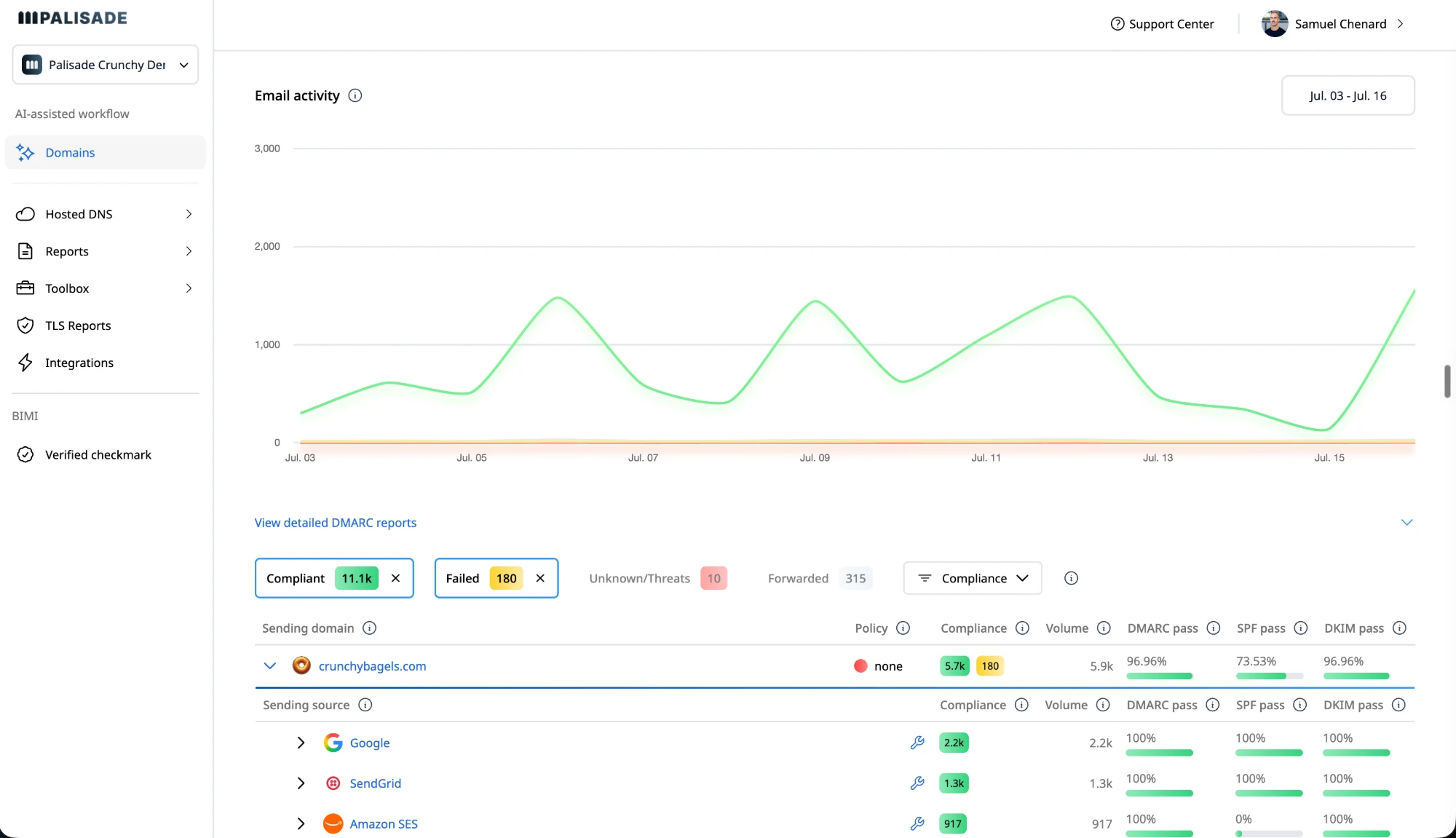
- AI agent that investigates senders, drafts SPF/DKIM fixes, and proposes each step toward p=reject: Agent drafts and proposes
The difference appears when a report identifies a sender that needs work. Mimecast's public material describes a setup wizard, recommendation engine, self-service tools, and optional active monitoring by Mimecast experts. It does not advertise an AI agent that identifies the sender, drafts the SPF or DKIM change, and carries the domain through policy steps for customer approval (checked 2026-08-26). Palisade's agent is designed around that handoff: it does the investigation and drafting, while the customer remains the release gate. Source (2026-08-26) Source 2 (2026-08-26)
Guided setup vs agent preparation
Mimecast's guided path includes DNS delegation
Mimecast's January 2026 product announcement adds an important qualification to the older setup-wizard description. It says DMARC Analyzer supports DNS delegation so customers can centralize management of SPF, DKIM, and DMARC records in the platform, configure delegation once, and have the service maintain those records. The same announcement says the rebuilt service uses Mimecast's AWS architecture, offers data-residency controls, and gives Mimecast customers access through the Mimecast Administration Console with single sign-on and role-based access control. Source (2026-08-26)
DMARCAnalyzer

Palisade
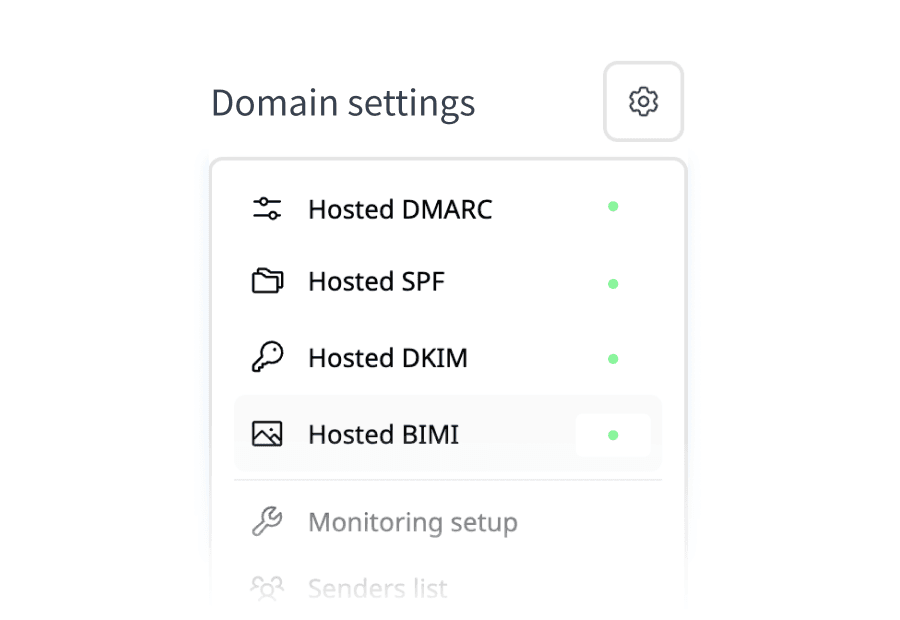
- DMARC record setup wizard and SPF/DKIM/DMARC checker tools: Agent prepares records
- Delegated hosting or management of SPF, DKIM, and DMARC records: Hosted on managed DNS
That is a reasonable fit for an organization already standardizing on Mimecast and comfortable making a vendor part of its authentication-management path. It is still a guided operating model in the public documentation: the service supplies visibility, recommendations, delegation, and optional experts, while the page does not describe an AI agent that independently turns report findings into approved DNS changes. Palisade also offers hosted records and Smart DNS Deployment through the customer's DNS provider, but its differentiator is that the agent prepares the work for review instead of creating another queue of recommendations. Source (2026-08-26) Source 2 (2026-08-26)
API access vs commercial clarity
DMARC Analyzer API access and commercial scope
Mimecast publishes a DMARC Analyzer developer surface rather than leaving automation as an implied promise. The public API documentation includes compliance endpoints that identify domains eligible for enforcement, schemas for source statistics, DNS record values, and domain status, plus task resources with types such as DNS, DMARC compliance, source, and DNS delegation. That should interest teams building their own reporting, governance, or workflow layer around Mimecast data. Source (2026-08-26) Source 2 (2026-08-26)
DMARCAnalyzer

- DNS-change monitoring, alerts, summary reports, and two-factor authentication: Prompts, alerts, and 2FASource
- API for compliance, domain, source, DNS, and task workflows: Authenticated API operationsSource 1, Source 2
- Native ConnectWise, HaloPSA, and Autotask integrations for DMARC operations: Not advertisedSource
Palisade
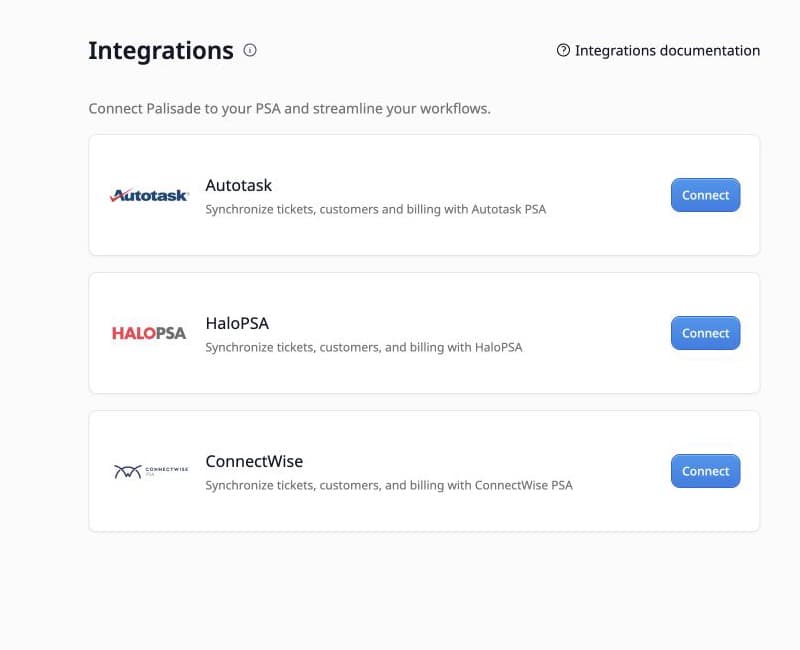
- DNS-change monitoring, alerts, summary reports, and two-factor authentication: Agent alerts on tickets
- API for compliance, domain, source, DNS, and task workflows: Included on every plan
- Native ConnectWise, HaloPSA, and Autotask integrations for DMARC operations: Native PSA integrations
What a buyer cannot establish from public material is the packaging: Mimecast does not publish a DMARC Analyzer plan table that says which customers receive API access, how usage is metered, or whether the API carries a separate charge (checked 2026-08-26). That is why this profile marks API parity as a capability but does not claim API access on every plan. Palisade publishes API access on every plan, so the decision is whether you want a documented Mimecast API whose commercial terms are confirmed in sales, or a published inclusion you can plan around. Source (2026-08-26) Source 2 (2026-08-26)
Quote pricing vs published rates
Pricing and MSP fit require a direct quote
Mimecast does not give a public DMARC Analyzer rate card on the current product page. The page invites visitors to start a DMARC free trial and describes capabilities, but it does not state a price, plan names, billing period, included domain count, message-volume threshold, or retention schedule. That makes DMARCAnalyzer difficult to compare on software spend alone. An MSP or internal team should ask Mimecast to quote the exact number of domains, reporting volume, data residency, API access, DNS delegation, and any managed-service component needed. Source (2026-08-26)
DMARCAnalyzer
A relevant product screenshot was not available in the reviewed evidence.
- Public per-domain or plan-level pricing for DMARC Analyzer: Not publishedSource
Palisade
A relevant product screenshot was not available in the reviewed evidence.
- Public per-domain or plan-level pricing for DMARC Analyzer: Published IT plan prices
Palisade publishes a different commercial model. IT teams choose a flat monthly email-volume tier starting at $19/month, with a set-up-domain allowance by tier and free, unlimited domain adding. MSP pricing is per client domain based on portfolio size, with a minimum of 5 client domains, no client email metering, and a free NFR domain. The practical comparison is therefore not only quote versus published rate: it is also whether your technicians will operate a guided program themselves, buy Mimecast expertise, or have Palisade's agent perform the investigation and configuration work before each approved change. Source (2026-08-26)
What each side charges
Three points on each published range: the cheapest plan, one in the middle, and the top of what the vendor publishes. Every plan on both sides is in the pricing section further down.
- DMARC AnalyzerCustom (contact sales)
Aggregate, forensic and TLS reports; DMARC record setup wizard; recommendation engine; and access through Mimecast's current no-charge trial offering
- DMARC Analyzer with managed services (opt-in)Custom (contact sales)
Adds Mimecast experts who guide setup through to full DMARC enforcement, with deployment and management expertise
- IT teams: up to 100,000 emails/mo$19/mo ($15/mo billed annually)
2 set-up domains (adding is unlimited), unlimited retention, every core feature
- IT teams: up to 1,000,000 emails/mo$99/mo ($79/mo billed annually)
Same product: 10 set-up domains, pick the tier that matches your sending
- Enterprise (more than 2.5M / month)Custom
Custom volume, retention, and terms
Dashboard access vs programmatic access
Mimecast's DMARC Analyzer API, with its published MCP server for Incydr
Mimecast publishes a DMARC Analyzer API. Its public reference documents a task-details HTTP endpoint and OAuth 2.0 bearer authentication through client credentials. The task schema covers DNS, DMARC compliance, source, and DNS-delegation work. The reference does not state which DMARC Analyzer plans include API access, so that commercial term still needs confirmation from Mimecast. Source (2026-08-27)
DMARCAnalyzer

Palisade
A relevant product screenshot was not available in the reviewed evidence.
- Documented API for programmatic DMARC Analyzer access: REST API published
- MCP server for connecting AI assistants to DMARC data: MCP server published
- Advertised AI workflow for DMARC remediation: Agent drafts fixes
Mimecast's DMARC Analyzer page describes self-service tools, a recommendation engine, and optional expert guidance. Mimecast's broader FAQ calls the platform AI-powered, but it lists DMARC Analyzer as domain-spoofing prevention rather than assigning it an AI workflow. Its community index names an MCP server for Incydr, while the current DMARC Analyzer announcement does not advertise an MCP server or AI-assistant integration for this product (checked 2026-08-27). Source (2026-08-27) Source 2 (2026-08-27) Source 3 (2026-08-27) Source 4 (2026-08-27)
Palisade publishes an MCP server and a REST API. Its agent investigates senders, drafts SPF and DKIM fixes, and proposes each policy step. A human approves before anything ships.
Reachable from your own AI tools
Palisade's MCP server exposes 42 tools over OAuth, so the assistant your team already uses can read domains, pull the exact records to publish and work the task queue. These are the clients the connection guide walks through.
- ChatGPT
- Claude
- Codex
- Cursor
- Windsurf
- Any MCP client





Still deciding between DMARCAnalyzer and Palisade? See what changes with Palisade.
15-day full-product trial. Nothing is charged until it ends.


 Microsoft 365
 Zoho Mail

The agent does the heavy lifting
Sources identified, SPF and DKIM fixes drafted, each policy step proposed. You approve; nothing ships on its own.
Connect your AI with MCP
42 tools over MCP, so your assistant reads your domains and works the queue.
Connect your DNS manager directly


One-time sign-in supports 64 providers without retaining credentials. Optional account connections support Cloudflare, GoDaddy and Route 53. You approve every change.
“We evaluated many DMARC providers before choosing Palisade. The quality of their product, the responsiveness and friendliness of their team and their rapid progress on their product roadmap made it a no-brainer for us to move forward.”
DMARCAnalyzer pricing explained (and how Palisade compares)
DMARCAnalyzer's original domain now routes into Mimecast's DMARC Analyzer product page. Mimecast publishes the product's capabilities and a free-trial CTA, but the public pages checked on August 26, 2026 do not publish a price, billing interval, domain allowance, or plan matrix.
What you'd actually pay
The same five buyer sizes on every comparison, so a shape carries from one page to the next.
1 domain, up to 1,000 emails a month
2 set-up domains, up to 100K emails a month
10 set-up domains, up to 1M emails a month
20 set-up domains, up to 2.5M emails a month
Client domains under management, any volume
Palisade’s figures are derived from its published tiers. DMARCAnalyzer pricing or licensing source reference: vendor source citation date 2026-08-28. Plans and prices may have changed since.
How DMARCAnalyzer prices
- Mimecast publishes no DMARC Analyzer prices; the product and trial pages route buyers to 'Get a Quote' (checked 2026-07-18).
- Mimecast does not publish a DMARC Analyzer plan-by-plan rate card or a public scope for quoted subscriptions.
- The current free-trial page states that the no-charge trial runs for 30 days and includes DMARC Analyzer; it does not establish a standalone product price.
- The 2024 product datasheet publishes data retention up to 365 days. Current pricing does not itemize retention by subscription tier; confirm the quoted allowance.
How Palisade prices
- Palisade publishes flat monthly IT-team plans sized by email volume, starting at $19/month with 2 to 20 set-up domains by tier; adding domains is free and unlimited, and annual billing is 20% lower.
- Palisade MSP pricing is per client domain with a rate that improves as the portfolio grows and a minimum of 5 client domains. Client email volume is not metered, and the MSP's own domain is included as a free Not-For-Resale license.
- Palisade includes API access on every plan and offers a 15-day full-product trial.
- Palisade's agent investigates senders, configures SPF and DKIM, and proposes policy steps toward p=reject; your team reviews each change before it ships.
DMARCAnalyzer source reference: primary reference citation date 2026-08-30.DMARCAnalyzer source reference: additional source reference citation date 2026-10-13.Palisade source reference: the public pricing page citation date 2026-08-30.Plans and prices may have changed since.
Start a 15-day full-product trial of Palisade. Nothing is charged until it ends.
What each one covers, and where it stops
Published facts only, read from each vendor's own material. Neither column describes a hands-on trial, because we have not run one.
DMARCAnalyzer, now presented by Mimecast as DMARC Analyzer, is a cloud service for DMARC reporting, domain visibility, guided setup, and policy monitoring. It brings aggregate, forensic, and TLS reports together with sending-source visibility, charts, alerts, and a record setup wizard for teams assessing their email-authentication posture.
The service is aimed at teams that want a guided DMARC program within the Mimecast platform, including organizations that centralize SPF, DKIM, and DMARC record management through DNS delegation. Mimecast documents an authenticated API, while its public pages do not publish a price, billing interval, domain allowance, or plan matrix.
Palisade is built around an agent that does the DMARC work rather than reporting on it. It identifies every sending source, drafts the SPF and DKIM changes each one needs, and proposes the next policy step when the evidence supports it.
The agent investigates every sender, drafts every fix, and proposes each policy step, you approve before anything ships.
- Provides charts and sending-source visibility for DMARC reports
- Provides forensic reports with message-level detail
- Provides TLS reports alongside DMARC reporting
- Provides a DMARC record setup wizard and authentication checkers
- Supports DNS delegation for centralized SPF, DKIM, and DMARC management
- The agent investigates senders and drafts the fix, so the work arrives prepared rather than as a list of findings
- Hosted SPF, DKIM and DMARC records, so an approved change can be carried out rather than handed off
- Portfolio workflow for MSPs, with ConnectWise, HaloPSA and Autotask integrations and a free NFR domain
- An MCP server and a REST API, so the same data and workflow are reachable from the AI tools a team already uses
- Does not advertise an AI enforcement agent that drafts SPF and DKIM changes or carries policy steps for approval
- Does not advertise native ConnectWise, HaloPSA, or Autotask integrations for DMARC operations
- Does not publish per-domain or plan-level DMARC Analyzer pricing
- Does not advertise an MCP server for connecting AI assistants to DMARC data
- Every policy change waits for a human approval, by design: nothing ships on the agent's own authority
- MSP pricing is portfolio-based per client domain, with a minimum of 5 client domains
- Plans are sized by monthly email volume, so a low-domain, high-volume sender lands on a higher tier than domain count alone suggests
- Starts at
- Not published; contact Mimecast
- Free trial
- 30-day Cloud Integrated trial includes DMARC Analyzer
- Billing interval
- Not published
- Domain allowance
- Not published
- Managed service price
- Not published
- Starts at
- IT plans from $19/mo by email volume; 15-day trial
- Trial
- 15 days, full product
- MSP model
- Portfolio-based per client domain; minimum of 5 client domains
What Palisade customers say
5.0 out of 5 on G2Trusted by over 10,000 domains
“Palisade made it so easy for us to get our blue verified checkmark and achieve our BIMI compliance”


Sources and further reading
Source checks run through 2026-10-13; every entry keeps its individual check date.
- Mimecast DMARC Analyzer product page
Checked 2026-08-28
- Mimecast DMARC policy guide
Checked 2026-10-13
- Mimecast DMARC Analyzer 2.0 announcement
Checked 2026-10-13
- Mimecast SPF, DKIM, BIMI, and DMARC checkers
Checked 2026-08-26
- Mimecast DMARC Analyzer API: enforcement endpoint
Checked 2026-08-26
- Mimecast DMARC Analyzer API access check
Checked 2026-08-27
- Mimecast acquisition announcement
Checked 2026-08-26
- Mimecast Community MCP announcement index
Checked 2026-08-27
- Mimecast AI and machine-learning FAQ
Checked 2026-08-27
- Mimecast DMARC Analyzer data sheet
Checked 2026-10-13
- Mimecast DMARC Analyzer API
Checked 2026-10-13
- Mimecast free trial
Checked 2026-10-13
- Source
Checked 2026-10-13
- Source
Checked 2026-10-13
- Source
Checked 2026-10-13
- Source
Checked 2026-08-27
- Source
Checked 2026-08-30
Palisade vs DMARCAnalyzer: FAQ
What is DMARCAnalyzer?
DMARCAnalyzer is the original product name for the DMARC Analyzer service now presented by Mimecast. It provides cloud-based DMARC reporting, domain visibility, guided setup, alerts, and policy-monitoring tools, with aggregate, forensic, and TLS reporting described on Mimecast's current product page.
Does DMARCAnalyzer have an AI enforcement agent?
Mimecast advertises a recommendation engine, self-service tools, and optional expert guidance. It does not advertise an AI enforcement agent that drafts SPF and DKIM fixes and carries each policy step for approval. Palisade's agent is built specifically for that investigation-and-drafting loop.
Does DMARCAnalyzer support DNS delegation?
Yes. Mimecast's product announcement says DMARC Analyzer supports DNS delegation for centralized SPF, DKIM, and DMARC management, with the platform maintaining delegated records. Confirm the current setup and contract terms with Mimecast before migrating production DNS.
How much does DMARCAnalyzer cost?
Mimecast does not publish a public DMARC Analyzer price, plan matrix, billing interval, or per-domain rate on the current product pages checked August 26, 2026. The public page offers a free-trial CTA, so request a quote for the domains, volume, API, delegation, and managed-service scope you need.
Does DMARCAnalyzer have an API?
Yes. Mimecast publishes DMARC Analyzer API documentation covering compliance, domains, DNS values, source statistics, and task resources. The public pages do not say which commercial plans include API access or how usage is priced.
Can I run DMARCAnalyzer and Palisade together?
Yes. DMARC reporting supports multiple reporting destinations, so both services can receive reports during an evaluation window. Keep DNS ownership and policy changes coordinated, compare sender findings, and move the reporting destination once your team chooses its operating model.
Switching from DMARCAnalyzer takes three steps
- 1
Batch-import your domains
Bring your client domains into Palisade in bulk, or let your ConnectWise, HaloPSA, or Autotask integration sync them automatically.
- 2
Run both platforms in parallel
Keep both reporting destinations configured during the overlap, verify external-report authorization where required, and confirm reports arrive in both platforms before retiring DMARCAnalyzer. Review hosted-record dependencies before changing DNS.
- 3
Cut DNS over on your schedule
Point records at Palisade's hosted infrastructure, then retire the old setup when you're satisfied.
15-day full-product trial. Nothing is charged until it ends.
Source citations on this page run through 2026-10-13; individual claims retain their dates and evidence limitations. Spotted something out of date? Tell us and we'll fix it.