Understanding SPF Failures: Protecting Your Email Reputation
 ChatGPT
 Claude
 Gemini
 Perplexity
 Grok
Grok
What an SPF failure actually is
SPF (Sender Policy Framework) lets a domain publish, in DNS, the list of servers allowed to send mail on its behalf. When a receiving server gets a message, it checks the sending IP against that list and produces a result. An "SPF failure" is any result that isn't a clean pass — and the consequences range from a quiet reputation hit to outright rejection, depending on which failure it is.
Understanding which failure you're looking at is the whole game, because they mean very different things. SPF is defined in RFC 7208, and it returns one of several distinct results.
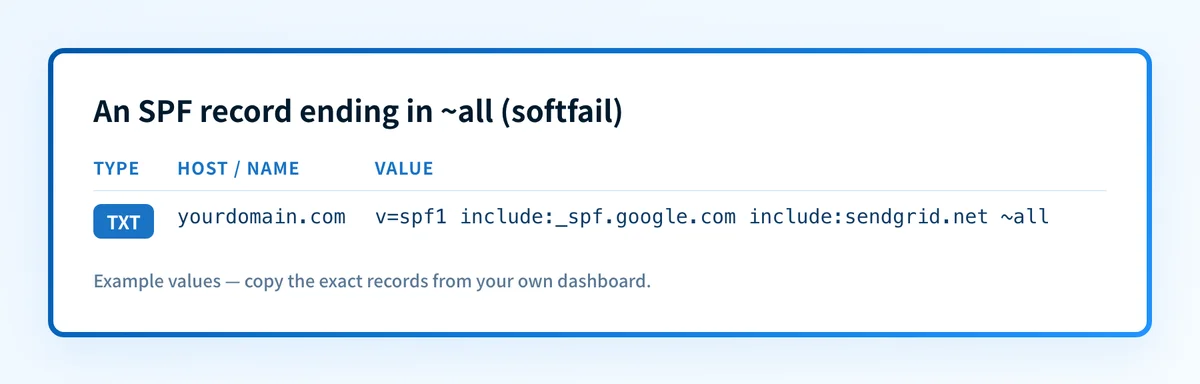
The SPF results, and what each one means
- Pass — the sending IP is authorized. Nothing to fix.
- Fail (hardfail) — the IP is explicitly not authorized. Produced by a record ending in
-all. Receivers are entitled to reject the message. - SoftFail — the IP is probably not authorized, but the domain isn't asserting it firmly. Produced by
~all. Mail is usually accepted but marked suspicious. - Neutral — the domain explicitly takes no position (
?all). Treated almost like having no SPF at all. - None — the domain publishes no SPF record, or none could be found.
- PermError — a permanent error in the record itself: broken syntax, more than one SPF record, or too many DNS lookups. The check can't complete until you fix the record.
- TempError — a transient DNS problem (a timeout, for example). Usually resolves on its own.
-all) versus softfail (~all). A hardfail tells receivers to reject outright; a softfail tells them to accept but treat with suspicion. Most domains should run ~all while rolling out authentication and only tighten to -all once DMARC reports confirm every legitimate sender passes — see softfail vs hardfail for the full trade-off.
Common causes of SPF failures
Exceeding the 10 DNS-lookup limit
This is the single most common cause of a broken SPF record. RFC 7208 caps the number of mechanisms that require a DNS lookup — include, a, mx, ptr, exists, and the redirect modifier — at 10 per evaluation. Every include: for a third-party sender (Google Workspace, Microsoft 365, a marketing platform) can pull in further nested lookups, and it adds up fast. Go over 10 and the result is a PermError, which means SPF fails for all your mail, not just the extra sender. There's also a limit of 2 void lookups (lookups that return nothing) before a PermError.
More than one SPF record
A domain may publish only one SPF TXT record. If two exist — often one left behind by a previous provider — the result is a PermError. Merge everything into a single v=spf1 ... record.
Forwarding
SPF checks the envelope sender (the MAIL FROM / Return-Path), not the visible From: address. When a message is forwarded, the forwarding server sends from its IP, which your SPF record doesn't authorize — so SPF fails at the next hop even though the mail is legitimate. This is why DKIM matters: its signature survives forwarding, so DMARC can still pass on DKIM when SPF breaks.
An un-included sender
Adding a new email tool — a CRM, a ticketing system, a newsletter platform — without adding its include: to your SPF record means its mail fails SPF from day one. Every service that sends as your domain has to be listed.
Syntax mistakes
A stray space, a missing include: prefix, or the wrong all qualifier produces either a PermError or an unintended result. The SPF syntax guide covers the mechanisms and qualifiers in detail.
Why SPF failures hurt your reputation
A failing SPF check rarely just bounces one message. Repeated failures — from a lookup-limit PermError, an un-included sender, or a mis-set -all — teach mailbox providers that mail from your domain is unreliable, and that lowers your domain reputation across the board. Worse, a PermError can make your entire domain fail authentication at once, which under an enforced DMARC policy means legitimate mail gets quarantined or rejected. Protecting deliverability and protecting SPF are the same task.
How to fix and prevent SPF failures
- Audit your record. Run your domain through the SPF lookup tool to see the current record, count the DNS lookups, and catch PermErrors.
- Stay under 10 lookups. Remove
include:entries for services you no longer use. If you're near the limit, flatten the record (replace some includes with the underlying IP ranges) or consolidate senders. - Keep one record. Delete duplicate SPF TXT records so only a single
v=spf1record remains. - List every sender. Add an
include:(or the correct IP mechanism) for each service that legitimately sends as your domain. - Use
~allwhile rolling out. Start with softfail, watch DMARC reports, and only move to-allonce every legitimate source passes. - Pair SPF with DKIM and DMARC. Because forwarding breaks SPF, DKIM gives you a second, forwarding-resistant path to authenticate, and DMARC alignment is what turns passing checks into real spoofing protection.
Related reading
Questions readers ask
Frequently asked questions
Keep going with AI
Ask AI how this applies to you
Take this guide to your assistant — each question opens pre-filled, with a link back to this page so it can read the details.
- Does an SPF softfail mean my email will be rejected?


- How does this apply to my domain?
- What should I do about it, step by step?

Written by
Ian BussieresCTO & Co-Founder, Palisade
Ian Bussieres is the CTO and co-founder of Palisade, AI-first DMARC software for IT teams and MSPs.
More from Ian →